News
Photos: ‘No Kings’ protests across the country


In large cities and small towns across the country, millions took to the streets today in protest against the policies of President Trump and his administration.
Organized by “No Kings,” a network of progressive groups opposed to the administration’s agenda, the protests are the third wave of demonstrations since the President took office for a second term. Last year, millions attended protests in June and again in October.
Crowds assemble at the Embarcadero in San Francisco prior to the start of the protest.
Martin do Nascimento/KQED
hide caption
toggle caption
Martin do Nascimento/KQED
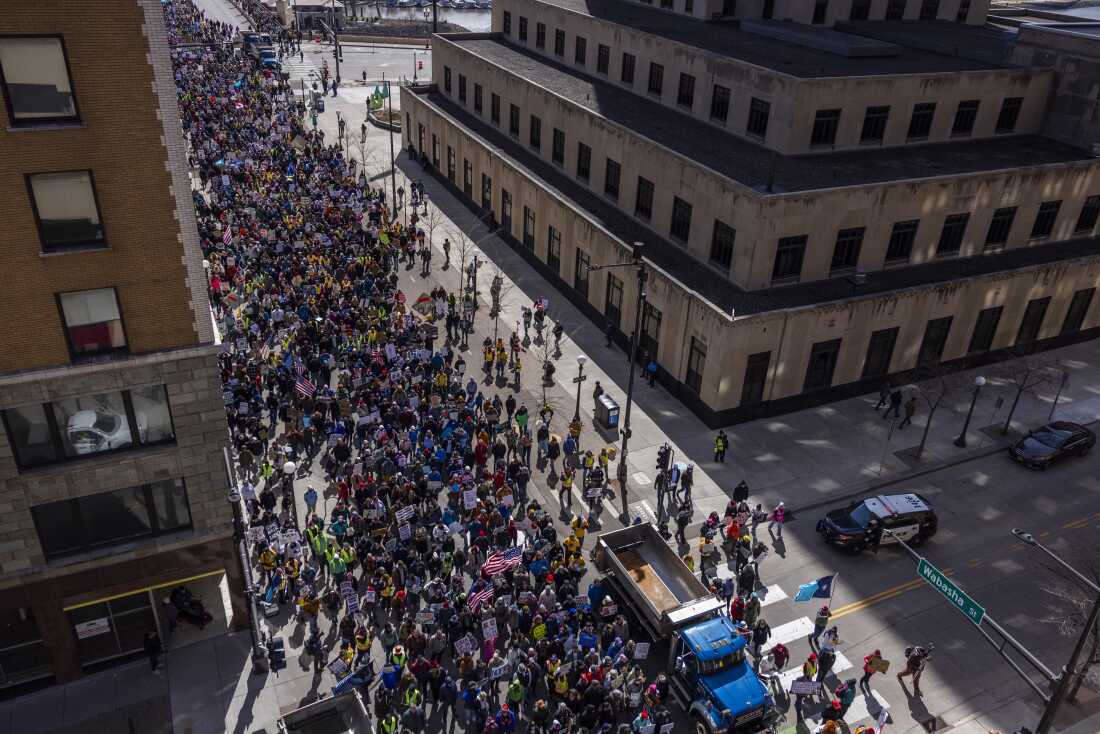
Thousands of community members marched in the flagship “No Kings” protest in St. Paul.
Jaida Grey Eagle/MPR News
hide caption
toggle caption
Jaida Grey Eagle/MPR News
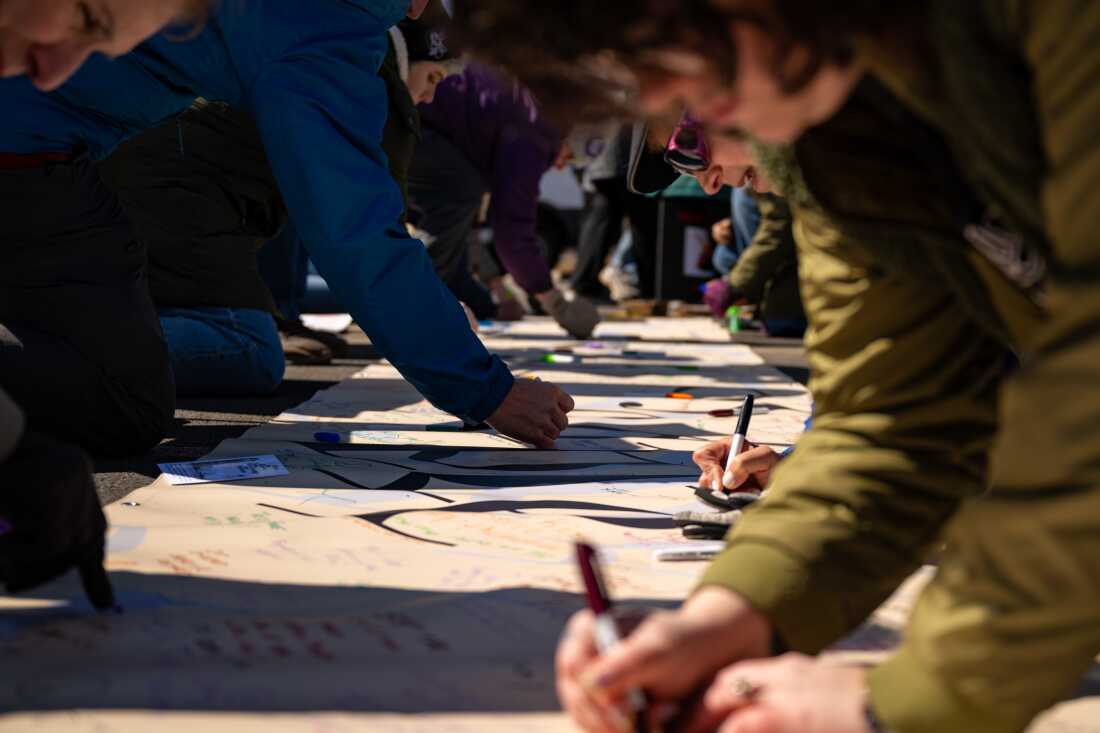
Thousands sign a banner in Hartford at the Capitol that says “We the People.”
Tyler Russell/Connecticut Public
hide caption
toggle caption
Tyler Russell/Connecticut Public
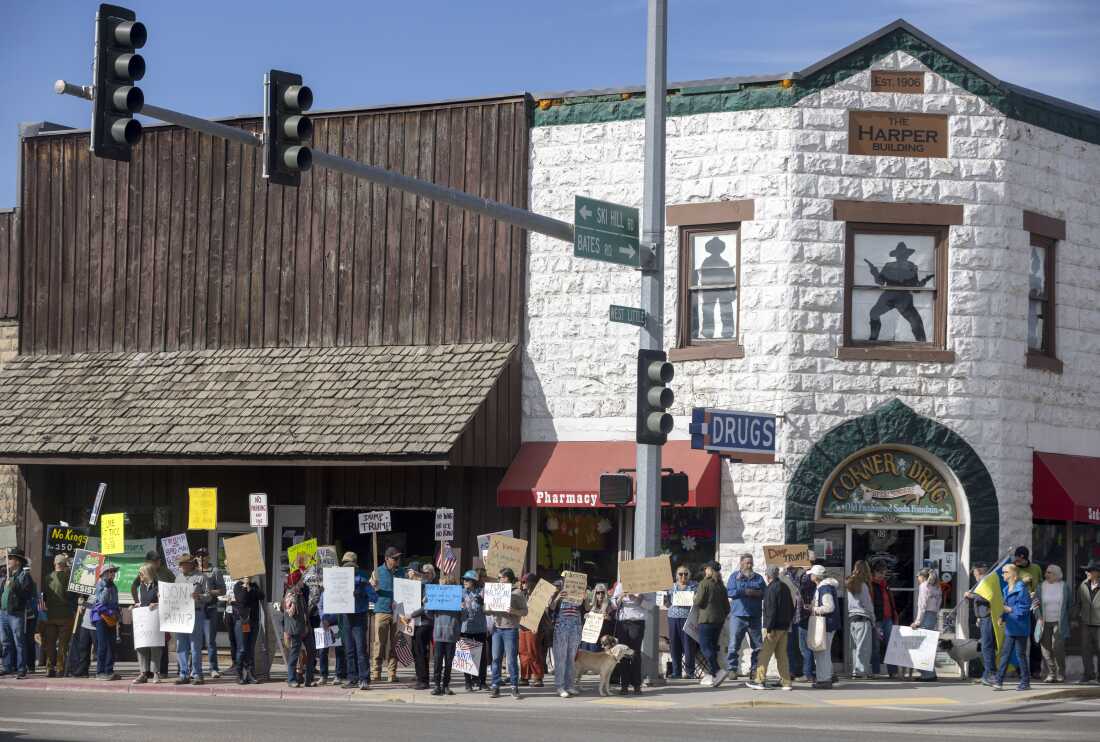
Protesters hold signs and chant slogans in Driggs, Idaho.
Natalie Behring/Getty Images
hide caption
toggle caption
Natalie Behring/Getty Images
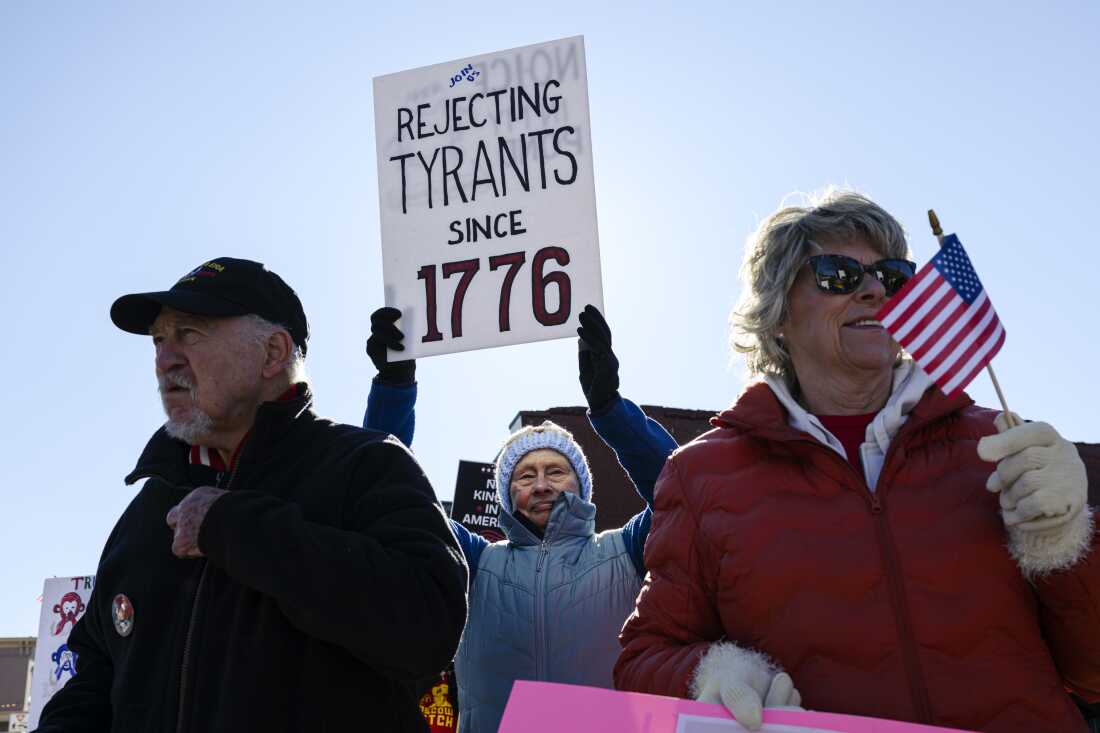
Demonstrators gather while holding signs near a roadside in Shelbyville, Kentucky.
Jon Cherry/Getty Images
hide caption
toggle caption
Jon Cherry/Getty Images
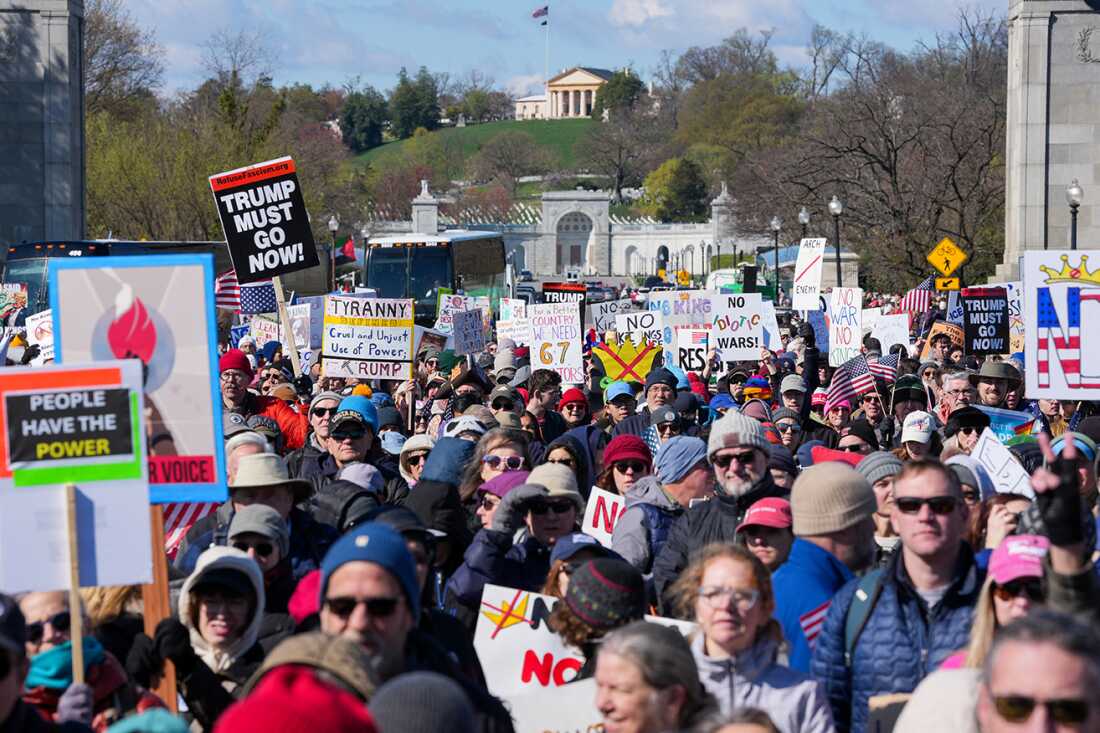
Demonstrators walk across the Memorial Bridge from Arlington, Virginia into Washington, DC.
Ken Cedeno/AFP
hide caption
toggle caption
Ken Cedeno/AFP
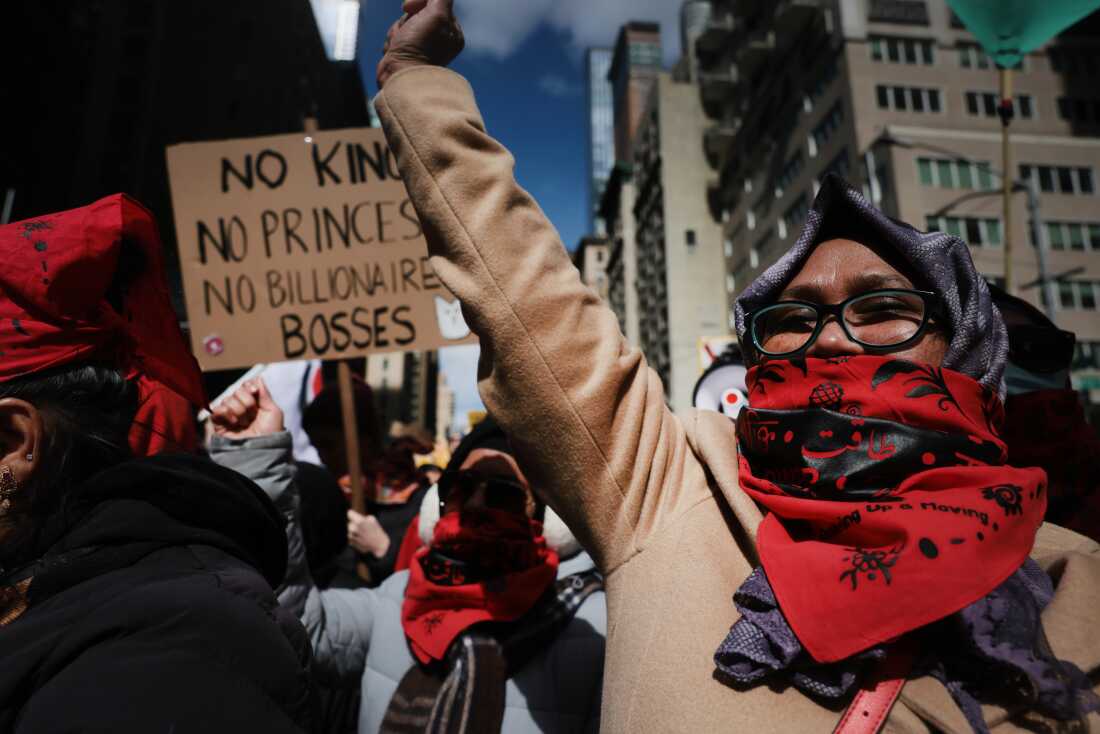
Demonstrators march down 7th Avenue and Broadway in Manhattan.
Spencer Platt/Getty Images
hide caption
toggle caption
Spencer Platt/Getty Images
![HARTFORD, CONNECTICUT, MARCH 28, 2026: Ken MacDonald tears up as he listens to a speech about the plight of his fellow veterans. “[Trump]’s playing with the lives of military people,” he said. Thousands rally at the “No Kings” protest at the capitol in Hartford on March 28, 2026. (Tyler Russell/Connecticut Public)](https://npr.brightspotcdn.com/dims3/default/strip/false/crop/6981x4654+0+0/resize/1100/quality/50/format/jpeg/?url=http%3A%2F%2Fnpr-brightspot.s3.amazonaws.com%2Feb%2F8b%2Fba7a9cb744baa343c85d45caf5ed%2F260328-nokingshartford-trb4371.jpg)
Ken MacDonald tears up in Hartford as he listens to a speech about the plight of his fellow veterans.
Tyler Russell/Connecticut Public
hide caption
toggle caption
Tyler Russell/Connecticut Public

A large crowd marches across the South First bridge toward a gathering at Auditorium Shores in Austin, Texas.
Patricia Lim/KUT News
hide caption
toggle caption
Patricia Lim/KUT News
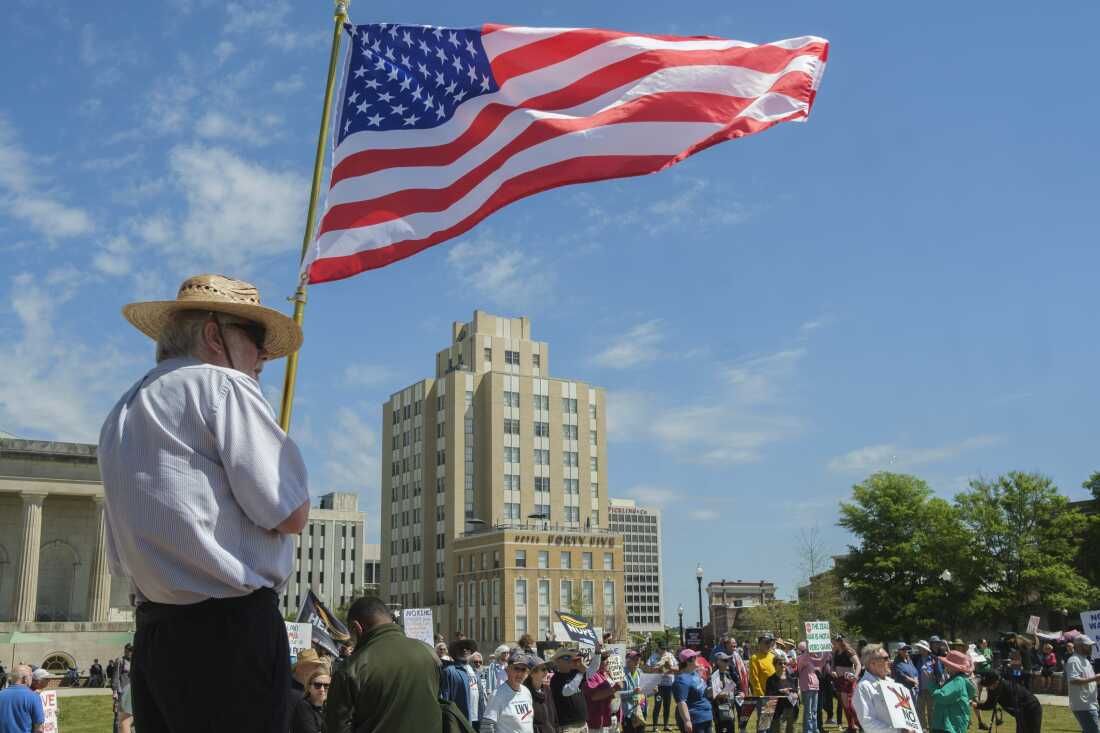
Lindsay Holliday waves an American flag in Rosa Parks Square in Macon, Georgia.
Grant Blankenship/GPB News
hide caption
toggle caption
Grant Blankenship/GPB News
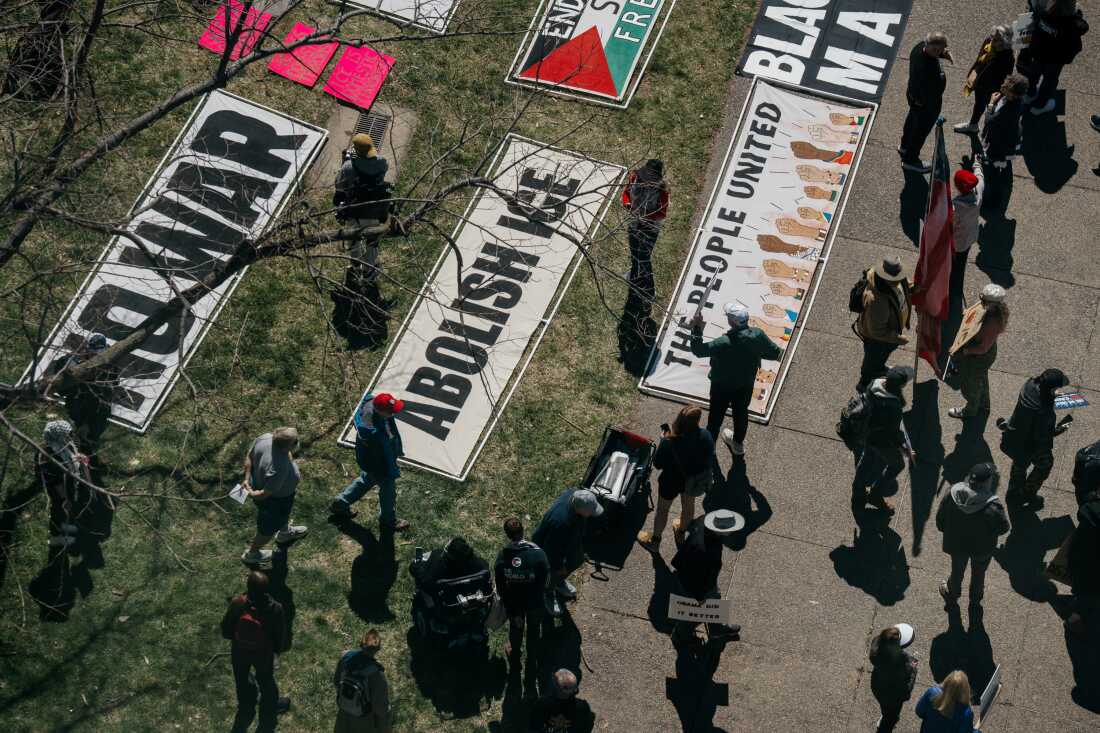
Demonstrators in downtown St. Louis walk by large banners decrying the U.S. conflict in Iran and U.S. Immigration and Customs Enforcement.
Brian Munoz/St. Louis Public Radio
hide caption
toggle caption
Brian Munoz/St. Louis Public Radio
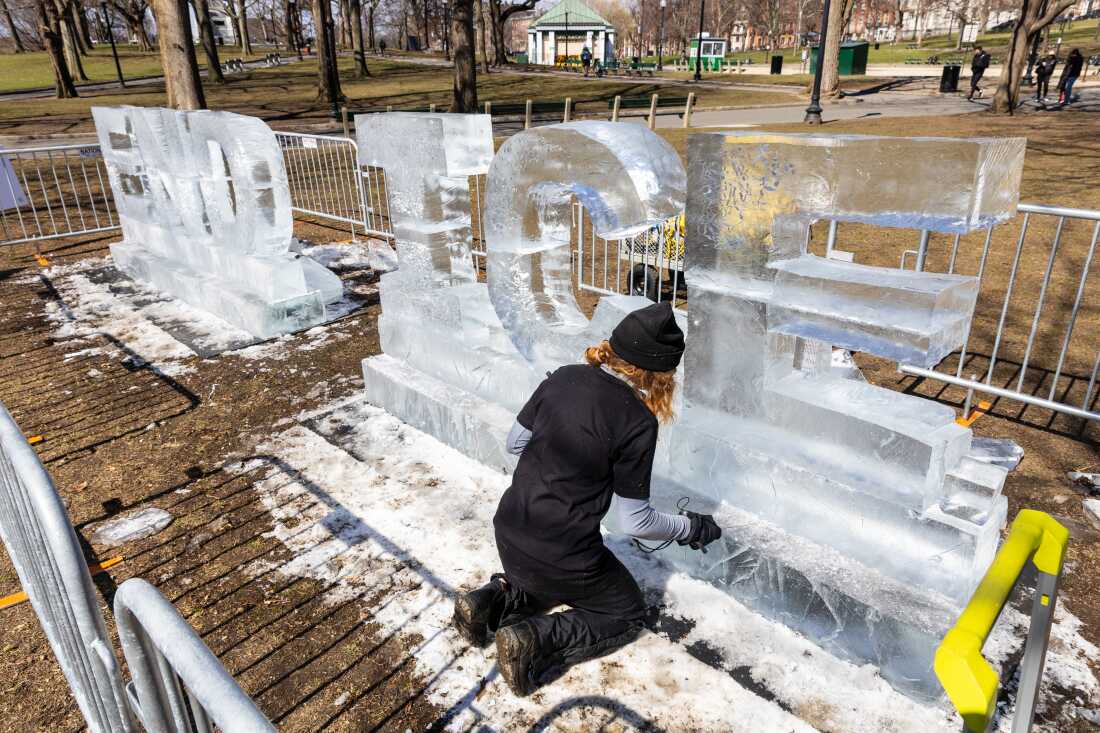
Kat Carves works on a ice sculpture that says ‘End Ice’ ahead of the rally on the Boston Common in Boston.
Arthur Mansavage/GBH News
hide caption
toggle caption
Arthur Mansavage/GBH News
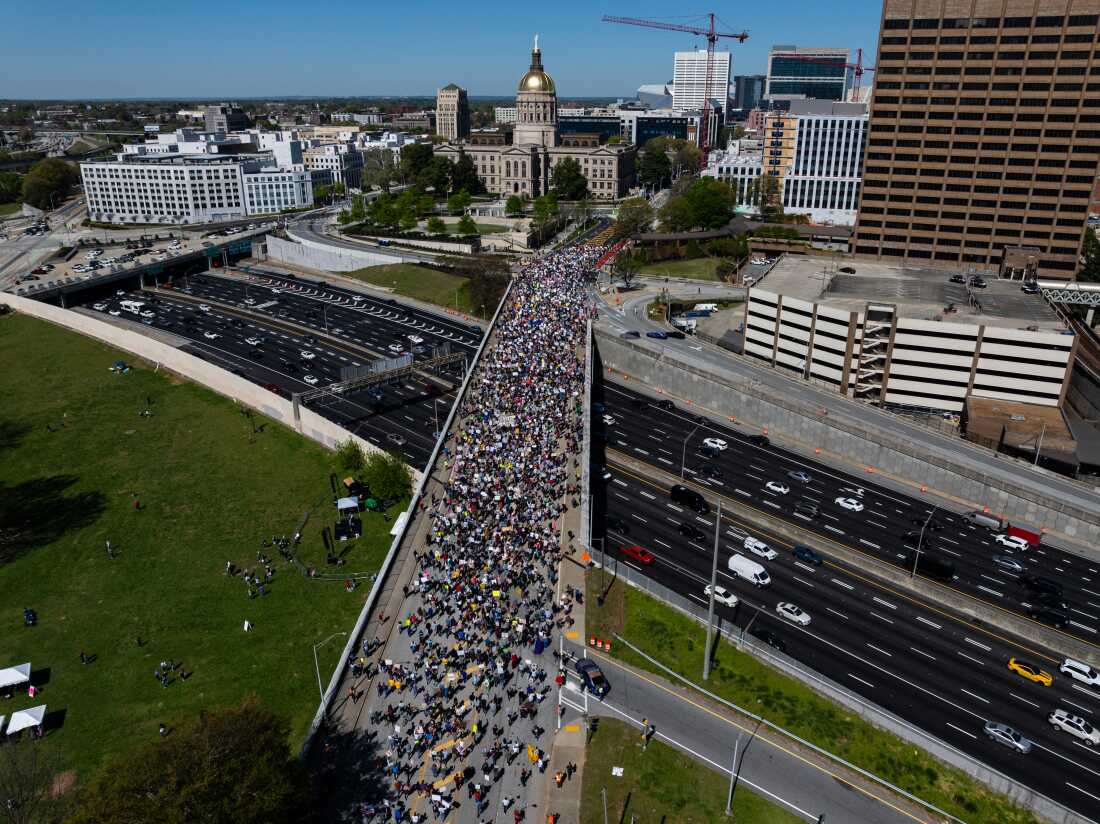
Protestors march across an overpass near the Georgia state Capitol building in Atlanta.
Elijah Nouvelage/AFP
hide caption
toggle caption
Elijah Nouvelage/AFP
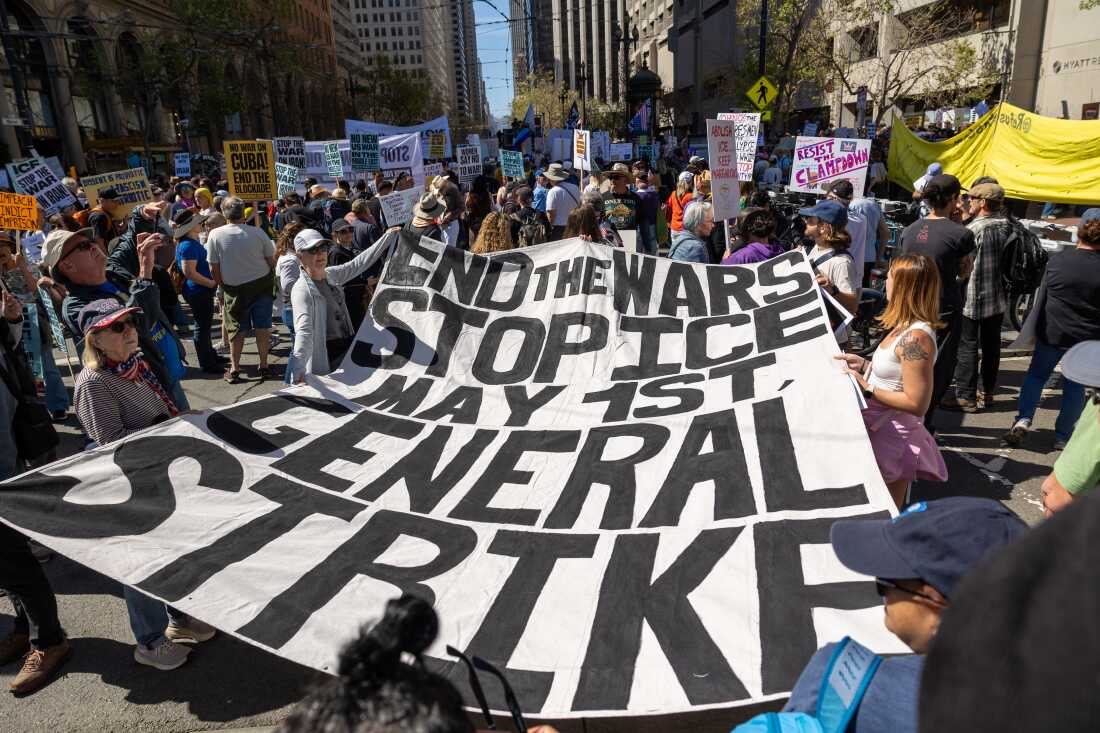
Protesters hold a banner reading “End the wars, stop ICE, general strike” at Embarcadero Plaza in San Francisco.
Gustavo Hernandez/KQED
hide caption
toggle caption
Gustavo Hernandez/KQED

Maria Perry, left, and John Stock, right, joined protesters gathering in Mill Creek Park in Kansas City, Missouri.
Julie Denesha/KCUR
hide caption
toggle caption
Julie Denesha/KCUR
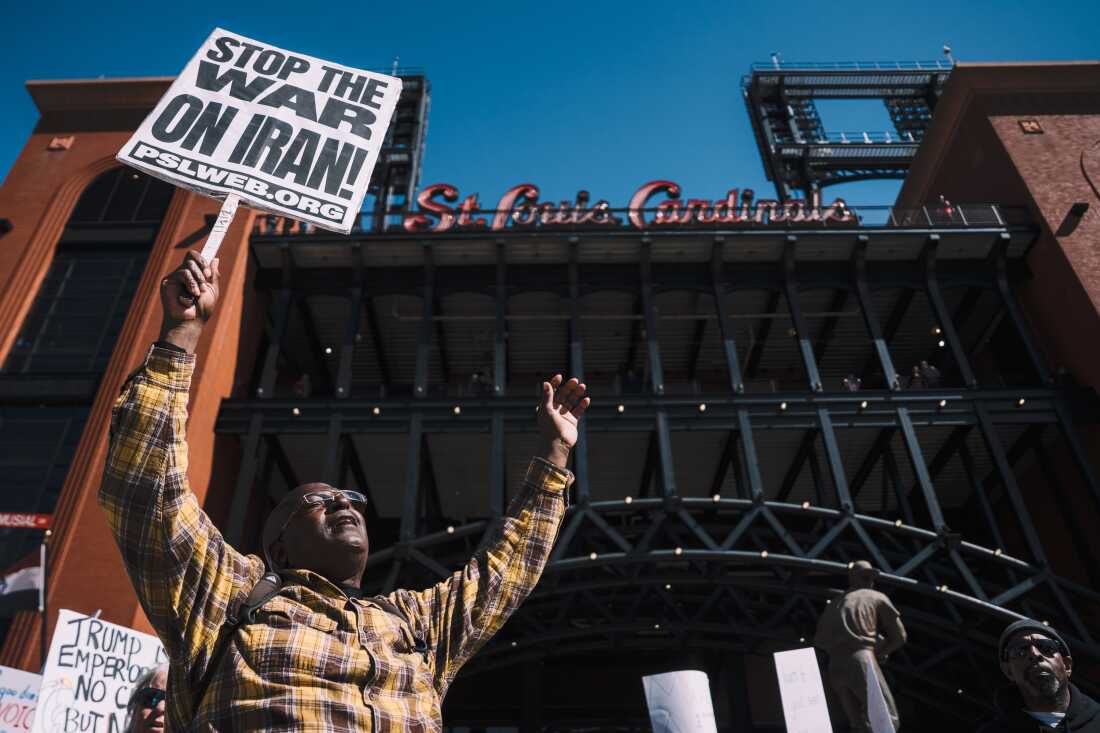
Duane Inge, a 63-year-old demonstrator, protests in front of Busch Stadium in downtown St. Louis.
Brian Munoz/St. Louis Public Radio
hide caption
toggle caption
Brian Munoz/St. Louis Public Radio

A protestor wears a “Let’s be brave” pin at a rally in Richmond, Virginia.
Shaban Athuman/VPM
hide caption
toggle caption
Shaban Athuman/VPM
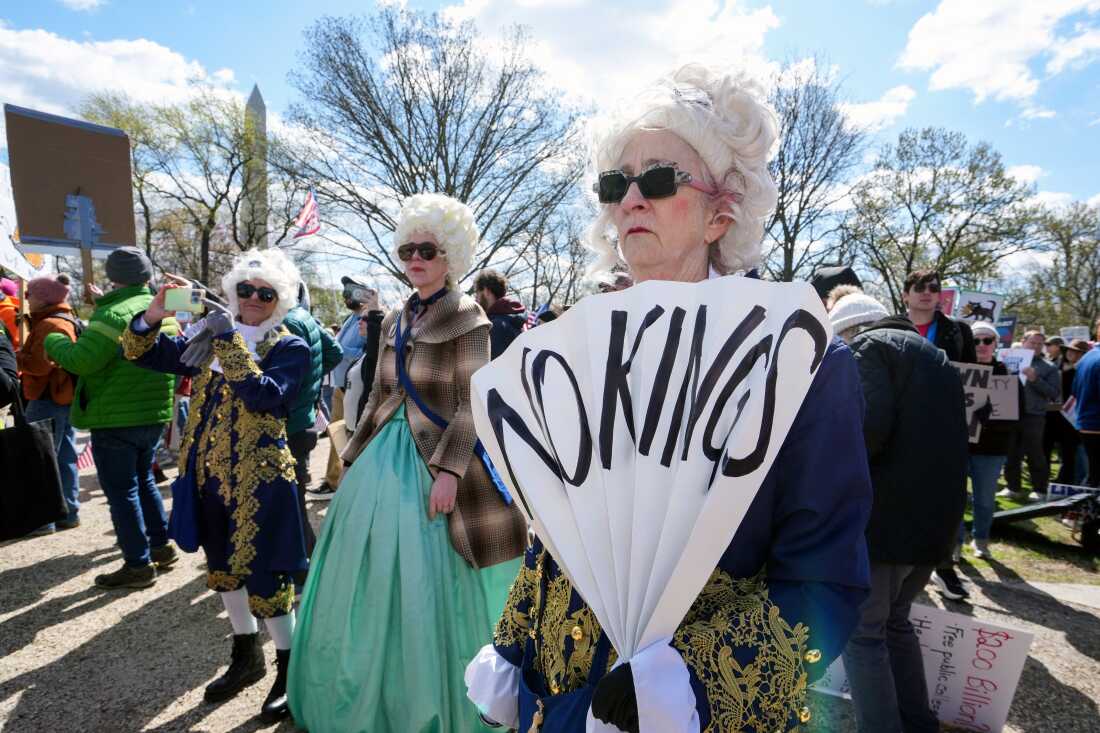
Demonstrators in costumes stand along the National Mall in Washington, DC.
Ken Cedeno/AFP
hide caption
toggle caption
Ken Cedeno/AFP
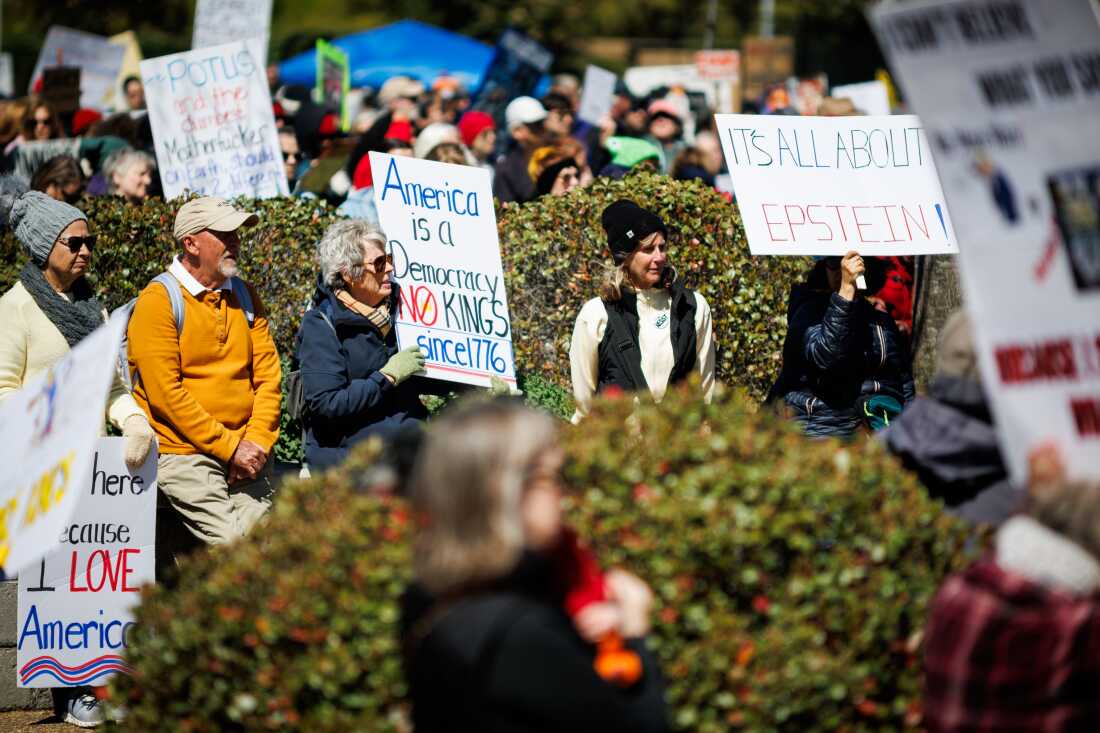
Protestors listens as speakers address the crowd gathered in Richmond, Virginia.
Shaban Athuman/VPM News
hide caption
toggle caption
Shaban Athuman/VPM News
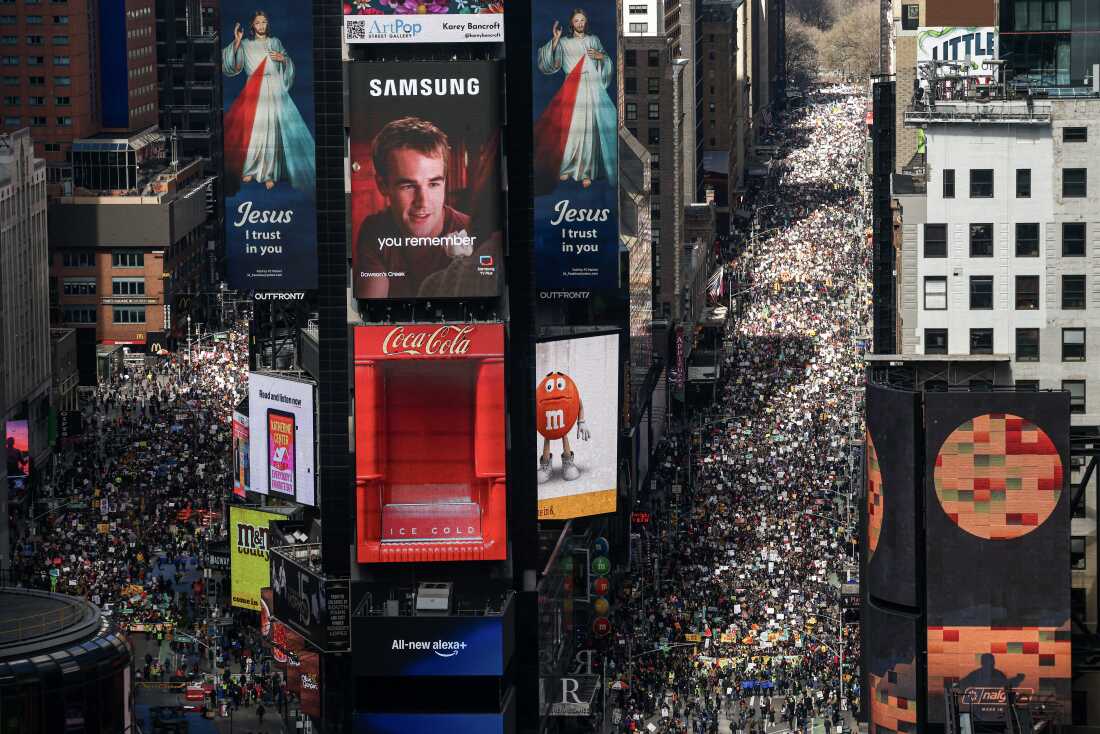
Protesters descend on Times Square in New York City.
Charly Triballeau/AFP
hide caption
toggle caption
Charly Triballeau/AFP
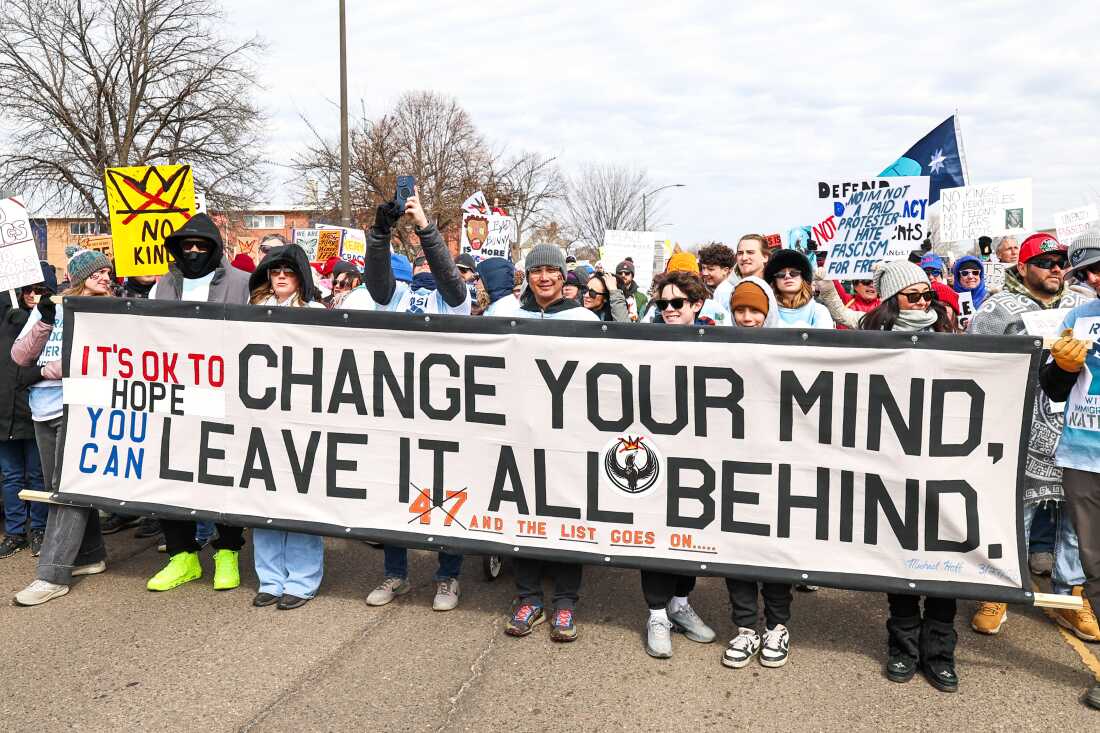
Demonstrators begin to march from the Western Sculpture Garden at the Minnesota State Capitol in St. Paul.
Steven Garcia/Minnesota Public Radio
hide caption
toggle caption
Steven Garcia/Minnesota Public Radio

Thousands march towards the Steel Bridge from the waterfront in Portland, Oregon.
Saskia Hatvany/OPB
hide caption
toggle caption
Saskia Hatvany/OPB


Xavier Becerra, Democratic gubernatorial candidate for California, and Steve Hilton, Republican gubernatorial candidate for California, shake hands while arriving for a gubernatorial debate at KRON Studios in San Francisco in April.
Jason Henry/Getty Images North America
hide caption
toggle caption
Jason Henry/Getty Images North America
SAN FRANCISCO — The primary election for California governor is too close to call, with vote counting continuing Wednesday. Democrat Xavier Becerra and Republican business executive Steve Hilton lead the field with Democrat Tom Steyer in third place.
In California’s unusual primary system, all candidates, regardless of party, appear on a single ballot open to any registered voter. The top two candidates then move on to the general election, even if they’re from the same party. This year, voters had 60 names for governor to choose from.
The winner will lead the country’s most populous state, where leaders often take on national political prominence. Incumbent Gov. Gavin Newsom is at his two-term limit and could be a Democratic contender for president.
Becerra, former Health and Human Services secretary under President Joe Biden, pitched himself to voters as an experienced political leader who isn’t afraid of President Trump, but his lead caps one of the most surprising and dramatic comebacks in recent state political history. As recently as April, polls were showing Becerra — also a former member of Congress and California attorney general — languishing in single digits in a crowded field.
In his remarks at his watch party in Los Angeles, Becerra noted his underdog status.
“Here in Hollywood’s hometown, we love a good underdog success story,” he said, drawing parallels between his campaign and his immigrant parents’ success story in California. “Guess what? The underdog stayed in the fight. Like my parents, I never gave up. Never stopped putting one foot in front of the other. Never stopped believing in the beacon-like goodness of California. And thankfully, neither did you.”
Hilton is a former Fox News commentator who also served as a political adviser to former British Prime Minister David Cameron. He was endorsed by President Trump in April, helping him to pull ahead of Riverside County Sheriff Chad Bianco, the other major Republican in the race. Hilton has campaigned on the idea that California needs change after 16 years under total Democratic control.
The race is narrowing down after a tumultuous campaign
At his watch party in Huntington Beach, the British-born candidate — who became an American citizen five years ago — said it was the “honor of his lifetime” to receive over 1 million votes so far.
“Change is coming to California and it’s long overdue,” Hilton said. “We’re not there yet, but it’s looking good. It looks very much as if Californians really will have the chance to vote for change in November and take our state in a new direction.”
Democratic billionaire activist Steyer spent more than $213 million of his own money to boost his candidacy and push a progressive, populist message. While he was trailing Becerra and Hilton on Tuesday night, he said at his watch party in San Francisco that he remains confident he can close the gap in the days ahead.
“Together, we’ve scared the hell out of the corporate interests used to getting their way,” Steyer said. “It might take some time to figure out where this is going. We’re going to wait until every ballot is counted. We’re gonna give democracy a time to work. And we know we finished really strong.”
The early results are not certain to hold, in part because of unusual voting patterns in this primary election: Ballot-tracking data heading into Tuesday evening showed that Republicans were more likely to vote early by mail, while Democratic voters in this deep-blue state held onto their mail-in ballots or chose to vote in person. That’s the reverse of recent elections, which saw more Democrats voting by mail and Republicans tending to vote in person on Election Day.
The uncertainty on election night capped a race that remained crowded and unsettled to the end. To some extent, the race was defined by who wasn’t running.
Some of the state’s most high-profile Democrats — former Vice President Kamala Harris, U.S. Sen. Alex Padilla and California Attorney General Rob Bonta — all passed on a potential bid to succeed Newsom.
The race was disrupted in April when then-U.S. Rep. Eric Swalwell’s campaign for governor imploded amid allegations of sexual assault and harassment. Swalwell resigned from Congress shortly after the accusations surfaced and has denied assault allegations.
Swalwell had been gaining in polls and racking up high-profile endorsements, and his exit seemed to primarily benefit Becerra, who had been stuck in single digits in many polls. Ultimately, it quieted fears among Democrats who worried that the messy Democratic field could result in Bianco and Hilton winning the top spots in the June primary.
Marisa Lagos covers California politics at KQED and co-hosts the Political Breakdown show and podcast.

The U.S. Supreme Court
Tasos Katopodis/Getty Images
hide caption
toggle caption
Tasos Katopodis/Getty Images
The Supreme Court on Tuesday cleared the way for Alabama to use a congressional district map favored by Republicans.
The court, in an unsigned order, overturned a three-judge district court panel that found that the map is “tainted by intentional race-based discrimination.” The court’s three liberals publicly dissented.
The ruling means that Alabama’s 2026 midterm elections will feature six Republican-leaning districts and one Democratic-leaning one, as opposed to a map with only five safe Republican seats. Democrat Shomari Figures, who represents Alabama’s Second District, will likely lose his seat as a result of the high court’s ruling.
The story of Alabama’s congressional map is long and tortured. It began in 2021, when the state implemented a new map to account for population changes in the census. The map featured only one majority-black district out of seven, even though the state is more than one-quarter Black.
Voters immediately sued, claiming the map illegally diluted minority votes in violation of the Voting Rights Act and the Constitution. Lower court judges agreed, ruling that the state must draw a map with two districts where Black voters have a realistic chance of electing their candidate of choice. The Supreme Court more than once has ordered Alabama to draw a compliant map.
But the state has refused and instead continued to litigate the case. On Tuesday, that tactic paid off.
What changed? In April, the Supreme Court’s conservative supermajority all but gutted what remains of the Voting Rights Act, ruling that states cannot purposefully draw districts that are majority-minority.
Alabama then asked the high court to reinstate the state’s old map, under the theory that this new ruling meant that it was permissible to use a map with only one majority-Black district. In an unsigned, unexplained order in May, the high court essentially reversed its previous opinions, and allowed Alabama to use the old map for the upcoming midterm elections.
This set off a flurry of activity in Alabama. By the time the Supreme Court issued its May order, absentee balloting had already begun, using the court-drawn map. So Republican Governor Kay Ivey cancelled elections and scheduled a special primary for August for the affected congressional races.
The case, however, was not over.
In its ruling, the Supreme Court had ordered a lower court panel to continue evaluating Alabama’s map in light of its recent Voting Rights Act decision. And just 15 days after that order, the panel, composed of three Republican judges—two of them Trump appointees—concluded unanimously that even under the Supreme Court’s new standards, the plan for a single black district was “intentionally discriminatory.”
So, once again, Alabama returned to the Supreme Court, arguing that the map was partisan, not racially discriminatory. In short, that the Republican legislature simply drew the map to elect more Republicans. And that under the Supreme Court’s new interpretation of the Voting Rights Act, the GOP map should be allowed to stand.
The court’s conservative agreed, writing that the lower court “did not heed the presumption of legislative good faith.”
The court’s three liberals publicly dissented, castigating the conservative majority for failing to abide by its 2006 decision in the case of Purcell v. Gonzalez. That decision declared that courts should not change election rules too close to an election.
Justice Sonia Sotomayor, in her dissent, said the court “debases the democratic process” and “corrodes the rule of law by rewarding Alabama’s gamesmanship and outright defiance of court orders.”
Tuesday’s decision is the latest in a series of Supreme Court rulings that could well reshape the 2026 midterm elections, making it much harder for Democrats to prevail.

Note: Map shows the area with a shake intensity of 3 or greater, which U.S.G.S. defines as “weak,” though the earthquake may be felt outside the areas shown. The New York Times
A minor, 3.7-magnitude earthquake struck in the San Francisco Bay Area on Tuesday, according to the United States Geological Survey.
The temblor happened at 9:44 a.m. Pacific time about 4 miles southeast of Cloverdale, Calif., data from the agency shows.
U.S.G.S. data earlier reported that the magnitude was 3.6.
As seismologists review available data, they may revise the earthquake’s reported magnitude. Additional information collected about the earthquake may also prompt U.S.G.S. scientists to update the shake-severity map.
Subsequent quakes have been reported in the same area. Such temblors are typically aftershocks caused by minor adjustments along the portion of a fault that slipped at the time of the initial earthquake.
Aftershocks detected
Quakes and aftershocks within 100 miles
Aftershocks can occur days, weeks or even years after the first earthquake. These events can be of equal or larger magnitude to the initial earthquake, and they can continue to affect already damaged locations.
The New York Times When quakes and aftershocks occurred
Sources: United States Geological Survey (epicenter, aftershocks, shake intensity); LandScan via Oak Ridge National Laboratory (population density) | Notes: Shaking categories are based on the Modified Mercalli Intensity scale. When aftershock data is available, the corresponding maps and charts include earthquakes within 100 miles and seven days of the initial quake. All times above are Pacific time. Shake data is as of Tuesday, June 2 at 12:59 p.m. Eastern. Aftershocks data is as of Tuesday, June 2 at 1:59 p.m. Eastern.
-
 Sports7 minutes ago
Nelly Korda, Michelle Wie West and more: Who to watch at U.S. Women’s Open
-

 World19 minutes ago
EU launches major tech push to break US and China dependence
-
News42 minutes ago
California’s primary for governor is undecided as candidates vie to be in the top two
-

 Los Angeles, Ca2 hours ago
California primary election results: governor and L.A. mayor races
-

 Detroit, MI2 hours ago
Another bribery scandal hits Detroit. It involves the People Mover
-

 San Francisco, CA3 hours ago
What’s Worth More Than Cash in San Francisco Real Estate? Anthropic Stock
-

 Dallas, TX3 hours ago
Dallas weighs $500 million‑plus repair plans as City Hall’s future comes up for debate
-

 Miami, FL3 hours ago
Miami biotech executive was followed into his condo by man who allegedly threw him from 25th floor

