News
Marijuana rescheduling would bring some immediate changes, but others will take time

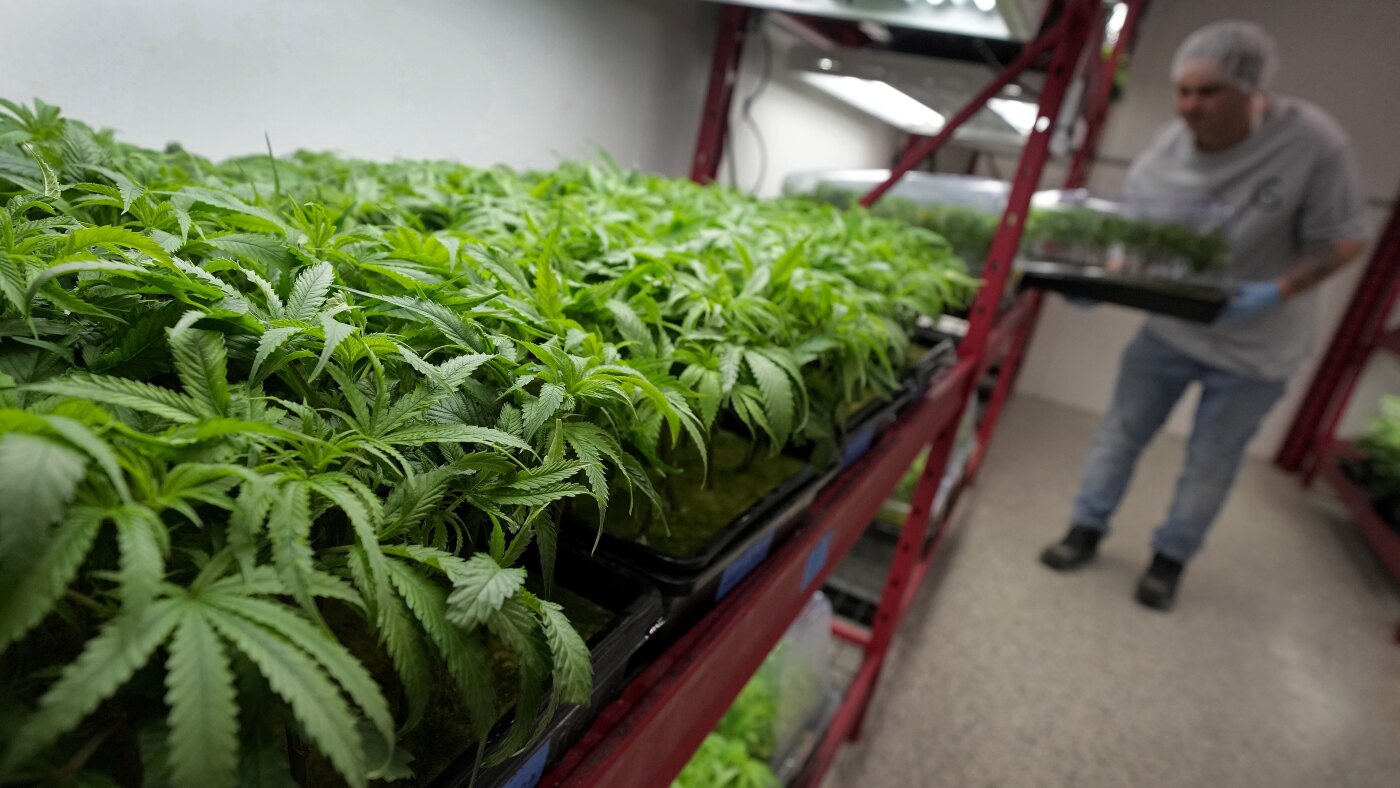
Michael Stonebarger sorts young cannabis plants at a marijuana farm in Grandview, Mo., in 2022. President Trump set the process in motion to ease federal restrictions on marijuana. But his order doesn’t automatically revoke laws targeting marijuana, which remains illegal to transport over state lines.
Charlie Riedel/AP
hide caption
toggle caption
Charlie Riedel/AP
President Trump’s long-anticipated executive order to loosen U.S. restrictions on marijuana promises to bring immediate relief for cannabis businesses — but only in some respects. And although rescheduling it as a lower-risk drug is touted as opening a new era for cannabis research, experts say it’s not as simple as flipping a light switch.
“It’s hard to see the big headlines of, ‘Marijuana rescheduled to [Schedule] III; marijuana research will open,’” says Gillian Schauer, executive director of the nonpartisan Cannabis Regulators Association, which includes agencies from 46 states. “You know, those things are not true as of now.”

That’s because on its own, Trump’s Dec. 18 order isn’t enough to rewrite federal drug policy that has stood for more than 50 years.
“The Controlled Substances Act [of 1970] does not grant any president the authority to unilaterally reschedule a drug,” Schauer says. Such changes are historically made through either a rulemaking process, or an act of Congress.
Many details will shape how the administration enacts Trump’s order, affecting the timeline and scope for easing marijuana restrictions. But when it does happen, rescheduling won’t automatically revoke federal laws targeting marijuana, and interstate marijuana commerce would remain illegal, Schauer says.
It’s not yet known how other policies might change.
“We don’t know what will happen to federal drug testing requirements,” Schauer says, until agencies issue guidance.
Here’s a rundown of other key questions raised by the rescheduling order:
The time frame depends on which path the DOJ takes
Trump’s order directs Attorney General Pam Bondi to “take all necessary steps to complete the rulemaking process related to rescheduling marijuana to Schedule III” of the Controlled Substances Act “in the most expeditious manner in accordance with Federal law … “

The directive evokes the process that started under former President Joe Biden. Under his administration, both the Department of Health and Human Services and the Justice Department advanced a proposal to reclassify pot from Schedule I, meaning it has no medical use and a high potential for abuse, to the lower-risk Schedule III, which includes ketamine, Tylenol with codeine, and anabolic steroids.
The Trump administration could resume the process that was already underway under Biden. But the new executive order’s mention of the Controlled Substances Act’s Section 811 hints at a potential shortcut.
“That allows the attorney general to move a drug to whatever schedule they deem is best, without going through the usual steps that are needed to reschedule a drug,” Schauer says.
The streamlined process was meant to ensure the U.S. can do things such as complying with international drug treaty obligations. But a historic precedent also links it to cannabis: In 2018, it was used to schedule the CBD epilepsy drug Epidiolex, months after it became the first U.S.-authorized purified medicine derived from marijuana. The drug was placed in Schedule V, the least restrictive schedule.

President Trump displays an executive order reclassifying marijuana as a less dangerous drug in the Oval Office on Dec. 18.
Evan Vucci/AP
hide caption
toggle caption
Evan Vucci/AP
Will the DOJ call for public comment?
The Trump administration’s approach to administrative hearings and public comment periods would also help determine the pace of rescheduling.
“I would anticipate, if they use that [expedited] option, that we would not see a comment period,” shortening the process, Schauer explains.
But rescheduling could take longer if the Justice Department follows the traditional, and lengthy, notice-and-comment process.

Again, Bondi has options that could speed things up. She could choose to issue a final rule after a public comment period, for instance, or do so without a comment period.
“Some of the calculation for that may be on the legal end,” Schauer says. Noting that some anti-marijuana groups are vowing to file legal challenges to block rescheduling, she adds that the DOJ will likely have to balance Trump’s call for expedience with the need to defend its actions in court.
If the rule is published for comment, interest would likely be intense: In 2024, the DEA’s earlier proposed rescheduling rule for marijuana attracted more than 43,000 comments.
Cannabis firms would get tax relief, but credit cards remain forbidden
Sam Brill, CEO of Ascend Wellness Holdings, a multistate dispensary company, says rescheduling could bring a cascade of positive changes to his industry. But one benefit could come immediately, he says.
“The biggest thing that happens overnight is the 280E, the restrictive punitive tax code that is set on us,” would no longer apply to marijuana businesses, he says.
Like other businesses, Brill’s company is obligated to pay taxes on income. But because their core product is a Schedule I drug, the IRS says that under Internal Revenue Code Section 280E, they’re blocked from claiming common tax deductions, exposing them to a higher effective tax rate.
Section 280E “does not allow us to basically deduct normal expenses that everyone else can deduct,” Brill says. “I can’t deduct the rent for my stores, the cost of my employees in those stores, my interest expense.”
Brill says that some cannabis companies, including his, say 280E should not apply to them — but the IRS disagrees. As a result, Brill says, his company sets aside a large reserve fund in case the IRS comes after them.
“For 2024 alone, the value of this reserve” was about $38 million, Brill says, “which includes interest and penalties.”
Brill hopes marijuana’s changing status might also eventually lead to other restrictions falling, especially the inability of cannabis operations to accept credit cards. Most financial institutions refuse to provide basic banking services to state-authorized marijuana businesses, due to potential liability.
“The lack of the use of a credit card is really one of the biggest challenges for customers,” he says. Citing the importance of payday, Brill says: “For us, Friday by far is the biggest day every single week because this is a cash business.”
Medical research
Scientists welcomed news in 2023 that the Biden administration was moving toward reclassifying marijuana, and Trump says his move will boost medical research. But both then and now, there are caveats.
One benefit of the new rules is that they wouldn’t require marijuana researchers to go through the onerous process of obtaining a Schedule I license, and they would also ease rigorous laboratory regulations.
“You have very stringent requirements, for example, for storage and security and reporting all of these things,” neuroscientist Staci Gruber, of McLean Hospital in Massachusetts and Harvard Medical School, told NPR last year.
But another obstacle promises to be more stubborn: finding marijuana to study. The U.S. requires researchers to obtain marijuana from a handful of sources, which is itself an improvement over decades in which they were compelled to use one facility based at the University of Mississippi.
And, as Schauer notes, federal rules about sourcing marijuana have been decided separately from the controlled substances schedule.
“This does a little to make research easier,” Schauer says of the current rescheduling effort. “But there’s a lot that will still be challenging in researching cannabis unless we see a lot of agency policies change and adjust.”



Former president Bill Clinton is scheduled to give deposition Friday to a congressional committee investigating his links to Jeffrey Epstein, one day after Hillary Clinton testified before the committee and called the proceedings “partisan political theatre” and “an insult to the American people”.
During remarks before the House oversight committee, Hillary Clinton, the former secretary of state, insisted on Thursday that she had never met Epstein.
The former Democratic president, however, flew on Epstein’s private jet several times in the early 2000s but said he never visited his island.
Clinton, who engaged in an extramarital affair while president and has been accused of sexual misconduct by three women, also appears in a photo from the recently released files, in a hot tub with Epstein and a woman whose identity is redacted.
Clinton has denied the sexual misconduct claims and was not charged with any crimes. He also has not been accused of any wrongdoing connected to Epstein.
Epstein visited the White House at least 17 times during the early years of Clinton’s presidency, according to White House visitor records cited in news reports. Clinton said he cut ties with him around 2005, before the disgraced financier, who died from suicide in 2019, pleaded guilty to solicitation of a minor in Florida.
The House committee subpoenaed the Clintons in August. They initially refused to testify but agreed after Republicans threatened to hold them in contempt.
The Clintons asked for their depositions to be held publicly, with the former president stating that to do so behind closed doors would amount to a “kangaroo court”.
“Let’s stop the games + do this the right way: in a public hearing,” Clinton said on X earlier this month.
The committee’s chair, James Comer, did not grant their request, and the proceedings will be conducted behind closed doors with video to be released later.
On Thursday, Hillary Clinton’s proceedings were briefly halted after representative Lauren Boebert leaked an image of Clinton testifying.
During the full day deposition, Clinton said she had no information about Epstein and did not recall ever meeting him.
Before the deposition, Comer said it would be a long interview and that one with Bill Clinton would be “even longer”.

CASE 0:26-cv-00107-PJS-DLM
Doc. 12-1 Filed 02/26/26
Page 5 of 17
and to file a status update by 11:00 am on January 20. ECF No. 5. Respondents never provided a bond hearing and did not release Petitioner until January 21, ECF Nos. 10, 12, after failing to file an update, ECF No. 9. Further, Respondents released Petitioner subject to conditions despite the Court’s release order not providing for conditions. ECF Nos. 5, 12–13.
Abdi W. v. Trump, et al., Case No. 26-CV-00208 (KMM/SGE)
On January 21, 2026, the Court ordered Respondents, within 3 days, to either (a) complete Petitioner’s inspection and examination and file a notice confirming completion, or (b) release Petitioner immediately in Minnesota and confirm the date, time, and location of release. ECF No. 7. No notice was ever filed. The Court emailed counsel on January 27, 2026, at 10:39 am. No response was provided.
Adriana M.Y.M. v. David Easterwood, et al., Case No. 26-CV-213 (JWB/JFD)
On January 24, 2026, the Court ordered immediate release in Minnesota and ordered Respondents to confirm the time, date, and location of release, or anticipated release, within 48 hours. ECF No. 12. Respondent was not released until January 30, and Respondents never disclosed the time of release, instead describing it as “early this morning.” ECF No. 16.
Estefany J.S. v. Bondi, Case No. 26-CV-216 (JWB/SGE)
On January 13, 2026, at 10:59 am, the Court ordered Respondents to file a letter by 4:00 pm confirming Petitioner’s current location. ECF No. 8. After receiving no response, the Court ordered Respondents, at 5:11 pm, to immediately confirm Petitioner’s location and, by noon on January 14, file a memorandum explaining their failure to comply with the initial order. ECF No. 9. Respondents did not file the memorandum, requiring the Court to issue another order. ECF No. 12. On January 15, the Court ordered immediate release in Minnesota and required Respondents to confirm the time, date, and location of release within 48 hours. ECF No. 18. On January 20, having received no confirmation, the Court ordered Respondents to comply immediately. ECF No. 21. Respondents informed the Court that Petitioner was released in Minnesota on January 17, but did not specify the time. ECF No. 22.
5

James Hickman holds a photo montage of the late Rev. Jesse Jackson before a public visitation at Rainbow/PUSH Coalition in Chicago on Thursday.
Nam Y. Huh/AP
hide caption
toggle caption
Nam Y. Huh/AP
CHICAGO — A line of mourners streamed through a Chicago auditorium Thursday to pay final respects to the Rev. Jesse Jackson Sr. as cross-country memorial services began in the city the late civil rights leader called home.
The protege of the Rev. Martin Luther King Jr. and two-time presidential candidate will lie in repose for two days at the headquarters of the Rainbow PUSH Coalition before events in Washington, D.C., and South Carolina, where he was born.
Family members wiped away tears as the casket was brought into the stately brick building. Flowers lined the sidewalks where people waiting to enter watched a large screen playing video excerpts of Jackson’s notable speeches. Some raised their fists in solidarity.
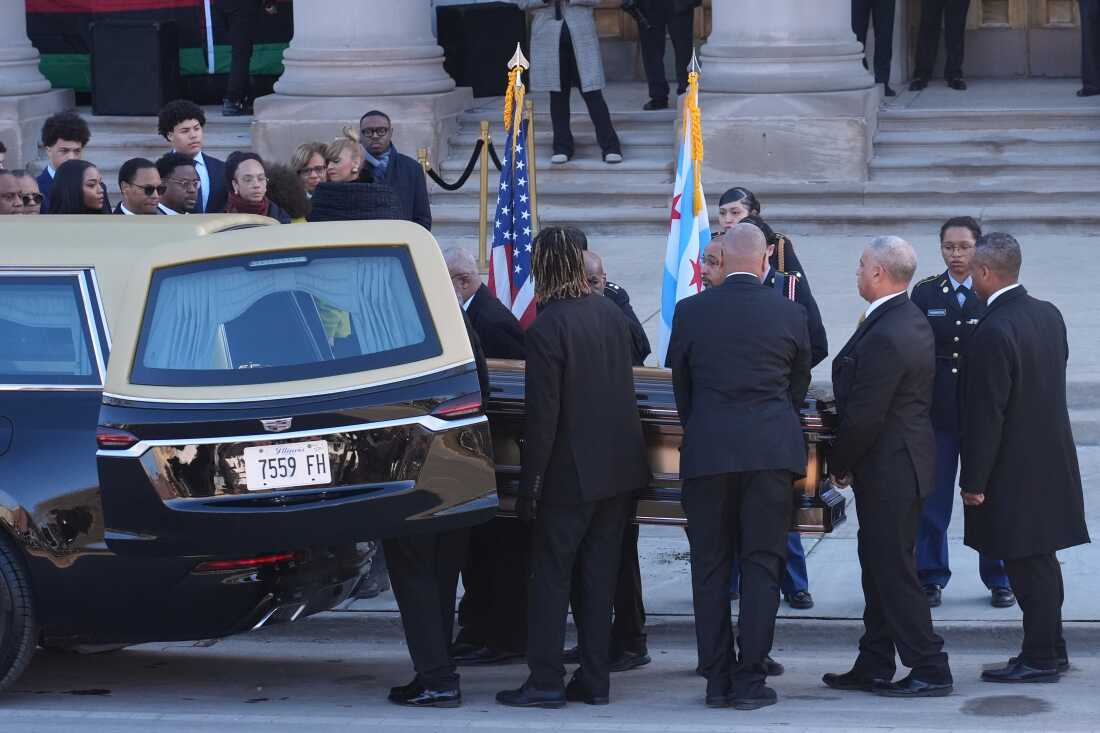
The casket with the Rev. Jesse Jackson arrives before a public visitation at Rainbow/PUSH Coalition in Chicago on Thursday.
Nam Y. Huh/AP
hide caption
toggle caption
Nam Y. Huh/AP
Inside, Jackson’s children, Chicago Mayor Brandon Johnson and the Rev. Al Sharpton were among those who stood by the open casket to shake hands and hug those coming to view the body of Jackson, dressed in a suit and blue shirt and tie.
“The challenge for us is that we’ve got to make sure that all he lived for was not in vain,” Sharpton told reporters. “Dr. King’s dream and Jesse Jackson’s mission now falls on our shoulders. We’ve got to stand up and keep it going.”
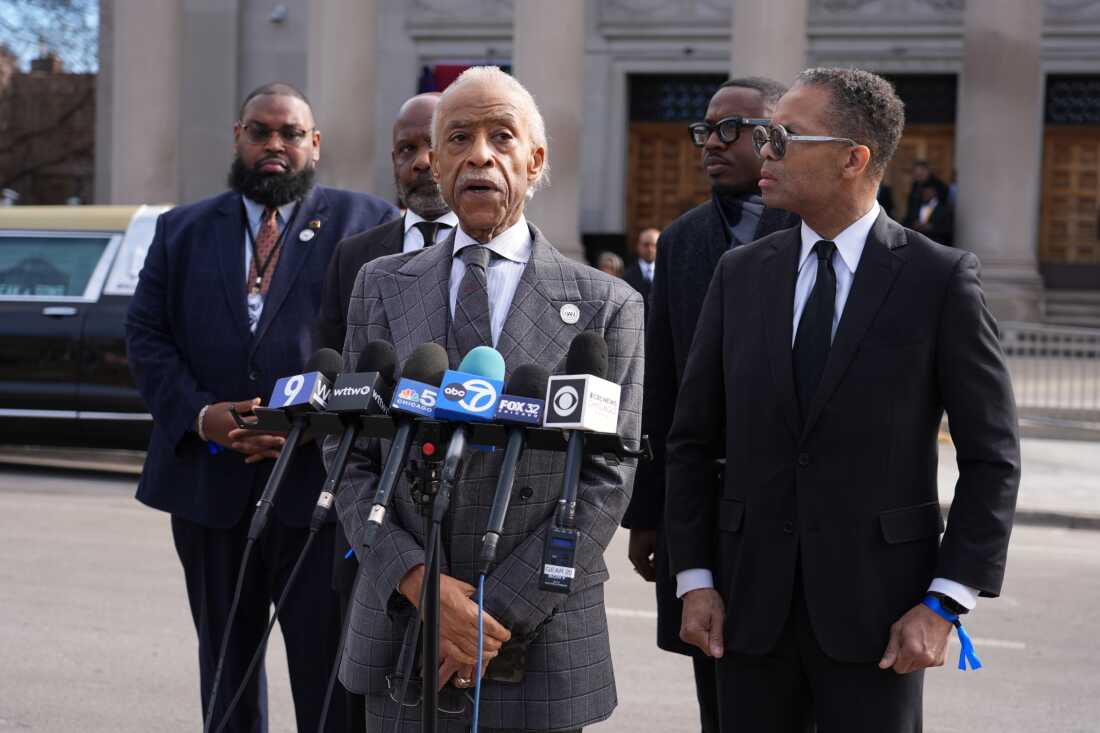
The Rev. Al Sharpton speaks as Jesse Jackson Jr. listens after the public visitation for the Rev. Jesse Jackson at Rainbow/PUSH Coalition in Chicago on Thursday.
Nam Y. Huh/AP
hide caption
toggle caption
Nam Y. Huh/AP
Jackson died last week at age 84 after battling a rare neurological disorder that affected his mobility and ability to speak in his later years.
Remembrances have already poured in from around the globe, and several U.S. states, including Minnesota, Iowa and North Carolina, are flying flags at half-staff in his honor.
But perhaps nowhere has his death been felt as strongly as in the nation’s third-largest city, where Jackson lived for decades and raised his six children, including a son who is a congressman.
Bouquets have been left outside the family’s Tudor-style home on the city’s South Side for days. Public schools have offered condolences, and city trains have used digital screens to display Jackson’s portrait and his well-known mantra, “I am Somebody!”

People wait to enter the security checkpoint for the public visitation for the Rev. Jesse Jackson at Rainbow/PUSH Coalition in Chicago on Thursday.
Nam Y. Huh/AP
hide caption
toggle caption
Nam Y. Huh/AP
His causes, both in the United States and abroad, were countless: Advocating for the poor and underrepresented on issues including voting rights, job opportunities, education and health care. He scored diplomatic victories with world leaders, and through his Rainbow PUSH Coalition, he channeled cries for Black pride and self-determination into corporate boardrooms, pressuring executives to make America a more open and equitable society.

“We honor him, and his hard-earned legacy as a freedom fighter, philosopher, and faithful shepherd of his family and community here in Chicago,” the mayor said in a statement.
Next week, Jackson will lie in honor at the South Carolina Statehouse, followed by public services. According to Rainbow PUSH’s agenda, Gov. Henry McMaster is expected to deliver remarks; however, the governor’s office said Thursday that his participation wasn’t yet confirmed. Jackson spent his childhood and started his activism in South Carolina.
Details on services in Washington have not yet been made public. However, he will not lie in honor at the United States Capitol rotunda after a request for the commemoration was denied by the House Speaker Mike Johnson’s office.
The two weeks of events will wrap up next week with a large celebration of life gathering at a Chicago megachurch and finally, homegoing services at the headquarters of the Rainbow PUSH Coalition.
Family members said the services will be open to all.
“Our family is overwhelmed and overjoyed by the amazing amount of support being offered by common, ordinary people who our father’s life has come into contact with,” his eldest son, Jesse Jackson Jr., said before the services began. “This is a unique opportunity to lay down some of the political rhetoric and to lay down some of the division that deeply divides our country and to reflect upon a man who brought people together.”
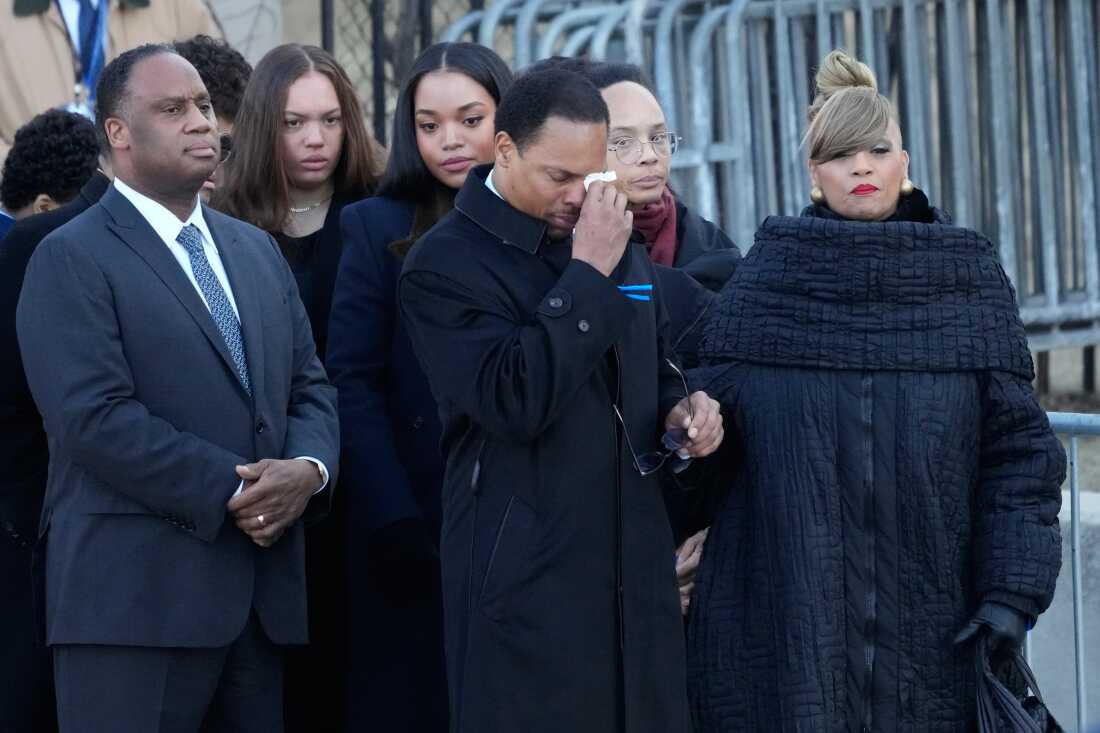
The family of the Rev. Jesse Jackson arrives as Yusep Jackson wipes his eyes before public visitation at Rainbow/PUSH Coalition in Chicago on Thursday.
Nam Y. Huh/AP
hide caption
toggle caption
Nam Y. Huh/AP
The services included prayers from some of the city’s most well-known religious leaders, including Chicago Cardinal Blase Cupich. Mourners of all ages — from toddlers in strollers to elderly people in wheelchairs — came to pay respects.
Video clips of his appearances at news conferences, the campaign trail and even “Sesame Street” also played inside the auditorium.
Claudette Redic, a retiree who lives in Chicago, said her family has respected Jackson, from backing his presidential ambitions to her son getting a scholarship from a program Jackson championed.
“We have generations of support,” she said. “I’m hoping we continue.”

300,000 Chrome users hit by fake AI extensions
Commentary: How Trump helped foreign markets outperform U.S. stocks during his first year in office
Philip Glass canceled a Kennedy Center show, but this conductor brings his work center stage at L.A. Opera

L.A. Affairs: Sick of swiping, I tried speed dating. The results surprised me

Contributor: The last shreds of our shared American culture are being politicized

Florida High School Football Rankings: Top 25 teams – Oct. 21

Cleary's 21 help Le Moyne down Central Connecticut State 69-64 in OT

How old is Bo Nix? What to know about Oregon quarterback ahead of 2024 NFL Draft

99th annual Pony Swim held in Virginia

Indiana Members Credit Union announced as new anchor tenant at Bottleworks District

Has India’s influence in Afghanistan grown under the Taliban?

Bill Clinton to testify before House committee investigating Epstein links

Read Judge Schiltz’s Order

Vulnerable House Dem lashes out at Trump’s ‘racist’ SOTU challenge: ‘That was uncomfortable’

Italy calls for suspension of EU carbon market
-

 World1 day ago
Exclusive: DeepSeek withholds latest AI model from US chipmakers including Nvidia, sources say
-

 Massachusetts2 days ago
Mother and daughter injured in Taunton house explosion
-

 Montana1 week ago
2026 MHSA Montana Wrestling State Championship Brackets And Results – FloWrestling
-

 Oklahoma1 week ago
Wildfires rage in Oklahoma as thousands urged to evacuate a small city
-

 Louisiana4 days ago
Wildfire near Gum Swamp Road in Livingston Parish now under control; more than 200 acres burned
-

 Technology6 days ago
YouTube TV billing scam emails are hitting inboxes
-

 Denver, CO2 days ago
10 acres charred, 5 injured in Thornton grass fire, evacuation orders lifted
-

 Technology6 days ago
Stellantis is in a crisis of its own making