News
Judge dismisses charges in Nevada pro-Trump fake electors case over venue question

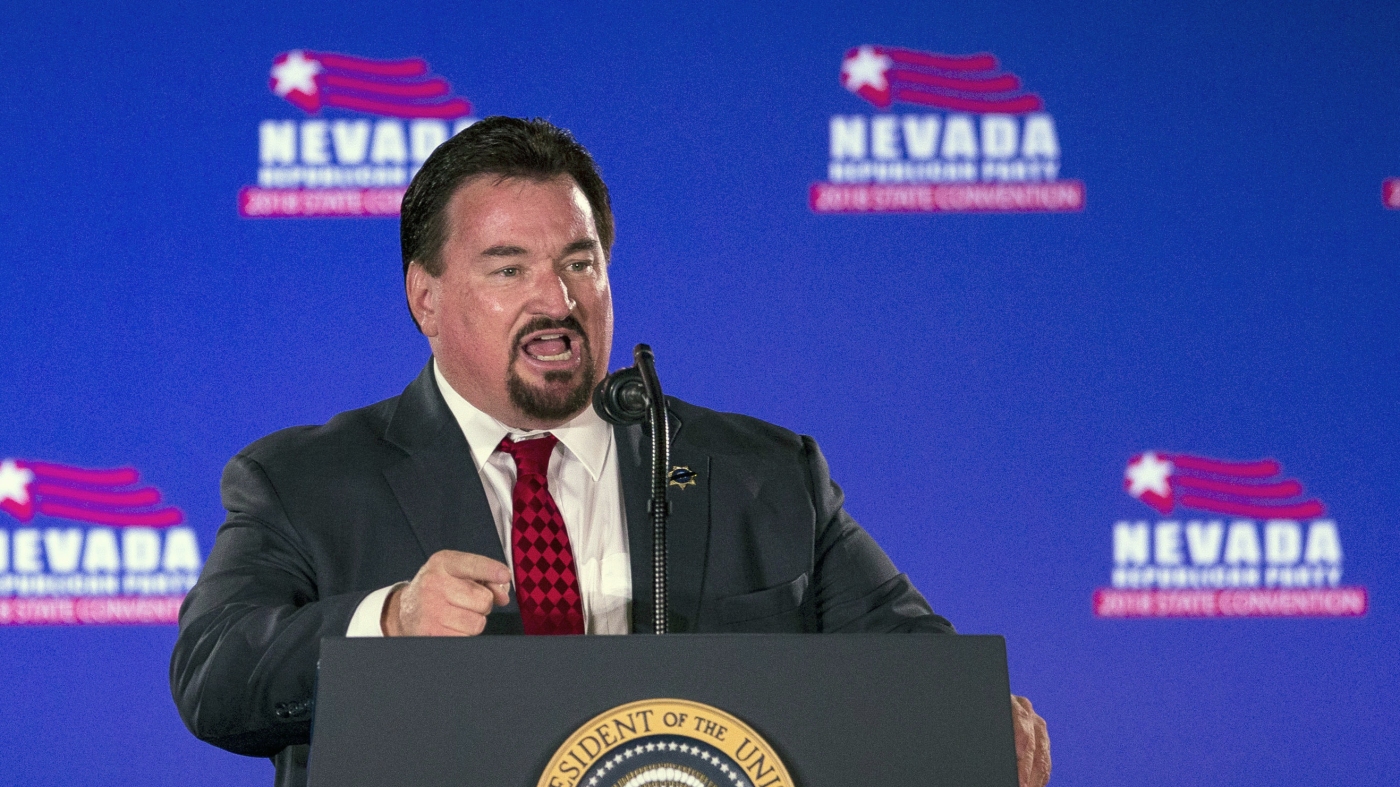
Nevada state Republican Party Chair Michael McDonald is seen in 2018 in Las Vegas. On Friday, a judge dismissed a criminal indictment against six Republicans, including McDonald, accused of submitting certificates to Congress falsely declaring Donald Trump the winner of the state’s 2020 presidential election.
L.E. Baskow/AP
hide caption
toggle caption
L.E. Baskow/AP
LAS VEGAS — A Nevada state court judge dismissed a criminal indictment Friday against six Republicans accused of submitting certificates to Congress falsely declaring Donald Trump the winner of the state’s 2020 presidential election, potentially killing the case with a ruling that state prosecutors chose the wrong venue to file the case.
Nevada Attorney General Aaron Ford stood in a Las Vegas courtroom a moment after Clark County District Court Judge Mary Kay Holthus delivered her ruling, declaring that he would take the case directly to the state Supreme Court.
“The judge got it wrong and we’ll be appealing immediately,” Ford told reporters afterward. He declined any additional comment.
Defense attorneys bluntly declared the case dead, saying that to bring the case now to another grand jury in another venue such as Nevada’s capital city of Carson City would violate a three-year statute of limitations on filing charges that expired in December.
“They’re done,” said Margaret McLetchie, attorney for Clark County Republican Party Chairman Jesse Law, one of the defendants in the case.
The judge called off trial, which had been scheduled for next January, for defendants that included state GOP Chairman Michael McDonald; national party committee member Jim DeGraffenreid; national and Douglas County committee member Shawn Meehan; and Eileen Rice, a party member from the Lake Tahoe area. Each was charged with offering a false instrument for filing and uttering a forged instrument, felonies that carry penalties of up to four or five years in prison.
Defense attorneys contended that Ford improperly brought the case in Las Vegas instead of Carson City or Reno, northern Nevada cities closer to where the alleged crime occurred. They also accused prosecutors of failing to present to the grand jury evidence that would have exonerated their clients, and said their clients had no intent to commit a crime.
All but Meehan have been named by the state party as Nevada delegates to the 2024 Republican National Convention next month in Milwaukee.
Meehan’s defense attorney, Sigal Chattah, said her client “chose not to” seek the position. Chattah ran as a Republican in 2022 for state attorney general and lost to Ford, a Democrat, by just under 8% of the vote.
After the court hearing, Hindle’s attorney, Brian Hardy, declined to comment on calls that his client has faced from advocacy groups that say he should resign from his elected position as overseer of elections in northern Nevada’s Story County, a jurisdiction with a few more than 4,100 residents. Those calls included ones at a news conference Friday outside the courthouse by leaders of three organizations.
Nevada is one of seven presidential battleground states where slates of fake electors falsely certified that Trump had won in 2020, not Democrat Joe Biden.
Others are Arizona, Georgia, Michigan, New Mexico, Pennsylvania and Wisconsin.
Criminal charges have been brought in Michigan, Georgia and Arizona.
Trump lost Nevada in 2020 by more than 30,000 votes to Biden and the state’s Democratic electors certified the results in the presence of Nevada Secretary of State Barbara Cegavske, a Republican. Her defense of the results as reliable and accurate led the state GOP to censure her, but Cegavske later conducted an investigation that found no credible evidence of widespread voter fraud in the state.



The Supreme Court
Win McNamee/Getty Images
hide caption
toggle caption
Win McNamee/Getty Images
The Supreme Court on Monday intervened in New York’s redistricting process, blocking a lower court decision that would likely have flipped a Republican congressional district into a Democratic district.
At issue is the midterm redrawing of New York’s 11th congressional district, including Staten Island and a small part of Brooklyn. The district is currently held by a Republican, but on Jan. 21, a state Supreme Court judge ruled that the current district dilutes the power of Black and Latino voters in violation of the state constitution.
GOP Rep. Nicole Malliotakis, who represents the district, and the Republican co-chair of the state Board of Elections promptly appealed to the U.S. Supreme Court, asking the justices to block the redrawing as an unconstitutional “racial gerrymander.” New York’s congressional election cycle was set to officially begin Feb. 24, the opening day for candidates to seek placement on the ballot.
As in this year’s prior mid-decade redistricting fights — in Texas and California — the Trump administration backed the Republicans.
Voters and the State of New York contended it’s too soon for the Supreme Court to wade into this dispute. New York’s highest state court has not issued a final judgment, so the voters asserted that if the Supreme Court grants relief now “future stay applicants will see little purpose in waiting for state court rulings before coming to this Court” and “be rewarded for such gamesmanship.” The state argues this is an issue for “New York courts, not federal courts” to resolve, and there is sufficient time for the dispute to be resolved on the merits.
The court majority explained the decision to intervene in 101 words, which the three dissenting liberal justices summarized as “Rules for thee, but not for me.”
The unsigned majority order does not explain the Court’s rationale. It says only how long the stay will last, until the case moves through the New York State appeals courts. If, however, the losing party petitions and the court agrees to hear the challenge, the stay extends until the final opinion is announced.
Dissenting from the decision were Justices Sonia Sotomayor, Elena Kagan, and Ketanji Brown Jackson. Writing for the three, Sotomayor said that if nonfinal decisions of a state trial court can be brought to highest court, “then every decision from any court is now fair game.” More immediately, she noted, “By granting these applications, the Court thrusts itself into the middle of every election-law dispute around the country, even as many States redraw their congressional maps ahead of the 2026 election.”
Monday’s Supreme Court action deviates from the court’s hands-off pattern in these mid-term redistricting fights this year. In two previous cases — from Texas and California — the court refused to intervene, allowing newly drawn maps to stay in effect.
Requests for Supreme Court intervention on redistricting issues has been a recurring theme this term, a trend that is likely to grow. Earlier last month the high court allowed California to use a voter-approved, Democratic-friendly map. California’s redistricting came in response to a GOP-friendly redistricting plan in Texas that the Supreme Court also permitted to move forward. These redistricting efforts are expected to offset one another.
But the high court itself has yet to rule on a challenge to Louisiana’s voting map, which was drawn by the state legislature after the decennial census in order to create a second majority-Black district. Since the drawing of that second majority-black district, the state has backed away from that map, hoping to return to a plan that provides for only one majority-minority district.
The Supreme Court’s consideration of the Louisiana case has stretched across two terms. The justices failed to resolve the case last term and chose to order a second round of arguments this term adding a new question: Does the state’s intentional creation of a second majority-minority district violate the constitution’s Fourteenth and Fifteenth Amendments’ guarantee of the right to vote and the authority of Congress to enforce that mandate?
Following the addition of the new question, the state of Louisiana flipped positions to oppose the map it had just drawn and defended in court. Whether the Supreme Court follows suit remains to be seen. But the tone of the October argument suggested that the court’s conservative supermajority is likely to continue undercutting the 1965 Voting Rights Act.

Note: Map shows the area with a shake intensity of 3 or greater, which U.S.G.S. defines as “weak,” though the earthquake may be felt outside the areas shown. The New York Times
A minor earthquake with a preliminary magnitude of 3.5 struck in Central California on Monday, according to the United States Geological Survey.
The temblor happened at 7:17 a.m. Pacific time about 6 miles northwest of Pinnacles, Calif., data from the agency shows.
As seismologists review available data, they may revise the earthquake’s reported magnitude. Additional information collected about the earthquake may also prompt U.S.G.S. scientists to update the shake-severity map.
Source: United States Geological Survey | Notes: Shaking categories are based on the Modified Mercalli Intensity scale. When aftershock data is available, the corresponding maps and charts include earthquakes within 100 miles and seven days of the initial quake. All times above are Pacific time. Shake data is as of Monday, March 2 at 10:20 a.m. Eastern. Aftershocks data is as of Monday, March 2 at 11:18 a.m. Eastern.

The U.S. and Israel have been conducting strikes against targets in Iran since Saturday morning, with the aim of toppling Tehran’s clerical regime. Iran has fired back, with retaliatory assaults featuring missiles and drones targeting several Gulf countries and American bases in the Middle East.
“All six aircrew ejected safely, have been safely recovered, and are in stable condition. Kuwait has acknowledged this incident, and we are grateful for the efforts of the Kuwaiti defense forces and their support in this ongoing operation,” Central Command said.
“The cause of the incident is under investigation. Additional information will be released as it becomes available,” it added.
In a separate statement later Monday, Central Command said that American forces had been killed during combat since the strikes began.
“As of 7:30 am ET, March 2, four U.S. service members have been killed in action. The fourth service member, who was seriously wounded during Iran’s initial attacks, eventually succumbed to their injuries,” it said.
Major combat operations continue and our response effort is ongoing. The identities of the fallen are being withheld until 24 hours after next of kin notification,” Central Command added.
This story has been updated.
Supreme Court blocks redrawing of New York congressional map, dealing a win for GOP

Oregon Dems block effort to alert ICE before illegal immigrant murderers are released

Terrifying moment caught on camera as road collapse suddenly swallows vehicles at busy intersection

Jasmine Crockett campaign reportedly kicked Atlantic writer out of rally for being a ‘top-notch hater’

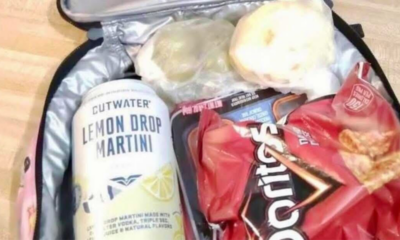
Atlanta-area police blast parents over vodka martini packed in school lunch: ‘That is NOT apple juice’

Florida High School Football Rankings: Top 25 teams – Oct. 21

Cleary's 21 help Le Moyne down Central Connecticut State 69-64 in OT

How old is Bo Nix? What to know about Oregon quarterback ahead of 2024 NFL Draft

99th annual Pony Swim held in Virginia

Indiana Members Credit Union announced as new anchor tenant at Bottleworks District
Supreme Court blocks redrawing of New York congressional map, dealing a win for GOP

Map: Earthquake Shakes Central California

Gas prices could jump as Middle East tensions threaten global oil supply

Pakistan calls troops, orders 3-day curfew as 24 killed in pro-Iran rallies

US says Kuwait accidentally shot down 3 American jets
-

 World5 days ago
Exclusive: DeepSeek withholds latest AI model from US chipmakers including Nvidia, sources say
-

 Massachusetts5 days ago
Mother and daughter injured in Taunton house explosion
-

 Denver, CO5 days ago
10 acres charred, 5 injured in Thornton grass fire, evacuation orders lifted
-

 Louisiana1 week ago
Wildfire near Gum Swamp Road in Livingston Parish now under control; more than 200 acres burned
-

 Technology1 week ago
YouTube TV billing scam emails are hitting inboxes
-

 Politics1 week ago
OpenAI didn’t contact police despite employees flagging mass shooter’s concerning chatbot interactions: REPORT
-

 Technology1 week ago
Stellantis is in a crisis of its own making
-

 News1 week ago
World reacts as US top court limits Trump’s tariff powers