News
In attempting to curtail immigration, the U.S. looks for allies in Latin America


U.S. President Joe Biden greets President of Mexico Andres Manuel Lopez Obrador during a welcome ceremony as part of the ‘2023 North American Leaders’ Summit at Palacio Nacional on January 09, 2023 in Mexico City, Mexico.
Hector Vivas/Getty Images/Getty Images South America
hide caption
toggle caption
Hector Vivas/Getty Images/Getty Images South America
Earlier this week President Joe Biden announced Executive Actions which, with some exceptions, effectively closes the border to most undocumented asylum seekers.
This is the latest of a series of measures the administration has enacted in recent weeks with the goal of curtailing illegal immigration into the country.
In pursuing that objective, the administration has also been leaning on governments of Mexico and Central America, where the outcome of recent presidential elections could impact the flow of migrants to the US.
US immigration policy is toothless without Mexican cooperation, which has been in effect for decades.
Current President Andres Manuel Lopez Obrador has been accepting deportees, and last year deployed the Mexican national guard to police migration, leading to serious accusations of human rights abuses.
The recent election of President Claudia Scheinbaum is unlikely to change much, migration has become a major issue in Mexico.
“It now is a priority for Mexico”, says Lila Abad, of the Wilson Center. “And that’s because Mexico is no longer just a transit country. It is now a destination country.”
Like her predecessor, Scheinbaum has said that in order to stop immigration, root causes like poverty must be addressed.
While the recent Mexican elections don’t change much, there have been several significant shifts in Central America. Panama recently electedPresident Jose Raul Mulino, who has vowed to close the Darien Gap, the dangerous jungle region that hundreds of thousands of migrants trek through to get to the U.S. every year. It’s not clear how Mulino would do that.
Then in El Salvador Nayib Bukele started on June 1 a second term as president. The US has had an uneasy relationship with the self-described“worlds coolest dictator”. But last week Secretary of Homeland Security Alejandro Mayorkas attended his presidential inauguration ceremony.
Roman Gressier from the newspaper El Faro In English says, it’s clear that the Biden Administration has shifted its stance to “we’re not getting in the mud on the issue of unconstitutional re-election, and we are stressing migration cooperation, and economic.”
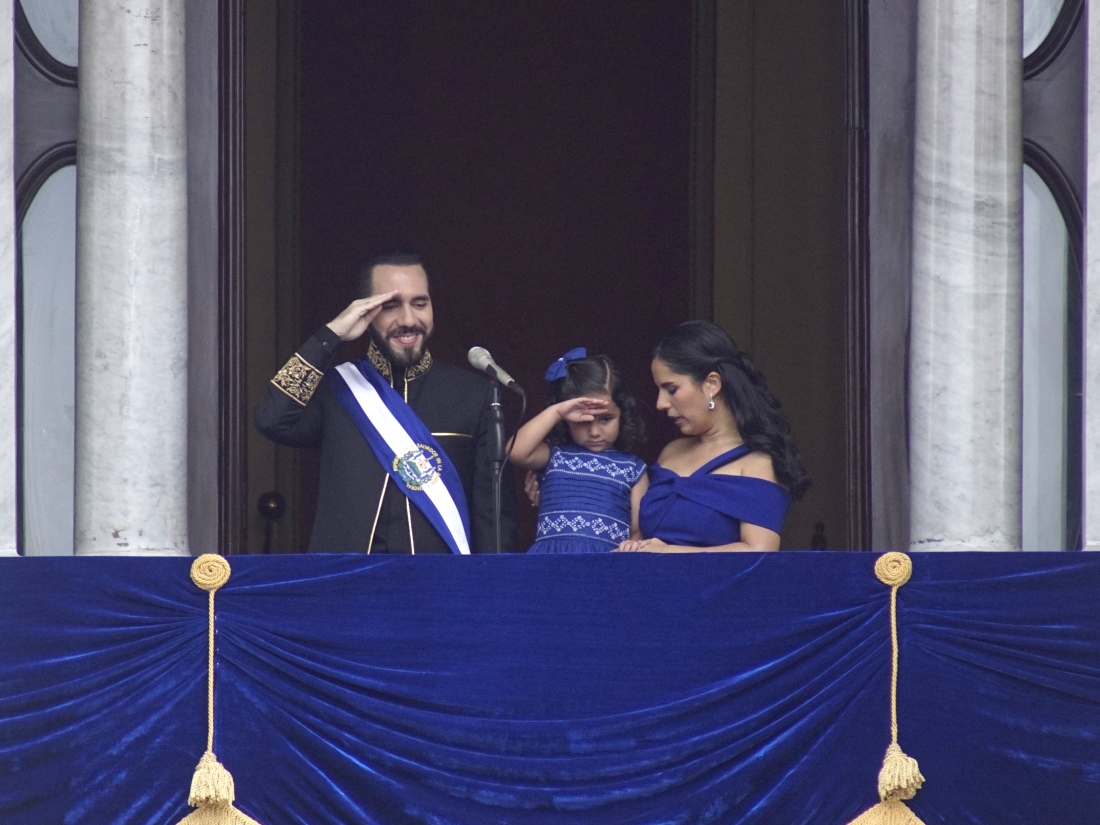
El Salvador’s President Nayib Bukele and his daughter Layla salute while standing on a balcony with first lady Gabriela Roberta Rodríguez, after he was sworn in for a second term, in San Salvador, El Salvador, Saturday, June 1, 2024.
Salvador Melendez/AP/AP
hide caption
toggle caption
Salvador Melendez/AP/AP
At the end of the day, immigration analysts say deterrence alone doesn’t work long term to curb irregular migration, certainly not when people are fleeing for their lives.
To that point, perhaps one of the most impacting of migration is happening in Venezuela, a country going through a severe humanitarian crisis. Around 7.7 million Venezuelan migrants and refugees have been displaced as of last year. The exodus shows no signs of slowing down.
Estefani, a Venezuelan mom living in a New York City shelter, recently told NPR she knew the route to the U.S. could be dangerous, even deadly, but she didn’t feel she had a choice. She asked for her name to be withheld because she was sexually assaulted on her journey.
“Raising a child in Venezuela is very difficult. You can feed them lunch, but then there’s no dinner,” she said.
Estefani tried to live in Colombia and Ecuador, and eventually got desperate enough that she ventured to the U.S.
As presidential campaigns intensify in the United States, there is a growing pressure for Latin American countries to help enforce immigration. But analysts say that as long as people like Estefani see no other choice but to pick up and leave their country, any deterrence policies in the U.S.-Mexico border is no more than a short-lived fix.


News
Trump’s ‘American Flag Blue’ in the Lincoln Memorial pool is already gray — and the Olympic canoer ‘vandal’ is fighting his arrest | Fortune

The newly drained Lincoln Memorial Reflecting Pool’s bottom surface has noticeably faded since it was lined with a protective coating in a color President Donald Trump called “American flag blue” this spring.
An Associated Press reporter and photographer viewed the fenced-off Reflecting Pool on Wednesday from the top of the Washington Monument. The new liner appears grayer than when the pool was repainted and refilled with water in early June. Debris that had been visible earlier this week after the pool was drained is now largely gone, after work crews removed it.
Trump’s problem-plagued effort to revamp the landmark has stretched well past his initial goal of having the Reflecting Pool ready by July 4 for the nation’s 250th birthday.
The president at first suggested his renovations would cost $1.5 million, but the bill ballooned to more than $16 million by June.
Trump had said the repairs would last a century, but within days of the project’s initial completion last month, the water was beset by an algae bloom and pieces of the new coating appeared to be peeling off the bottom.
Ohio-based Green Water Solutions, also known as Greenwater Services, was given a $1.7 million contract to install a water-purification system in the Reflecting Pool, while Virginia-based Atlantic Industrial Coatings was awarded $14.7 million to repaint and waterproof the pool’s concrete floor.
Vandalism charges were levied against a former Olympic canoeist
Trump has repeatedly blamed vandals for the peeling paint, though critics allege it’s from shoddy repair work.
Trump has said, without citing evidence, that vandals made a “350-foot gash” in the liner and caused other problems. No large slash marks were immediately visible Wednesday from the Washington Monument view. It was not possible to do a more up-close inspection of the entire pool due to a dark fence surrounding the perimeter.
Interior Secretary Doug Burgum, whose agency oversees the National Park Service, said that after the water is drained and debris is cleaned from Independence Day fireworks, the plan for the pool is straightforward: “Repair the vandalism that was done. Fill it back up again.” He was speaking with conservative podcaster Katie Miller.
Court documents show that the National Park Service reported to the U.S. Park Police a June 9 incident in which a sharp knife or razor was said to have cut the pool’s new liner.
Former Olympic canoe racer David Hearn pleaded not guilty last week in D.C. Superior Court to deliberately damaging the Reflecting Pool. Hearn has said he reached inside the pool to examine the peeled sealant and let go of a chunk when he was told to by a park worker.
His attorneys and other Trump administration critics have derided the case as an abuse of prosecutorial power and maintain he is being scapegoated for the poor job done fixing up the Reflecting Pool.
At least three other people have been charged in the same court with misdemeanors for allegedly removing pieces of paint from the pool, court records show. All three pleaded not guilty during initial court appearances.
The work on the Reflecting Pool is just one of a number of projects Trump has spearheaded across the nation’s capital. Most prominently, he demolished the White House’s East Wing to build a $400 million ballroom and plans to build a towering arch. between the Lincoln Memorial and Arlington National Cemetery.

Argentina’s Lionel Messi celebrates the team’s second goal by Lautaro Martínez during their World Cup semifinal against England on Wednesday in Atlanta. Argentina defeated the English 2-1 to advance to Sunday’s final against Spain.
Shaun Botterill/Getty Images
hide caption
toggle caption
Shaun Botterill/Getty Images
ATLANTA — Argentina, the death-defying defending World Cup champion, will play for a second consecutive title after scoring two late goals to beat England in the semifinal, 2-1.

For a fourth straight knockout game, Argentina survived a heart-stoppingly close call. First was Cape Verde, the African island nation underdog, who took the champions to extra time. Then was the furious miracle comeback after Egypt took a 2-0 lead. Then, in the quarterfinal, a shorthanded Switzerland squad forced extra time despite a 72nd-minute red card.
This gutsy Argentina squad prevailed in all three games, and Wednesday, they pulled it off yet again. In the 55th minute, England took a 1-0 lead when forward Anthony Gordon tapped in a cross.
But, as the clock ticked up, Argentina turned up the intensity. A relentless onslaught yielded near miss after near miss before finally midfielder Enzo Fernández scored off a rocket from outside the penalty area to equalize the game at 1-1 in the 85th minute.
Then, in stoppage time, forward Lautaro Martínez sent the Argentina crowd into delirium with a header off a cross from 39-year-old superstar Lionel Messi, who assisted on both goals.
“I think that this team plays the best when we are facing a difficult situation, with adversity, ” said Argentina coach Lionel Scaloni afterward. “We had a challenging game, a challenging situation. There was blood in the water, and we went for it.”
In Sunday’s final they will face Spain, which defeated France on Tuesday 2-0 to contend for their second-ever title.

England’s Anthony Gordon celebrates scoring his team’s first goal during the World Cup semifinal against Argentina on Wednesday in Atlanta.
Justin Setterfield/Getty Images
hide caption
toggle caption
Justin Setterfield/Getty Images
Wednesday’s game, the sixth meeting between these two teams at the men’s World Cup, was the newest chapter in their storied rivalry. That history includes the infamous “Hand of God” goal scored by Diego Maradona in the 1986 World Cup, four years after a war between the two countries over the Falkland Islands. The British won the war, but the sovereignty of the territory is still under dispute.
(Asked Tuesday about the “Hand of God,” which was the first of two goals scored by Maradona, coach Scaloni slyly deflected. “I think all of the world remembers that game, remembers Diego’s performance, remembers above all the second goal,” he said.)
To hear England’s coach, none of that mattered on Wednesday. “We respect our opponent, but we don’t dip in historic events, and we don’t make it bigger than it is,” Thomas Tuchel told reporters the day before the match.
Yet from the opening kick, both teams eagerly played a physical game: Collisions, jersey tugs, tough tackles, bodies flying to the ground. Referee Ismail Elfath, the first American man to work a World Cup semifinal, awarded a yellow card to each team before halftime.

And after the game, as Argentina’s players celebrated on the field, midfielder Giovani Lo Celso, who did not play in the match, unfurled a white banner bearing the words “Las Malvinas son Argentinas,” or “the Malvinas are Argentine,” a reference to the Argentine name for the Falkland Islands. The banner appeared to have been first held by Argentina fans in the stands.
For England fans, the pain is a familiar one as they watched the team fall short in yet another major tournament knockout game. England lost in the Euros final in both 2024 and 2020, and the last time they reached the World Cup semifinal in 2018, they lost by the same score as Wednesday’s match, 2-1, despite scoring first.

England’s forward Harry Kane (#9) and teammates react after losing their World Cup semifinal match 2-1 against Argentina.
Odd Andersen/AFP via Getty Images
hide caption
toggle caption
Odd Andersen/AFP via Getty Images
“It’s a similar story to what’s happened in previous tournaments,” England Captain Harry Kane conceded afterward. “We’d done so well for that 60 minutes. We scored. We deserved to be ahead. And then, for one reason or another, we struggled to keep the ball. We struggled to put pressure on the ball and it just allowed them to create more momentum.”
The atmosphere inside Mercedes-Benz Stadium in Atlanta was raucous and ear-splitting. Argentine fans by the thousands wore the white and sky blue striped jerseys bearing the name of their star Messi. The English celebrated their team wearing all-white or all-red jerseys of their scoring sensations: Kane and Jude Bellingham.
But neither star could save England from another defeat, extending what has already been an agonizing 60-year wait to return to the final.
NPR’s Russell Lewis contributed reporting from Atlanta
News
ICE should do traffic stops despite recent shootings, Trump says, seeming to oppose new suspension

WASHINGTON (AP) — The Immigration and Customs Enforcement agency should continue vehicle stops after recent fatal shootings, President Donald Trump said on Wednesday, seeming to oppose a new suspension of the practice used as part of his immigration crackdown.
ICE is “doing a GREAT job, one that has to be done,” Trump wrote on his social media site.
The Republican president said that to remove criminals he claims were let into the country under the previous Democratic administration “we must be strong, tough, and smart, and we CANNOT give up one of ICE’s most important and effective Crime Fighting tools, THE TRAFFIC STOP!” Trump said, “Once we do, we are playing right into the criminal’s hands.”
Trump administration officials have told Immigration and Customs Enforcement officers to suspend most vehicle stops after two deadly shootings within a week, people familiar with the decision said Tuesday.
The suspension was ordered after an ICE officer shot and killed a Colombian driver Monday in Maine and a week after another officer shot and killed a motorist in Houston, renewing criticism of the agency’s enforcement tactics that were widely condemned last winter after the killings of Alex Pretti and Renee Good in Minnesota.
In Florida on Tuesday, a third man in roughly a week died during an encounter with immigration officers. This time, a 28-year-old man was killed after he was hit by a tractor trailer while running from immigration and other federal officers, authorities said.
It’s a narrative that has been repeated again and again since the Trump administration’s immigration crackdown began, with federal officers confronting drivers and then saying they opened fire when the drivers’ vehicles became a danger. That’s despite decades of warnings from policing experts that shooting into moving cars presents a danger of its own and should almost always be avoided.
There have been at least 10 deaths involving encounters with immigration agents since Trump launched his deportation campaign. At least four of those deaths involved people in vehicles, including the one last week in Houston, a trend so troubling that U.S. Sen. Susan Collins, R-Maine, said Tuesday that she had urged Department of Homeland Security Secretary Markwayne Mullin “to cease all non-urgent vehicle stops.”
John Sandweg, who was acting director at ICE, which is part of DHS, during President Barack Obama’s Democratic administration, estimated recently that there have been roughly 18 traffic stop shootings during the Trump immigration crackdown.
The office of Maine Sen. Angus King, an independent who caucuses with Democrats, was told by DHS that ICE was suspending traffic stops, office spokesperson Matthew Felling said.
ICE, which has been under pressure to beef up arrest and deportation numbers, often says people it’s trying to arrest are increasingly resistant to leaving their homes. ICE officers blame immigration advocates who advise immigrants to stay in their homes unless ICE produces a warrant signed by an independent judge instead of the administrative warrants the agency generally uses that are signed by another ICE officer. So, ICE officers say, they’re forced to find other areas in which to make arrests.
Shooting angers Maine
Hundreds of people in Maine protested Tuesday over the fatal shooting of Johan Sebastián Durán Guerrero, a 25-year-old Colombian national. Advocacy groups said Guerrero, who had a wife and a young daughter, was authorized to work in the United States.
DHS said Monday that an officer, “fearing for public safety,” shot and killed Durán Guerrero while officers were watching the home of someone they believed was in the U.S. illegally and facing a final order of removal from the country. It said in a post on X that when ICE tried to stop a car driven by someone who came from the home, the person attempted to flee in the vehicle and the officer fired.
That was a shift from how King earlier described the encounter, when he said Mullin told him the officer opened fire after the man tried to use his vehicle as a weapon. King said Mullin told him the officers were trying to serve an arrest warrant but not for the man who was shot.
In a scathing post on X, outgoing Colombian President Gustavo Petro called the shooting a targeted killing “at the hands of the U.S. government.”
Petro, who has openly quarreled with Trump, urged Trump to provide an explanation and accused ICE officers of treating Durán Guerrero as “an inferior being without rights.”
In Wednesday’s social media post, Trump told ICE to be “judicious, fair and smart, and go back and do your very important job.”
Maine’s congressional delegation on Tuesday demanded a “comprehensive, transparent, and expedited investigation.”
Questions surround the shooting
Photos showed bullet holes in Durán Guerrero’s car windshield, but the officers involved in the shooting didn’t have body cameras, leaving many questions. Among them are how close the officer was to the vehicle when shooting, whether officers told Durán Guerrero to stop and why ICE believes he had put the public in danger.
Border czar Tom Homan told reporters Tuesday that the investigation needs to play out and that officers will be held accountable if they are found to have acted inappropriately or illegally.
Maine’s attorney general’s office, which said it is working with federal agencies to investigate, said initial statements suggest the driver was trying to flee in the direction of the officer, whose name hasn’t been released and who was placed on leave.
Collins said Mullin told her the DHS inspector general is investigating in cooperation with the FBI.
Democrats seeking to unseat Collins in November have sought to connect her with ICE’s methods, which have drawn public scrutiny and derision. Collins later said in a statement that although ICE needs to improve, eliminating the agency would make the nation less safe.
Maine Secretary of State Shenna Bellows, a Democrat who is vying for Collins’ seat, called the ICE officers at the shooting “thugs” during a vigil Tuesday in Lewiston.
___
Whittle contributed from Biddeford, Maine; Brook from New Orleans; and Sisak from New York.
-

 Politics9 minutes ago
Inside Trump’s Swift Construction of a White House Helipad
-

 Science21 minutes ago
The Wildfire Researchers Who Burn Houses Down on Purpose
-
Lifestyle45 minutes ago
Apache chef Nephi Craig says cooking Native food saved his life
-

 Technology57 minutes ago
Google is better at playing the AI regulations game
-

 World1 hour ago
Iran calls on Houthis to prepare to cut off Red Sea gateway — can the terror group do it?
-

 Politics1 hour ago
Todd Blanche roasts Adam Schiff in heated hearing: ‘You’re a lawyer, you know the rules’
-

 Health1 hour ago
Game-changing cholesterol pill wins FDA approval after cutting LDL nearly 60%
-

 Sports1 hour ago
2026 AL, NL MVP Odds: Ohtani Favored; Alvarez Holding Off Challengers

