News
In a setback for Trump, Indiana lawmakers defeat redistricting plan

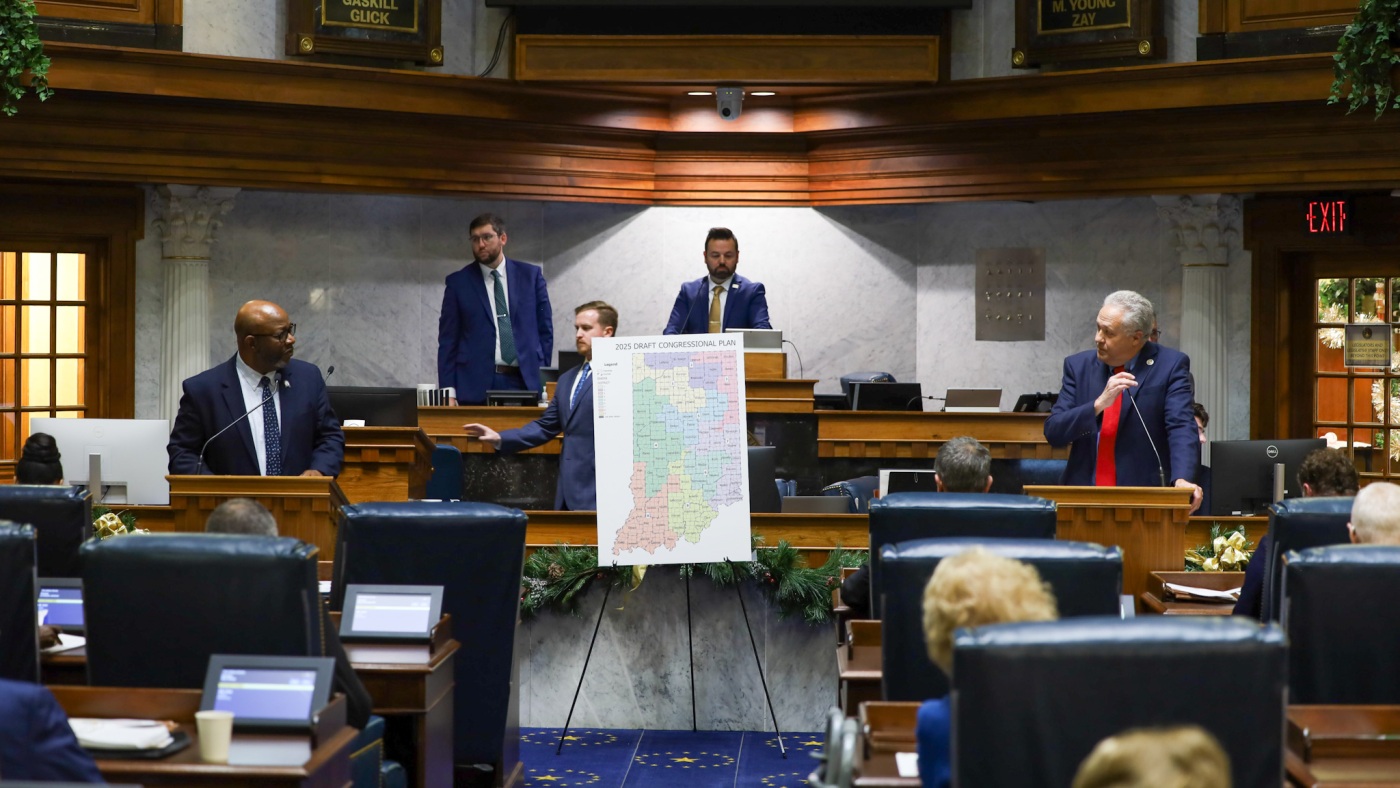
Members of the Indiana Senate debate the redistricting plan backed by President Trump in the state capitol Thursday.
Zach Bundy/WFYI
hide caption
toggle caption
Zach Bundy/WFYI
The Indiana Senate has voted 31 to 19 against the congressional redistricting called for by President Trump in his attempt to help Republicans win the 2026 midterm elections.
The defeat Thursday in the Indiana Senate, where 40 of the 50 members are Republicans, is the first time Trump’s redistricting campaign has been voted down by members of his own party. Republicans in Texas, Missouri and North Carolina have answered his call for an unusual mid-decade redistricting scramble.
“My opposition to mid-cycle gerrymandering is not in contrast to my conservative principles, my opposition is driven by them,” Republican state Sen. Spencer Deery said during the debate. “As long as I have breath, I will use my voice to resist a federal government that attempts to bully, direct and control this state or any state. Giving the federal government more power is not conservative.”
The move was also opposed by Indiana Democrats, who currently hold just two of the state’s nine U.S. House seats and said it would dilute the voting power of minority communities.
Usually, states redistrict early in the decade after the decennial census count.
The vote came after weeks of political turmoil and some threats
Trump has urged Republican-led states to conduct an unusual, mid-decade redistricting effort aimed at helping Republicans hold onto their majority in the U.S. House in next year’s midterm elections. California Democrats responded with their own redistricting effort but so far red states have gained a few-seat advantage over blue states.

The Indiana vote came after weeks of turmoil and with opposition from some Republicans, who had said their constituents did not want to alter the current districts.
Outside of the chamber ahead of the vote, protesters could be heard chanting “vote no” and “Hoosiers fight fair.”
Indiana Gov. Mike Braun, a Republican, has supported Trump’s call and both of them have threatened to support primary challenges against senators who don’t support redistricting. Amid rising tensions over redistricting in the state, Braun and other Republican lawmakers said they and their families have been the subject of anonymous threats.
As the Senate debated the bill to redistrict, Vice President Vance wrote on X that the Republican Senate President Pro Tempore Rodric Bray had told the administration he wouldn’t fight redistricting but was encouraging votes against it. “That level of dishonesty cannot be rewarded,” Vance wrote. Bray voted no.
Republicans who backed redistricting said it was for political gain to help keep the U.S. House in Republican control and noted that some Democratic-led states have redrawn their districts to favor Democrats in the past.
“Only a handful of districts throughout the United States will determine who controls Congress. We may or may not do our part today to keep our nation in the hands of Republicans and do the right thing for our state,” Republican state Sen. Mike Young told the chamber. “Whether we choose to play the game or not play the game we will determine the fate of our state and country.”
Ben Thorp is a reporter for WFYI. Larry Kaplow is with NPR.



new video loaded: What the Texas Primary Battle Means for the Midterms
By J. David Goodman, Alexandra Ostasiewicz, June Kim and Luke Piotrowski
March 1, 2026

Gunfire rang out at a bar in Austin, Texas, early Sunday and at least three people were killed, the city’s police chief said.
Austin Police Chief Lisa Davis told reporters the shooter was killed by officers at the scene.
Fourteen others were hospitalized and three were in critical condition, Austin-Travis County EMS Chief Robert Luckritz said.
“We received a call at 1:39 a.m. and within 57 seconds, the first paramedics and officers were on scene actively treating the patients,” Luckritz said.
There was no initial word on the shooter’s identity or motive.
Davis noted how fortunate it was that there was a heavy police presence in Austin’s entertainment district at the time, enabling officers to respond quickly as bars were closing.
“Officers immediately transitioned … and were faced with the individual with a gun,” Davis said. “Three of our officers returned fire, killing the suspect.”
She called the shooting a “tragic, tragic” incident.

Austin Mayor Kirk Watson said his heart goes out to the victims, and he praised the swift response of first responders.
“They definitely saved lives,” he said.
Davis said federal law enforcement is aiding the investigation.


Here are the 9 San Diego County communities that set or tied heat records

Four new community-powered fridges open on Milwaukee’s North Side

Drama mars finish of half-marathon national championships in Atlanta

Man killed over Louie Vuitton bag, suspect was on bond for suspected carjacking, charges say

Indianapolis Colts Player Spotlight: Tight End Mo Alie-Cox

Florida High School Football Rankings: Top 25 teams – Oct. 21

Cleary's 21 help Le Moyne down Central Connecticut State 69-64 in OT

How old is Bo Nix? What to know about Oregon quarterback ahead of 2024 NFL Draft

99th annual Pony Swim held in Virginia

Indiana Members Credit Union announced as new anchor tenant at Bottleworks District

Video: What the Texas Primary Battle Means for the Midterms

Dems’ potential 2028 hopefuls come out against US strikes on Iran

At least nine killed after Iranian strike on Israel’s Beit Shemesh

Mass shooting at Austin, Texas bar leaves at least 3 dead, 14 wounded, authorities say

Mamdani’s response to Trump’s Iran strike sparks conservative backlash: ‘Rooting for the ayatollah’
-

 World4 days ago
Exclusive: DeepSeek withholds latest AI model from US chipmakers including Nvidia, sources say
-

 Massachusetts4 days ago
Mother and daughter injured in Taunton house explosion
-

 Montana1 week ago
2026 MHSA Montana Wrestling State Championship Brackets And Results – FloWrestling
-

 Denver, CO4 days ago
10 acres charred, 5 injured in Thornton grass fire, evacuation orders lifted
-

 Louisiana7 days ago
Wildfire near Gum Swamp Road in Livingston Parish now under control; more than 200 acres burned
-

 Technology1 week ago
YouTube TV billing scam emails are hitting inboxes
-

 Technology1 week ago
Stellantis is in a crisis of its own making
-

 Politics1 week ago
OpenAI didn’t contact police despite employees flagging mass shooter’s concerning chatbot interactions: REPORT