News
Immigrant whose skull was broken in 8 places during ICE arrest says beating was unprovoked

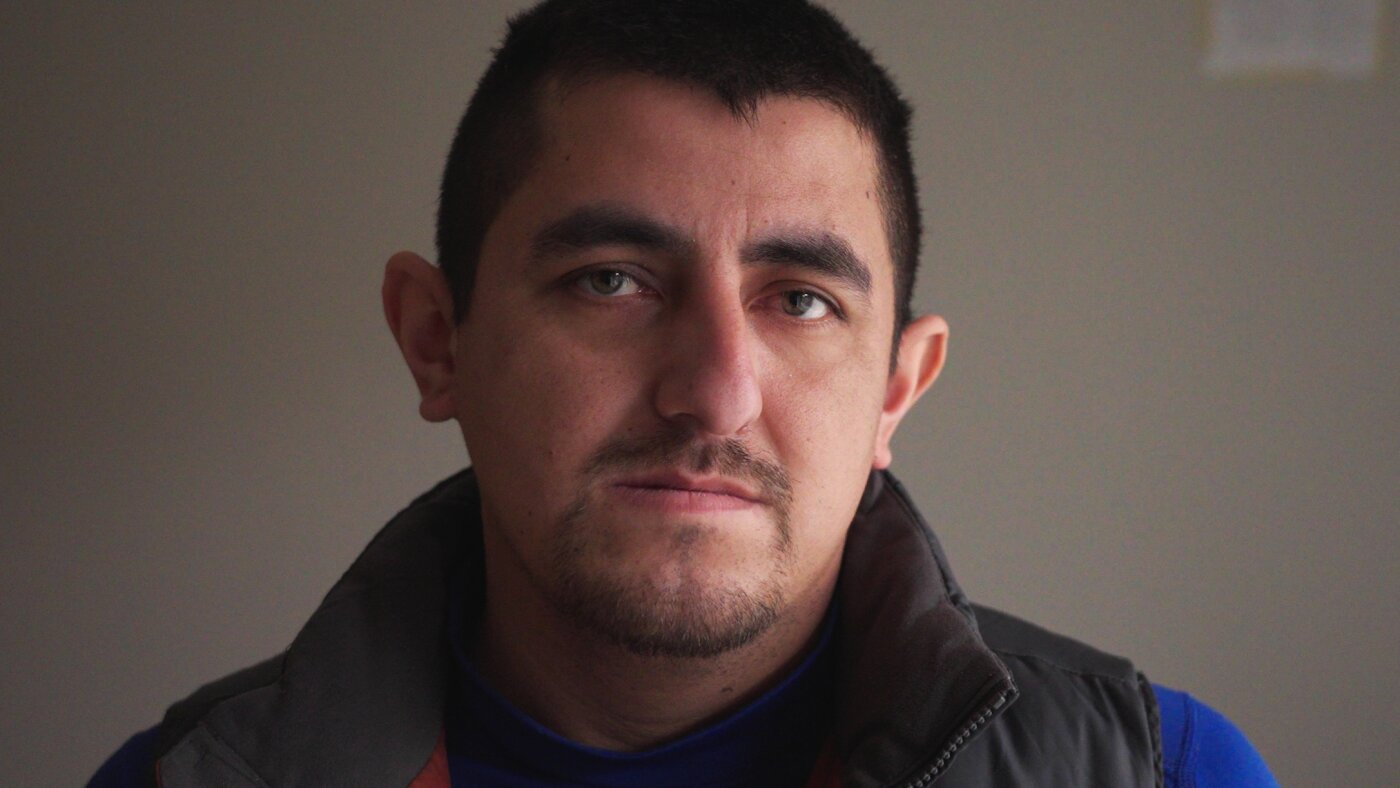
Alberto Castañeda Mondragón poses for a portrait at an apartment on Feb. 4, 2026, in St. Paul, Minn.
Mark Vancleave/AP
hide caption
toggle caption
Mark Vancleave/AP
MINNEAPOLIS — Alberto Castañeda Mondragón says his memory was so jumbled after a beating by immigration officers that he initially could not remember he had a daughter and still struggles to recall treasured moments like the night he taught her to dance.
But the violence he endured last month in Minnesota while being detained is seared into his battered brain.
He remembers Immigration and Customs Enforcement agents pulling him from a friend’s car on Jan. 8 outside a St. Paul shopping center and throwing him to the ground, handcuffing him, then punching him and striking his head with a steel baton. He remembers being dragged into an SUV and taken to a detention facility, where he said he was beaten again.
He also remembers the emergency room and the intense pain from eight skull fractures and five life-threatening brain hemorrhages.
“They started beating me right away when they arrested me,” the Mexican immigrant recounted this week to The Associated Press, which recently reported on how his case contributed to mounting friction between federal immigration agents and a Minneapolis hospital.
Castañeda Mondragón, 31, is one of an unknown number of immigration detainees who, despite avoiding deportation during the Trump administration’s enforcement crackdown, have been left with lasting injuries following violent encounters with ICE officers. His case is one of the excessive-force claims the federal government has thus far declined to investigate.
He was hurt so badly he was disoriented for days at Hennepin County Medical Center, where ICE officers constantly watched over him.
Officers claimed he ran headfirst into a wall
The officers told nurses Castañeda Mondragón “purposefully ran headfirst into a brick wall,” an account his caregivers immediately doubted. A CT scan showed fractures to the front, back and both sides of his skull — injuries a doctor told AP were inconsistent with a fall.
“There was never a wall,” Castañeda Mondragón said in Spanish, recalling ICE officers striking him with the same metal rod used to break the windows of the vehicle he was in. He later identified it as an ASP, a telescoping baton routinely carried by law enforcement.
Training materials and police use-of-force policies across the U.S. say such a baton can be used to hit the arms, legs and body. But striking the head, neck or spine is considered potentially deadly force.
“The only time a person can be struck in the head with any baton is when the person presents the same threat that would permit the use of a firearm — a lethal threat to the officer or others,” said Joe Key, a former Baltimore police lieutenant and use-of-force expert who testifies in defense of police.
Once he was taken to an ICE holding facility at Ft. Snelling in suburban Minneapolis, Castañeda Mondragón said officers resumed beating him. Recognizing that he was seriously hurt, he said, he pleaded with them to stop but they just “laughed at me and hit me again.”
“They were very racist people,” he said. “No one insulted them, neither me nor the other person they detained me with. It was their character, their racism toward us, for being immigrants.”
The Department of Homeland Security, which includes ICE, did not respond to repeated requests for comment over the last two weeks on Castañeda Mondragón’s injuries.
It is unclear whether his arrest was captured on body-camera footage or if there might be additional recordings from security cameras at the detention center.
In a recent bid to boost transparency, DHS announced a broad rollout of body cameras for immigration officers in Minneapolis as the government also draws down ICE’s presence there.
ICE deportation officer William J. Robinson did not say how Castañeda Mondragón’s skull was smashed in a Jan. 20 declaration filed in federal court. During the intake process, it was determined he “had a head injury that required emergency medical treatment,” he wrote in the filing.
The declaration also stated that Castañeda Mondragón entered the U.S. legally in March 2022, and that the agency determined only after his arrest that he had overstayed his visa. A federal judge later ruled his arrest had been unlawful and ordered him released from ICE custody.
Video shows him stumbling during arrest
A video posted to social media captured the moments immediately after Castañeda Mondragón’s arrest as four masked men walk him handcuffed through a parking lot. The video shows him unsteady and stumbling, held up by ICE officers.
“Don’t resist,” shouts the woman who is recording. “Cause they ain’t gonna do nothing but bang you up some more.”
“Hope they don’t kill you,” she adds.
“And y’all gave the man a concussion,” a male bystander shouts.
The witness who posted the video declined to speak with AP or provide consent for the video’s publication, but Castañeda Mondragón confirmed he is the handcuffed man seen in the recording.
At least one ICE officer later told staff at the medical center that Castañeda Mondragón “got his (expletive) rocked,” according to court documents filed by a lawyer seeking his release and nurses who spoke with AP.
AP interviewed a doctor and five nurses about Castañeda Mondragón’s treatment at HCMC and the presence of ICE officers inside the hospital. They spoke on condition of anonymity because they were not authorized to discuss patient care and feared retaliation. AP also consulted an outside physician, who affirmed the injuries were inconsistent with an accidental fall or running into a wall.
Minnesota state law requires health professionals to report to law enforcement any wounds that could have been perpetrated as part of a crime.
An HCMC spokeswoman declined to say this week whether anyone at the facility had done so. However, following the Jan. 31 publication of AP’s initial story about Castañeda Mondragón’s arrest, hospital administrators opened an internal inquiry seeking to determine which staff members have spoken to the media, according to internal communications viewed by AP.
Minnesota Gov. Tim Walz posted a link to AP’s prior story about Castañeda Mondragón, but his office has not said whether state authorities would pursue answers.
“Law enforcement cannot be lawless,” Walz wrote in the post on X. “Thousands of aggressive, untrained agents of the federal government continue to injure and terrorize Minnesotans. This must end.”
Castañeda Mondragón’s arrest came a day after the first of two fatal shootings of U.S. citizens in Minneapolis by immigration officers, triggering widespread public protests.
Elected officials call for accountability
Minnesota congressional leaders and other elected officials, including St. Paul Mayor Kaohly Her, called this week for an investigation of Castañeda Mondragón’s injuries.
The Ramsey County Attorney’s Office, which oversees St. Paul, urged Castañeda Mondragón to file a police report to prompt an investigation. He said he plans to file a complaint. A St. Paul police spokesperson said the department would investigate “all alleged crimes that are reported to us.”
While the Trump administration insists ICE limits its operations to immigrants with violent rap sheets, Castañeda Mondragón has no criminal record.
“We are seeing a repeated pattern of Trump Administration officials attempting to lie and gaslight the American people when it comes to the cruelty of this ICE operation in Minnesota,” Sen. Tina Smith, a Minnesota Democrat, said in a statement.
Rep. Kelly Morrison, another Democrat and a doctor, recently toured the Whipple Building, the ICE facility at Ft. Snelling. She said she saw severe overcrowding, unsanitary conditions and an almost complete lack of medical care.
“If any one of our police officers did this, you know what just happened in Minnesota with George Floyd, we hold them accountable,” said Democratic Rep. Betty McCollum, whose district includes St. Paul.
A native of Veracruz, Mexico, Castañeda Mondragón came to Minnesota nearly four years ago on a temporary work visa and found jobs as a driver and roofer. He uses his earnings to support his elderly father, who is disabled and diabetic, and his 10-year-old daughter.
On the day of his arrest, he was running errands with a friend when they suddenly found themselves surrounded by ICE agents. They began breaking the windows and opening the doors of the vehicle. He said the first person who hit him “got ugly with me for being Mexican” and not having documents showing his immigration status.
About four hours after his arrest, court records show, Castañeda Mondragón was taken to an emergency room in the suburb of Edina with swelling and bruising around his right eye and bleeding. He was then transferred to the Minneapolis medical center, where he told staff he had been “dragged and mistreated by federal agents,” before his condition deteriorated, court records show.
A week into his hospitalization, caregivers described him as minimally responsive. As his condition slowly improved, hospital staff handed him his cellphone, and he spoke with his child in Mexico, whom he could not remember.
“I am your daughter,” she told him. “You left when I was 6 years old.”
His head injuries erased past experiences that for his daughter are unforgettable, including birthday parties and the day he left for the U.S. She’s been trying to revive his memory in daily calls.
“When I turned 5, you taught me how to dance for the first time,” she reminded him recently.
“All these moments, really, for me, have been forgotten,″ he said.
He showed gradual improvement and, to the surprise of some who treated him, was released from the hospital on Jan. 27.
Long recovery lies ahead
He faces a long recovery and an uncertain future. Questions loom about whether he will be able to continue to support his family back in Mexico. “My family depends on me,” he said.
Though his bruises have faded, the effects of his traumatic brain injuries linger. In addition to the problems with his memory, he also has issues with balance and coordination that could prove debilitating for a man whose work requires going up and down ladders. He said he is unable to bathe himself without help.
“I can’t get on a roof now,” he said.
Castañeda Mondragón, who does not have health insurance, said doctors have told him he needs ongoing care. Unable to earn a living, he is relying on support from co-workers and members of the Minneapolis-St. Paul community who are raising money to help provide food, housing and medical care. He has launched a GoFundMe.
Still, he hopes to stay in the U.S. and to provide again someday for his loved ones. He differentiates between people in Minnesota, where he said he has felt welcome, and the federal officers who beat him.
“It’s immense luck to have survived, to be able to be in this country again, to be able to heal, and to try to move forward,” he said. “For me, it’s the best luck in the world.”
But when he closes his eyes at night, the fear that ICE officers will come for him dominates his dreams. He is now terrified to leave his apartment, he said.
“You’re left with the nightmare of going to work and being stopped,” Castañeda Mondragón said, “or that you’re buying your food somewhere, your lunch, and they show up and stop you again. They hit you.”



Singer-songwriter Lee Greenwood discusses the momentum behind America 250 celebrations on ‘Mornings with Maria.’
The U.S. Mint is moving forward with a gold commemorative coin featuring President Donald Trump after a federal arts commission approved a design Thursday, with Treasury officials citing a legal authority that allows the inclusion of a sitting president despite longstanding restrictions.
FOX Business confirmed with a source familiar with the Commission of Fine Arts that the design shown is the mock-up approved by the panel, clearing a key step toward production of the coin.
The move is notable because federal law traditionally bars living individuals from appearing on U.S. currency, but Treasury officials say a separate statutory authority allows the minting of gold coins that can feature the sitting president, setting up a potential break from long-standing precedent.
“As we approach our 250th birthday, we are thrilled to prepare coins that represent the enduring spirit of our country and democracy, and there is no profile more emblematic for the front of such coins than that of our serving President, Donald J. Trump,” U.S. Treasurer Brandon Beach said in a statement provided to FOX Business.
TRUMP WAIVES JONES ACT FOR 60 DAYS IN BID TO FREE UP THE FLOW OF OIL TO US PORTS
A semiquincentennial commemorative gold coin design featuring U.S. President Donald Trump, in this undated handout image. The black and white sketch shows what one side of the coin is expected to look like. (U.S. Mint/Handout via REUTERS / Reuters)
Beach added that the proposed commemorative gold coin would be separate from circulating currency and fall under the Treasury secretary’s discretion.
“The Secretary has sole discretion on final design selection,” the statement said, noting the process followed review opportunities presented to advisory bodies.
The move would mark a rare instance of a sitting U.S. president appearing on a government-issued coin.
Treasury officials pointed to a provision under federal law, 31 U.S.C. § 5112, that allows the secretary to authorize bullion and proof gold coins with specifications, designs and inscriptions determined at their discretion.
FED’S POWELL SAYS IT’S ‘TOO SOON TO KNOW’ IRAN WAR’S IMPACT ON ECONOMY
People view the portrait of U.S. President Donald Trump, taken by official White House photographer Daniel Torok which is the basis of a proposed U.S. Mint semiquincentennial commemorative gold coin design, on display at the Smithsonian National Port (REUTERS/Jonathan Ernst / Reuters)
The authority allows coins to be issued “in accordance with such designs… and inscriptions as the Secretary… may prescribe from time to time,” according to the statute cited by Treasury officials.
The Treasury statement also noted that the Citizens Coinage Advisory Committee (CCAC) declined to review the proposed designs, while the Commission of Fine Arts (CFA) “has taken every opportunity to review thus far.”
Officials said the Mint fulfilled its statutory obligation to seek CCAC input despite the panel opting not to weigh in on the designs.
The approved design features Trump in a suit and tie with a stern expression, leaning forward with his hands resting on a desk in a forceful pose, according to materials presented to the commission.
BESSENT RULES OUT GOVERNMENT INTERVENTION IN OIL FUTURES MARKET DURING IRAN WAR
President Donald Trump speaks during a press conference at Trump National Doral in Miami, Florida, on March 9, 2026. (Saul Loeb/AFP via Getty Images / Getty Images)
The coin includes “LIBERTY” along the top and the dates “1776–2026,” marking the nation’s semiquincentennial.
The reverse side is expected to depict a bald eagle in flight alongside traditional inscriptions including “UNITED STATES OF AMERICA” and “E PLURIBUS UNUM.”
The Associated Press first reported that the Commission of Fine Arts approved the design without objection during its March meeting on Thursday.
The effort represents a departure from traditional practice, as U.S. currency has historically avoided depicting living individuals, though commemorative and bullion coins operate under different rules.
Officials said the coin will be part of a limited production run, with final details on size and denomination still under consideration.
GET FOX BUSINESS ON THE GO BY CLICKING HERE
The coin is tied to the nation’s 250th anniversary celebrations in 2026, with Treasury officials framing the effort as part of a broader initiative to mark the milestone.
The White House did not immediately respond to FOX Business’ request for comment.
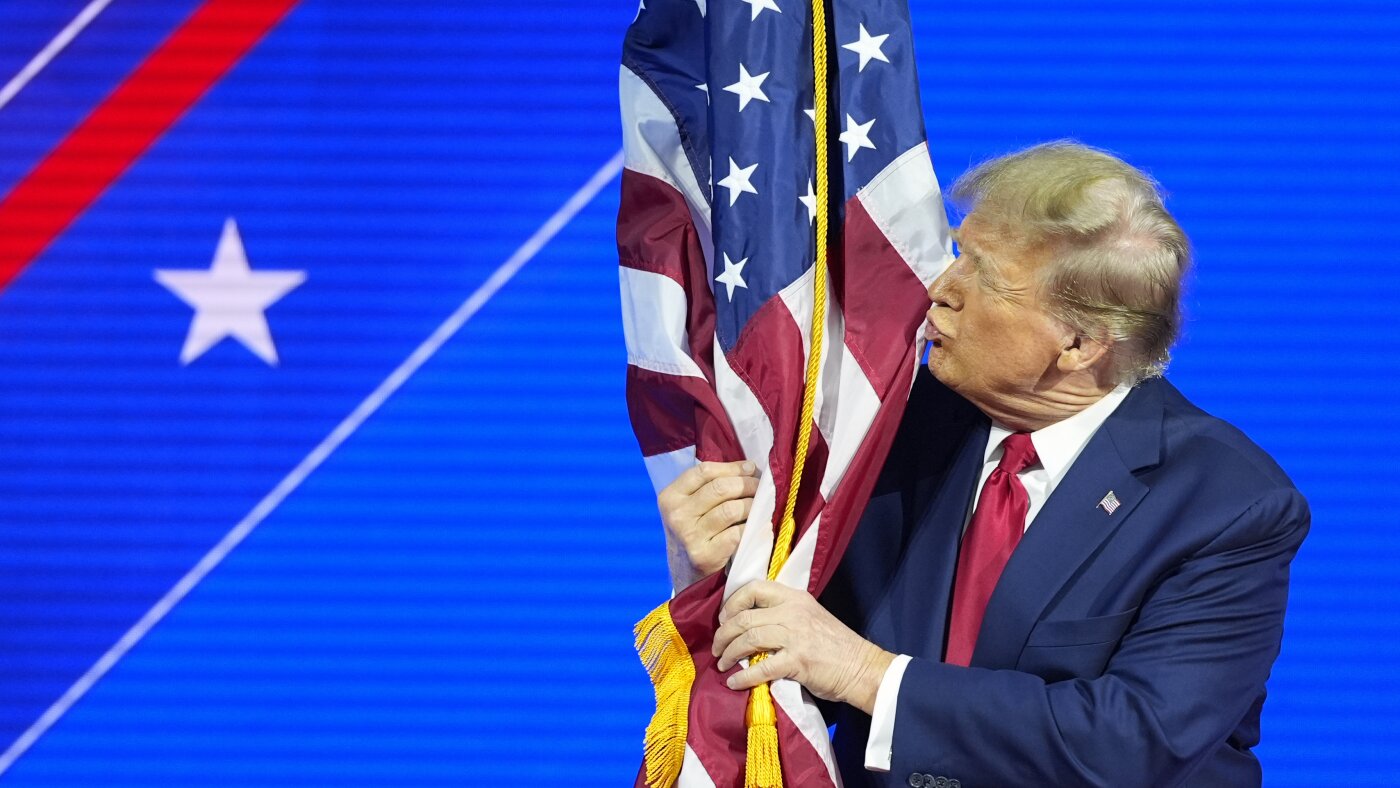
Before he was elected to a second term, former President Donald Trump hugged and kissed the U.S. flag as he spoke at the Conservative Political Action Conference at National Harbor, in Oxon Hill, Md., in 2024.
Alex Brandon/AP
hide caption
toggle caption
Alex Brandon/AP
Three major reports out this month say President Trump has done serious damage to American democracy at remarkable speed since his return to the White House.
An annual report from V-Dem, an institute at Sweden’s University of Gothenburg, concluded democracy had deteriorated so much in the U.S. that it lowered the country’s democracy ranking from 20th to 51st out of 179 countries.
The U.S. landed between Slovakia and Greece.

Meanwhile, Bright Line Watch, which surveys more than 500 U.S. scholars, concluded that the U.S. system now falls nearly midway between liberal democracy and dictatorship. The newest survey comes out next week. Bright Line Watch’s co-directors spoke to NPR exclusively ahead of publication.
Yet another report out Thursday from Freedom House, a Washington, D.C.-based democracy think-tank, said that among free countries, the U.S. joined Bulgaria and Italy in registering the largest declines in political rights and civil liberties last year.
“The developments in the United States are moving towards dictatorship, what the founders wanted to avoid,” said Staffan Lindberg, the V-Dem Institute’s founding director, who spent seven years in the U.S. “It’s the most rapid decline ever in the history of the United States and one of the most rapid in the world.”
V-Dem stands for Varieties of Democracy. More than 4,000 scholars contributed data to the report, which is the largest of its kind.
White House spokeswoman Olivia Wales dismissed V-Dem’s analysis as “a ridiculous claim made by an irrelevant, blatantly biased organization.”
She called Trump a champion for freedom and democracy and the most transparent and accessible president ever.
“His return to the White House saved the legacy media from going out of business,” Wales said.

Trump has rejected criticism that he tries to rule as an autocrat.
“A lot of people are saying maybe we like a dictator,” Trump said to reporters in the Oval Office last August. “I don’t like a dictator. I’m not a dictator.”
Lindberg said V-Dem downgraded America’s rating based on the Trump administration concentrating executive power, overstepping laws, circumventing the Republican-led Congress as well as attacks on the news media and freedom of speech. Lindberg, a political scientist, is struck by the speed with which Trump has acted.
“Under the Trump administration, democracy has been rolled back as much during just one year as it took Modi in India and Erdogan in Turkey 10 years to accomplish, and Orban in Hungary four years,” said Lindberg, referring to Indian Prime Minister Narendra Modi, Turkish President Recep Tayyip Erdogan and Hungarian Prime Minister Viktor Orbán.
All three of those leaders came to power through democratic elections, but scholars say they have since undermined checks and balances on executive power to try to ensure they remain in office.
Trump is a big fan of Orbán’s and has praised him as a “strongman” and a “tough person.” Orbán faces election next month — the first real challenge to his rule in a decade and a half.

President Trump is a big fan of Hungarian Prime Minister Viktor Orbán, pictured at the White House on Nov. 7, 2025. Political scientists view Orbán as an autocratic leader who has chipped away at this country’s system of checks and balances.
Roberto Schmidt/Getty Images
hide caption
toggle caption
Roberto Schmidt/Getty Images
Scholars are alarmed by Trump’s blitz on the U.S. system of governance, but John Carey, a co-director of Bright Line Watch, says the United States’ democracy rating might have slid even further in recent months if not for the courts pushing back.
Carey says autocrats try to co-opt or pressure government institutions that serve as referees but notes that didn’t work last month as the Supreme Court ruled against the president on tariffs.
“One of the things that the tariff decision suggested [is] he has not fully captured that set of referees,” said Carey, a professor of political science at Dartmouth, “and that’s the most important set.”
Brendan Nyhan, a fellow Dartmouth professor and Bright Line co-director, adds that just because Trump has undermined democracy, doesn’t mean the effects are permanent.
“There’s just no question that what we’re seeing is the authoritarian playbook,” said Nyhan, “but there’s no guarantee that Trump will be able to operate this way after the midterms, let alone a successor after 2028.”
Yana Gorokhovskaia, director for strategy and design for Freedom House, says some of Trump’s policies abroad also are undermining the country’s democratic standing overseas.
For instance, the State Department often used to call out election fraud in other countries, but under Trump, it has said it will only comment on foreign elections when the U.S. has a clear and compelling interest.
“What we’re losing is democratic solidarity globally,” Gorokhovskaia said. “We’re no longer emphasizing … a distinction between democracies and autocracies in the world.”
That doesn’t mean the U.S. doesn’t take sides in foreign elections. Just last month, Secretary of State Marco Rubio publicly endorsed Orbán, Hungary’s autocratic leader, for a fifth term.

Halle O’Brien writes during after-school cursive club, held by teacher Sherisse Kenerson, at Holmes Middle School in Alexandria, Va.
Anna Rose Layden for NPR
hide caption
toggle caption
Anna Rose Layden for NPR
Twelve-year-old Sandi Chandee wants to be a doctor when she grows up. But that’s not why she memorized one of the longest medical terms in the English language:
Pneumonoultramicroscopicsilicovolcanoconiosis.
In Sherisse Kenerson’s after-school classroom, Sandi takes out a piece of paper and fills up a whole line to spell the word that describes a type of lung disease. The word allows her to practice cursive — her new favorite method of writing.
When she becomes a doctor, Sandi, who signs her cursive autograph with a heart above the i, is determined to have a perfect signature.
Twelve-year-old Halle O’Brien, Sandi’s cursive partner-in-crime, agrees.
“I prefer writing in cursive,” Halle said.
The pair are proud members of the Holmes Middle School cursive club in Virginia. Cursive has been on the upswing for years now. More than two dozen states now require cursive instruction in schools after the 2010 Common Core standards omitted the skill.
Kenerson, a multilingual teacher at Holmes, started the middle school club when students couldn’t read her writing on the board. They just stared at her blankly, she said.

Conrad Thompson writes during cursive club.
Anna Rose Layden for NPR
hide caption
toggle caption
Anna Rose Layden for NPR
“I realized they didn’t know how to write or read in cursive,” Kenerson said. For an educator who firmly believes that quotes deserve to be written in cursive, and has a new one on her board each month, Kenerson wanted to give students a chance to understand the magic of the loopy writing.
The club exploded in popularity this past winter, with local news stations and the Washington Post crediting it for “keeping cursive alive.” Since then, Kenerson has been racking her brain trying to figure out why it has drawn so much attention.

She has received fan mail from retirees and teachers (written in cursive, of course). She has heard from people in Idaho, Pennsylvania and Florida. She has even had Zoom calls with educators in Oklahoma and Maryland to explain how she runs the club.
“I’m flabbergasted,” Kenerson said. “I’m just going along with the ride.”
She decided that cursive is a way to hold on to the past, and many people are not ready to let it go.

Teacher Sherisse Kenerson has received fan mail from retirees and teachers for starting the club.
Anna Rose Layden for NPR
hide caption
toggle caption
Anna Rose Layden for NPR
Kenerson’s after-school club is a local example of a nationwide trend — cursive handwriting is back in many classrooms across the country. Teachers and legislators credit the resurgence to nostalgia and some evidence of educational benefits. But surprisingly, the curves and swoops are contentious among experts, and some argue that cursive does not add any real value for students, especially in the age of artificial intelligence.
“I have seen no evidence that cursive brings any particular cognitive or learning benefit beyond that brought by hand printing,” wrote Mark Warschauer, a professor of education at the University of California, Irvine, in an email to NPR. He noted that the cognitive benefits of young students writing by hand in general are already well established.
Warschauer, who founded the UC Irvine Digital Learning Lab, opposes teaching cursive in schools because of the “waste of time and effort” when print handwriting, voice-to-text applications, and keyboards are easily accessible to students.
Much of the cursive debate centers around time in the classroom. Should educators spend precious minutes teaching another way to write on paper when technology is so prevalent?
Shawn Datchuk, a professor of special education at the University of Iowa, said the answer does not have to be one or the other. In his college classroom, he sees students increasingly using tablets and a stylus to take notes.
“What that means is that as a country, we likely need to help our students become multi-modal,” Datchuk said. They need to not only be able to handwrite using print, but also use cursive, type, and interact with technology, he said.

Top left: Kenerson demonstrates writing cursive letters on the whiteboard. Right: Kenerson helps a student with their worksheet. Bottom: Sandi Chandee (right) and Halle O’Brien practice their writing during cursive club.
Anna Rose Layden for NPR
hide caption
toggle caption
Anna Rose Layden for NPR
Technology is not a fix-all for students, though, he said.
“One of the dirty secrets behind spell checker and artificial intelligence is that you still need to be able to spell in order to use those well,” Datchuk said.
He and a team of researchers compiled the known studies on cursive teaching. Some studies used antiquated technology like ink wells and quill tips, so they were cut. A few of the others were missing details on how the instruction was implemented. With those caveats, Datchuk said, preliminary evidence shows cursive writing could improve spelling.
Datchuk said the “special sauce” for cursive is that students have to pay closer attention to how letters connect when they write.
Kenerson, the cursive club’s founder, said she’s seen anecdotal evidence that cursive helps students with dyslexia. Sharon Quirk-Silva, a California assemblymember who introduced the cursive bill in the state, said she’s also heard anecdotal evidence that cursive can be therapeutic for students with special needs.
Since Quirk-Silva’s 2023 cursive mandate, she said the reception from constituents has been overwhelmingly positive.
Datchuk, the University of Iowa professor, said he receives a constant stream of emails from people asking about cursive, but his reason for studying the technique was personal — his 8-year-old son, who is reading Harry Potter, still passes his grandmother’s birthday cards to his dad to read.
“That brings up the larger generational divide that’s probably happened not only with my sons, but with kids and young adults across the United States who just never received instruction in cursive,” Datchuk, a former elementary school teacher, said.
Antonio Benavides, an 11-year-old in Kenerson’s cursive club, is an example of that divide. His dad heard about the club and immediately sent Antonio.

Antonio Benavides says his penmanship has improved since joining cursive club.
Anna Rose Layden for NPR
hide caption
toggle caption
Anna Rose Layden for NPR
Now, he sticks his tongue out and stares intently at the loops in front of him. He enjoys practicing the curves, and he said his normally sprawling print penmanship has improved.
“I’m like, ‘Are you kidding me, cursive club, what do I need that for?’” Benavides remembered telling his dad. But now, “Yeah, I like it,” he said.
When there’s a moment of silence as the students practice their i’s and t’s, Antonio whispers, “I love that sound.”
“The sound of a pencil when it’s silent is just so nice,” he explained.
Steve Graham, the Regents Professor at Arizona State University’s College for Teaching and Learning Innovation, argues that despite the media attention, cursive never really went anywhere. Graham, who has authored numerous books about writing, said he has been hearing about the “death of handwriting or the death of cursive” for about 50 years. At one point, his responses to questions from reporters became “snarky,” he said.
“I’d say, ‘Well, damn, I didn’t hear it was buried,’” Graham said. “Can you tell me where? I’d like to visit the grave.”
Graham is ambivalent about whether cursive or print is a more effective tool for students. He said he thinks the fixation on cursive is an adult phenomenon.

Kenerson started the club after she realized students could not read her cursive handwriting on the board.
Anna Rose Layden for NPR
hide caption
toggle caption
Anna Rose Layden for NPR
“I’m often amazed at how much attention it gets,” Graham said. With more studies, Graham said he thinks the differences in benefits between the two types of handwriting will be insignificant. He said what’s more important is spending the time to teach kids to write.
Back in Kenerson’s cursive club, 11-year-old Conrad Thompson said she’s the only student in her history class who can read her teacher’s huge Declaration of Independence printout. It makes her proud.

Conrad Thompson is proud of her cursive skills.
Anna Rose Layden for NPR
hide caption
toggle caption
Anna Rose Layden for NPR
“Hopefully, one day, me and my family will get to go see it in person,” Conrad said.
As for Sandi and Halle, the pair have no doubts about their newfound skill.
“Will you be back next week?” Halle asked Sandi about the after-school club.
“Of course I will,” Sandi responded.

Farmington, Farmington Hills push for revitalization of Grand River

Elderly driver sentenced to probation in West Portal crash that killed family of 4

Dallas Police tweak off-duty job rule after saying man impersonated police

Fire tears through longtime Miami Gardens home of retired teacher

National Park Service removes historic films about mill workers in Lowell

Florida High School Football Rankings: Top 25 teams – Oct. 21

How old is Bo Nix? What to know about Oregon quarterback ahead of 2024 NFL Draft

Cleary's 21 help Le Moyne down Central Connecticut State 69-64 in OT

99th annual Pony Swim held in Virginia

Indiana Members Credit Union announced as new anchor tenant at Bottleworks District

Pritzker pushes prosecutions of Trump officials as part of Dem ‘Project 2029’ agenda

Iran’s Khamenei says enemy ‘defeated’ in written Nowruz message

Gold Trump coin moves forward after Treasury invokes rare authority

Meet the longtime biz partner of Ilhan Omar’s husband as questions swirl over her skyrocketing net worth

‘Nobody can blackmail us’: Leaders excoriate Orbán’s veto
-

 Detroit, MI2 days ago
Drummer Brian Pastoria, longtime Detroit music advocate, dies at 68
-

 Oklahoma6 days ago
Family rallies around Oklahoma father after head-on crash
-

 Nebraska1 week ago
Wildfire forces immediate evacuation order for Farnam residents
-

 Georgia5 days ago
How ICE plans for a detention warehouse pushed a Georgia town to fight back | CNN Politics
-

 Massachusetts1 week ago
Massachusetts community colleges to launch apprenticeship degree programs – The Boston Globe
-

 Alaska6 days ago
Police looking for man considered ‘armed and dangerous’
-

 Colorado1 week ago
‘It’s Not a Penalty’: Bednar Rips Officials For MacKinnon Ejection | Colorado Hockey Now
-

 Southwest1 week ago
Talarico reportedly knew Colbert interview wouldn’t air on TV before he left to film it