Connect with us

News

Elon Musk’s riskiest bet yet: Donald Trump

Published

on

Elon Musk’s riskiest bet yet: Donald Trump

Among the many audacious gambles that mark Elon Musk’s career, few have been bolder than the bet he is now placing on Donald Trump.

From satellites to electric vehicles, brain chips to AI-powered robots, Musk owns a series of businesses that depend heavily on contracts and rules set by the federal government.

Yet in an election that most political analysts believe to be a coin toss, the world’s richest man has tied his reputation and fortune to Trump’s latest quest for the White House.

Speaking earlier this month to Tucker Carlson, the firebrand former Fox TV host, Musk was only half-joking when he mused about Trump: “If he loses, I’m fucked.”

As the election enters its final stage, Musk’s embrace of the Trump campaign is becoming ever tighter.

Advertisement

It was revealed this week that Musk has donated at least $75mn to his pro-Trump group, America Pac, which has already spent over $118mn on efforts to support the campaign including ads, yard signs and a door-knocking operation.

When Trump held a rally two weeks ago in Butler, Pennsylvania — the site of the July assassination attempt on him — Musk was the surprise guest, bouncing on to the stage like an excited child.

Musk has used X, the social network he owns, to pump out pro-Trump content, including some of the most lurid conspiracy theories that have taken hold on the right.

Musk told a campaign event in the swing state of Pennsylvania this week that the biggest reason for backing Trump was the need for ‘sensible regulations’ © Anna Moneymaker/Getty Images
View between the heads of spectators of Donald Trump as he speaks at a rally
Trump, who until recently was highly sceptical of electric vehicles, speaks at a rally in Butler, Pennsylvania where Musk was his surprise guest © Jen Golbeck/SOPA Images/Reuters

On Thursday, Musk was back in Pennsylvania, the most important swing state in the election, to make the case for Trump to voters on his own. During the hour-long rally, he sported a gold Make America Great Again hat and gave some hints at the business rationale for his all-in support of Trump — a politician who until recently was highly sceptical of electric vehicles.

Musk said the biggest reason for backing Trump was the need for “sensible regulations”, claiming that “SpaceX can build a giant rocket faster than the licence can be processed by the government, which is insane.” He added: “If the current trend of strangulation by overregulation is not turned around, we won’t get to Mars.”

The owner of Tesla, SpaceX, xAI and X has aspirations to shape the future of humanity — a Neuralink chip in the brain, a robot in the home, a driverless car to get to work, a rocket to colonise Mars. Musk’s bet appears to be that if Trump wins, he would gain substantial influence over how the government treats his companies.

Advertisement

The gamble would pay off if SpaceX and its Starlink satellites can earn more contracts from the US national security apparatus or if Tesla could win over Republicans sceptical of electric vehicles — and perhaps limit probes by regulators into the safety of its self-driving technology. And under Trump, X would be much less likely to clash with the administration over Musk’s absolute conception of “free speech”.

Trump has promised if elected that Musk would lead a “department of government efficiency”.

For Musk critics, the embrace of Trump is an extension of his long-running tussles with the public bodies whose decisions are central to the innovative industries in which Musk operates.

“Regulators have been a thorn in Tesla’s side for years,” says Dan O’Dowd, founder of a software company who is also a critic of Tesla’s efforts in driverless vehicles. “Musk believes that he is above the law.”


Musk and Trump used to be polar opposites in political terms. While the former president has often described climate change as a “hoax”, Musk used to boast that the mission of Tesla was “to help reduce risk of catastrophic climate change”.

Advertisement

The billionaire entrepreneur voted for Joe Biden, Hillary Clinton and Barack Obama in recent elections. Even in 2022, he was of the view that it was “time for Trump to hang up his hat and sail into the sunset”.

But during the past few months, Musk has not only become Trump’s most influential supporter, but has also embraced some of his most explosive rhetoric — including the claim that vice-president Kamala Harris would make the US a one-party state by turning illegal immigrants into Democrats. “If Trump doesn’t win, this is the last election,” Musk said on Thursday.

Musk’s shift began during the pandemic. He chose to get the Covid-19 jab but was a sceptic of government vaccine requirements for federal employees and contractors. Musk also became increasingly opposed to “woke” culture on the left and had a public argument with his transgender daughter.

Elon Musk gives a small bow of the head as Donald Trump congratulates him after the launch of a SpaceX Falcon 9 rocket and Crew Dragon spacecraft
Musk acknowledges Trump’s congratulations after the launch of a SpaceX rocket and crewed spacecraft in 2020. Musk voted for Joe Biden in that year’s US elections © Jonathan Ernst/Reuters

Trevor Traina, a Trump donor who served as the ex-president’s US ambassador to Austria, suggests Musk is participating directly in politics for personal rather than commercial reasons. “As the world’s richest man, there is nothing Elon needs. He is just getting involved,” Traina says.

Musk has also had fights with the Biden administration. During Biden’s first year in office, the Tesla CEO, who has a long history of opposition to trade unions, felt snubbed when he was not invited to a White House event featuring US electric-vehicle manufacturers and the United Auto Workers union.

At the event, Biden praised Mary Barra, CEO of General Motors — which sells fewer than a fifth as many EVs as Tesla — telling her, “You electrified the entire automobile industry. I’m serious. You led, and it matters.”

Advertisement

“He’s never forgotten it,” says a former senior Tesla executive.


For Tesla, the risk of Musk’s election intervention is that it alienates the company’s natural customers. Only 13 per cent of Republicans say they are likely to seriously consider buying an electric vehicle, according to Pew Research, compared with 45 per cent of Democrats.

Trump himself has not been an ally of Tesla’s; he began a sentence this week on Fox saying, “The problem with electric vehicles” before cutting himself off, noting that “Elon Musk is a very good friend of mine.”

“It’s a high-risk, high-reward strategy. I suppose if Trump wins, he looks like a genius. If Trump loses, it doesn’t look so clever,” says Andrew Palmer, former chief executive of Aston Martin. “Whilst I think most people admire what he does, I think there is a risk that it would stimulate people to look for alternatives to Tesla.”

However some of Musk’s Silicon Valley rivals speculate that his goals around Tesla are longer term.

Advertisement

They say that Musk is aware that Tesla’s core business is increasingly under threat from cheaper Chinese EVs and rapidly advancing battery technology. The company has not released a new mass market product since the Model Y in 2020 and it remains unclear when a planned more affordable $25,000 vehicle will be launched.

Instead of releasing new cars — sales of which still account for four-fifths of Tesla’s revenue — Musk has pivoted the company to autonomous driving, robotaxis and AI-powered humanoid robots called Optimus.

A Tesla Optimus Robot in a glass case
Tesla’s Optimus robot at the Paris Auto Show this week. Musk’s aspirations to shape the future of humanity include a robot in the home © Benoit Tessier/Reuters
Aerial View of Tesla’s robotaxi
A golden cybercab wowed Musk’s fans at the ‘We, Robot’ event in Los Angeles earlier this month, but scant details underwhelmed investors © Tesla/Handout/Reuters

The billionaire laid out his sci-fi vision of the future at a splashy “We, Robot” launch at a film studio lot in Los Angeles last week. The dancing robots and golden cybercab wowed his fans, but scant details underwhelmed investors. The stock fell 9 per cent.

Using standard industry valuation multiples, Drew Dickson, founder of Albert Bridge Capital, estimates that Tesla’s auto business may be worth between $70bn and $100bn. By his calculations, that means the remaining $650bn of its market value — and as much as $90bn of Musk’s personal wealth — is largely based on investor optimism about its as-yet unproven technologies, all of which face significant regulatory hurdles before coming to market.

“The entire presentation was done on a movie set, so it was tough for observers to know what was real or not,” says Dickson, who has a short position in Tesla. “One thing Elon is extremely good at: distracting people from an underlying business that has a lot of questions.”

If Trump wins, Musk might hope that Tesla gets a more sympathetic hearing from the federal government. At the moment, the National Highway Traffic Safety Administration, Department of Justice and Securities and Exchange Commission are all investigating Tesla’s claims about its driver-assistance systems.

Advertisement

NHTSA said on Friday that it has opened a new probe into Tesla after a vehicle with its “full self-driving” technology fatally struck a pedestrian.

Musk promised attendees that self-driving vehicles would be available in Texas and California from next year and robocabs on the road by 2027, but both would require Tesla to secure at least the so-called “Level 4, High Automation” classification and permits from state regulators at a pace far faster than any rivals have achieved.

The process took Google’s Waymo years and required its taxis to be equipped with a wider array of expensive sensors, including lidar laser-based object detection. Tesla’s full self-driving technology relies solely on cameras and is currently ranked as advanced level 2, which means drivers have to keep their hands on the wheel.

“I tend to be a little optimistic with timeframes,” Musk admitted at the event.


Among the Musk companies, SpaceX could benefit most from a close relationship with a US president. Analysts at Morgan Stanley forecast that the company’s revenues could triple to $63bn by 2030, driven to a large degree by Starlink, the satellite internet business which operates a network of 6,000 low-orbit satellites. SpaceX has already surpassed 100 launches this year.

Advertisement

In 2014, SpaceX sued the US Air Force to get into the launch business and has since become Nasa’s indispensable partner in supplying, and soon retiring, the International Space Station and getting astronauts to the moon.

$63bnSome forecasts for SpaceX revenues in 2030, triple what they are now

Although SpaceX has won multibillion-dollar contracts under Biden, it has also sparred with a multitude of federal and state authorities that Musk accuses of stifling innovation with red tape and rules.

Those include the Federal Aviation Administration, National Labor Relations Board and US Fish and Wildlife Service over alleged permitting, labour and environmental violations. Musk has called on the FAA chief to resign, sued the NLRB and mocked regulators claiming he needs a fish licence to launch a rocket.

Musk has also clashed with the Federal Communications Commission. The company needs FCC approval to lower the orbit of its Gen2 satellites even further and ultimately wants to increase their number to 29,988 from the currently permitted 7,500. Musk sharply criticised the FCC for revoking in 2022 a near-$900mn Starlink deal to provide rural broadband after questioning its promises on speed and reliability.

Advertisement

As Musk has intensified his support for Trump, Harris has in turn gone on the attack against the billionaire, using his name in her fundraising pleas.

Her running mate, Minnesota governor Tim Walz, told a rally with Michigan union workers that Republicans only care “about their billionaire friends like Elon Musk”.

“This is the guy that wants to be our economic tsar,” asked Walz. “The guy who wants to fire workers and bust unions? A guy who wants to take auto manufacturing to Mexico and source it with Chinese-made parts? You talk to your neighbours and friends and tell me if anybody in Michigan thinks that’s a good idea.”

Onlookers watch from nearby sand dunes as SpaceX’s Starship rocket is prepared for a test launch
Onlookers watch as SpaceX’s Starship rocket is prepared for a test launch in Texas earlier this month. California has blocked the company from increasing the number of its launches there © Eric Gay/AP

A dispute with the California coastal commission last week hinted at how Musk might respond to a Trump loss: by claiming political motives for any decisions that go against his companies.

The California panel voted to deny a request from the US Space Force to increase the number of launches in the state using SpaceX’s Falcon 9 rockets. One member of the panel also criticised Musk for “hopping about the country spewing . . . political falsehoods” while clamouring for more lucrative government contracts.

In response, SpaceX is suing the regulator and accused it of seeking to “punish a company for the political views and statements of its largest shareholder and CEO”.

Advertisement

Traina, the Trump donor, believes such battles would also continue in a second Trump term. Musk’s “first impulse” as the head of the government efficiency department “would be to eliminate the California Coastal Commission”. But he adds: “I doubt that is possible.”

Musk insists he is only acting out of concern for the country. “I’m politically active now,” he said at the rally on Thursday, “because I think the future of America and the future of civilisation is at stake.”

News

Bill Clinton to testify before House committee investigating Epstein links

Published

on

Bill Clinton to testify before House committee investigating Epstein links

Former president Bill Clinton is scheduled to give deposition Friday to a congressional committee investigating his links to Jeffrey Epstein, one day after Hillary Clinton testified before the committee and called the proceedings “partisan political theatre” and “an insult to the American people”.

During remarks before the House oversight committee, Hillary Clinton, the former secretary of state, insisted on Thursday that she had never met Epstein.

The former Democratic president, however, flew on Epstein’s private jet several times in the early 2000s but said he never visited his island.

Clinton, who engaged in an extramarital affair while president and has been accused of sexual misconduct by three women, also appears in a photo from the recently released files, in a hot tub with Epstein and a woman whose identity is redacted.

Clinton has denied the sexual misconduct claims and was not charged with any crimes. He also has not been accused of any wrongdoing connected to Epstein.

Advertisement

Epstein visited the White House at least 17 times during the early years of Clinton’s presidency, according to White House visitor records cited in news reports. Clinton said he cut ties with him around 2005, before the disgraced financier, who died from suicide in 2019, pleaded guilty to solicitation of a minor in Florida.

The House committee subpoenaed the Clintons in August. They initially refused to testify but agreed after Republicans threatened to hold them in contempt.

The Clintons asked for their depositions to be held publicly, with the former president stating that to do so behind closed doors would amount to a “kangaroo court”.

“Let’s stop the games + do this the right way: in a public hearing,” Clinton said on X earlier this month.

The committee’s chair, James Comer, did not grant their request, and the proceedings will be conducted behind closed doors with video to be released later.

Advertisement

On Thursday, Hillary Clinton’s proceedings were briefly halted after representative Lauren Boebert leaked an image of Clinton testifying.

During the full day deposition, Clinton said she had no information about Epstein and did not recall ever meeting him.

Before the deposition, Comer said it would be a long interview and that one with Bill Clinton would be “even longer”.

Continue Reading

News

Read Judge Schiltz’s Order

Published

on

Read Judge Schiltz’s Order

CASE 0:26-cv-00107-PJS-DLM

Doc. 12-1 Filed 02/26/26

Page 5 of 17

and to file a status update by 11:00 am on January 20. ECF No. 5. Respondents never provided a bond hearing and did not release Petitioner until January 21, ECF Nos. 10, 12, after failing to file an update, ECF No. 9. Further, Respondents released Petitioner subject to conditions despite the Court’s release order not providing for conditions. ECF Nos. 5, 12–13.

Abdi W. v. Trump, et al., Case No. 26-CV-00208 (KMM/SGE)

On January 21, 2026, the Court ordered Respondents, within 3 days, to either (a) complete Petitioner’s inspection and examination and file a notice confirming completion, or (b) release Petitioner immediately in Minnesota and confirm the date, time, and location of release. ECF No. 7. No notice was ever filed. The Court emailed counsel on January 27, 2026, at 10:39 am. No response was provided.

Adriana M.Y.M. v. David Easterwood, et al., Case No. 26-CV-213 (JWB/JFD)

On January 24, 2026, the Court ordered immediate release in Minnesota and ordered Respondents to confirm the time, date, and location of release, or anticipated release, within 48 hours. ECF No. 12. Respondent was not released until January 30, and Respondents never disclosed the time of release, instead describing it as “early this morning.” ECF No. 16.

Estefany J.S. v. Bondi, Case No. 26-CV-216 (JWB/SGE)

On January 13, 2026, at 10:59 am, the Court ordered Respondents to file a letter by 4:00 pm confirming Petitioner’s current location. ECF No. 8. After receiving no response, the Court ordered Respondents, at 5:11 pm, to immediately confirm Petitioner’s location and, by noon on January 14, file a memorandum explaining their failure to comply with the initial order. ECF No. 9. Respondents did not file the memorandum, requiring the Court to issue another order. ECF No. 12. On January 15, the Court ordered immediate release in Minnesota and required Respondents to confirm the time, date, and location of release within 48 hours. ECF No. 18. On January 20, having received no confirmation, the Court ordered Respondents to comply immediately. ECF No. 21. Respondents informed the Court that Petitioner was released in Minnesota on January 17, but did not specify the time. ECF No. 22.

5

Continue Reading

News

Chicagoans pay respects to Jesse Jackson as cross-country memorial services begin

Published

on

Chicagoans pay respects to Jesse Jackson as cross-country memorial services begin

James Hickman holds a photo montage of the late Rev. Jesse Jackson before a public visitation at Rainbow/PUSH Coalition in Chicago on Thursday.

Nam Y. Huh/AP


hide caption

toggle caption

Advertisement

Nam Y. Huh/AP

CHICAGO — A line of mourners streamed through a Chicago auditorium Thursday to pay final respects to the Rev. Jesse Jackson Sr. as cross-country memorial services began in the city the late civil rights leader called home.

The protege of the Rev. Martin Luther King Jr. and two-time presidential candidate will lie in repose for two days at the headquarters of the Rainbow PUSH Coalition before events in Washington, D.C., and South Carolina, where he was born.

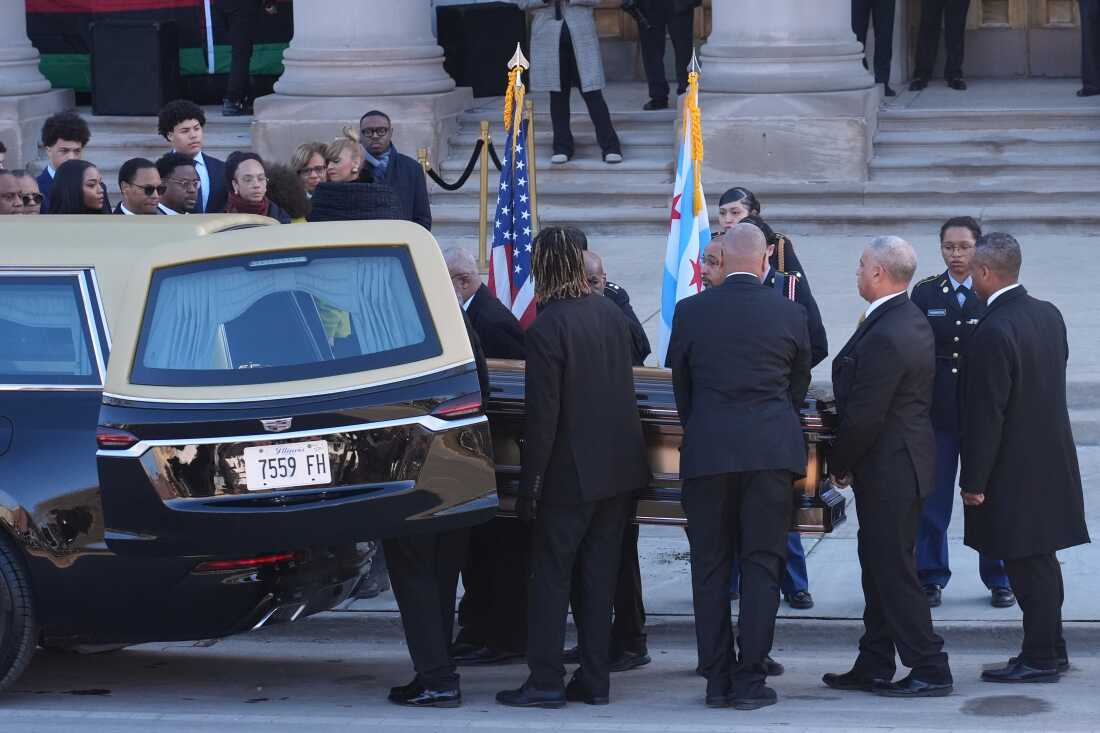
Family members wiped away tears as the casket was brought into the stately brick building. Flowers lined the sidewalks where people waiting to enter watched a large screen playing video excerpts of Jackson’s notable speeches. Some raised their fists in solidarity.

Advertisement
The casket with the Rev. Jesse Jackson arrives before a public visitation at Rainbow/PUSH Coalition in Chicago on Thursday.

The casket with the Rev. Jesse Jackson arrives before a public visitation at Rainbow/PUSH Coalition in Chicago on Thursday.

Nam Y. Huh/AP


hide caption

toggle caption

Nam Y. Huh/AP

Advertisement

Inside, Jackson’s children, Chicago Mayor Brandon Johnson and the Rev. Al Sharpton were among those who stood by the open casket to shake hands and hug those coming to view the body of Jackson, dressed in a suit and blue shirt and tie.

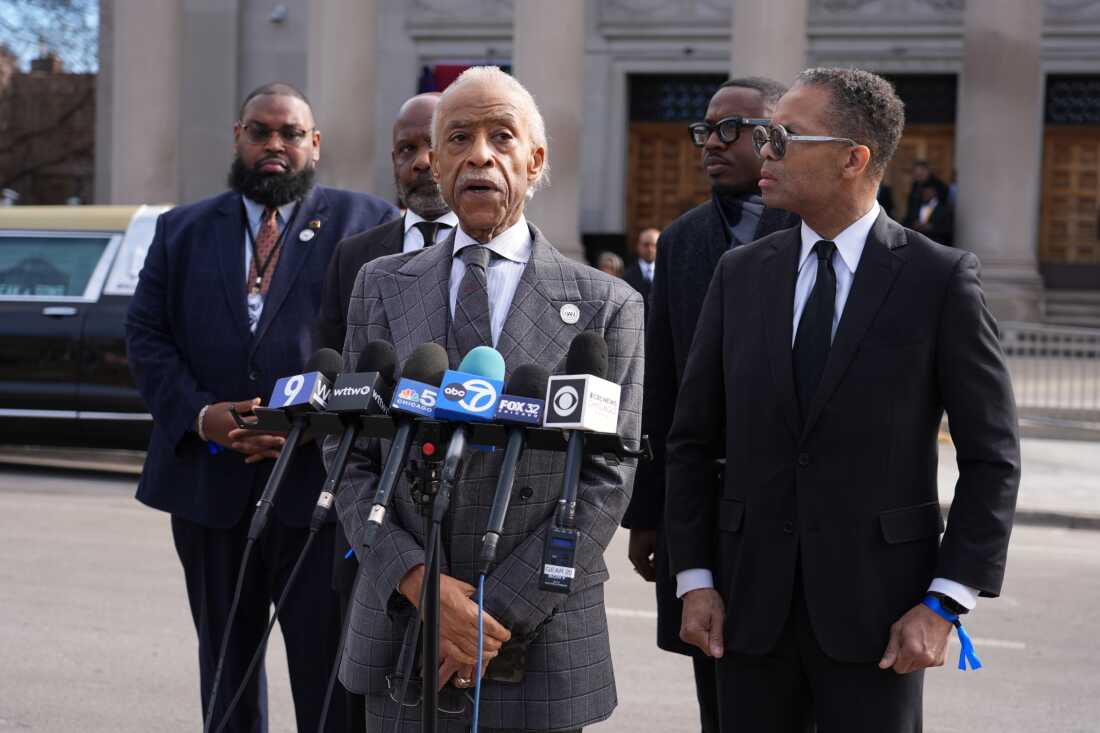
“The challenge for us is that we’ve got to make sure that all he lived for was not in vain,” Sharpton told reporters. “Dr. King’s dream and Jesse Jackson’s mission now falls on our shoulders. We’ve got to stand up and keep it going.”

The Rev. Al Sharpton speaks as Jesse Jackson Jr. listens after the public visitation for the Rev. Jesse Jackson at Rainbow/PUSH Coalition in Chicago on Thursday.

The Rev. Al Sharpton speaks as Jesse Jackson Jr. listens after the public visitation for the Rev. Jesse Jackson at Rainbow/PUSH Coalition in Chicago on Thursday.

Nam Y. Huh/AP


hide caption

Advertisement

toggle caption

Nam Y. Huh/AP

Jackson died last week at age 84 after battling a rare neurological disorder that affected his mobility and ability to speak in his later years.

Advertisement

Remembrances have already poured in from around the globe, and several U.S. states, including Minnesota, Iowa and North Carolina, are flying flags at half-staff in his honor.

But perhaps nowhere has his death been felt as strongly as in the nation’s third-largest city, where Jackson lived for decades and raised his six children, including a son who is a congressman.

Bouquets have been left outside the family’s Tudor-style home on the city’s South Side for days. Public schools have offered condolences, and city trains have used digital screens to display Jackson’s portrait and his well-known mantra, “I am Somebody!”

People wait to enter the security checkpoint for the public visitation for the Rev. Jesse Jackson at Rainbow/PUSH Coalition in Chicago on Thursday.

People wait to enter the security checkpoint for the public visitation for the Rev. Jesse Jackson at Rainbow/PUSH Coalition in Chicago on Thursday.

Nam Y. Huh/AP


hide caption

Advertisement

toggle caption

Nam Y. Huh/AP

His causes, both in the United States and abroad, were countless: Advocating for the poor and underrepresented on issues including voting rights, job opportunities, education and health care. He scored diplomatic victories with world leaders, and through his Rainbow PUSH Coalition, he channeled cries for Black pride and self-determination into corporate boardrooms, pressuring executives to make America a more open and equitable society.

Advertisement

“We honor him, and his hard-earned legacy as a freedom fighter, philosopher, and faithful shepherd of his family and community here in Chicago,” the mayor said in a statement.

Next week, Jackson will lie in honor at the South Carolina Statehouse, followed by public services. According to Rainbow PUSH’s agenda, Gov. Henry McMaster is expected to deliver remarks; however, the governor’s office said Thursday that his participation wasn’t yet confirmed. Jackson spent his childhood and started his activism in South Carolina.

Details on services in Washington have not yet been made public. However, he will not lie in honor at the United States Capitol rotunda after a request for the commemoration was denied by the House Speaker Mike Johnson’s office.

The two weeks of events will wrap up next week with a large celebration of life gathering at a Chicago megachurch and finally, homegoing services at the headquarters of the Rainbow PUSH Coalition.

Family members said the services will be open to all.

Advertisement

“Our family is overwhelmed and overjoyed by the amazing amount of support being offered by common, ordinary people who our father’s life has come into contact with,” his eldest son, Jesse Jackson Jr., said before the services began. “This is a unique opportunity to lay down some of the political rhetoric and to lay down some of the division that deeply divides our country and to reflect upon a man who brought people together.”

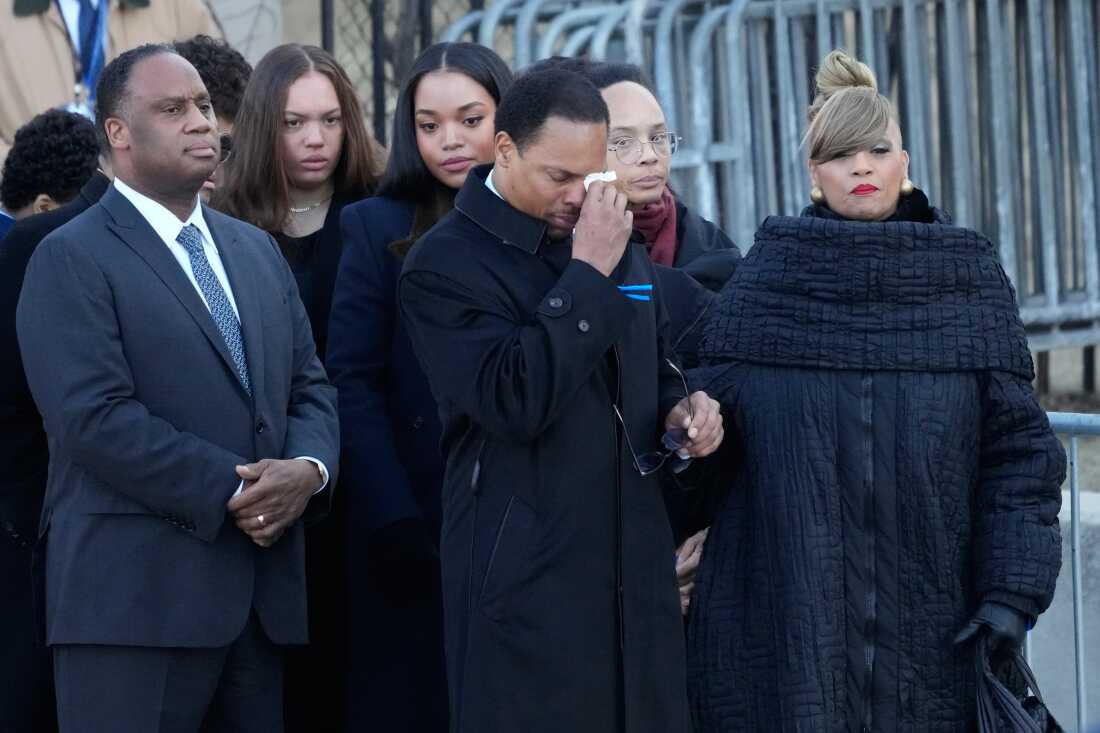
The family of the Rev. Jesse Jackson arrives as Yusep Jackson wipes his eyes before public visitation at Rainbow/PUSH Coalition in Chicago on Thursday.

The family of the Rev. Jesse Jackson arrives as Yusep Jackson wipes his eyes before public visitation at Rainbow/PUSH Coalition in Chicago on Thursday.

Nam Y. Huh/AP


hide caption

toggle caption

Advertisement

Nam Y. Huh/AP

The services included prayers from some of the city’s most well-known religious leaders, including Chicago Cardinal Blase Cupich. Mourners of all ages — from toddlers in strollers to elderly people in wheelchairs — came to pay respects.

Video clips of his appearances at news conferences, the campaign trail and even “Sesame Street” also played inside the auditorium.

Claudette Redic, a retiree who lives in Chicago, said her family has respected Jackson, from backing his presidential ambitions to her son getting a scholarship from a program Jackson championed.

Advertisement

“We have generations of support,” she said. “I’m hoping we continue.”

Continue Reading

Trending