People participate in a protest and noise demonstration calling for an end to federal immigration enforcement operations in the city, Friday, Jan. 9, 2026, in Minneapolis.
John Locher/AP
hide caption
toggle caption
John Locher/AP
MINNEAPOLIS — A Minnesota prosecutor on Friday called on the public to share with investigators any recordings and evidence connected to the fatal shooting of Renee Good as a new video emerged showing the final moments of her encounter with an immigration officer.
The Minneapolis killing and a separate shooting in Portland, Oregon, a day later by the Border Patrol have set off protests in multiple cities and denunciations of immigration enforcement tactics by the U.S. government. The Trump administration has defended the officer who shot Good in her car, saying he was protecting himself and fellow agents.
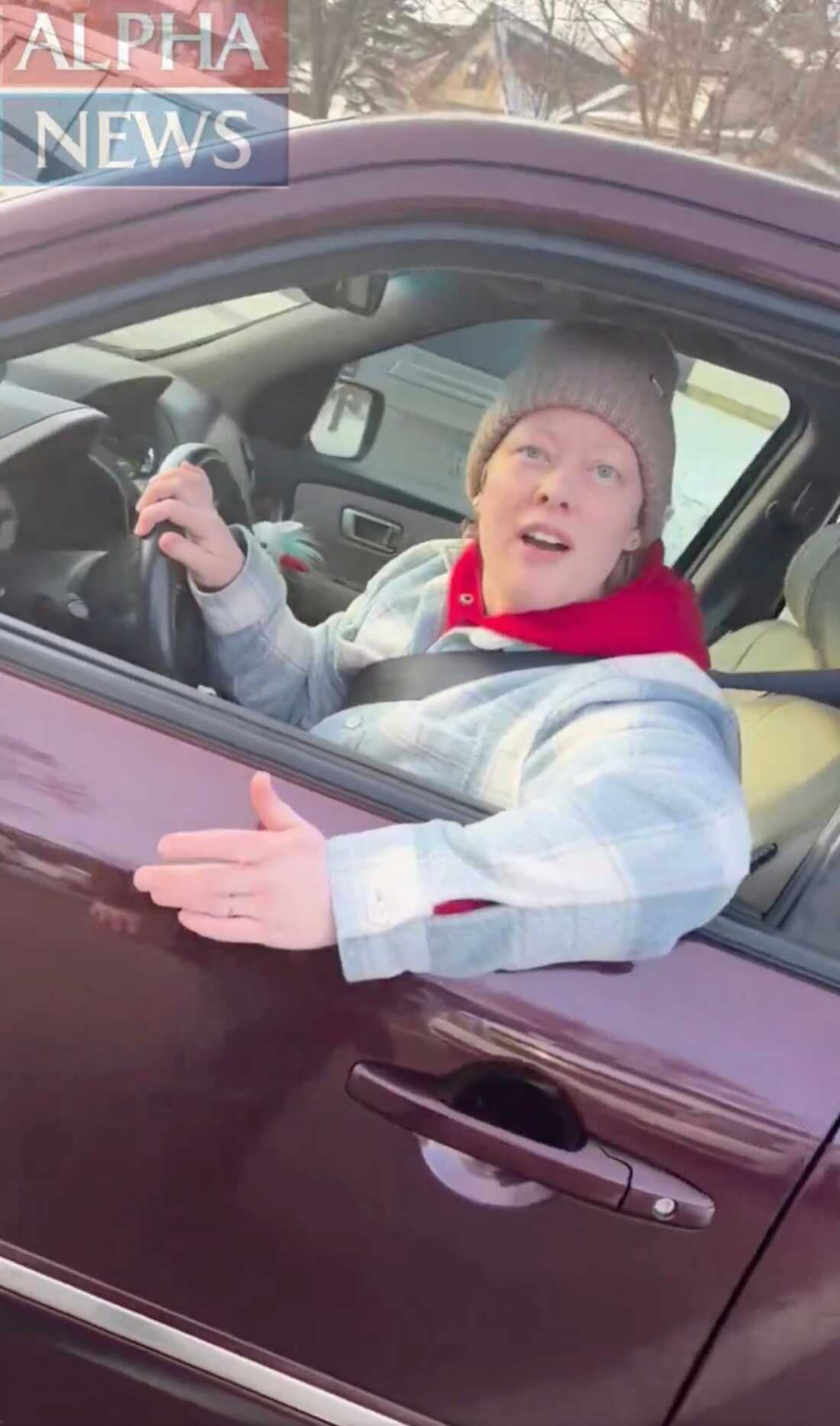
The reaction to the shooting has largely been focused on witness cellphone video of the encounter. A new, 47-second video that was published online by a Minnesota-based conservative news site, Alpha News, and later reposted on social media by the Department of Homeland Security shows the shooting from the perspective of ICE officer Jonathan Ross, who fired the shots.
This image from video made by Immigration and Customs Enforcement officer Jonathan Ross via Alpha News shows Renee Good in her vehicle in Minneapolis on Wednesday, Jan. 7, 2026.
Jonathan Ross/AP/ICE
hide caption
toggle caption
Jonathan Ross/AP/ICE
Sirens blaring in the background, he approaches and circles Good’s vehicle in the middle of the road while apparently filming on his cellphone. At the same time, Good’s wife also was recording the encounter and can be seen walking around the vehicle and approaching the officer. A series of exchanges occurred:
“That’s fine, I’m not mad at you,” Good says as the officer passes by her door. She has one hand on the steering wheel and the other outside the open driver side window.
“U.S. citizen, former f—ing veteran,” says her wife, standing outside the passenger side of the SUV holding up her phone. “You wanna come at us, you wanna come at us, I say go get yourself some lunch big boy.”
Other officers are approaching the driver’s side of the car at about the same time and one says: “Get out of the car, get out of the f—ing car.” Ross is now at the front driver side of the vehicle. Good reverses briefly, then turns the steering wheel toward the passenger side as she drives ahead and Ross opens fire.
The camera becomes unsteady and points toward the sky and then returns to the street view showing Good’s SUV careening away.
“F—ing b—,” someone at the scene says.
A crashing sound is heard as Good’s vehicle smashes into others parked on the street.
Federal agencies have encouraged officers to document encounters in which people may attempt to interfere with enforcement actions, but policing experts have cautioned that recording on a handheld device can complicate already volatile situations by occupying an officer’s hands and narrowing focus at moments when rapid decision-making is required.
Under an ICE policy directive, officers and agents are expected to activate body-worn cameras at the start of enforcement activities and to record throughout interactions, and footage must be kept for review in serious incidents such as deaths or use-of-force cases. The Department of Homeland Security has not responded to questions about whether the officer who opened fire or any of the others who were on the scene were wearing body cameras.
Homeland Security says video shows self-defense
Vice President JD Vance and Homeland Security spokesperson Tricia McLaughlin said in posts on X that the new video backs their contention that the officer fired in self-defense.
“Many of you have been told this law enforcement officer wasn’t hit by a car, wasn’t being harassed, and murdered an innocent woman,” Vance said. “The reality is that his life was endangered and he fired in self defense.”
Minneapolis Mayor Jacob Frey has said any self-defense argument is “garbage.”
Policing experts said the video didn’t change their thoughts on the use-of-force but did raise additional questions about the officer’s training.
“Now that we can see he’s holding a gun in one hand and a cellphone in the other filming, I want to see the officer training that permits that,” said Geoff Alpert, a criminology professor at the University of South Carolina.
The video demonstrates that the officers didn’t perceive Good to be a threat, said John P. Gross, a professor at the University of Wisconsin Law School who has written extensively about officers shooting at moving vehicles.
“If you are an officer who views this woman as a threat, you don’t have one hand on a cellphone. You don’t walk around this supposed weapon, casually filming,” Gross said.
Ross, 43, is an Iraq War veteran who has served in the Border Patrol and ICE for nearly two decades. He was injured last year when he was dragged by a driver fleeing an immigration arrest.
Attempts to reach Ross at phone numbers and email addresses associated with him were not successful.
Prosecutor asks for video and evidence
Meanwhile, Hennepin County Attorney Mary Moriarty said that although her office has collaborated effectively with the FBI in past cases, she is concerned by the Trump administration’s decision to bar state and local agencies from playing any role in the investigation into Good’s killing.
She also said the officer who shot Good in the head does not have complete legal immunity, as Vance declared.
“We do have jurisdiction to make this decision with what happened in this case,” Moriarty said at a news conference. “It does not matter that it was a federal law enforcement agent.”
Moriarty said her office would post a link for the public to submit footage of the shooting, even though she acknowledged that she wasn’t sure what legal outcome submissions might produce.
Good’s wife, Becca Good, released a statement to Minnesota Public Radio on Friday saying, “kindness radiated out of her.”
“On Wednesday, January 7th, we stopped to support our neighbors. We had whistles. They had guns,” Becca Good said.
“I am now left to raise our son and to continue teaching him, as Renee believed, that there are people building a better world for him,” she wrote.
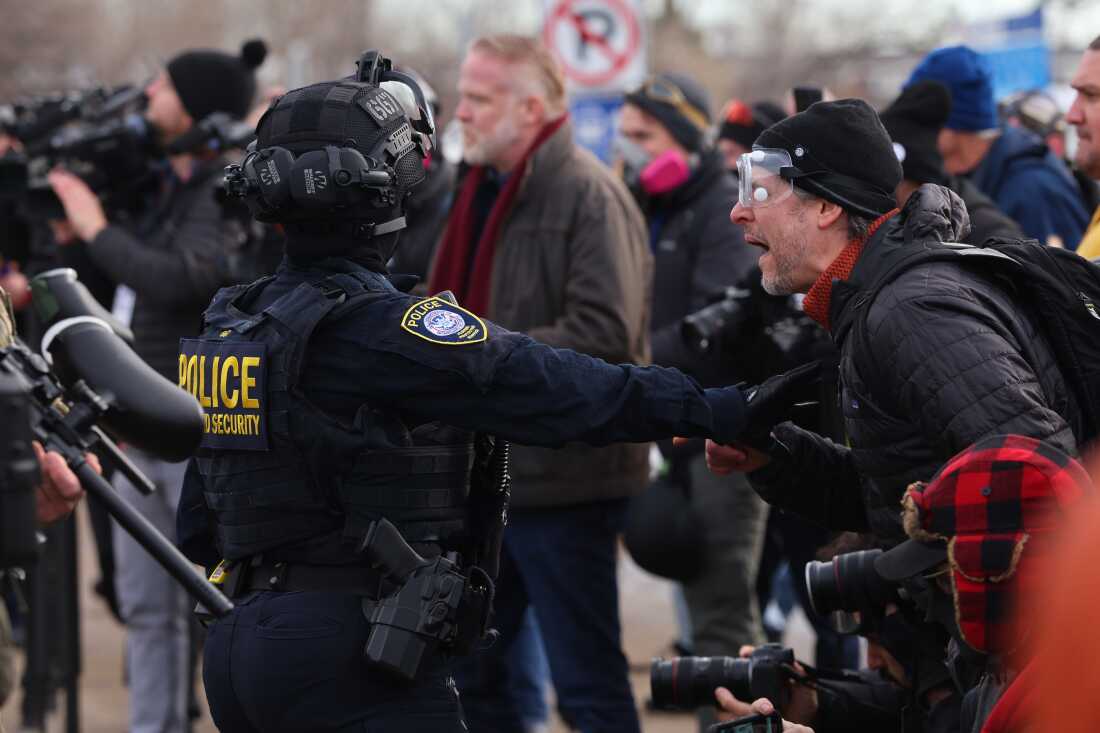
Protesters confront law enforcement outside the Bishop Henry Whipple Federal Building in Minneapolis, Friday, Jan. 9, 2026.
Adam Bettcher/AP
hide caption
toggle caption
Adam Bettcher/AP
The reaction to Good’s shooting was immediate in the city where police killed George Floyd in 2020, with hundreds of protesters converging on the shooting scene and the school district canceling classes for the rest of the week as a precaution and offering an online option through Feb. 12.
On Friday, protesters were outside a federal facility serving as a hub for the immigration crackdown that began Tuesday in Minneapolis and St. Paul. That evening, hundreds protested and marched outside two hotels in downtown Minneapolis where immigration enforcement agents were supposed to be staying. Some people were seen breaking or spray painting windows and state law enforcement officers wearing helmets and holding batons ordered the remaining group of fewer than 100 people to leave late Friday.
Shooting in Portland
The Portland shooting happened outside a hospital Thursday. A federal border officer shot and wounded a man and woman in a vehicle, identified by the Department of Homeland Security as Venezuela nationals Luis David Nico Moncada and Yorlenys Betzabeth Zambrano-Contreras. Police said they were in stable condition Friday after surgery, with DHS saying Nico Moncada was taken into FBI custody
DHS defended the actions of its officers in Portland, saying the shooting occurred after the driver with alleged gang ties tried to “weaponize” his vehicle to hit them. It said no officers were injured.
Portland Police Chief Bob Day confirmed that the two people shot had “some nexus” to Tren de Aragua, a Venezuelan gang. Day said they came to the attention of police during an investigation of a July shooting believed to have been carried out by gang members, but they were not identified as suspects.
The chief said any gang affiliation did not necessarily justify the shooting by U.S. Border Patrol. The Oregon Department of Justice said it would investigate.
On Friday evening, hundreds of protesters marched to the ICE building in Portland.
The biggest crackdown yet
The Minneapolis shooting happened on the second day of the immigration crackdown in the Twin Cities, which Homeland Security said is the biggest immigration enforcement operation ever. More than 2,000 officers are taking part and Homeland Security Secretary Kristi Noem said they have made more than 1,500 arrests.
The government is also shifting immigration officers to Minneapolis from sweeps in Louisiana, according to documents obtained by The Associated Press. This represents a pivot, as the Louisiana crackdown that began in December had been expected to last into February.
Good’s death — at least the fifth tied to immigration sweeps since President Donald Trump took office — has resonated far beyond Minneapolis. More protests are planned for this weekend, according to Indivisible, a group formed to resist the Trump administration.