News
Closing arguments for Trump's trial have been made. What now? : Consider This from NPR


Former U.S. President Donald Trump speaks to the media as he arrives for his hush money trial at Manhattan Criminal Court on May 28, 2024 in New York City.
Pool/Getty Images
hide caption
toggle caption
Pool/Getty Images

Former U.S. President Donald Trump speaks to the media as he arrives for his hush money trial at Manhattan Criminal Court on May 28, 2024 in New York City.
Pool/Getty Images
Nearly two dozen witnesses and 21 days of court later, Donald Trump’s New York hush money trial is coming to a close.
Twelve New Yorkers have been listening to witnesses like adult film actor Stormy Daniels and Trump’s former fixer Michael Cohen.
Today, those jurors heard closing arguments, first from the defense, and then the prosecution. Now, they have to determine whether Trump falsified business records to cover up an alleged affair with Daniels ahead of the 2016 presidential election.
What final impressions did the closing arguments leave, and what could that mean for Donald Trump?
For sponsor-free episodes of Consider This, sign up for Consider This+ via Apple Podcasts or at plus.npr.org.
Email us at considerthis@npr.org.
This episode was produced by Jonaki Mehta. It was edited by Courtney Dorning.Our executive producer is Sami Yenigun.



Former president Bill Clinton is scheduled to give deposition Friday to a congressional committee investigating his links to Jeffrey Epstein, one day after Hillary Clinton testified before the committee and called the proceedings “partisan political theatre” and “an insult to the American people”.
During remarks before the House oversight committee, Hillary Clinton, the former secretary of state, insisted on Thursday that she had never met Epstein.
The former Democratic president, however, flew on Epstein’s private jet several times in the early 2000s but said he never visited his island.
Clinton, who engaged in an extramarital affair while president and has been accused of sexual misconduct by three women, also appears in a photo from the recently released files, in a hot tub with Epstein and a woman whose identity is redacted.
Clinton has denied the sexual misconduct claims and was not charged with any crimes. He also has not been accused of any wrongdoing connected to Epstein.
Epstein visited the White House at least 17 times during the early years of Clinton’s presidency, according to White House visitor records cited in news reports. Clinton said he cut ties with him around 2005, before the disgraced financier, who died from suicide in 2019, pleaded guilty to solicitation of a minor in Florida.
The House committee subpoenaed the Clintons in August. They initially refused to testify but agreed after Republicans threatened to hold them in contempt.
The Clintons asked for their depositions to be held publicly, with the former president stating that to do so behind closed doors would amount to a “kangaroo court”.
“Let’s stop the games + do this the right way: in a public hearing,” Clinton said on X earlier this month.
The committee’s chair, James Comer, did not grant their request, and the proceedings will be conducted behind closed doors with video to be released later.
On Thursday, Hillary Clinton’s proceedings were briefly halted after representative Lauren Boebert leaked an image of Clinton testifying.
During the full day deposition, Clinton said she had no information about Epstein and did not recall ever meeting him.
Before the deposition, Comer said it would be a long interview and that one with Bill Clinton would be “even longer”.


CASE 0:26-cv-00107-PJS-DLM
Doc. 12-1 Filed 02/26/26
Page 5 of 17
and to file a status update by 11:00 am on January 20. ECF No. 5. Respondents never provided a bond hearing and did not release Petitioner until January 21, ECF Nos. 10, 12, after failing to file an update, ECF No. 9. Further, Respondents released Petitioner subject to conditions despite the Court’s release order not providing for conditions. ECF Nos. 5, 12–13.
Abdi W. v. Trump, et al., Case No. 26-CV-00208 (KMM/SGE)
On January 21, 2026, the Court ordered Respondents, within 3 days, to either (a) complete Petitioner’s inspection and examination and file a notice confirming completion, or (b) release Petitioner immediately in Minnesota and confirm the date, time, and location of release. ECF No. 7. No notice was ever filed. The Court emailed counsel on January 27, 2026, at 10:39 am. No response was provided.
Adriana M.Y.M. v. David Easterwood, et al., Case No. 26-CV-213 (JWB/JFD)
On January 24, 2026, the Court ordered immediate release in Minnesota and ordered Respondents to confirm the time, date, and location of release, or anticipated release, within 48 hours. ECF No. 12. Respondent was not released until January 30, and Respondents never disclosed the time of release, instead describing it as “early this morning.” ECF No. 16.
Estefany J.S. v. Bondi, Case No. 26-CV-216 (JWB/SGE)
On January 13, 2026, at 10:59 am, the Court ordered Respondents to file a letter by 4:00 pm confirming Petitioner’s current location. ECF No. 8. After receiving no response, the Court ordered Respondents, at 5:11 pm, to immediately confirm Petitioner’s location and, by noon on January 14, file a memorandum explaining their failure to comply with the initial order. ECF No. 9. Respondents did not file the memorandum, requiring the Court to issue another order. ECF No. 12. On January 15, the Court ordered immediate release in Minnesota and required Respondents to confirm the time, date, and location of release within 48 hours. ECF No. 18. On January 20, having received no confirmation, the Court ordered Respondents to comply immediately. ECF No. 21. Respondents informed the Court that Petitioner was released in Minnesota on January 17, but did not specify the time. ECF No. 22.
5

James Hickman holds a photo montage of the late Rev. Jesse Jackson before a public visitation at Rainbow/PUSH Coalition in Chicago on Thursday.
Nam Y. Huh/AP
hide caption
toggle caption
Nam Y. Huh/AP
CHICAGO — A line of mourners streamed through a Chicago auditorium Thursday to pay final respects to the Rev. Jesse Jackson Sr. as cross-country memorial services began in the city the late civil rights leader called home.
The protege of the Rev. Martin Luther King Jr. and two-time presidential candidate will lie in repose for two days at the headquarters of the Rainbow PUSH Coalition before events in Washington, D.C., and South Carolina, where he was born.
Family members wiped away tears as the casket was brought into the stately brick building. Flowers lined the sidewalks where people waiting to enter watched a large screen playing video excerpts of Jackson’s notable speeches. Some raised their fists in solidarity.
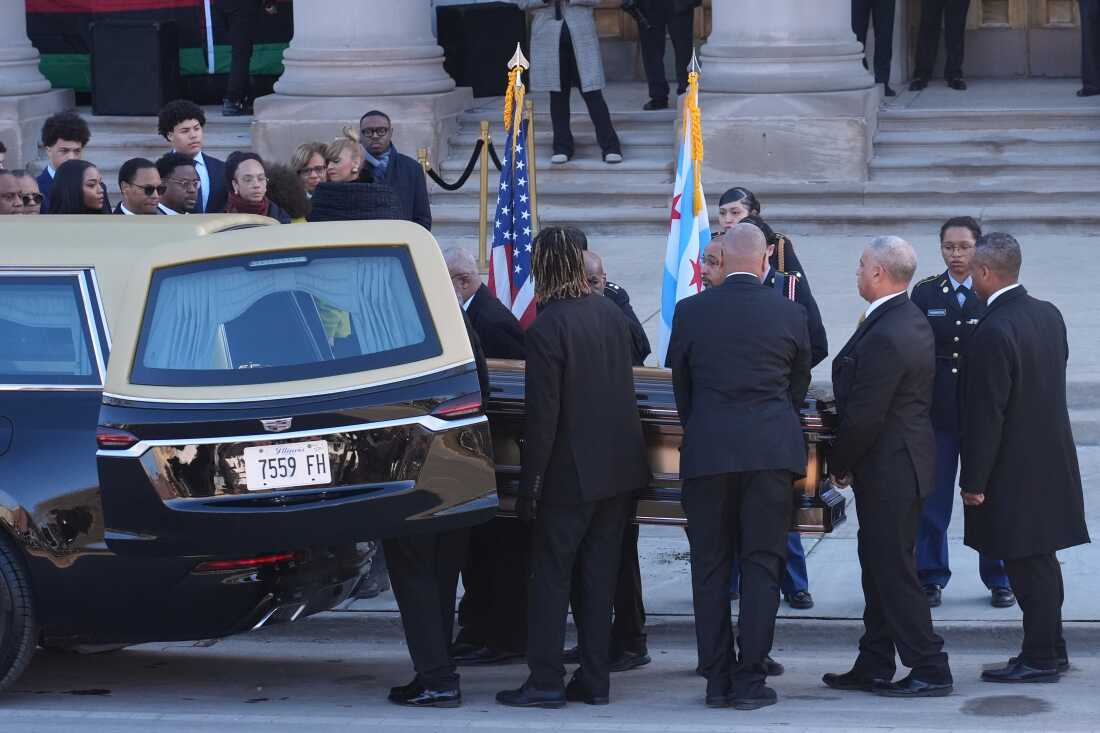
The casket with the Rev. Jesse Jackson arrives before a public visitation at Rainbow/PUSH Coalition in Chicago on Thursday.
Nam Y. Huh/AP
hide caption
toggle caption
Nam Y. Huh/AP
Inside, Jackson’s children, Chicago Mayor Brandon Johnson and the Rev. Al Sharpton were among those who stood by the open casket to shake hands and hug those coming to view the body of Jackson, dressed in a suit and blue shirt and tie.
“The challenge for us is that we’ve got to make sure that all he lived for was not in vain,” Sharpton told reporters. “Dr. King’s dream and Jesse Jackson’s mission now falls on our shoulders. We’ve got to stand up and keep it going.”
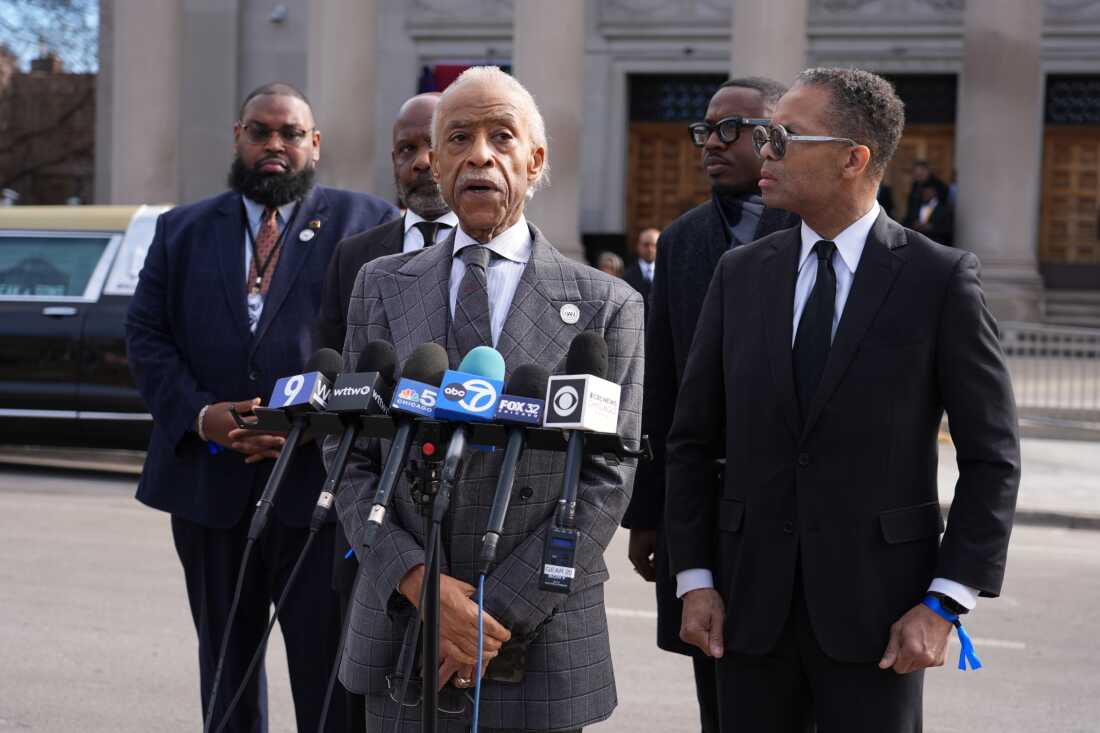
The Rev. Al Sharpton speaks as Jesse Jackson Jr. listens after the public visitation for the Rev. Jesse Jackson at Rainbow/PUSH Coalition in Chicago on Thursday.
Nam Y. Huh/AP
hide caption
toggle caption
Nam Y. Huh/AP
Jackson died last week at age 84 after battling a rare neurological disorder that affected his mobility and ability to speak in his later years.
Remembrances have already poured in from around the globe, and several U.S. states, including Minnesota, Iowa and North Carolina, are flying flags at half-staff in his honor.
But perhaps nowhere has his death been felt as strongly as in the nation’s third-largest city, where Jackson lived for decades and raised his six children, including a son who is a congressman.
Bouquets have been left outside the family’s Tudor-style home on the city’s South Side for days. Public schools have offered condolences, and city trains have used digital screens to display Jackson’s portrait and his well-known mantra, “I am Somebody!”

People wait to enter the security checkpoint for the public visitation for the Rev. Jesse Jackson at Rainbow/PUSH Coalition in Chicago on Thursday.
Nam Y. Huh/AP
hide caption
toggle caption
Nam Y. Huh/AP
His causes, both in the United States and abroad, were countless: Advocating for the poor and underrepresented on issues including voting rights, job opportunities, education and health care. He scored diplomatic victories with world leaders, and through his Rainbow PUSH Coalition, he channeled cries for Black pride and self-determination into corporate boardrooms, pressuring executives to make America a more open and equitable society.

“We honor him, and his hard-earned legacy as a freedom fighter, philosopher, and faithful shepherd of his family and community here in Chicago,” the mayor said in a statement.
Next week, Jackson will lie in honor at the South Carolina Statehouse, followed by public services. According to Rainbow PUSH’s agenda, Gov. Henry McMaster is expected to deliver remarks; however, the governor’s office said Thursday that his participation wasn’t yet confirmed. Jackson spent his childhood and started his activism in South Carolina.
Details on services in Washington have not yet been made public. However, he will not lie in honor at the United States Capitol rotunda after a request for the commemoration was denied by the House Speaker Mike Johnson’s office.
The two weeks of events will wrap up next week with a large celebration of life gathering at a Chicago megachurch and finally, homegoing services at the headquarters of the Rainbow PUSH Coalition.
Family members said the services will be open to all.
“Our family is overwhelmed and overjoyed by the amazing amount of support being offered by common, ordinary people who our father’s life has come into contact with,” his eldest son, Jesse Jackson Jr., said before the services began. “This is a unique opportunity to lay down some of the political rhetoric and to lay down some of the division that deeply divides our country and to reflect upon a man who brought people together.”
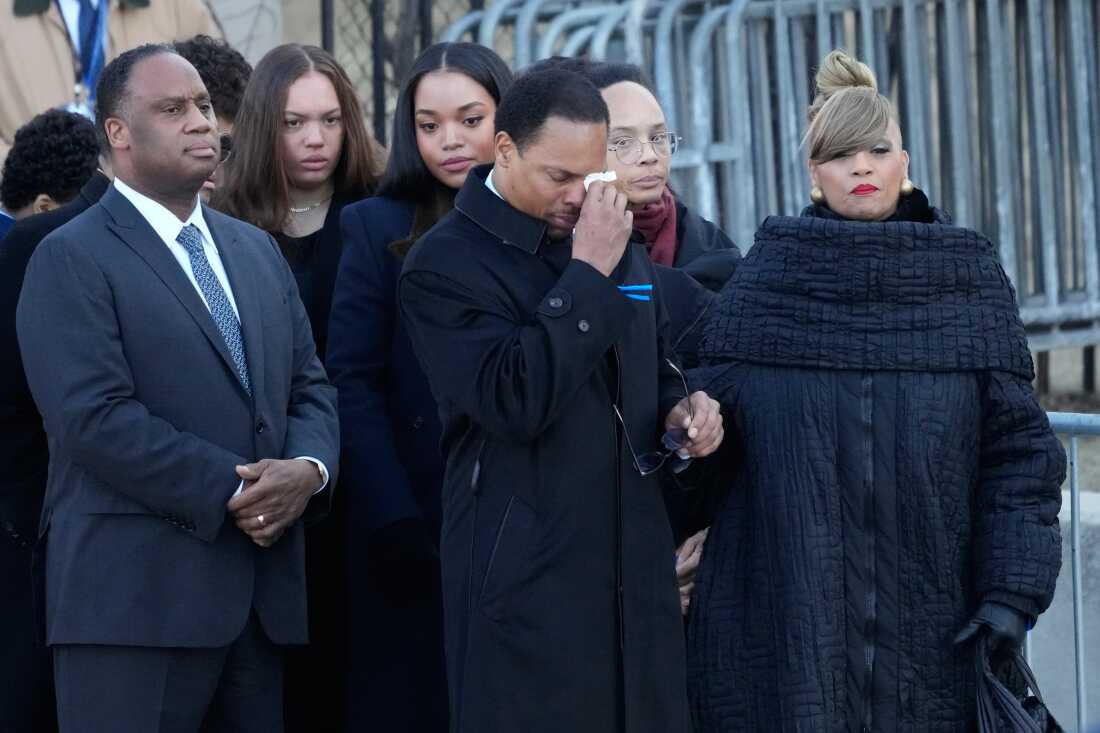
The family of the Rev. Jesse Jackson arrives as Yusep Jackson wipes his eyes before public visitation at Rainbow/PUSH Coalition in Chicago on Thursday.
Nam Y. Huh/AP
hide caption
toggle caption
Nam Y. Huh/AP
The services included prayers from some of the city’s most well-known religious leaders, including Chicago Cardinal Blase Cupich. Mourners of all ages — from toddlers in strollers to elderly people in wheelchairs — came to pay respects.
Video clips of his appearances at news conferences, the campaign trail and even “Sesame Street” also played inside the auditorium.
Claudette Redic, a retiree who lives in Chicago, said her family has respected Jackson, from backing his presidential ambitions to her son getting a scholarship from a program Jackson championed.
“We have generations of support,” she said. “I’m hoping we continue.”

Heart disease threat projected to climb sharply for key demographic

Anthony Richardson free to seek trade after injury setbacks amid Colts’ shift to Daniel Jones

300,000 Chrome users hit by fake AI extensions
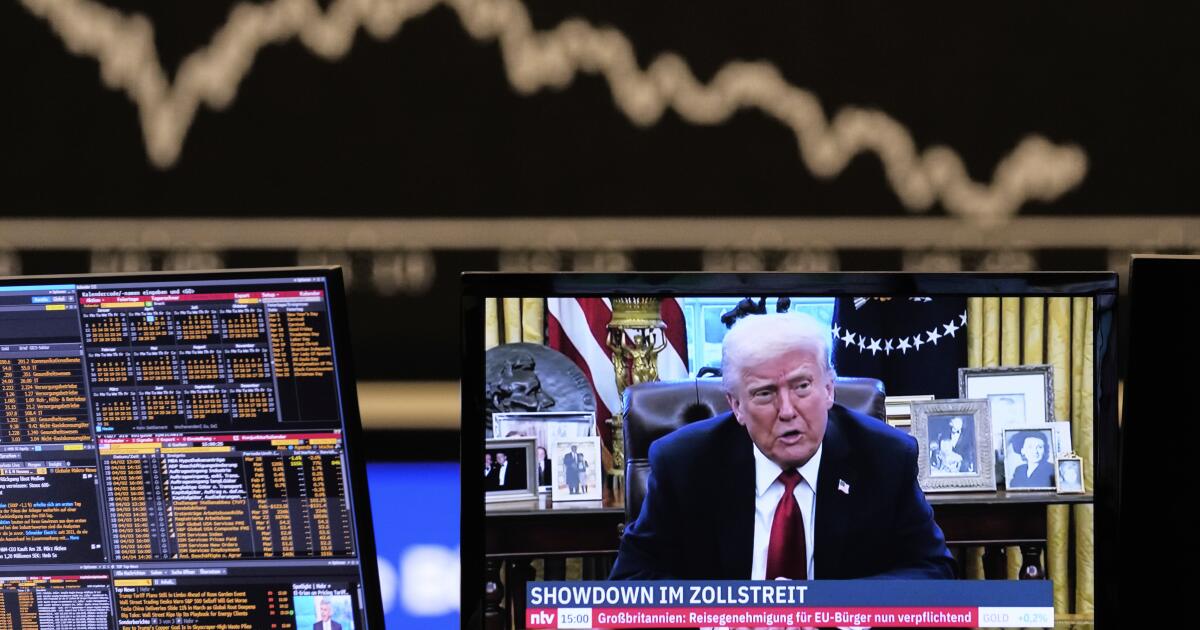
Commentary: How Trump helped foreign markets outperform U.S. stocks during his first year in office
Philip Glass canceled a Kennedy Center show, but this conductor brings his work center stage at L.A. Opera

Florida High School Football Rankings: Top 25 teams – Oct. 21

Cleary's 21 help Le Moyne down Central Connecticut State 69-64 in OT

How old is Bo Nix? What to know about Oregon quarterback ahead of 2024 NFL Draft

99th annual Pony Swim held in Virginia

Indiana Members Credit Union announced as new anchor tenant at Bottleworks District

Has India’s influence in Afghanistan grown under the Taliban?

Bill Clinton to testify before House committee investigating Epstein links

Read Judge Schiltz’s Order

Vulnerable House Dem lashes out at Trump’s ‘racist’ SOTU challenge: ‘That was uncomfortable’

Italy calls for suspension of EU carbon market
-

 World1 day ago
Exclusive: DeepSeek withholds latest AI model from US chipmakers including Nvidia, sources say
-

 Massachusetts2 days ago
Mother and daughter injured in Taunton house explosion
-

 Montana1 week ago
2026 MHSA Montana Wrestling State Championship Brackets And Results – FloWrestling
-

 Oklahoma1 week ago
Wildfires rage in Oklahoma as thousands urged to evacuate a small city
-

 Louisiana4 days ago
Wildfire near Gum Swamp Road in Livingston Parish now under control; more than 200 acres burned
-

 Technology6 days ago
YouTube TV billing scam emails are hitting inboxes
-

 Denver, CO2 days ago
10 acres charred, 5 injured in Thornton grass fire, evacuation orders lifted
-

 Technology6 days ago
Stellantis is in a crisis of its own making