Connect with us

News

China announces 34% retaliatory tariffs on US imports

Published

on

China announces 34% retaliatory tariffs on US imports

Unlock the White House Watch newsletter for free

China has announced duties of 34 per cent on all US imports in retaliation to Donald Trump’s tariffs, moving the world closer to a full-blown trade war as the US president vowed he would never back down.

Global stock markets extended their losses on Friday after Beijing’s statement, with the S&P 500 down 2.4 per cent at its open and the Europe-wide Stoxx 600 4 per cent lower.

“CHINA PLAYED IT WRONG, THEY PANICKED — THE ONE THING THEY CANNOT AFFORD TO DO!” Trump posted on his Truth Social network just before Wall Street began trading for the day.

Advertisement

The new Chinese tariff matches the US president’s latest increase in duties on Beijing and comes on top of a previous tit-for-tat round this year.

The country’s Ministry of Commerce said on Friday that it would be imposed on all US imported goods from April 10, a day after America’s “reciprocal” levies come into effect.

Beijing’s move was accompanied by a slew of other measures, including restrictions on rare earth exports and a probe of the China subsidiary of DuPont, the US chemicals giant.

Trump said he would persist with his policy, which will take Washington’s tariffs to their highest for more than a century, despite the falls on Wall Street and other stock exchanges around the world.

“TO THE MANY INVESTORS COMING INTO THE UNITED STATES AND INVESTING MASSIVE AMOUNTS OF MONEY, MY POLICIES WILL NEVER CHANGE,” he posted. “THIS IS A GREAT TIME TO GET RICH, RICHER THAN EVER BEFORE!”

Advertisement

The US president’s announcement this week of the 34 per cent tariff on Chinese imports to the US will take average US tariffs on Chinese goods to 76 per cent, according to analysis by the Peterson Institute of International Economics.

That figure is well above the 60 per cent Trump threatened during last year’s election campaign.

Beijing, which had previously considered such a level of tariffs as a worst-case scenario, denounced the new US duties as “a typical unilateral bullying move”.

It added that this week’s round of US tariffs “does not comply with the rules of international trade and seriously damages the legitimate rights and interest of China”.

Leah Fahy, a China economist at Capital Economics, said in a research note that Beijing’s new 34 per cent retaliatory duty pushed the country’s average tariff on US imports up to about 50 per cent, and marked a “significant escalation”.

Advertisement

Some content could not load. Check your internet connection or browser settings.

The latest measures are likely to have the most impact on US agricultural exports, including soyabeans, wheat and corn. China is also a significant importer of pharmaceuticals, crude oil, petroleum gas and liquefied natural gas from the US.

The trade war comes at a sensitive moment for Chinese President Xi Jinping, who has leaned on exports to steer the world’s second-largest economy through a property sector slump and deflation.

Alicia García-Herrero, chief economist for Asia-Pacific at Natixis, said Beijing’s latest round of tariffs suggested it was trying to position itself to be first in line for high-level negotiations with Washington.

Trump’s move to impose steep tariffs on US trading partners around the world has convulsed markets. On Thursday, about $2.5tn in market value was erased from Wall Street stocks and all of the dollar’s post-election gains were wiped out.

Advertisement

As the falls continued on Friday, the FTSE 100 slumped 3.5 per cent and Germany’s Dax lost 3.8 per cent.

Some content could not load. Check your internet connection or browser settings.

Investors swept into US Treasuries, pushing the 10-year yield down 0.13 percentage points on the day to 3.93 per cent.

Beijing is among the biggest targets of the “reciprocal” tariffs unveiled by Trump, who had already imposed a separate duty of 20 per cent on Chinese goods earlier this year.

Andrew Gilholm, head of China analysis at consultancy Control Risks, said Beijing could suffer “major self-inflicted damage” from fully matching US tariffs, given China’s trade surplus with the US and the tariffs it already has in place.

China announced export bans on seven types of rare earths on Friday, while US tech companies, including drone makers Skydio and Brinc Drones, were added to its “unreliable entity” list, which bans Chinese suppliers from selling components to them.

Advertisement

News

Trump administration sends letter wiping out addiction, mental health grants

Published

on

Trump administration sends letter wiping out addiction, mental health grants

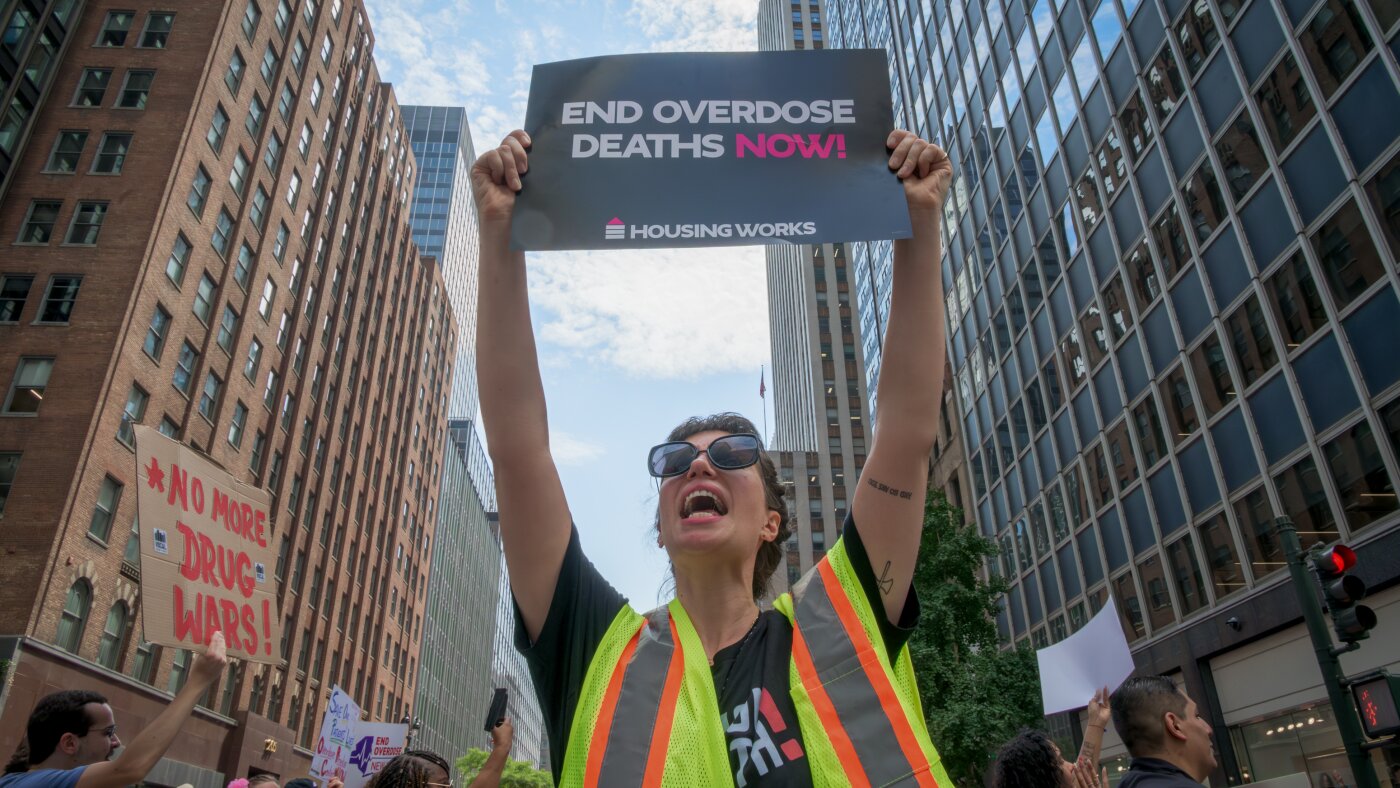
A demonstrator holds a sign during International Overdose Awareness Day on Aug. 28, 2024 in New York City.

Erik McGregor/LightRocket via Getty Images


hide caption

toggle caption

Advertisement

Erik McGregor/LightRocket via Getty Images

The Trump administration sent shockwaves through the U.S. mental health and drug addiction system late Tuesday, sending hundreds of termination letters, effective immediately, for federal grants supporting health services.

Three sources said they believe total cuts to nonprofit groups, many providing street-level care to people experiencing addiction, homelessness and mental illness, could reach roughly $2 billion. NPR wasn’t able to independently confirm the scale of the grant cancellation. The U.S. Substance Abuse and Mental Health Services Administration (SAMSHA) didn’t respond to a request for clarification.

“We are definitely looking at severe loss of front-line capacity,” said Andrew Kessler, head of Slingshot Solutions, a consultancy firm that works with mental health and addiction groups nationwide. “[Programs] may have to shut their doors tomorrow.”

Advertisement

Kessler said he has reviewed numerous grant termination letters from “Salt Lake City to El Paso to Detroit, all over the country.”

Ryan Hampton, the founder of Mobilize Recovery, a national advocacy nonprofit for people in and seeking recovery, told NPR his group lost roughly $500,000 “overnight.”

“Waking up to nearly $2 billion in grant cancellations means front-line providers are forced to cease overdose prevention, naloxone distribution, and peer recovery services immediately, leaving our communities defenseless against a raging crisis,” Hampton said. “This cruelty will be measured in lives lost, as recovery centers shutter and the safety net we built is slashed overnight. We are witnessing the dismantling of our recovery infrastructure in real-time, and the administration will have blood on its hands for every preventable death that follows.”

Copies of the letter sent to two different organizations and reviewed by NPR signal that SAMHSA officials no longer believe the defunded programs align with the Trump administration’s priorities.

The letter points to efforts to reshape the national health system in part by restructuring SAMHSA’s grant program, which “includes terminating some of its … awards.”

Advertisement

According to the letter, grants are terminated as of Jan.13, adding that “costs resulting from financial obligations incurred after termination are not allowable.”

The National Association of County Behavioral Health and Developmental Disability Directors sent a letter to members saying it believes “over 2,000 grants [nationwide] with a total of more than $2 billion” are affected. The group said it’s still working to understand the “full scope” of the cuts.

This move comes on top of deep Medicaid cuts, passed last year by the Republican-controlled Congress, which affect numerous mental health and addiction care providers.

Kessler told NPR he’s hearing alarm from care providers nationwide that the safety net for people experiencing an addiction or mental health crisis could unravel.

“In the short term, there’s going to be severe damage. We’re going to have to scramble,” he said.

Advertisement

Regina LaBelle, a Georgetown University professor who served as acting head of the Office of National Drug Control Policy during the Biden administration, said the SAMHSA grants pay for lifesaving services.

“From first responders to drug courts, continued federal funding quite literally save lives,” LaBelle said. “The overdose epidemic has been declared a public health emergency and overdose deaths are decreasing. This is no time to pull critical funding.”

Requests for comment from SAMHSA and the Department of Health and Human Services were not immediately returned.

This is a developing story.

Advertisement
Continue Reading

News

Video: Clashes With Federal Agents in Minneapolis Escalate

Published

on

Video: Clashes With Federal Agents in Minneapolis Escalate

new video loaded: Clashes With Federal Agents in Minneapolis Escalate

transcript

transcript

Clashes With Federal Agents in Minneapolis Escalate

Fear and frustration among residents in Minneapolis have mounted as ICE and Border Patrol agents have deployed aggressive tactics and conducted arrests after the killing of Renee Good by an immigration officer last week.

“Open it. Last warning.” “Do you have an ID on you, ma’am?” “I don’t need an ID to walk around in — In my city. This is my city.” “OK. Do you have some ID then, please?” “I don’t need it.” “If not, we’re going to put you in the vehicle and we’re going to ID you.” “I am a U.S. citizen.” “All right. Can we see an ID, please?” “I am a U.S. citizen.”

Advertisement
Fear and frustration among residents in Minneapolis have mounted as ICE and Border Patrol agents have deployed aggressive tactics and conducted arrests after the killing of Renee Good by an immigration officer last week.

By Jamie Leventhal and Jiawei Wang

January 13, 2026

Continue Reading

News

Lindsey Halligan argues she should still be U.S. attorney, accuses judge of abuse of power

Published

on

Lindsey Halligan argues she should still be U.S. attorney, accuses judge of abuse of power

Top Justice Department officials defended Lindsey Halligan’s attempts to remain in her position as a U.S. attorney in court filings Tuesday, responding to a federal judge who demanded to know why she was continuing to do so after another judge had found that her appointment was invalid.

The filing, signed by Halligan, Attorney General Pam Bondi and Deputy Attorney General Todd Blanche, accused a Trump-appointed judge of “gross abuse of power,” and attempting to “coerce the Executive Branch into conformity.”

Last week, U.S. District Judge David Novak, who sits on the federal bench in Richmond, ordered Halligan to provide the basis for her repeated use of the title of U.S. attorney and explain why it “does not constitute a false or misleading statement.” 

Novak gave Halligan seven days to respond to his order and brief on why he “should not strike Ms. Halligan’s identification as United States attorney” after she listed herself on an indictment returned in the Eastern District of Virginia in December as a “United States attorney and special attorney.”

U.S. District Judge Cameron Currie had ruled in November that Halligan’s appointment as interim U.S. attorney was invalid and violated the Constitution’s Appointments Clause, and she dismissed the cases Halligan had brought against former FBI Director James Comey and New York Attorney General Letitia James. 

Advertisement

The statute invoked by the Trump administration to appoint Halligan allows an interim U.S. attorney to serve for 120 days. After that, the interim U.S. attorney may be extended by the U.S. district court judges for the region. 

Currie found that the 120-day clock began when Halligan’s predecessor, Erik Siebert was initially appointed in January 2025. Currie concluded that when that timeframe expired, Bondi’s authority to appoint an interim U.S. attorney expired along with it. 

The judge ruled that Halligan had been serving unlawfully since Sept. 22 and concluded that “all actions flowing from Ms. Halligan’s defective appointment” had to be set aside. That included the Comey and James indictments.

In their response, Bondi, Blanche and Halligan called Novak’s move an “inquisition,” “insult,” and a “cudgel” against the executive branch. The Justice Department argued that Currie’s ruling in November applied only to the Comey and James cases and did not bar Halligan from calling herself U.S. attorney in other cases that she oversees. 

“Adding insult to error, [Novak’s order] posits that the United States’ continued assertion of its legal position that Ms. Halligan properly serves as the United States Attorney amounts to a factual misrepresentation that could trigger attorney discipline. The Court’s thinly veiled threat to use attorney discipline to cudgel the Executive Branch into conforming its legal position in all criminal prosecutions to the views of a single district judge is a gross abuse of power and an affront to the separation of powers,” the Justice Department wrote.

Advertisement

In his earlier order, Novak said that Currie’s decision “remains binding precedent in this district and is not subject to being ignored.”

The Justice Department called Currie’s ruling “erroneous”: and said that Halligan is entitled to maintain her position “notwithstanding a single district judge’s contrary view.”

On Monday, the second-highest ranking federal prosecutor in the Eastern District of Virginia, Robert McBride, was fired after he refused to help lead the Justice Department’s prosecution of Comey, a source familiar with the matter told CBS News. McBride is a former longtime federal prosecutor in Kentucky’s Eastern District and had only been on the job as first assistant U.S. attorney for a few months after joining the office in the fall. 

Halligan is a former insurance lawyer who was a member of President Trump’s legal team, and joined Mr. Trump’s White House staff after he won a second term in 2024. In September, Halligan was selected to serve as interim U.S. attorney for the Eastern District of Virginia after her predecessor abruptly left the post amid concerns he would be forced out for failing to prosecute James.

Just days after she was appointed, Halligan sought and secured a two-count indictment against Comey alleging he lied to Congress during testimony in September 2020. James, the New York attorney general, was indicted on bank fraud charges in early October. Both pleaded not guilty and pursued several arguments to have their respective indictments dismissed, including the validity of Halligan’s appointment, and claims of vindictive prosecution.

Advertisement

Continue Reading

Trending