News
Bishop Asks Trump to ‘Have Mercy’ on Immigrants and Gay Children


Bishop Mariann Edgar Budde was nearing the end of her sermon for the inaugural prayer service on Tuesday when she took a breath and looked directly at President Donald J. Trump.
“I ask you to have mercy upon the people in our country who are scared now,” said Bishop Budde, the leader of the Episcopal Diocese of Washington. “There are gay, lesbian and transgender children in Democratic, Republican and independent families, some who fear for their lives.”
The direct appeal to Mr. Trump, at the start of the first full day of his presidency, was a remarkable moment. Twenty-four hours after he had reclaimed the highest office in the land, summoning tech billionaires as witnesses and pulling off a sweeping display of power by signing of a flurry of executive orders, he was suddenly confronted by an extraordinary act of public resistance from an unlikely source: a soft-spoken bishop.
“The vast majority of immigrants are not criminals,” Bishop Budde said. “I ask you to have mercy, Mr. President, on those in our communities whose children fear that their parents will be taken away, and that you help those who are fleeing war zones and persecution in their own lands to find compassion and welcome here.”
Mr. Trump, seated in the first row of pews in the towering Washington National Cathedral, looked down and then away. Vice President JD Vance raised his eyebrows and looked several times at his wife, Usha Vance, who kept her gaze trained ahead on the bishop. When Bishop Budde finished, Mr. Trump said something to Mr. Vance, who shook his head in apparent irritation. Members of the Trump family seated directly behind them appeared to look at one another, noticeably perturbed. Eric Trump, Mr. Trump’s middle son, shook his head.
It was not how Mr. Trump has generally been spoken to as he returns to the White House. Since winning the election, he has been courted by powerful business leaders and politicians alike, including many who kept their distance during his first term. Just the day before, he celebrated his return to office with an inauguration in the Capitol Rotunda, a rally surrounded by supporters and a succession of inaugural balls. Even former President Joseph R. Biden Jr. greeted Mr. Trump at the White House by saying, “Welcome home.”
Bishop Budde’s comments came a day after Mr. Trump issued a flurry of executive orders focused on transgender rights and immigration.
The appeal by the pastor clearly grabbed Mr. Trump’s attention. Asked by a reporter what he thought of the service, the president said: “Did you like it? Did you find it exciting? Not too exciting, was it?
“I didn’t think it was a good service, no,” Mr. Trump continued. “They could do much better.”
In an interview, Bishop Budde said she had decided to speak to the president directly because “of the fear that I have seen and experienced among our people — people that I know and love, both within the immigrant community and within the L.G.B.T.Q. community, and how terrified so many are.”
She said she was concerned about “the level of license to be really quite cruel” that some people feel now.
“I wasn’t necessarily calling the president out. I was trying to say, ‘The country has been entrusted to you,’” Bishop Budde said. “And one of the qualities of a leader is mercy, right? Mercy. And to be mindful of the people who are scared.”
Bishop Budde is not the only prominent clergy member to call attention to the fear caused by Mr. Trump’s agenda. Pope Francis on Sunday called Mr. Trump’s plans for mass deportations “a disgrace.”
Mr. Trump began his presidency on Monday with executive actions that aimed to turn his campaign rhetoric into tangible policies, including one that rescinded a Biden administration order that sought to prevent discrimination on the basis of gender identity or sexual orientation.
Mr. Trump’s new order, the administration said, seeks to defend women against “gender ideology extremism” that allows biological males to undermine their rights and privacy. And the definitions it sets forth go further to more explicitly define “sex.”
Under the order signed by Mr. Trump on Monday, males and females would be defined at “conception,” the text states. Someone who eventually produces “the large reproductive cell” would be deemed female, the order says. A male would be defined as the person who eventually “produces the small reproductive cell.”
The order also says that the federal government would no longer recognize “gender identity,” and only “sex” as defined by “an individual’s immutable biological classification as either male or female.”
The order also prohibits the use of federal funds for any promotion of “gender ideology” through grants or other government programming, as well as the use of public funding for transition-related medical procedures in prisons.
The order effectively defines transgender Americans out of existence.
“At its core, this executive order is an appallingly cruel effort to make transgender people strangers to the law and push them back into the closet,” said Sarah Warbelow, legal director at the Human Rights Campaign.
Mr. Trump also issued multiple immigration-related executive orders on Monday that suspended refugee admissions, severely restricted asylum for migrants and made clear that he intended to deploy the military to the southern border. The border, however, remains relatively calm after a record number of illegal crossings earlier in the Biden administration.
The Trump administration also rescinded a Biden policy that directed Immigration and Customs Enforcement agents to not make arrests at schools, places of worship and other places described as “sensitive locations.”
Throughout his campaign, and during his first term, Mr. Trump often portrayed all migrants crossing the border illegally as criminals. While sporadic crimes by migrants have gained national attention in recent years, homeland security officials themselves acknowledge that most people crossing the border are fleeing poverty or violence and seeking a better life.
“There are times when he talks of immigrants in broad strokes that feel as if the image portrayed is that all immigrants who are coming into the country are dangerous,” Bishop Budde said. “And I know that’s not true. It’s not true.”



By Hamed Aleaziz, Sutton Raphael, Thomas Vollkommer, Gilad Thaler, Whitney Shefte and Alexandra Ostasiewicz
March 27, 2026

Seth Bodnar, the former president of the University of Montana, is now running for Senate as an independent
Kirk Siegler/NPR
hide caption
toggle caption
Kirk Siegler/NPR
BUTTE, Mont. – It’s long been an adage in Montana politics that if you’re running for office, you’d better have a float in the Butte St. Paddy’s Day Parade, which draws thousands to the mining city’s historic uptown, soaking up the nostalgia – and the Guiness.
Here, you’re just steps from the towering old mining headframes and the one mile long and half mile wide Berkeley Pit. Now shuttered, it was once one of the world’s largest copper deposits.
Larry Carden, in a Notre Dame sweatshirt, never misses the parade.
“You’ll see a lot more boos for the Republicans than you will the Democrats, I can guarantee you that,” he says.
That’s a nod to Butte’s long history of Democratic politics and a strong labor movement going back to around 1900, when the “Copper King” mine owners ruled Montana business and media, and bribed their way into political office. Today, Carden, who’s retired, is worried that the mega rich are again influencing politics here, and how expensive life is in his home state.
“Between health care and gas and food, and you go to the store the other day, there’s rib steaks $19.99 a pound, you know,” Carden says.
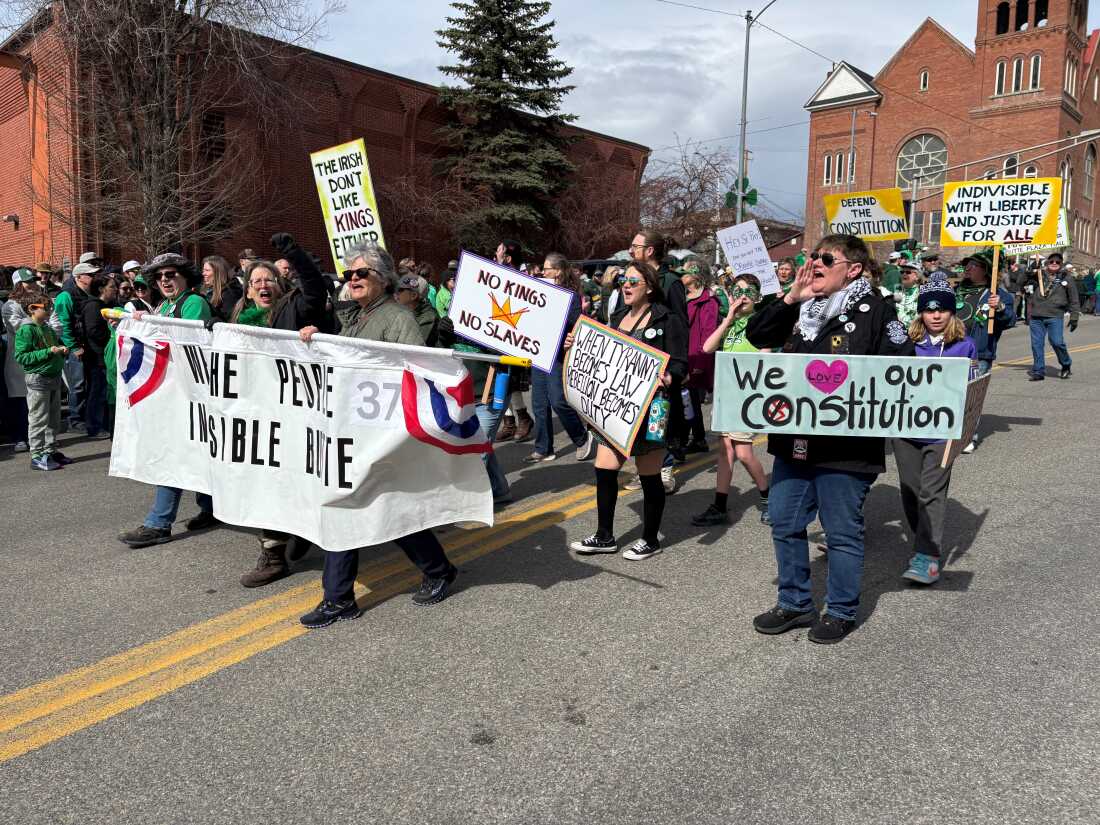
A political group marches in the St. Patrick’s Day parade in Butte, Montana, March 17 2026
Kirk Siegler/NPR
hide caption
toggle caption
Kirk Siegler/NPR
This year’s parade followed an unusually turbulent few days in Montana’s political scene – half of its congressional delegation abruptly retired. Despite the state’s recent tilt from purple to deep red, the races for their seats could be more in play now because of the way Senator Steve Daines and Congressman Ryan Zinke, both Republicans, gave up them up and chose their successors. In Daines’ case, he withdrew his candidacy just minutes before the filing deadline.
Like a lot of people in Butte, Carden is a longtime Democrat. But he says he’s grown disillusioned with party politics.
“I would rather everything be independent where there is no party designation and then you have to pay more attention to who the person actually is,” Carden says.
New Candidate opts to go independent
That’s exactly what Seth Bodnar, a former Green Beret running for U.S. Senate, is trying to capitalize on. He joined other candidates mixed in with Irish dancing troupes and fire department floats, as he walked the parade route along Park Street shaking the occasional hand and tossing candy.
In an interview with NPR earlier in Missoula, Bodnar, who recently resigned his post as University of Montana president, pitched what he says would be his bi-partisan appeal.
“I’m an independent,” Bondar says. “When I raised my right hand at the age of 18 and I swore an oath to this Constitution when I joined the military, not to a political party.”.
Person over party used to be the playbook in Montana, which some call just one long Main Street. It’s how former Senator Jon Tester used to win despite being a Democrat as the state got redder.
The day after Bodnar formally announced he was gathering signatures to get on the ballot, his long shot bid got taken a lot more seriously.
Sen. Steve Daines, who was elected to the Senate in 2014, sent shockwaves through the state’s political scene when he announced in a video posted to X that he’d decided not to seek reelection.
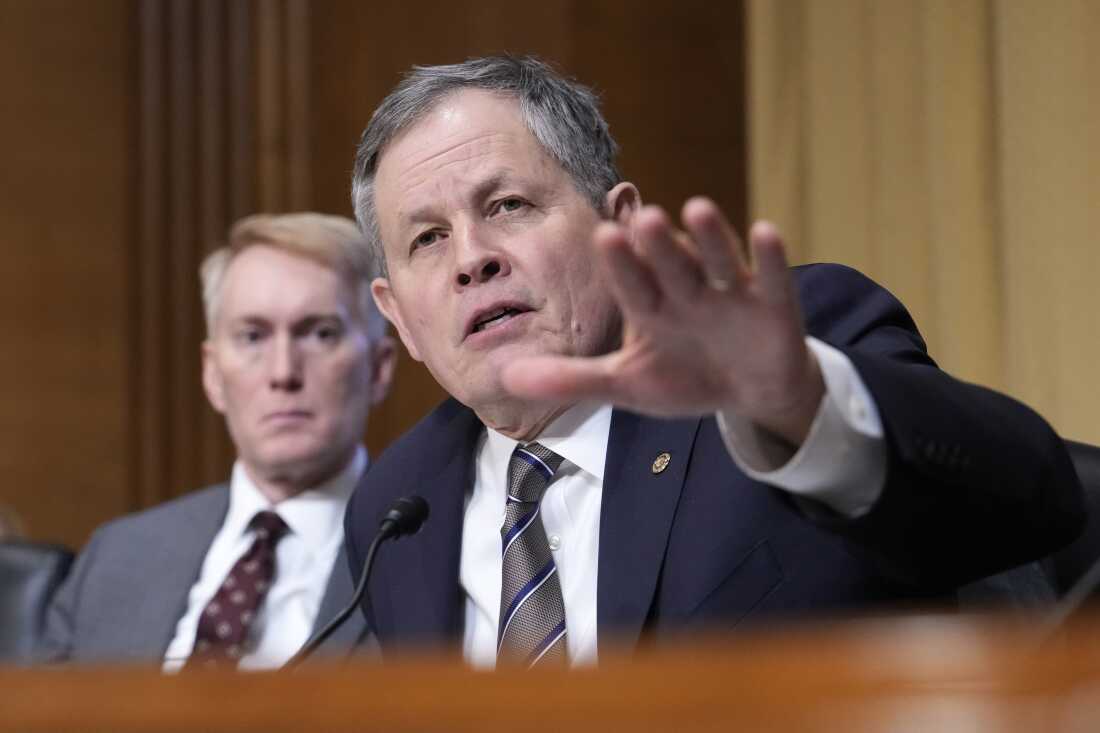
Sen. Steve Daines, R-Mont., speaks at the Senate Finance Committee confirmation hearing for Scott Bessent, President-elect Donald Trump’s choice to be Secretary of the Treasury, at the Capitol in Washington, Thursday, Jan. 16, 2025.
Ben Curtis/AP/AP
hide caption
toggle caption
Ben Curtis/AP/AP
“I’m also very thankful to have served alongside President Trump and my colleagues in the Senate,” Daines said in the video. “Together we built a conservative majority on the Supreme Court, we delivered the largest tax cut in U.S. history, we unleashed American energy dominance and secured our southern border.”
Daines’ late hour withdrawal presumably clears the way for his chosen successor, Kurt Alme, the U.S. Attorney for Montana until he declared his candidacy for Daines’ seat. Daines later said withdrawing earlier could have enticed a prominent Democrat like Tester to enter the race.
Independent Seth Bodnar says it reminds him of the Montana of old.
“We have direct election of senators in the United States in part because of political corruption in this state 125 years ago, Copper Kings trying to buy U.S. Senate seats,” Bodnar says. “That didn’t work back then and it’s not going to work right now.”
But Democrats say Bodnar’s entry as an independent will just split the liberal vote.
The GOP base is angry too
“Montanans are getting very indignant about what they see as out and out dishonesty,” says Roger Koopman, a former Republican legislator and Montana Public Service commissioner from Bozeman.
Koopman says the party establishment’s backroom dealing is a gift to Democrats and especially Seth Bodnar, who he says is a liberal running as an independent.
“They’re going to say, ‘hey, I’m over these Republicans playing games with me, you can’t do that and expect me to vote for you, I’m not going to vote Democrat, but here’s this guy out here who says he’s independent, let me give him a try,’” Koopman says.
Alme has been keeping a low profile. Political pundits say that might be by design. A campaign spokesperson sent NPR this statement: “Anyone could run for this seat. Kurt is running on his record as the Trump-endorsed candidate of common sense who knows how to be tough on violent crime, dismantle drug cartels, and deliver historic tax relief. Voters will decide, and Kurt is confident in his work serving Montana and helping President Trump put America First.”
At Montana State University, political science department chair Eric Austin says he expects party tensions will cool and Republicans will rally around their nominee by November.
“I think in part that speaks to the changes in the electorate in the state,” Austin says. “As the state has become more red, people have more strongly affiliated themselves with the Republican Party and less as independents.”
However, Austin says the midterms will be a referendum on President Trump and there’s growing economic anxiety in Montana. Farmers are getting hurt by Trump’s tariffs. His Iran War has sent fertilizer prices soaring, raised interest rates and the cost of gas.
Back in Butte, at the St. Paddy’s Day parade, longtime Democratic activist Evan Barrett says there’s a resurgence in populist resentment in Montana.

Longtime Montana Democratic party activist Evan Barrett at the St. Patrick’s Day parade in Butte, Montana, March 17 2026
Kirk Siegler/NPR
hide caption
toggle caption
Kirk Siegler/NPR
“It’s almost like a repetition of the past,” says Barrett, a one time economic aide to former Governor Brian Schweitzer.
Ducking into an old storefront to take a break from the spectacle of the parade, Barrett told NPR there’s a feeling in the electorate that a lot of outside money is coming into influence politics, but not staying in Montana and being invested into things like schools.
“So this is a really wild and different year,” Barrett says. “Anybody that tells you they know what’s gonna happen, well, be a bit skeptical.”
President Trump has endorsed last minute Senate candidate Kurt Alme but it’s not clear what kind of effect that might have on voters in November.

new video loaded: Savannah Guthrie Says She Believes Her Mother Was Taken for Ransom
transcript
transcript
Savannah Guthrie Says She Believes Her Mother Was Taken for Ransom
Savannah Guthrie spoke on the “Today” show in her first interview since her mother, Nancy Guthrie, was abducted from her home near Tuscon, Ariz.
-
“The ransom note, notes for ransom requests came. Did you believe those to be real?” “The two notes that we received that we responded to — I tend to believe those are real.” “Really?” “We still don’t know. Honestly, we don’t know anything. We don’t know anything. So I don’t know that it’s because she’s my mom. But yeah, that’s probably — which is too much to bear to think that I brought this to her bedside, that it’s because of me. And I just say, I’m so sorry, Mommy. I’m so sorry. We need answers. We cannot be at peace without knowing. And someone can do the right thing. And it is never too late to do the right thing.”
By Christina Kelso
March 26, 2026

50 years of DC Metro: A look back in photos

WKYC Channel 3

Austin’s Star Is Still Shining Bright: Venture Funding To City’s Startups Hits All-Time High

How To Watch: Michigan vs Alabama in NCAA Tournament Sweet 16

This Day in Alaska History-March 27th, 1964

Florida High School Football Rankings: Top 25 teams – Oct. 21

How old is Bo Nix? What to know about Oregon quarterback ahead of 2024 NFL Draft

Cleary's 21 help Le Moyne down Central Connecticut State 69-64 in OT

99th annual Pony Swim held in Virginia

Indiana Members Credit Union announced as new anchor tenant at Bottleworks District

Video: Will ICE Change Under Its New Leader?

DHS shutdown breakthrough comes at cost for Republicans as funding fights nears end

Rubio joins crucial G7 talks as Iran war set to dominate second day
A surprise resignation could open the door for an independent to win a Montana Senate seat

Video: Savannah Guthrie Says She Believes Her Mother Was Taken for Ransom
-

 Detroit, MI1 week ago
Drummer Brian Pastoria, longtime Detroit music advocate, dies at 68
-

 Science1 week ago
How a Melting Glacier in Antarctica Could Affect Tens of Millions Around the Globe
-
 Science1 week ago
I had to man up and get a mammogram
-

 Movie Reviews1 week ago
‘Youth’ Twitter review: Ken Karunaas impresses audiences; Suraj Venjaramoodu adds charm; music wins praise | – The Times of India
-

 Sports6 days ago
IOC addresses execution of 19-year-old Iranian wrestler Saleh Mohammadi
-

 New Mexico5 days ago
Clovis shooting leaves one dead, four injured
-
 Business1 week ago
Disney’s new CEO says his focus is on storytelling and creativity
-

 Texas1 week ago
How to buy Houston vs. Texas A&M 2026 March Madness tickets