News
An independent effort says AI is the secret to topple two-party power in Congress


The Independent Center is using AI to identify Congressional districts where independent candidates could win over the Democrat or Republican candidate. Its goal is to elect at least a handful of independents to disrupt the two-party system on Capitol Hill.
Glenn Harvey for NPR
hide caption
toggle caption
Glenn Harvey for NPR
The rise of AI assistants is rewriting the rhythms of everyday life: people are feeding their blood test results into chatbots, turning to ChatGPT for advice on their love lives and leaning on AI for everything from planning trips to finishing homework assignments.
Now, one organization suggests artificial intelligence can go beyond making daily life more convenient. It says it’s the key to reshaping American politics.
“Without AI, what we’re trying to do would be impossible,” explained Adam Brandon, a senior advisor at the Independent Center, a nonprofit that studies and engages with independent voters.
The goal is to elect a handful of independent candidates to the House of Representatives in 2026, using AI to identify districts where independents could succeed and uncover diamond in the rough candidates.
In a time when control of the House balances on a knife’s edge, winning even a handful of seats could deny either party from getting a majority and upend the way the House currently operates.
It’s a bold proposition in a system that hasn’t seen a new independent candidate win a House seat in 35 years.
But data shows a rise in moderate and independent voters. Gallup found 43% of Americans — a record high — claiming the independent label in 2024. Exit polls that year showed 34 percent of voters identified as independent, up from 26 percent in 2020.
“There’s a huge chunk of people who for different reasons can’t stomach either of the two parties,” said David Barker, a professor of government at American University. “It’s the first time in a long time where a plurality of Americans are now identifying as independents, and so that does seem to signal a pretty important shift.”
Brandon said that shift is what makes the time right to disrupt the status quo.
“It’s like Uber and taxis. You had a system with an obvious flaw, that had entrenched operators and took a radical change to go completely around it,” he told NPR. “And that’s what we’re feeling now. People are so stuck into ‘Republican’ and ‘Democrat’ and we’re like, well, there’s something else.”
‘We’re political fighters’
Trying to throw a wrench into the stranglehold of a two-party system is an uphill battle, pushing against political orthodoxy and plenty of skeptics.
But the Independent Center’s strategists are a far cry from political newbies.
“We’re political fighters,” said Brandon, who served as President of FreedomWorks, the conservative grassroots group that helped turn Tea Party activists into a political force before closing its doors last year. “We have built a team of people that know how to do this. We’re not going to be pushovers.”
Brandon works closely with Brett Loyd, who runs The Bullfinch Group, the nonpartisan polling and data firm overseeing the polling and research at the Independent Center. He previously worked on President Trump’s polling team, when the president was a candidate.
“I’m a statistician. I kind of joke that I worked for the RNC because they offered me a job before the DNC,” he said with a smile. “My job is numbers and sentiment and game theory. It’s not necessarily Republican or Democratic.”
He makes it clear the goal of their work isn’t to erase partisanship altogether.
“This isn’t going to work everywhere. It’s going to work in very specific areas,” Loyd said. “If you live in a hyper-Republican or hyper-Democratic district, you should have a Democrat or Republican representing you.”
But with the help of AI, he’s identified 40 seats that don’t fit that mold, where he said independents can make inroads with voters fed up with both parties. The Independent Center plans to have about ten candidates in place by the spring, with the goal of winning at least half of the races.
Brandon predicts those wins could prompt moderate partisans in the House to switch affiliations.
“I had one Republican [member] tell me in his office, ‘I’m too chicken**** to do this right now,’” he recalled. “‘But if you can do this, I will join you.’”
From mining Reddit to matching on LinkedIn
Their proprietary AI tool created by an outside partner has been years in the making.
While focus groups and polling have long driven understanding of American sentiments, AI can monitor what people are talking about in real time.
“Polling is a snapshot in time — a Tuesday at 11 when you got the phone call or you were at the focus group, this is how you felt, but then you went home and your views changed. We can watch that,” Brandon said.
They’re using AI to understand core issues and concerns of voters, and to hunt for districts ripe for an independent candidate to swoop in.
“A district that’s 50% Republican and 50% Democratic that keeps flip flopping because of who showed up on a given night, is that something that is truly independent versus a district in Arizona where a plurality is independent but they’re plugging their nose and voting?” Loyd explained. “We’re looking at voter participation rates. What districts have really low turnout because those people aren’t excited to go to the ballot box.”
He’s also looking at districts with younger voters, who he said embrace the independent message.
“When I say Gen Z and millennials, people keep rolling their eyes and they’re like, ‘the kids,’” he said. “Well, those kids are going to be more than half the electorate in the next presidential election.”
From there, the next step is taking the data and finding what the dream candidate looks like.
The Independent Center is recruiting candidates both from people who reach out to the organization directly and with the help of AI.
They can even run their data through LinkedIn to identify potential candidates with certain interests and career and volunteer history.
“Usually they’re not self-promoting, but their actions leave a footprint,” Loyd said, giving the example of someone volunteering at an event covered by the local paper. “We ask our AI to find that footprint.”
The AI also informs where a candidate is best placed to win.
Brandon points to one instance where a candidate was poised to run in their home district. The AI showed the district next door is a better bet.
“30 minutes way, perfect fit,” he said. “And that’s what [that person’s] going to do, because we found they matched up perfectly.”
‘What’s wrong with spoiling something people don’t like?’
One criticism Brandon and Loyd acknowledge they hear often is the idea of ‘spoilers’ — non-winning candidates whose presence on the ballot affects which candidate wins.
“It’s a partisan, archaic line,” Loyd said. “What’s wrong with spoiling something people don’t like?”
He said the people criticizing independents getting into races as spoilers have an entrenched interest in the current system.
“The Republican and Democratic establishments still live in a world that’s binary. It’s Coke or Pepsi, it’s Ford or Chevy, it’s MSNBC or Fox News,” he said. “That works for people that watch MSNBC and Fox News. Everybody else? We don’t live in that binary system anymore.”
Brandon said the only thing to do is lean in.
“We’re going to embrace the spoiler because what we’re spoiling is a pretty corrupt system.”


Lionel Messi #10 of Argentina celebrates scoring his team’s second goal during their World Cup match against Egypt in Atlanta on Tuesday.
Elsa/Getty Images
hide caption
toggle caption
Elsa/Getty Images
They looked beaten. And out. Argentina, the defending World Cup champion and No. 1-ranked team, was down 2-0 late against Egypt.

Then, in a span of 13 remarkable minutes, Argentina scored not once, not twice, but three times, capping a comeback for the ages and leaving Egypt stunned and shellshocked.
For much of the game in Atlanta, Egypt was in control, hobbling Argentina early. The Egyptian attack began almost immediately with a stunning header goal delivered by Yasser Ibrahim in the 15th minute. After that, Egypt’s defense closed ranks, making it practically impossible for Argentina to equalize.
It was downhill from there for the Argentines: team captain Lionel Messi failed to convert a penalty kick, and in the 67th minute, Egypt got a second goal from Mostafa Ziko (after an earlier Egyptian goal had been disallowed after a video review). It looked like Argentina was finished. On the brink of elimination.
But no one told the Argentine players that.
In the 79th minute, Lionel Messi began doing his thing. He fired a cross near the Egyptian goal, and Cristian Romero headed it in. Messi was not done. Four minutes later, he powered a shot past the Egyptian keeper. It was his eighth goal of this tournament, the most of any player. The score was 2-2.
Then, in stoppage time, yet another Argentina header and another goal, this time from Enzo Fernandez.
“This is the World Cup for you,” said Messi after the game. “It wasn’t easy to come back from two goals down. But as I always say, this group never gives up. We always try to fight until the end.”
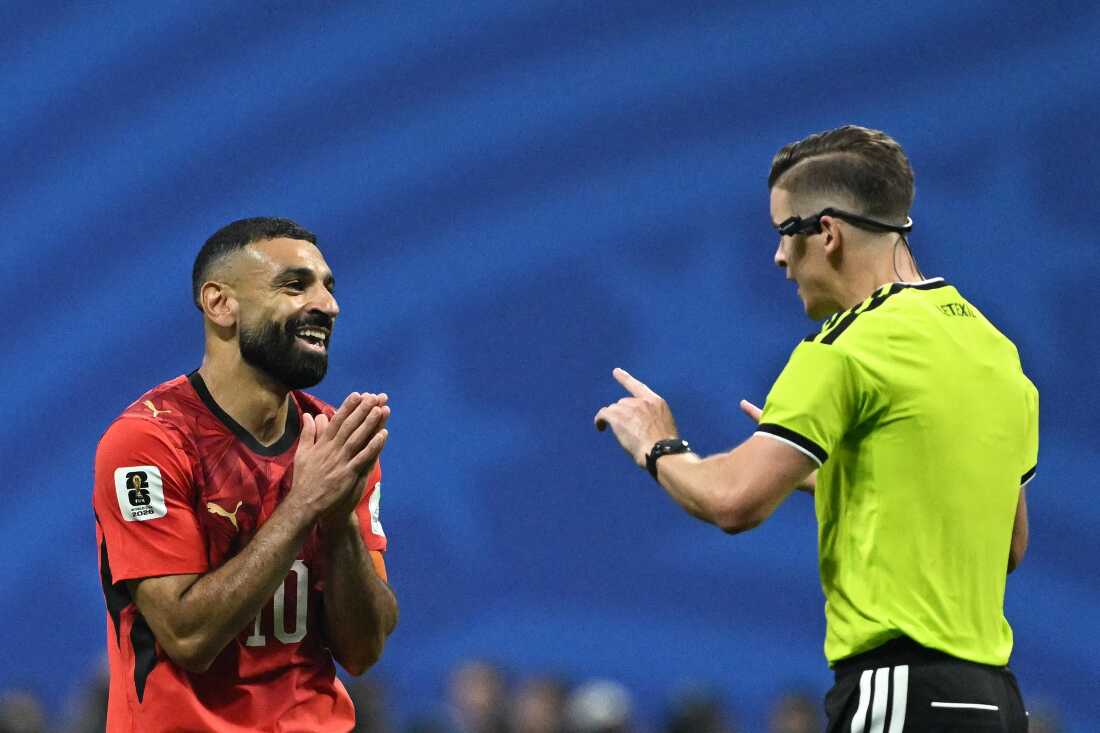
French referee François Letexier speaks with Egypt forward Mohamed Salah during the World Cup Round of 16 match between Argentina and Egypt in Atlanta.
Roberto Schmidt/AFP via Getty Images
hide caption
toggle caption
Roberto Schmidt/AFP via Getty Images
Afterward, Egypt coach Hossam Hassan complained about the French referee and the officiating. “I am not convinced. I am not convinced with this outcome. I’m not convinced with the way things unfolded during this match,” said Hassan in a post-match news conference. “We have been treated unfairly today. We have suffered injustice.”
“We would have deserved to earn this win, but we are leaving with honor, with pride, regardless of this defeat,” said Hossan.
African soccer teams have been the stars of this World Cup. Morocco has yet to lose a game. Cape Verde qualified for the first time in its history and stymied Spain, Uruguay and Saudi Arabia. Argentina barely beat them in a nail-biter of a match.
For Egypt, getting this far in the tournament is historic in itself: it’s the first time the team has made it this far. For Argentina, it was a terrifying yet relieving victory: several players, including Messi himself, cried after the game.
Next, they move to the quarterfinals and will play the winner of today’s Switzerland-Colombia match.

Top Senate Democrats are pushing for answers on whether a provision in a controversial settlement agreement between President Trump and his own administration applies to companies co-founded by or affiliated with the Trump family.
As part of a deal struck in May by the Justice Department to resolve a lawsuit brought by Mr. Trump, the Internal Revenue Service is permanently barred from pursuing claims against Mr. Trump, his oldest sons Don Jr. and Eric, and the Trump Organization based on prior tax returns.
In a one-page document signed by Acting Attorney General Todd Blanche and dated May 19, the Justice Department said the defendants in the president’s lawsuit — the IRS and the Treasury Department — are “FOREVER BARRED and PRECLUDED” from “prosecuting or pursuing, any and all claims” arising from tax returns filed before the settlement took effect. Blanche also wrote that the settlement applies to “parties including trusts, parent, sister, or related companies, affiliates, and subsidiaries.”
Now, Senators Elizabeth Warren of Massachusetts, Senate Minority Leader Chuck Schumer of New York, and Ranking Member of the Senate Finance Committee Ron Wyden of Oregon are pushing 11 businesses and organizations with ties to the Trump family to get answers for the “significant questions” the settlement raises relating to the tax audit provision, and whether the companies are included in the deal.
“Under the guise of a so-called legal settlement, the Trump administration has attempted to decree that the President, his family, and their entire business empire — potentially including entities with even the vaguest ‘affiliation’ to the family — are to face zero consequences if they have committed a range of financial crimes or misdeeds — regardless of the severity of the violation,” the senators wrote in letters transmitted to the companies Monday night.
The letters were sent to mining company Kaz Resources, defense firm Powerus, cryptocurrency companies World Liberty Financial and American Bitcoin, robotics startup Foundation Future Industries, investment firm 1789 Capital, private aviation company Tag Air, and prediction markets Polymarket and Kalshi.
All of the companies either were founded by Mr. Trump and his two adult sons, or list members of the Trump family as advisers, board members, or partial owners. Donald Trump Jr. sits on Polymarket’s advisory board and 1789 Capital, where he’s a partner, has invested in Polymarket. Days before Mr. Trump took office for his second term, Kalshi also announced Trump Jr. would be a strategic adviser.
The Democrats, who are in the minority, lack subpoena power, so Mr. Trump, his children and his companies can’t be forced to answer the questions posed by the senators.
According to recent financial disclosures, the president earned more than a billion dollars from cryptocurrency ventures alone last year, including from his meme coin business and World Liberty Financial, his family’s cryptocurrency firm.
Separately, the senators also asked the Trump Organization in a separate letter if it believes it has “immunity from all audits, civil penalties or federal prosecution” for any crimes that could have occurred before the settlement.
Trump Media and Technology Group, which is majority owned by a trust that lists Mr. Trump as the sole beneficiary and operates the Truth Social platform he uses daily, also received a letter from the Democratic senators.
“The public deserves transparency about the scope of this get-out-of-jail free card for Trump-aligned businesses, and about whether you intend to rely on this settlement as a free pass for any possible violations of the law,” the senators continued in their letter, which also seeks any communications that executives at the companies have had with the Justice Department and White House leading up to or after the settlement was signed.
The settlement was announced months after Mr. Trump and two of his sons and the Trump Organization accused the IRS and Treasury Department of unlawfully allowing a government contractor to leak tax returns to media outlets in 2020.
In a statement, a Justice Department spokesperson said “the IRS routinely provides releases as part of resolving taxpayer reviews and audits. This settlement follows that same standard practice.”
The spokesperson did not provide specific information about which companies are covered by the audit provision, or whether the Trump Organization and Trump family are the only entities covered by that addendum.

Charles De Ketelaere #17 of Belgium celebrates after scoring his team’s second goal during the World Cup Round of 16 match against the United States on Monday in Seattle.
Alex Grimm/Getty Images
hide caption
toggle caption
Alex Grimm/Getty Images
SEATTLE — This time was supposed to be different.
The U.S. men’s national team came into this FIFA World Cup with a lineup full of players with key roles in Europe’s top leagues. They had the name-brand coach — Mauricio Pochettino, of Tottenham, PSG and Chelsea fame. And they had homefield advantage, with every game on U.S. soil for the first time in three decades.

For weeks, the hype seemed like it might be real: The team’s three wins over Paraguay, Australia and Bosnia-Herzegovina were the most ever by a U.S. men’s squad in a World Cup. A new generation of American fans filled stadiums by the tens of thousands and tuned in on TV by the tens of millions.
But in the end, the Americans’ exit was the same as it ever was: Eliminated yet again in the Round of 16 at the hands of a European team — this time, Belgium, by a score of 4-1.
From the moment they stepped onto the Seattle field, the U.S. was outclassed by their opponent, No. 9-ranked Belgium. Countless turnovers and defensive lapses were seized on by the Belgians, who needed only nine minutes to take a 1-0 lead.
Then, once the Americans equalized on a free kick by midfielder Malik Tillman, Belgium scored yet again in barely a minute of play. Belgian forward Charles De Ketelaere scored both his team’s first-half goals.
After halftime, came an embarrassing nail in the coffin that silenced the Seattle sellout crowd for good — a 57th minute roll-in by Hans Vanaken after a slip-up by goalkeeper Matt Freese outside of the penalty area left the goal unguarded. Belgian forward Romelu Lukaku added a stoppage-time goal to seal the final score at 4-1.

Malik Tillman #17 of the United States celebrates scoring his team’s only goal during their World Cup match against Belgium. In what was one of the few bright spots of the game, the U.S. pulled even with Belgium at 1-1. The tie lasted less than two minutes before Belgium scored again.
Luke Hales/Getty Images
hide caption
toggle caption
Luke Hales/Getty Images
“It stinks,” said U.S. midfielder Tyler Adams. “Tonight was not a good performance overall. It’s not what we look to achieve. There [were] a lot of things that we could have done better.”
The U.S. had entered Monday’s game under a cloud of controversy around their striker Folarin Balogun, who was shown a red card in last week’s Round of 32 match against Bosnia-Herzegovina. An automatic one-game suspension was set to sideline Balogun, the Americans’ leading scorer at the World Cup, for Monday’s game.
Then, the day before the game, a FIFA disciplinary panel took the highly unusual step of delaying Balogun’s suspension by a year to allow him to participate. Then, news broke that President Trump had personally called FIFA president Gianni Infantino to encourage him to review the red card.
The Royal Belgian Football Association said it would protest Balogun’s inclusion in the lineup. But even at full strength, the U.S. were never real contenders in Monday’s game.
U.S. defender and team captain Tim Ream said the controversy swirling around the team had no impact. “We were fully focused on us as a group and as a team and fully focused on the game and not really worrying about what was being said or debated in the outside world.”
Belgium will advance to the quarterfinals for the third time in the past four World Cups, where it will face Spain on Friday in Los Angeles.

Mauricio Pochettino, Head Coach of the United States, walks down the touchline during the Round of 16 World Cup match between the USA and Belgium in Seattle on Monday.
Carl Recine/Getty Images
hide caption
toggle caption
Carl Recine/Getty Images
-

 Los Angeles, Ca1 hour ago
Bicyclist killed by hit-and-run driver in Long Beach
-

 Detroit, MI2 hours ago
Child shot while riding bike outside home on Detroit’s west side, police say
-

 San Francisco, CA2 hours ago
Bay Area restaurant has strict policy on acceptable children behavior
-

 Dallas, TX2 hours ago
Detroit Pistons trade Marcus Sasser to Dusty May’s Dallas Mavericks
-

 Miami, FL2 hours ago
The offseason has been a massive success for the Miami Heat
-

 Boston, MA2 hours ago
Can’t afford Boston’s priciest restaurants? Try these instead. – The Boston Globe
-

 Denver, CO2 hours ago
City of Denver says images of piling waste a case of illegal dumping
-

 Seattle, WA2 hours ago
14-year-old dies in electric motorcycle crash at Seattle bike park

