News
Americans Wrestle With How Trump’s Tariffs May Change Shopping Lists


Charlene and Phil Willingham had been thinking for a while about replacing the 20-year-old appliances in their kitchen, but with the sudden prospect of rising costs, they decided that this was the moment. The Willinghams, both retired, turned up at a store in the suburbs of Chicago on Friday with a long shopping list: stove, refrigerator, microwave oven and dishwasher.
“We were going to take our time to get new appliances, but now because of these tariffs, I want to get them before any price increases take place,” Ms. Willingham, 64, said while shopping at the Abt Electronics store in Glenview, Ill. Of the Trump administration’s sweeping announcement of tariffs across the globe last week, she said, “It sort of set the fire.”
In grocery stores, car dealerships, malls and big discount chains around the country, interviews with more than two dozen Americans this weekend showed that many were racing to figure out how to get ahead of the new tariffs plan, quickly making calculated purchases, big and small.
“The panic is enough to make me want to buy,” Shali Santos, 28, said, after stocking up on essentials in bulk — water, soap, mouthwash — at a Costco Wholesale store in Marina del Rey, a waterfront community in Los Angeles County, and noticing that many people around her seemed to be stocking up more than usual on similar staples.
Others said their shopping habits were unchanged by the tariffs announcement, largely because they had patience and trust in the president’s long game, and figured that any short-term pain, including potential cost increases, would work itself out.
“I’m confident it will recover,” Gregg Harris, 61, said as he shopped for food at a Walmart in Nashville.
Nearly all, though, expressed lingering uncertainty about exactly how these tariffs — at least a 10 percent government surcharge on nearly all goods imported into the United States as well as higher rates on goods from many countries — would play out in their daily lives. How and when might prices be affected by President Trump’s moves? What items might be most hard hit? Even if they knew the answers to such questions, some asked, could they really afford purchasing big ticket items right now to avoid higher costs later?
“He’s doing a lot, which, I mean, that feels like a change, which can be refreshing,” said Mitchell Kwapick, 28, as he shopped for a nephew’s birthday gift at Target in suburban Milwaukee. “But it’s a lot of stuff that’s scary right now.”
The announcements of the tariffs quickly tanked global markets, dealing a blow to investment portfolios, and economists say many of the costs associated with the tariffs will be passed on to consumers. Supporters said the tariffs would ultimately bring jobs back in the United States, while opponents said they would upend the economy.
Among people interviewed at stores this weekend, levels of concern about rising prices — and new urgency to beat any effects of tariffs — seemed closely tied to partisan alliances.
At the Abt Electronics store in Glenview, where business was swift, Laura Papa, 44, came in with her family looking for a new wall oven and refrigerator.
“We were hoping to wait until the summer, but then this fiasco happened,” said Ms. Papa, an accountant who voted for Kamala Harris in November. She said that she viewed tariffs as likely to wreck the nation’s economy and offered advice to others browsing in the store: “You better get stuff before the price increases come.”
In Marina del Rey, Tamela Plaine, who also works as an accountant and voted for Ms. Harris, said she began to worry about tariffs immediately after Mr. Trump was elected, and rushed out to buy a Hyundai S.U.V. before he took office to avoid rising prices.
After the tariffs were announced last week, Ms. Plaine, 48, said she felt compelled to shop in bulk for a wide range of items at Costco in case their price tags started rising. But she said she also was hemmed in by circumstances that many Americans may be facing: a sense that the costs of ordinary items already are too high and that front-loading big expenses now is not affordable.
“I did panic when I got in there,” Ms. Plaine said of her urge to stock up as much as possible while at Costco. “But I was just like, I have to calm down, because I’m still check-to-check.”
Ms. Plaine said her worries about budgeting and rising costs have even led her to lose sleep in recent days. “I try not to freak out,” she said.
But many shoppers who had voted for Mr. Trump said they were not adjusting their buying habits at all based on tariffs.
“I love them,” Dixon Witherspoon, 66, said of tariffs as he shopped for an oven lightbulb at a Target in Nashville. “The problem with America is everybody is worried about their quarterly stock report and everything is short-term vision, which is not good for anything.”
Mr. Witherspoon, a retired executive in the insurance sector who said his own stock portfolio had seen significant losses, said he expects tariffs to enhance the nation’s manufacturing independence and make a fairer playing field for U.S. businesses. “Tariffs are going to be painful in the short run, but in the long run, they are going to be wonderful,” he said.
In Milwaukee, J.J. Kennedy, who said he strongly supports President Trump, said he did not expect his shopping habits to shift following the launching of tariffs.
Mr. Kennedy, who owns an architectural design company and was buying computer keyboards at a Best Buy, acknowledged that tariffs had sparked concern and confusion in the construction industry, and that new home prices could be affected.
Still, he did not expect it to matter.
“People are just going to pay the difference,” Mr. Kennedy, 45, said. “Inventory is so low around here, it’s unbelievable.”
Many shoppers said the prospect of tariffs simply added to anxiety about an already unforgiving economy. Even if prices had yet to surge, uncertainty about what was ahead and sudden declines to retirement savings accounts were worrying signs.
“Either directly or indirectly, everyone’s impacted — 401(k)s, my stocks have been impacted, my mother’s pension is being impacted, a lot of people’s investments are being impacted,” said Alonzo Beyene, the owner of a technology business who was shopping in Miami on Saturday morning.
In Milwaukee, Juanita Norris said her retirement account lost $8,000 in just two days.
“That’s $8,000 that could have gone toward a car for my kids,” she said.
She was planning to help them buy a car this spring, she said, but if prices rise, she will need to wait anyway.
Back at the appliance store in Illinois, the Willinghams studied a stainless steel six-burner stove.
Both Democrats, they contemplated the point of the tariffs.
“I don’t see how it benefited the American people,” Ms. Willingham said. “I really hope and pray things can be resolved soon.”
Mr. Willingham, 65, was more resigned: “It is what it is,” he said.
Robert Chiarito contributed reporting from Glenview, Ill., Mimi Dwyer from Los Angeles, Jamie McGee from Nashville, Dan Simmons from Milwaukee, and Verónica Zaragovia from Miami.



TEHRAN, Iran (AP) — U.S. President Donald Trump on Sunday made expletive-laden new threats to escalate strikes on Iran and its infrastructure if it doesn’t open the Strait of Hormuz by his deadline, after American forces rescued an aviator whose Iran-downed plane fell behind enemy lines.
A defiant Iran struck infrastructure targets in neighboring Gulf Arab countries, challenged the U.S. account of the rescue and threatened to restrict another heavily used waterway in the region, the Bab el-Mandeb Strait off the Arabian Peninsula.
In a social media post, Trump vowed to hit Iran’s power plants and bridges and said the country would be “living in Hell” if the Strait of Hormuz, crucial for global trade, isn’t opened by Tuesday. He ended with “Praise be to Allah.”
Trump has issued such deadlines before but extended them when mediators have claimed progress toward ending the war, which has killed thousands, shaken global markets and spiked fuel prices in just over five weeks.
“It seems Trump has become a phenomenon that neither Iranians nor Americans are able to fully analyze,” Iranian Culture Minister Sayed Reza Salihi-Amiri told visiting Associated Press journalists in an interview in Tehran, adding that the president “constantly shifts between contradictory positions.”
Both sides have threatened and hit civilian targets like oil fields and desalination plants critical for drinking water. Iran’s U.N. mission called Trump’s threat “clear evidence of intent to commit war crime.”
Iran’s military joint command warned of stepped-up attacks on regional oil and civilian infrastructure if the U.S. and Israel attack such targets there, according to state television.
The laws of armed conflict allow attacks on civilian infrastructure only if the military advantage outweighs the civilian harm, legal scholars say. It’s considered a high bar to clear, and causing excessive suffering to civilians can constitute a war crime.
U.S. describes a dramatic rescue
An intense search followed Friday’s crash of the F-15E Strike Eagle, while Iran promised a reward for the “enemy pilot.” It was the first known American aircraft to crash in Iranian territory since the U.S. and Israel launched the war on Feb. 28.
Trump said that the service member was “seriously wounded and really brave” and rescued from “deep inside the mountains” in an operation involving dozens of armed aircraft. He said a second crew member was rescued in “broad daylight” within hours of the crash.
A senior U.S. administration official said that prior to locating the pilot, the CIA spread word inside Iran that U.S. forces had found him and were moving him for exfiltration, confusing Iranian officials. The official spoke on the condition of anonymity to discuss details not yet made public.
Iran also shot down another U.S. military plane, demonstrating both the perils of the bombing campaign and the ability of Iran’s degraded military to hit back. Neither the status of the A-10 attack aircraft’s crew nor where it crashed is known.
On Sunday, Iran’s state television aired a video showing what it claimed were parts of U.S. aircraft — a transport plane and two helicopters — shot down by Iranian forces during the rescue operation.
However, a regional intelligence official briefed on the mission told the AP that the U.S. military blew up two transport planes because of a technical malfunction and brought in additional aircraft to complete the rescue. The official spoke on condition of anonymity to discuss the covert mission.
Two Black Hawk helicopters were hit but navigated to safe airspace, according to a person familiar with the situation who spoke on condition of anonymity to discuss the sensitive information.
Diplomatic efforts continue
Trump’s deadline centers on growing alarm over Iran’s grip on the Strait of Hormuz, critical for shipments of oil and gas from the Persian Gulf to Europe and Asia as well as humanitarian supplies. Some ships have paid Iran for passage.
An Iranian presidential spokesperson, Seyyed Mohammad Mehdi Tabatabaei, said on social media that the strait can reopen only if some transit revenues compensate Iran for war damages.
A top Iranian adviser, Ali Akbar Velayati, warned on social media that Tehran also could disrupt trade on the Bab el-Mandeb, a key waterway to and from the Suez Canal.
Diplomatic efforts continued. Oman’s Foreign Ministry said that deputy foreign ministers and experts from Iran and Oman met to discuss proposals to ensure “smooth transit” through the strait. Oman has often served as a mediator between the U.S. and Iran.
Egypt said that Foreign Minister Badr Abdelatty had spoken with U.S. envoy Steve Witkoff and Iranian Foreign Minister Abbas Araghchi, and with Turkish and Pakistani counterparts. Russia said that Araghchi also spoke with Russian Foreign Minister Sergey Lavrov.
Iran strikes Gulf targets
In the United Arab Emirates, authorities said that four people — one Nepali and three Pakistani — were hurt in fires caused by debris from the interception of an Iranian projectile at Khor Fakkan port, and intercepted debris caused fires at a petrochemical plant in Ruwais, halting operations.
In Kuwait, Iranian drone attacks caused significant damage to power plants and a petrochemical plant. They also put a water desalination station out of service, according to the Ministry of Electricity.
In Bahrain, a drone attack caused a fire at one of the national oil company’s storage facilities and a state-run petrochemical plant, the kingdom’s official news agency said.
In Israel, rescue authorities said that they were searching for three people in the northern city of Haifa after an apartment building was hit. It wasn’t immediately clear what struck it.
Meanwhile, more than 1,900 people have been killed in Iran since the war began.
In Gulf Arab states and the occupied West Bank, more than two dozen people have died, while 19 have been reported dead in Israel and 13 U.S. service members have been killed. In Lebanon, more than 1,400 people have been killed and more than 1 million people have been displaced. Eleven Israeli soldiers have died there.
___
Bassem Mroue reported from Tehran, Iran, Sam Metz from Jerusalem and Samy Magdy from Cairo. Jon Gambrell in Dubai, United Arab Emirates; Lisa Mascaro and Seung Min Kim in Washington; Munir Ahmed in Islamabad; and Farnoush Amiri in New York; contributed to this report.

A Florida Highway Patrol officer looks at pictures of undocumented immigrants accused of crimes before a press conference at the ICE Enforcement and Removal Operations building on November 13, 2025 in Miramar, Florida. Florida law enforcement agencies have among the highest ICE cooperation rates in the nation, with state troopers making a significant number of immigration arrests.
Joe Raedle/Getty Images North America
hide caption
toggle caption
Joe Raedle/Getty Images North America
A shift appears to be underway in how the federal government does immigration enforcement – away from the high-profile show of force seen during the Immigration and Customs Enforcement operation in Minnesota and toward a less visible approach, relying more on local police.
“Partnership is vitally important,” Markwayne Mullin, the new secretary for the Department of Homeland Security, told Congress at his confirmation hearing last month. “I would love to see ICE become a transport more than the front line. If we can get back into just simply working with law enforcement, we’re going to them, we’re picking up these criminals from their jail.”
In a statement to NPR this week, a DHS spokesperson echoed Mullin’s line of thinking: “ICE has supercharged efforts with state and local law enforcement to assist federal immigration officers in our efforts to make America safe again.”
Here’s what to know about how that shift is taking place – and what it might look like in communities around the country.
Why is this shift happening?
The enforcement operation in Minnesota was aggressive and highly visible: federal immigration officers slammed protesters to the ground, deployed tear gas in neighborhoods and outside schools, dragged people from their cars, and ultimately killed two U.S. citizens.
These tactics were also very politically unpopular. In February, an NPR/PBS News/Marist poll found that two thirds of Americans said ICE had gone too far.
How do ICE officers work with local and state police?
Mullin’s comments point to increased emphasis on the federal 287(g) program, which allows state and local law enforcement officers to take on some of the duties of ICE officers.
Though the program has existed for decades, the number of police and sheriff’s departments signing up for the program during President Trump’s second term has grown exponentially. During his first term in 2019, there were only 45 agreements. In 2025 alone, there were more than 1,100 agreements, a previous NPR analysis showed. Now, there are more than 1,600 agreements across 39 states, according to ICE.
About a third of the entire U.S. population now lives in a county where a local law enforcement agency has signed a 287(g) agreement, according to an ACLU report released in February.
The most intensive version of the program, called the Task Force Model, deputizes local police to enforce immigration law, including arresting people on ICE’s behalf during regular law enforcement work, like traffic stops. On its website, ICE refers to this model as a “force multiplier.”
That model, discontinued during the Obama administration, was revived when Trump took office again, and now makes up the majority of 287(g) agreements. More than 13,000 police officers around the country are taking part in that model, according to an analysis released earlier this year from FWD.us, an organization that advocates for immigration and criminal justice reform.
How does it affect communities when local police work with ICE?
It’s not uncommon for U.S. law enforcement to work with federal immigration authorities, even without a signed agreement. What has changed in recent years are mandates in states like Florida and Texas, where state officials required some or all law enforcement agencies to join a 287(g) program. In those two states alone, the ACLU report estimates that more than 40 million people live in a place where their local law enforcement signed one of these agreements.
Florida has among the most 287(g) agreements in the nation, along with Texas, according to the latest ICE data.
Coinciding with new enthusiasm from ICE for local partners, Gov. Ron DeSantis’ administration ramped up pressure on all Florida law enforcement agencies to sign up, despite only sheriffs being required. There were carrots in the form of bonuses for officers that received 287(g) training, and sticks in the form of threats to remove elected officials from office who didn’t sign on.
The campaign was successful. Agencies from the Florida Highway Patrol, to the Florida Fish and Wildlife Conservation Commission, to university campus police departments have all signed up to work with ICE.
On the ground, the seemingly ubiquitous partnerships have created a sea change in local policing.
At least 1,800 state troopers on Florida highways are trained to enforce immigration law alongside their regular police duties. That has created situations where traffic stops for minor offenses — like tinted windows or failing to use a turn signal — turn into inquiries into a person’s immigration status, an occurrence happening in Texas as well.
Arrests have risen sharply, with the Florida State Board of Immigration Enforcement reporting at least 10,000 immigration arrests by local agencies alone, not ICE, since last August. The majority of those arrests are made by Florida Highway Patrol troopers.
One county particularly affected is Palm Beach County and the majority-Hispanic city of Lake Worth Beach, where advocates with the Guatemalan-Maya Center have said Florida state troopers are profiling residents.
“ They’ve been the most aggressive in our cities,” Mariana Blanco, director of operations for the center, said at an event earlier this year. “They’re the ones that are targeting, racially profiling our people.”
Additionally, when local police work with ICE, it makes it harder for the community to be aware of immigration enforcement happening near them, says Kristin Etter, director of policy and legal services at the Texas Immigration Law Council.
She says that’s been the case in Texas for years, where local police cooperation with federal authorities represents a much quieter approach than the tactics seen in Minnesota – where observers would track ICE and use whistles to alert neighbors to their presence.
“Your whistle doesn’t work in Texas. You’re not going to need a whistle in Texas because you’re never going to have that Minneapolis moment. They’re going to try to keep this hidden as much as possible,” Etter says.
The fear, she says, is this more hidden form of enforcement will ramp up elsewhere in the country.
How do state and local police feel about working with ICE?
Some agencies that sign up for 287(g) agreements have been offered incentives from the federal government, including reimbursements for salaries, benefits and overtime pay for each officer trained for the Task Force Model, as well as thousands of dollars for new equipment and vehicles.
But beyond the monetary benefits, some sheriffs are also staunch ideological supporters of the Trump administration’s immigration approach.
“They came here to the United States illegally. A crime was committed every minute, every day and every year that that person is still here, they’re still committing the crime. They did not come here the right way,” Sheriff Billy Woods, of Marion County, Fla., said of undocumented immigrants.
Some police leaders across the country have expressed concerns that cooperating with federal immigration authorities erodes community trust – and could make undocumented immigrants and others afraid to call 911 when they are victims of a crime or to participate as witnesses in criminal investigations. Some states, like Maryland, have banned 287(g) agreements.
In Florida, the large number of people arrested by local police has also made some of DeSantis’ most fervent supporters uncomfortable.
“There are those here that are working hard. They have their kids in college or in school. They’re going to church on Sunday. They’re not violating the law. They are living the American dream,” Sheriff Grady Judd, of Polk County, Fla., said at a state immigration board meeting last month.
Judd stressed that he still felt strongly about detaining those who have committed crimes, but said “maybe there needs to be a path” for immigrants who are law-abiding and add to society, though it’s unclear what the sheriff meant specifically.
It’s also unclear if the recent pushback in Florida from several conservative sheriffs will change how immigration enforcement is conducted in the state. So far, immigrant advocates say not much has changed.
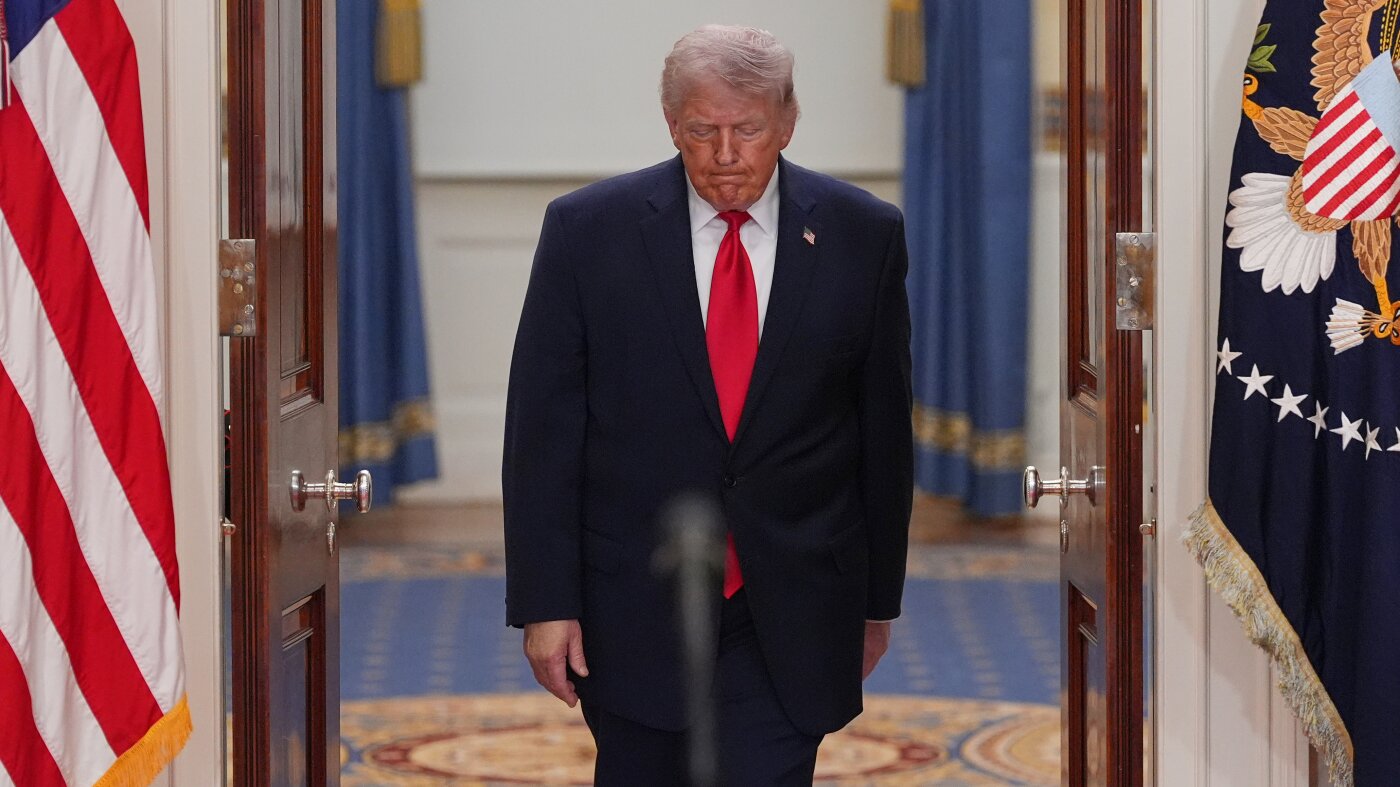
President Donald Trump arrives to speak about the Iran war from the Cross Hall of the White House on Wednesday, April 1, 2026, in Washington. (AP Photo/Alex Brandon, Pool)
Alex Brandon/AP Pool
hide caption
toggle caption
Alex Brandon/AP Pool
BOSTON — A federal judge has halted efforts by the Trump administration to collect data that proves higher education institutions aren’t considering race in admissions.

The ruling from U.S. District Court Judge F. Dennis Saylor IV in Boston on Friday granting the preliminary injunction follows a lawsuit filed earlier this month by a coalition of 17 Democratic state attorneys general. It will only apply to public universities in plaintiffs
The federal judge said the federal government likely has the authority to collect the data, but the demand was rolled out to universities in a “rushed and chaotic” manner.
“The 120-day deadline imposed by the President led directly to the failure of NCES (National Center for Education Statistics) to engage meaningfully with the institutions during the notice-and-comment process to address the multitude of problems presented by the new requirements,” Saylor wrote.
President Donald Trump ordered the data collection in August after he raised concerns that colleges and universities were using personal statements and other proxies to consider race, which he views as illegal discrimination.

In 2023, the Supreme Court ruled against the use of affirmative action in admissions but said colleges could still consider how race has shaped students’ lives if applicants share that information in their admissions essays.
The states argue the data collection risks invading student privacy and leading to baseless investigations of colleges and universities. They also argued that universities have not been given enough time to collect the data.
“The data has been sought in such a hasty and irresponsible way that it will create problems for universities,” a lawyer for the plaintiffs, Michelle Pascucci, told the court, adding that the effort seem was aimed at uncovering unlawful practices.
The Education Department has defended the effort, arguing taxpayers deserve transparency on how money is spent at institutions that receive federal funding.
The administration’s policy echoes settlement agreements the government negotiated with Brown University and Columbia University, restoring their federal research money. The universities agreed to give the government data on the race, grade-point average and standardized test scores of applicants, admitted students and enrolled students. The schools also agreed to be audited by the government and to release admissions statistics to the public.
The National Center for Education Statistics is to collect the new data, including the race and sex of colleges’ applicants, admitted students and enrolled students. Education Secretary Linda McMahon has said the data, which was originally due by March 18, must be disaggregated by race and sex and retroactively reported for the past seven years.
If colleges fail to submit timely, complete and accurate data, the administration has said McMahon can take action under Title IV of the Higher Education Act of 1965, which outlines requirements for colleges receiving federal financial aid for students.
The Trump administration separately has sued Harvard University over similar data, saying it refused to provide admissions records the Justice Department demanded to ensure the school stopped using affirmative action. Harvard has said the university has been responding to the government’s requests and is in compliance with the high court ruling against affirmative action. On Monday, the Education Department’s Office for Civil Rights directed Harvard to comply with the data requests within 20 days for face referral to the U.S. Justice Department.

Detroit, MI2 hours ago
Detroit Tigers defeated by St. Louis Cardinals 5-3

San Francisco, CA2 hours ago
Equipment problem causes delays at BART’s Embarcadero station

Dallas, TX2 hours ago
Los Angeles Lakers vs Dallas Mavericks Apr 5, 2026 Game Summary

Miami, FL2 hours ago
Miami teacher walks 120 miles in Spain to give students their first school dance

Boston, MA2 hours ago
Boston Weather: Mostly dry skies, late-week warm-up incoming

Florida1 year ago
Florida High School Football Rankings: Top 25 teams – Oct. 21

Oregon2 years ago
How old is Bo Nix? What to know about Oregon quarterback ahead of 2024 NFL Draft

Connecticut2 years ago
Cleary's 21 help Le Moyne down Central Connecticut State 69-64 in OT

Virginia2 years ago
99th annual Pony Swim held in Virginia

Indiana2 years ago
Indiana Members Credit Union announced as new anchor tenant at Bottleworks District

Politics10 hours ago
Tax day is next week: Avoid these 5 common mistakes that can cost you money

World11 hours ago
Hamas armed wing says disarmament demands not acceptable

News12 hours ago
Trump issues fiery new threat against Iran as details of US aviator’s rescue emerge

Politics22 hours ago
DHS slams Democrat Sen Chris Van Hollen claim, says illegal alien caused crash while fleeing ICE

World23 hours ago
Zelenskyy warns US-Iran war could divert critical aid from Ukraine
-

 South-Carolina1 week ago
South Carolina vs TCU predictions for Elite Eight game in March Madness
-

 Atlanta, GA1 day ago
1 teenage girl killed, another injured in shooting at Piedmont Park, police say
-

 Vermont1 week ago
Skier dies after fall at Sugarbush Resort
-

 Movie Reviews4 days ago
Vaazha 2 first half review: Hashir anchors a lively, chaos-filled teen tale
-

 Politics1 week ago
Trump’s Ballroom Design Has Barely Been Scrutinized
-

 Atlanta, GA1 week ago
Fetishist ‘No Kings’ protester in mask drags ‘Trump’ and ‘JD Vance’ behind her wheelchair
-
 Entertainment4 days ago
Inside Ye’s first comeback show at SoFi Stadium
-

 Politics1 week ago
JD Vance says he was ‘obsessed’ with UFOs, believes aliens are actually ‘demons’