News
2 years and counting. Inmate says medical delays still plague federal prison in Oregon

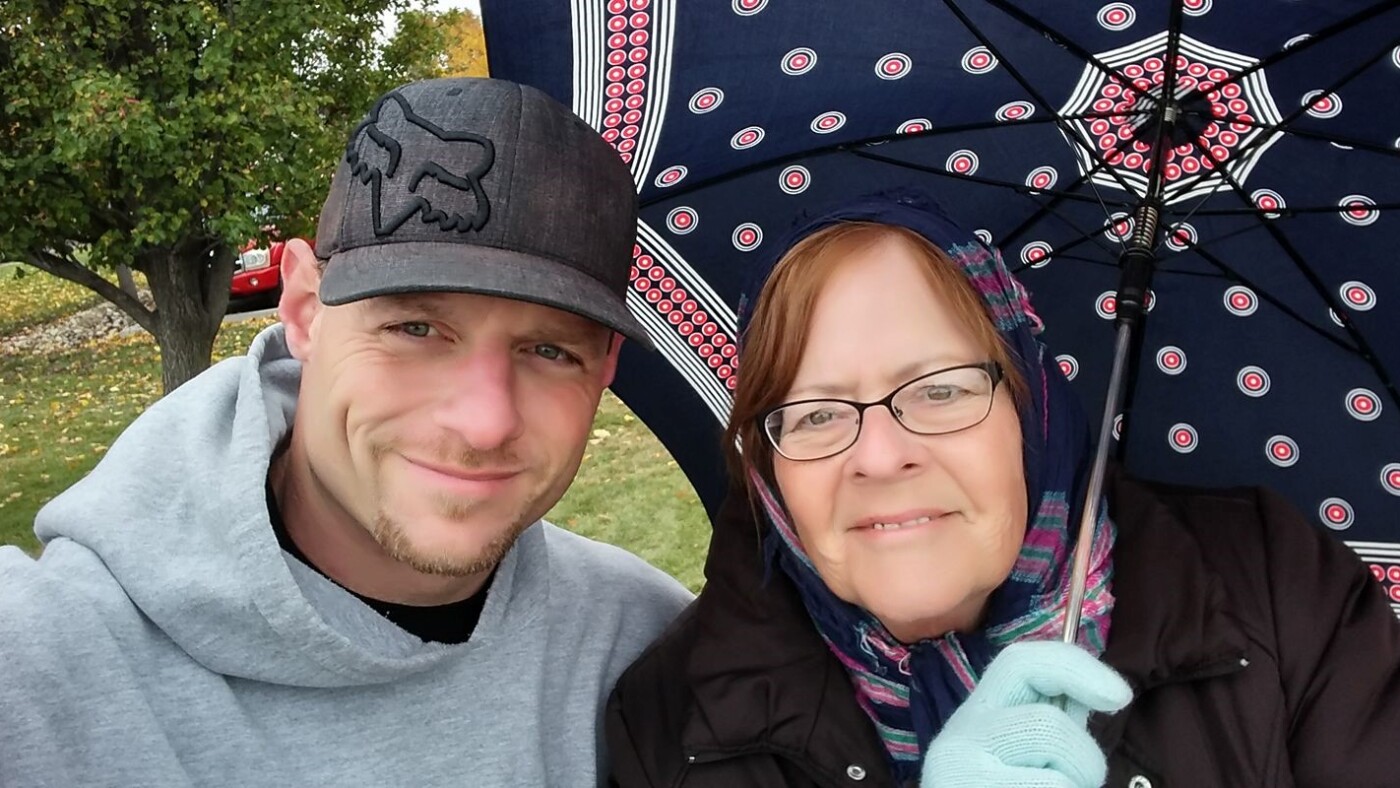
Luke Thornhill and his mother, Nancy Richardson, in an undated photo.
Nancy Richardson
hide caption
toggle caption
Nancy Richardson
Luke Thornhill is scheduled to be released from an Oregon prison in four years.
He’s terrified he might die before then.

He has family waiting for him in Idaho, “And I’m scared I’m never gonna see them again,” Thornhill said during multiple calls with NPR from prison.
He’s scared because he’s been suffering from serious medical issues — including severe abdominal pains, bloody bowel movements and a swollen abdomen — since at least 2022, when he was incarcerated in a different facility. And he says he has not been able to get the treatment that he needs.
“If you looked at my stomach, it bulges out on the right side, like the size of a grapefruit. And it just hurts all the time,” Thornhill says.
Now, he feels worse than ever, he says. Constant pain makes it difficult even to sleep through the night.
“If I’m not careful with what I eat or drink or careful of how I move then I’m in worse pain and bleeding even worse.”
Thornhill was sentenced to 80 months in federal prison on drug charges in March 2023.
In 2022, while incarcerated in Idaho, he underwent a colonoscopy, during which two polyps were removed.
After Idaho, Thornhill was moved to SeaTac, the federal prison in Seattle, and earlier this year was moved to the federal facility in Sheridan, Ore.
Since he left Idaho, Thornhill says, he hasn’t reviewed the biopsy results with any doctors at either SeaTac or Sheridan — and nothing about his situation has changed.
“We’re talking about something that I’ve been dealing with for a year now. I’ve been literally suffering for the last year. And I’ve been begging them to give me treatment for this,” he says. “Nobody can tell me there isn’t something wrong with me.”
The federal Bureau of Prisons said in response to specific questions about Thornhill’s complaints that “For privacy, safety, and security reasons, we do not discuss any individuals’ conditions of confinement, to include health status or medical treatment plans.”
Problems with prison health care are well documented
Delays or substandard health care for prisoners in the U.S. carceral system are not uncommon. In 2023, NPR published a report showing that nearly 5,000 federal prisoners died over the past decade from treatable conditions after not getting timely diagnoses or treatment while incarcerated.
Lawmakers have begun to put the U.S. federal prison system under more scrutiny. In late July, President Biden signed the Federal Prison Oversight Act into law, which mandates routine inspections of all federal Bureau of Prison’s facilities and the creation of an ombudsman to investigate the welfare and safety of inmates and staff.
The prison at Sheridan, in particular, has been criticized recently for medical delays, and at the end of 2023, investigators with the Justice Department launched an unannounced inspection of the facility.
In May 2024, the Justice Department’s Office of the Inspector General released a report that concluded staffing issues at Sheridan contributed to more than 100 missed inmate medical appointments between January and November 2023 and a backlog of hundreds of lab tests and pending X-ray orders — leading to medical conditions potentially going undiagnosed.
In response, the federal Bureau of Prisons said it made several changes since the inspection — including hiring more staff and making a substantial dent in the number of missed appointments and the testing backlog.
As of May 2024, the backlog of laboratory orders dropped to 44 from 725 and the backlog of pending X-ray orders was 84, down from 274, according to the inspection report. The BOP reported that 89 of 101 appointments had been completed since the OIG inspection.
But Thornhill and at least two other Sheridan inmates that reached out to NPR say they are still in dire need of medical care. Their repeated requests to see a doctor are not being addressed, they say. Thornhill says Sheridan’s claims that officials addressed the major backlog of lab tests and X-rays is flat-out wrong.
“The BOP is definitely broken,” Thornhill says.

An outside view of the federal prison in Sheridan, Ore., from 2018. In May, the Department of Justice’s Office of the Inspector General issued a report criticizing the prison’s backlog of medical requests.
Andrew Selsky/AP
hide caption
toggle caption
Andrew Selsky/AP
During the reporting of this story, NPR reviewed medical records and several requests for medical care that Thornhill sent to prison officials in Idaho and Seattle.
He said that for months he wasn’t able to make copies of documents or access his medical file and requests at Sheridan. Late this month, he reported finally getting copies of those records.
And, he told NPR, that despite submitting numerous requests for medical care at Sheridan, he discovered recently that officials there only have one of his requests for medical help on file.
Regarding Thornhill’s complaints about access to his medical records, the Bureau of Prisons said inmate medical records are “available for review upon request by any incarcerated person” who uses the proper request procedures. The requests should be processed within 30 days, the BOP said.
“All requests and the issuance of records are documented in the individual’s medical record. Currently, FCI Sheridan has no request for medical records older than 10 days, before fulfilment,” the BOP told NPR in a statement.
But Thornhill says that in the past, he has made multiple requests that were not honored.
BOP says it’s made changes
The OIG and the federal Bureau of Prisons have pointed to severe staffing shortages as a significant contributing factor to ongoing problems with the federally run prison system.
The BOP “has been transparent that staffing across the agency remains a challenge, as the FBOP is faced with the same worker shortage experienced by employers throughout the country,” the agency said in a statement to NPR. “The work to address these challenges is ongoing and includes a robust national recruitment strategy with the assistance of an external contract consultant.”
The agency told NPR in July that approximately 70% of positions in Sheridan’s Health Services Department are filled. Correctional services positions, such as guards, are approximately 87% filled.
Competing claims on test backlogs
One of the procedures Thornhill wanted to have done was an X-ray.
After the OIG report, Sheridan said X-ray order backlogs were being addressed. But Thornhill says that isn’t the case.
After the Sheridan report was published, Thornhill says he and about 100 other inmates were called to be taken to receive X-rays. Instead, he alleges that corrections staff repeatedly pressured him and other inmates — even some with broken bones — to sign forms refusing those X-rays.
Thornhill claims that officers at the prison made the experience as uncomfortable as possible — handcuffing each prisoner tightly around the wrists, putting them in cramped rooms and buses, serving them frozen meals without warming them up — to discourage them from wanting to undergo the process again. Thornhill believes the reason was to get the official number of X-ray requests down. He says he never signed the forms, but after a couple of months, still has not received an X-ray.
He says that of the couple dozen men who remained to get X-rays, only six or so were able to get the procedure done before staff said the machine was broken.
In response to these claims, the BOP said, “For privacy, safety, and security reasons, we do not discuss any individuals’ conditions of confinement, but as noted above, policy requires medical treatment which meets community standards and staff misconduct is not tolerated.”
It’s rare for prisoners to see an actual doctor, Thornhill says
Thornhill’s attempts to see a doctor for his medical issues go back to his time at SeaTac. Incarcerated there in 2023, he says he submitted several requests for follow-up medical treatment after his 2022 colonoscopy and as his symptoms appeared to worsen.
While at SeaTac, he was part of a group of inmates who spoke to the Seattle Times in an article published in February of this year about serious delays in medical care at that prison.
It was after this story published that Thornhill was moved to Sheridan.
He says he believes the move was punishment for speaking out about conditions at SeaTac.
In response to questions on Thornhill’s claims, the BOP said, “We cannot speak to this particular case, but FBOP does not tolerate staff misconduct, including retaliation. Consistent with national policy, all allegations of employee misconduct are referred to the FBOP’s Office of Internal Affairs” that are also reviewed by the Office of the Inspector General.
“Allegations of misconduct are thoroughly investigated, and appropriate action is taken if such allegations are sustained, including the possibility of referral for criminal prosecution when appropriate,” the BOP said.
Thornhill says his symptoms have continued to worsen while at Sheridan, and that nothing has happened after his numerous requests to see a doctor and have other tests done.
Requests to be seen by a nurse, doctor or dentist are a multistep process. In order to see medical staff at Sheridan, Thornhill says, inmates submit requests through the prison computer system. Inmates also submit a paper “cop out” or a physical request to be seen by medical staff.
After putting in the requests, inmates go down for sick-call, held four days a week
The Sheridan Admission and Orientation Handbook states this is “the most efficient way to obtain an examination by a physician or an outside specialist.” Inmates explain the “problem to the P.A. or nurse, and they will refer you to a physician, if your condition warrants it.”
For months, Thornhill says, “No matter how many times I put in to see a doctor, they call me down there and I end up seeing another nurse and she basically tells me she doesn’t know what’s going on with me and that she’ll put me in to see the doctor.” He adds that it’s not just him, it’s rare for anyone to see an actual doctor and when they do “it’s for basic stuff” like an ingrown nail.
It’s such a problem that Thornhill alleges inmates are turning to each other to get basic drugs for blood pressure or antibiotics — a not uncommon practice in prison.
In response, a BOP spokesman said the agency “does not comment on the conditions of confinement for any individual or group of individuals in our custody. Nor do we comment on anecdotal allegations.”
The BOP said it “takes pride in protecting and securing individuals entrusted in our custody” and makes “every effort to ensure the physical, medical, and mental safety” of those individuals.
Sheridan employs two medical doctors and one mid-level provider in the prison’s Health Services Department for its 1,539 inmates, according to the agency.
The BOP said in its statement to NPR that “Sheridan provides onsite medical provider coverage 14-hours per day, including weekends and holidays. The FBOP and FCI Sheridan provides essential medical, dental, and mental health services in a manner consistent with accepted community standards for a correctional environment.”
“All incarcerated individuals have daily access to medical care and appointments, and medical staff conduct daily rounds throughout each facility,” the agency continued.
“Each patient is independently treated on a case-by-case basis, and treatment is provided as clinically indicated.”
Only after NPR contacted representatives of Sheridan and the Bureau of Prisons about Thornhill’s situation did Thornhill report to us in mid-July that he finally saw a doctor and a cardiologist, who both agreed “something was wrong and ordered more tests,” he wrote in a letter to his mother shared with NPR.
This development gives Thornhill little confidence.
“I’m trying to be optimistic about it but it’s hard when I’m still in the same position I was. Hopefully they actually get me to the hospital to do these tests! I am going to pray about it and hope for the best,” he wrote to NPR in July.

Luke Thornhill in an old, undated photo. Thornhill is currently incarcerated in a federal prison in Sheridan, Ore., where he says prison officials are not addressing his and other inmates’ dire medical needs.
Nancy Richardson
hide caption
toggle caption
Nancy Richardson
Thornhill is under lockdown
In late July, Thornhill told NPR that Sheridan was under lockdown. The BOP confirmed that the prison was on “modified operations” but declined to provide specific details “for safety and security reasons.”
As of this week, the BOP confirmed to NPR that, aside from one unit, the prison has returned to normal operations.
For weeks, prison officials seriously curtailed communications and kept inmates in their cells most of the day. Though the lockdown has since been adjusted, Thornhill reports inmates are still only allowed to leave their cells for about 40 minutes a day.
Thornhill’s mother, Nancy Richardson, contacted NPR and lawmakers on his behalf as he’s struggled with medical issues since being incarcerated. She says she was only able to speak with him for five minutes every few days during the lockdown.
She’s 69 and lives in Idaho and hasn’t been able to visit her son since he’s been in federal custody. The lockdown made her more fearful for her son and his health.
“He’s sick and he’s needing medical care, and it’s just disheartening to not be able to do one thing about it,” she says. “I think people need to know what’s going on here.”
At the beginning of August, Thornhill was taken to an emergency room outside the prison via ambulance due to extremely high blood pressure. He has since returned to Sheridan, he and his mother confirmed.
There, he says, he finally received an X-ray of his chest.

News
Ukraine latest / Limits of military might / Can major powers regain dominance? : Sources & Methods

A view taken on June 24 shows a heavily damaged multi-story apartment building following a recent attack, which local Russian-installed officials called a Ukrainian drone strike, in the town of Gorlivka in the Donetsk region, Russian-controlled Ukraine, amid the ongoing Russian-Ukrainian conflict.
AFP via Getty Images
hide caption
toggle caption
AFP via Getty Images
Four years in and Ukraine is still giving Russia a run for its money. Four months in and Iran shows no sign of bowing to U.S. demands.
What do Russia’s fight with Ukraine and the U.S. war with Iran tell us about the limits of military might?
Host Mary Louise Kelly speaks with NPR’s Ukraine Correspondent Joanna Kakissis about the overnight attack in Kyiv, which comes on the heels of Ukraine’s drone assaults in Moscow. NPR National Security Correspondent Greg Myre joins them to talk about what the conflicts in Ukraine
and Iran say about military might and whether major powers can regain dominance.
Email the show at sourcesandmethods@npr.org
NPR+ supporters hear every episode without sponsor messages and unlock access to our complete archive. Sign up at plus.npr.org.
News
Newsom’s office responds to SCOTUS ruling on women’s sports as California faces ongoing trans athlete wave

Linda McMahon slams Democrats for dismissing women’s sports concerns
Education Secretary Linda McMahon discusses the Supreme Court’s ruling upholding transgender sports bans, emphasizing the need to protect women’s sports. McMahon highlights the impact on female athletes, addressing concerns about fairness, lost opportunities, and safety in locker rooms. She criticizes Democrats for their dismissal of these issues, reaffirming the Trump administration’s commitment to defending women’s rights under Title IX.
California Gov. Gavin Newsom’s office has responded after the U.S. Supreme Court made a historic ruling on trans athletes in women’s sports on Tuesday.
The court ruled 6-3 to uphold state laws that protect women’s sports from biological male trans athletes. California is one of 23 states in the country that don’t have laws to protect women’s sports, and since 2014, has had a law in place to protect the rights of males to compete against females.
A spokesperson for Newsom’s office said the Supreme Court ruling will not impact California’s current setup.
SUPREME COURT MAKES RULING ON TRANS ATHLETES IN WOMEN’S SPORTS
California Gov. Gavin Newsom speaks during a press conference in Hayward, California, on March 2, where he criticized President Donald Trump’s decision to strike Iran. (Tayfun Coskun/Anadolu via Getty Images)
“The Supreme Court’s decision does not affect California’s laws. The state remains committed to ensuring every Californian, including the LGBTQ community, is met with dignity and respect,” the spokesperson told Fox News Digital.
A source within Newsom’s office provided Fox News Digital a bulleted list titled “As a Governor, Governor Newsom has the strongest record in the country on protecting and expanding transgender rights.”
The list included several bragging points, including “making it easier to update gender markers on official documents,” and “appointed multiple trans judges.”
The list concludes by pointing out, “California is one of 22 states that have laws requiring transgender students to participate in sports consistent with their gender identity. California passed this law in 2013 (AB 1266) and it was signed into law by Governor Jerry Brown.”
Newsom’s state was ravaged by a trans athlete national media crisis in May, for the second year in a row and third time in total in one year, as prominent trans athlete AB Hernandez competed in girls’ sports.
Hernandez won two track and field state titles for the second straight year. Ahead of the first round of the state tournament in early May, “Save Girls Sports” protesters led by former NCAA women’s soccer player Sophia Lorey scheduled a press conference near the competition grounds.
AB HERNANDEZ ADVANCES IN CALIFORNIA STATE CHAMPIONSHIP AS SAVE GIRLS’ SPORTS ACTIVISTS RALLY NEARBY
A source within Newsom’s office previously addressed the press conference in the days leading up to the event in a statement provided to Fox News Digital, prompting controversy and criticism from locals.
“The Governor has said discussions on this issue should be guided by fairness, dignity, and respect. He rejects the right wing’s cynical attempt to weaponize this debate as an excuse to vilify individual kids. The Governor’s position is simple: stand with all kids and stand up to bullies,” the statement read.
The governor faced mass backlash from activists across the country for his office’s statement. The controversy only exploded the very next week when it was revealed the California Interscholastic Federation (CIF) re-implemented a pilot program that bumped every girl who finished behind the trans athlete up by one spot on the podium. The change resulted in now-infamous imagery of Hernandez sharing podium spots with the female second-place finishers.
President Donald Trump’s Department of Justice is engaged in Title IX lawsuits against education agencies in California for its policies that allow trans athletes in girls’ high school sports. The lawsuit was officially launched in July after Hernandez won two state finals in triple jump and high jump, and won second place in long jump, at last year’s championships.
Newsom previously declared that he believed males competing in girls’ sports is “deeply unfair” during an episode of his podcast with the late Charlie Kirk in March 2025.
Then in July 2025, Newsom spoke about the issue in an interview on the “Shawn Ryan Show” saying he has been “amazingly frustrated by it” and that he regularly encounters parents who are angry about the state’s policies at his children’s soccer games.
“Every parent coming up says, ‘It’s so unfair.’ Like ‘Whoa,’ like everywhere I went, progressively-minded people, not bigots, that are champions of trans policy like I am, but didn’t like the sports. They were like ‘come on man, you got to figure this out,’” Newsom said.
Newsom added that his allies in the LGBTQ caucus were “furious” with him after he made his initial comments in March while speaking to Kirk, and even recalled an alleged conversation with President Donald Trump about it.
CLICK HERE TO DOWNLOAD THE FOX NEWS APP
“Trump is having the time of his life, and I assure you he is because we’ve had conversations on this topic,” Newsom said.
“And now he’s suing and threatening us, and they’re just, and you know, I’m the poster child,” Newsom added. “But I do think we have to address that issue.”

Why are there so many Greeks in Tarpon Springs, Fla.? Because in the early 1900s, Greek sponge divers came from the Dodecanese islands and revolutionized the sponge industry on Florida’s gulf coast.
What explains the pockets of Portuguese and Cape Verdeans in New Bedford, Mass.? In the 1800s, winds pushed whaling boats east to the Azores and Cape Verde, where experienced whalers joined the crews.
There’s the Basque population in Boise, Idaho, whose ancestors traded a mountainous region between France and Spain for the American West in the hopes of finding gold but later turned to sheep herding. There are the families of Yemeni immigrants hired by Ford Motor Company to build cars in Detroit, and the Vietnamese refugees who were resettled near New Orleans and Houston, where they could carry on shrimping.
These stories are everywhere on this map of American ancestry, which shows how people described their backgrounds to the Census Bureau. There are nearly 200 unique identities represented; blend them — as 340 million Americans do — and we arrive at a jumbled, overlapping, story-filled infinity.
Much of what we see is a history of immigration. Over 250 years, the country has absorbed more than 100 million people. We can trace the pressures that pushed and pulled them here — and the policies that welcomed certain groups while keeping others out — through the patterns in where their descendants live today.
Now, a larger share of the country was born abroad than ever before, and the Trump administration’s sweeping immigration bans echo exclusionist policies enacted in response to similar demographic conditions a century ago.
Those policies defined Americans for generations. Recent efforts to limit immigration will likewise affect how future Americans understand their heritage and themselves.
How we got here
In the late 1700s, the area that would become the present-day United States was already diverse. At least 1.5 million Native people, and possibly many more, were living across the territory. They were joined by about three million Europeans and enslaved Africans living in both the English colonies and the French and Spanish territories.
From colonial times, immigration was an important contributor to population growth. It accelerated as the new country’s territory expanded west and immigrants arrived to settle it. From 1820 to 1860, more than five million people came, through a mostly open door.
With the advent of the steamship, the cost of passage plummeted, and companies offered special immigrant fares that were often coupled with rail tickets to the interior of the country. Once a community of immigrants was established somewhere, it tended to grow.
After 1840, immigration from Western Europe began to rise quickly as political instability in Germany and the famine in Ireland drove people to leave. Asian immigrants, drawn by the discovery of gold in California in 1848, were recruited to work on farms and railroads.
Later in the 19th century, pogroms across Eastern Europe and the aftermath of Italian reunification drove a surge of migration to the United States. From 1880 to 1920, 24 million immigrants arrived. They went almost everywhere except the South, where the land-owning elite already had cheap labor from the formerly enslaved and poor tenant farmers.
Cities swelled. In 1910, according to the Ellis Island National Museum of Immigration, three-quarters of the residents of Boston, Chicago, Cleveland, Detroit and New York City were immigrants or children of immigrants.
1850
2 million total immigrants
The 1850 census did not include data on the birthplace of enslaved people.
1910
14 million total immigrants
1970
9 million total immigrants
2024
50 million total immigrants
Many rural areas in the Midwest had a similar share of immigrants in 1910, but newcomers to the cities tended to be from novel sources like Russia or Italy. That meant there were more languages, more cuisines and more workers. It also meant there were more crowds, more slums and more people behaving in unfamiliar ways — fodder to drive views that the new immigrants were unassimilable and that policies were needed to keep them out.
The first federal law to severely limit immigration had come much earlier, in 1882, when practically all Chinese people were barred from entering the country. More restrictions followed, and eventually animosity toward new immigrants led to the passage of laws in the 1920s creating a quota system tied to nationality.
Western Europeans were given generous quotas and Southern and Eastern Europeans much smaller ones. For the rest of the Eastern Hemisphere, the quotas were set to almost nothing. Ships raced through the night to reach New York Harbor, all trying to be first to dock at Ellis Island.
There weren’t quotas for countries in the Americas and the Caribbean, but there were other restrictions. Mexicans faced mass deportation campaigns in the 1930s and 1950s, even as millions were recruited as temporary workers to fill agricultural jobs across the Southwest.
Over the next 40 years, these rules drove the foreign-born population in the United States to its lowest levels. Children of immigrants replaced immigrants, blending into American society while retaining their own cultural traditions.
Then, alongside the civil rights movement of the 1960s, activists and lawmakers who saw the national quota system as racist pushed to replace it with one based on employment and family ties.
Another decades-long wave of immigration followed, this time from different parts of the world.
Chart data is unavailable.
Share of immigrants in the United States by region of birth
The new rules allowed people to sponsor their family members and relatives, and they gave preference to workers with advanced degrees and specialized skills. The family visas, in particular, led to an unforeseen boom in immigration.
An expanded refugee program also brought more immigrants, many from Southeast Asia who were displaced by Cold War conflicts.
For the first time, immigrants from the Western Hemisphere faced limits on their numbers. Similar to the European workers who arrived earlier in the century, many chose to settle in the United States permanently instead of risking returning to their home countries between periods of working in the United States. Millions who couldn’t get visas turned to entering illegally.
The most recent immigration wave, during the Biden administration, was different still: The number of visas for immigrants remained steady, while migrants from Central America arrived at the southwest border in large numbers to seek asylum. Desperate conditions in Cuba, Haiti and Venezuela, as well as wars in Afghanistan, Ukraine and elsewhere led hundreds of thousands of people to flee to the United States — many of them drawn to established communities of immigrants from their countries.
Where we are today
The lines of American ancestry today are not neatly drawn, and groups overlap and spill into one another. Some people don’t answer the census questions about their origins at all. For others, it’s complicated. Descendents of enslaved people, for example, may identify themselves as African American because they are unable to trace their roots to a specific place.
Many areas have truly mixed populations, with people of several different ancestries nearly equally represented.
Take this area just southwest of Houston, for example:
Nigerian, Jordanian, Mexican, Vietnamese, African American, Salvadoran, Iraqi, German, English, Irish and Chinese people are all among the top groups in these neighborhoods.
Every city has its own distinct pattern, visualized in the the patchwork of gold, green and blue in Los Angeles, the stark reds, blues and yellows of Chicago, a purple Minneapolis, a green Honolulu:
Who comes next?
If the patterns in these maps reflect the immigration policies of at least a century ago, we can expect them to shift and change again as a result of contemporary decisions about who makes up the American mosaic.
No comprehensive immigration legislation has passed Congress since the 1980s. After a surge of immigration during the Biden administration, in which an estimated eight million people entered the country over three years, demographic experts now estimate that the United States could reach net-zero or negative immigration sometime soon. That is in part because of the Trump administration’s aggressive actions to speed deportations of people who are in the country illegally and to limit pathways to legal immigration.
At the same time, the factors that pull immigrants to the United States remain strong. And, unlike 100 years ago, the country now faces a declining population and work force. The tension between the need for new workers and resurgent nativist politics will influence who comes, who settles and who is counted among the ancestors of future generations.
About the data
The ancestry maps in this article and the related interactive map draw from seven tables of race, ethnicity and ancestry data that the Census Bureau published as part of the American Community Survey estimates for 2019-2024.
The census ancestry and origin data are estimates based on a sample of the population and include margins of error that can be large for small population groups. We used the estimates published by the Census Bureau without adjustment.
In the survey, respondents are asked questions about their race and whether they are of Hispanic or Latino origin. Each of those questions allows respondents to list their national origins. An additional question asks about their ancestries. People can claim multiple ancestries or origins and appear in multiple categories.
Some groups appear in multiple tables. For example, people can select “white” as their race and list “German” as a specific origin. Separately, anyone can also choose “German” in response to the survey’s ancestry question. For such groups, we used the table with the higher value for the country as a whole. In a small number of cases, similar ancestries were grouped together.
Colors for each census tract are blended based on the adjusted number of people who reported being of each race and ancestry in the tract, for each group above a minimum threshold.
In charts of the immigrant population, counts come from Census Bureau research publications, the 2000 census and the American Community Survey. Those counts include only foreign-born residents and exclude any descendants born in the United States.
-

 North Carolina4 minutes ago
Wake County woman says housing authority failed to pay thousands in rent for over a year
-

 New Jersey4 minutes ago
Air conditioning fails at Delaney Hall as heat wave leaves detainees struggling to breathe • The Jersey Vindicator
-

 New Mexico12 minutes ago
7 Best New Mexico Towns For Retirees
-

 North Dakota20 minutes ago
L.L. Bean to Open Store in North Dakota
-

 Ohio26 minutes ago
3 family members accused of murdering Ethan Vernon in Ohio
-
 Oklahoma29 minutes ago
New Oklahoma law requires emergency action plans for summer camps
-

 Oregon34 minutes ago
Here’s when you can see the Oregon Air National Guard flyovers on July 4
-

 Pennsylvania41 minutes ago
Fire tears through recycling center in Doylestown, Pennsylvania, officials say

