Wisconsin
Everything you need to know to register to vote in Wisconsin for the Nov. 5 election


How to register to vote in Wisconsin (you’ll need a have a photo ID)
Here’s how to register and vote in Wisconsin.
The Nov. 5 election is quickly approaching, and you may be seeing plenty of political ads on social media, television and elsewhere reminding you to register to vote.
Wisconsin is one of the 21 states with same-day voter registration, meaning if you decide you want to vote Nov. 5, you can register at the polls when you get there. But many people like to register beforehand, especially online.
Here’s a comprehensive guide to registering to vote in Wisconsin, including key deadlines, the materials you need, how long registration lasts, who qualifies and more:
Where and when can I register to vote in Wisconsin?
There are four ways to register to vote in Wisconsin: online, by mail, at your local clerk’s office or at your polling place on Election Day.
- Online through Oct. 16. You can register online at myvote.wi.gov, which is the state’s official website for voting registration. As long as the information you enter — like your address and driver’s license or ID card number — matches what the state DMV has on file, you’ll be able to register online. If not, you can register by mail.
- By mail, postmarked by Oct. 16. You can start filling out a registration form on myvote.wi.gov, but the form is also available here in English, Spanish and Hmong. You’ll need to print and sign the form, then mail or deliver it to your clerk’s office. If you’re registering by mail, you need to include a copy of a proof of residence document that’s not a lease.
- At your clerk’s office by Nov. 1 at 5 p.m. You can visit your clerk’s office during their business hours to register to vote, up until the Friday before the election at 5 p.m. You can find your clerk’s address here.
- At the polls on Election Day, 7 a.m. to 8 p.m. Wisconsin has same-day voter registration, so you can register when you get to your polling place.
More: Wisconsin election dates: Early voting, absentee requests, online registration deadline
What do I need to register to vote in Wisconsin?
You may have heard of Wisconsin’s photo ID law, which requires you to show photo identification to vote. You don’t need a photo ID when you’re just registering to vote, but you will need it when you vote at your polling place or request an absentee ballot.
Here’s what materials you do need to register:
- A driver’s license or state ID card, if you have it. If you have a valid driver’s license or state ID card, you will need to provide the number and expiration date. If your license or ID card is revoked, suspended or expired, or if you don’t have one, you will be asked for the last four digits of your Social Security number. If you have none of those things, there’s a place to note that and more information on the back of the form.
- Proof of residence. This proves that you live in the place where you are registering to vote in Wisconsin. Acceptable documents are explained in the section below.
More: Wisconsin voter ID law still causing confusion, stifles turnout in Milwaukee, voting advocates say
What is proof of residence for voter registration in Wisconsin?
Proof of residence shows that you live where you’re registering to vote in Wisconsin and is a different process than showing photo ID. It must show your current address, so if you’ve recently moved, it needs to reflect your new address. A driver’s license works as proof of residence, but only if it has your current address.
Here are more examples of proof of residence documents, and you can find more information here:
- A bank or credit card statement
- A paycheck or paystub
- A recent utility bill
- A real estate tax bill or receipt
- A residential lease, if it’s valid on the date of registration. You can’t use this one if you’re registering by mail
- An intake document from a nursing home or assisted living facility
- A university or college ID card with your photo. This can only be used if you have a fee receipt within the last nine months or if your college provides a housing list to the local clerk. This document provides more information for voters in college, and whether you can use your student ID as photo ID.
Your proof of residence doesn’t have to be a hard copy or paper version. You can also show it electronically on your phone or other electronic device if you’re registering at the polls, for example.
How long does voter registration last in Wisconsin?
If you vote often in elections, your registration shouldn’t expire. But if you haven’t voted in several years, it’s possible your name won’t be on the poll list when you go to vote. In that case, you’ll have to re-register to vote.
That’s because the state regularly cleans up its voter rolls, removing voters who haven’t voted in the last four years. The last time the state did that was in August 2023, deactivating about 100,000 voters who hadn’t voted since November 2018 and didn’t respond to a postcard asking if they wanted to stay registered.
There are other situations where you’ll need to re-register to vote:
- If you’ve moved since the last election. State law says you should register at your new address as long as you’ve lived there for at least 28 days before Election Day. If it’s less than 28 days, you must vote from your old address, either at your previous polling place or by absentee ballot. If you move to a new address, it could change which aldermanic ward or legislative district you vote in, for example.
- If you’ve changed your name. If you’ve legally changed your name, you’ll also need to re-register. You can start on myvote.wi.gov, and you might need to search using your previous name.
You’ll also need to provide the previous address or name you were registered under on your new form. You can always check if you’re currently registered to vote by typing in your name and date of birth at myvote.wi.gov.
Can I register to vote in Wisconsin if I have a felony?
One of the eligibility checkboxes on the registration form reads as follows: “Are not currently serving a sentence including incarceration, parole, probation, or extended supervision for a felony conviction.”
That’s also known as being “on paper.” Once you are “off paper,” you can vote, but you’ll have to re-register. Voting rights are also restored if you’re pardoned.
People in jail can still vote if they haven’t been convicted of a felony or treason or bribery misdemeanors, or if they’re being held on bail and haven’t been convicted.
More information is available here. The ACLU of Wisconsin also has an information page.
More: What to know about voting rights for felons in Wisconsin
How old do I have to be to vote in Wisconsin?
You must be at least 18 years old on or before Election Day to vote. You can register to vote if you’re not yet 18 but will turn 18 by Nov. 5.
How many registered voters does Wisconsin have?
As of Sept. 1, 2024, Wisconsin had 3,503,706 active registered voters. Wisconsin doesn’t collect information on the gender, race or political party of voters — you don’t register as a Republican or Democrat when you register to vote in Wisconsin.
The latest numbers show the 18-24 age group in Wisconsin has the lowest number of registered voters, at just over a quarter of a million. The 65-and-older age group has the most, at over a million.
What is MyVote WI?
MyVote.wi.gov is the official state website for voter registration and information. It’s run by the Wisconsin Elections Commission, which is the statewide board that maintains the voter database, gives guidance to local clerks, ensures compliance with election laws and other duties.
Here’s a list of things you can do on myvote.wi.gov, and links to that section of the website:
The Wisconsin Elections Commission also has a toll-free voter hotline: 866-VOTE-WIS (868-3947).
Have more questions about voting in Wisconsin? Let us know.
We want to hear what questions you have about the voting process in Wisconsin. Let us know what you’re curious about and we may answer your question in an upcoming story.



New Wisconsin athletic director Shawn Eichorst, who spent the last eight years at Texas, believes his new and old schools have much in common.
Both are well-regarded research universities in state capitals that belong to major conferences and have relatively similar enrollments.
He also pointed out one difference.
“There’s swag at Texas, right?” Eichorst said Tuesday during his introductory news conference. “There’s 30 million people in Texas. We’ve got swag, too, but we have a little humility with that deal. We need to get our shoulders up. We need to feel good about what it is that we’re doing.”
Wisconsin could gain more of that Texas swagger if its football program gets back to winning the way it did the last time Eichorst was employed in Madison. Eichorst, who most recently worked as a deputy athletic director at Texas, received a five-year deal worth $1.6 million annually, with provisions for increases and incentives. He was hired 2½ months after Chris McIntosh left to become the Big Ten’s deputy commissioner for strategy.
Eichorst worked at Wisconsin from 2006-11 when Barry Alvarez was AD and Bret Bielema was leading the football program. He followed that up with stints as an athletic director at Miami (2011-12) and Nebraska (2012-17) before Texas athletic director Chris Del Conte hired him in 2018.
He returns to Wisconsin with the Badgers coming off back-to-back losing seasons in football, a notable fall for a program that had 22 straight winning seasons from 2002-23. Wisconsin coach Luke Fickell has gone 17-21 after posting a 53-10 record with one College Football Playoff appearance in his last five years at Cincinnati.
Eichorst hasn’t worked with Fickell before but said he’s encouraged by their initial conversations.
“Obviously he’s won every place he’s been,” Eichorst said. “My expectation is more of me than him, meaning I need to pour into him, learn more about his program, how he has things set up, how his athletes are taken care of, how we’re supporting that endeavor. And then we can figure out, as we move along, what that might look like.”
Football struggles led to Eichorst’s downfall the last time he was an athletic director.
He fired Nebraska coach Bo Pelini in 2014 and hired Mike Riley, who had gone 93-80 in 14 seasons at Oregon State. Eichorst was dismissed shortly after Nebraska suffered an early-season loss to Northern Illinois in 2017. Riley was fired at the end of that season after going 19-19 in three years.
When Eichorst’s hiring was announced last week, he spoke about how much he had grown from that Nebraska stint. Wisconsin interim chancellor Eric Wilcots led the search and has emphasized Eichorst’s accomplishments at Texas, which has won the Learfield Directors’ Cup all-sports standings five times in the last six years.
Texas ranked anywhere from fifth to ninth in the Directors’ Cup standings in the five years before Wilcots’ arrival. Texas’ football team went a combined 23-27 from 2014-17 but has made two College Football Playoff appearances in the last three years.
“Everybody looks at the end result of what we did at Texas,” Eichorst said. “When we got there in 2018, we weren’t very good in a lot of areas. And that didn’t change overnight.”
Eichorst said one thing that has caught his attention about Wisconsin is the overall quality of its head coaches.
“You’re going to be as good as your coaches,” Eichorst said. “That’s it. If you have an elite group of coaches who are working together and uniting and galvanizing and learning from one another and taking it out to their individual programs, I think you can start to build something special. I go back to Texas. We built a room of really elite head coaches and put them at the top of everything we did to help guide us.”
Eichorst said this job is particularly important to him because of his Wisconsin roots. He was born in Lone Rock, about 45 miles northwest of the Madison campus.
He treasured his previous stint at Wisconsin and says he believes this school “represents everything that is great about higher education and college athletics.”
“Nobody will work harder for Wisconsin athletics,” Eichorst said. “I love this state, and I love everything that it represents. The passion is there. You can see it. I don’t have to make it up. I’ve lived it. It’s in my heart.”
___
AP college sports: https://apnews.com/hub/college-sports
Wisconsin
South Milwaukee, Wisconsin, officials in standoff with homeowner over year-round skeleton display

The city of South Milwaukee, Wisconsin, has ordered a homeowner to take down his year-round giant skeleton display or face fines, but the homeowner is standing firm and refusing, even as the deadline to remove the display has passed.
Now there’s a skeleton standoff.
The city cited ordinance violations in their order for Sean Oster to dismantle the lawn decorations. The notice specifically references “large Halloween decorations being displayed not during the appropriate time of year.”
Oster was also ordered to make other improvements to his property.
But Oster has refused to take down the display, which is re-dressed as the year goes on and is currently sporting a Fourth of July theme. The Institute for Justice, a public interest law firm, has come to his aid, saying the city’s actions violate Oster’s First Amendment rights.
City administrators declined to comment, citing a pending investigation. Neighbors have been divided by the display; some say they’re fine with it, and think it brings fun and positivity to the neighborhood, but some others want to see it removed and say the lawn should be kept up better and more consistently.
Oster said he’s hoping to reach an agreement with the city, and said he’s corrected all other violations outside of the display.
Wisconsin
Former Wisconsin judge to be sentenced after conviction in obstructing arrest of Mexican immigrant

Former Wisconsin Judge Hannah Dugan, who was convicted of felony obstruction for helping an immigrant evade federal officers in a case that highlighted President Donald Trump’s sweeping immigration crackdown, is scheduled to be sentenced Wednesday in federal court.
Dugan, 67, faces up to five years in prison after a jury convicted her on Dec. 19. She resigned from her position as a Milwaukee County circuit judge two weeks later amid threats of impeachment from Republican state lawmakers. She had been a judge for nine years.
Trump administration tried to make an example out of Milwaukee judge
The Trump administration brought the case against Dugan as the president pressed ahead with his sweeping immigration crackdown. Trump’s administration and his allies branded Dugan as an activist judge, while Dugan’s attorneys said during the trial that the Trump administration was trying to make an example out of Dugan to “crush her.”
Immigrant rights advocates and other Dugan allies argued that the administration was trying to use her case to blunt judicial opposition to Trump’s immigration efforts. The case became a bellwether nationally in the conflict between the judiciary and Trump’s immigration crackdown.
Republican U.S. Rep. Tom Tiffany, a fierce Trump loyalist running for Wisconsin governor, urged authorities to “lock her up” in a social media post following her conviction.
Dugan’s attorneys declined to comment ahead of the sentencing. Dugan did not testify during her trial, but her attorneys said she would be making comments to the court on Wednesday. That would be her first public comments on the case in more than a year.
Prosecutors push for ‘serious sentence’
Dugan’s attorneys argued that as a judge she was immune from prosecution. U.S. District Judge Lynn Adelman, who will hand down the sentence, has rejected attempts by Dugan to vacate her obstruction conviction.
Prosecutors argued in a sentencing memo filed last week that Dugan violated her oath as a judge and put both law enforcement and the public at risk.
“Judges are entrusted with tremendous discretion, but there is a line they cannot cross,” Executive Assistant U.S. Attorney Richard Frohling wrote. “The defendant crossed that line.”
Dugan’s attorneys argued she has “punished enough,” including resigning as a judge and facing threats of violence. They argued in her sentencing memo that she should not be sentenced to any jail time besides the part of one day she already spent in federal custody.
Under federal sentencing guidelines, the presentence report calls for 15 to 21 months behind bars. The judge is not bound by those guidelines.
Prosecutors said the average sentence for obstruction cases is 16 months, but they did not recommend a sentence.
“This was a serious offense, and it warrants a correspondingly serious sentence,” Frohling wrote.
No matter what she is sentenced to, Dugan’s attorneys said they plan to file an appeal.
Dugan’s case was a first for Wisconsin
Dugan’s case marked the first time that a state judge in Wisconsin went to trial on charges of obstructing immigration agents. She was found not guilty of concealing an individual to prevent arrest, a misdemeanor.
On April 18, 2025, immigration officers went to the Milwaukee County courthouse after learning 31-year-old Eduardo Flores-Ruiz had reentered the country illegally and was scheduled to appear before Dugan for a hearing in a state battery case.
Dugan confronted agents outside her courtroom and directed them to the chief judge’s office because she told them their administrative warrant wasn’t sufficient grounds to arrest Flores-Ruiz.
After the agents left, she led Flores-Ruiz and his attorney out a private jury door. Agents spotted Flores-Ruiz in the corridor, followed him outside and arrested him after a foot chase. A week later, FBI agents arrested Dugan in the courthouse, leading her outside in handcuffs.
Flores-Ruiz was deported in November.
-

 Health8 seconds ago
Dr Oz links obesity to chronic disease surge, says GLP-1s can ‘jumpstart’ better health
-

 Sports3 minutes ago
Pirates star pitcher makes unfortunate history after being taken out in middle of perfect game bid
-

 Technology8 minutes ago
Medical identity theft follows you into the doctor’s office
-
 Business15 minutes ago
California soccer fans sue StubHub after it fails to deliver expensive World Cup tickets
-
 Entertainment18 minutes ago
Lucas Museum to give free annual passes to South L.A. neighbors, host community preview day
-
 Lifestyle23 minutes ago
Meow Wolf taps famed L.A. animation house for its new Los Angeles venue
-
Politics30 minutes ago
Column: Trump decries ‘communism’ while his government takes ownership of companies
-
 Science33 minutes ago
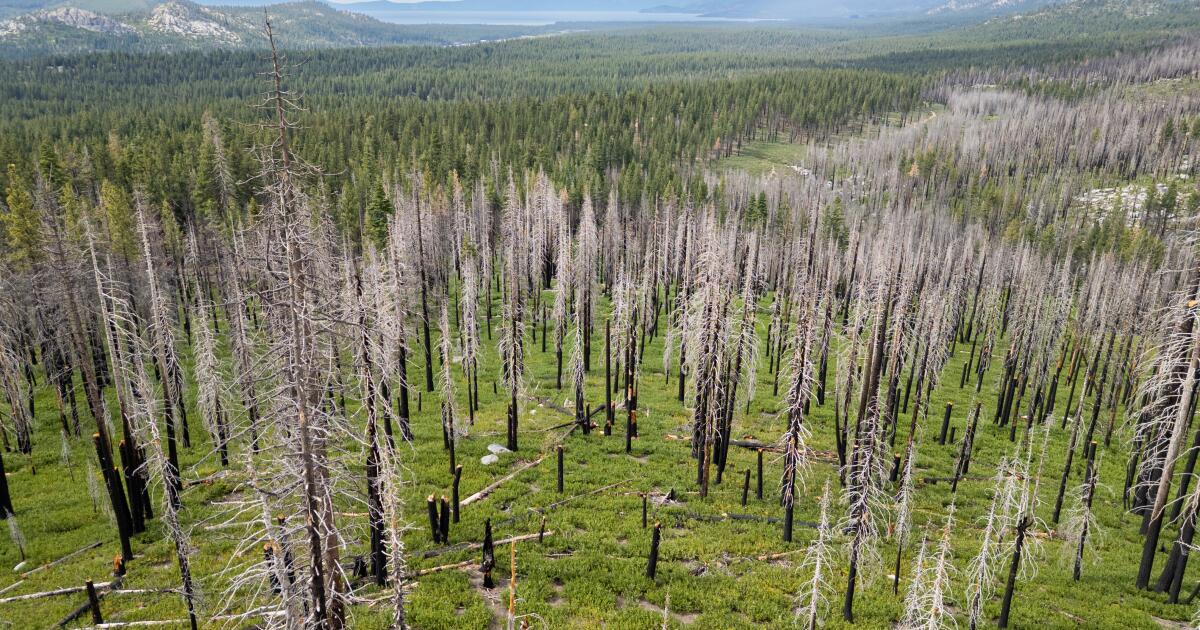
‘I’d rather my house burn down than get cancer’: Herbicide use upends California’s fight to save forests


