Midwest
Wisconsin consultants hired to redraw GOP-drawn legislative maps following court ruling

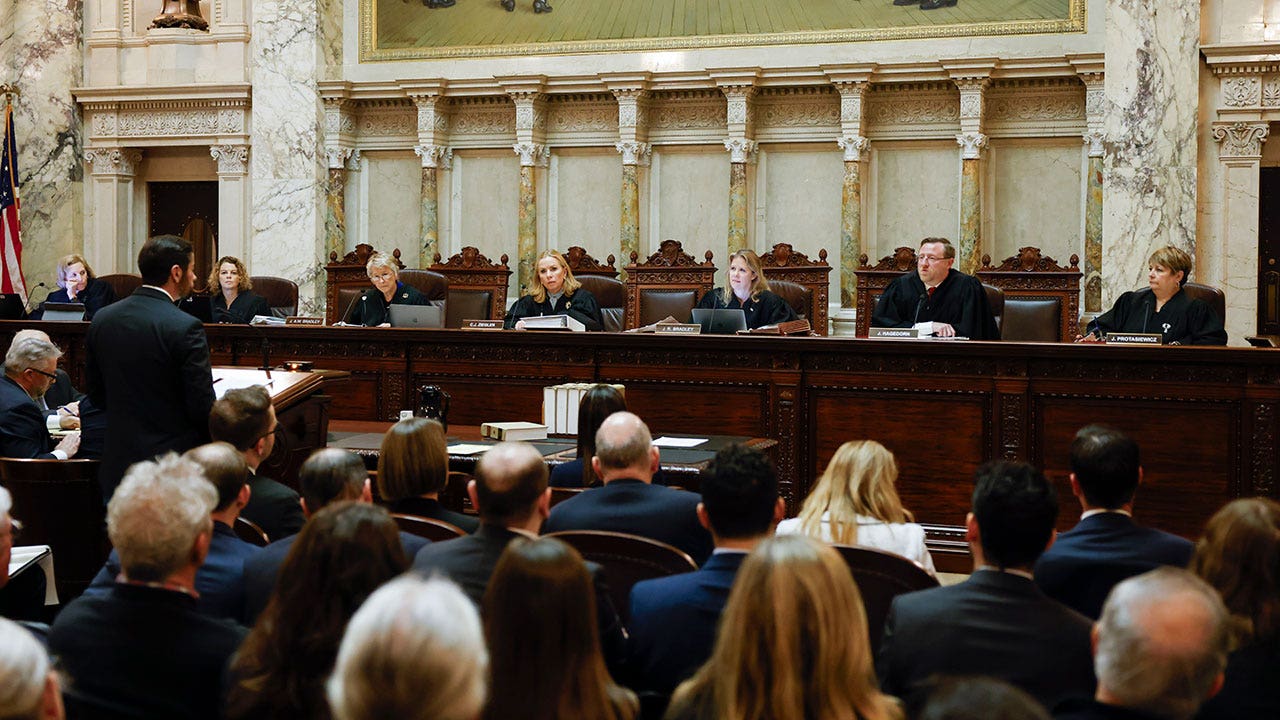
- Two consultants were hired to analyze new legislative boundary lines in Wisconsin after the state’s Supreme Court invalidated the existing Republican-drawn maps.
- Wisconsin, among over a dozen states, is facing challenges to redistricting maps following the 2020 U.S. census.
- The Wisconsin Supreme Court ruled last month that the current legislative maps are unconstitutional, requiring the Legislature to pass new maps.
Two consultants hired to analyze new legislative boundary lines in Wisconsin after the state’s Supreme Court tossed the current Republican-drawn maps will be paid up to $100,000 each in taxpayer money under terms of their contracts made public Thursday.
Each consultant will be paid an hourly rate of $450, up to $100,000 total, but the state director of courts has the authority to exceed the maximum amount if she determines it is necessary, according to the contracts.
Wisconsin is one of more than a dozen states currently wrestling with challenges to redistricting maps that were redrawn following the release of the 2020 U.S. census and first applied to the 2022 elections. Court challenges could result in new U.S. House and state legislative maps before the November election.
WISCONSIN SUPREME COURT TOSSES GOP-DRAWN LEGISLATIVE MAPS, ORDERS NEW VOTING BOUNDARIES
In Wisconsin, the court last month ruled that the current legislative maps are unconstitutional because many districts aren’t contiguous. The court ordered that either the Legislature pass new maps that Democratic Gov. Tony Evers is willing to sign into law, or the court will proceed with adopting its own map.
The Wisconsin Supreme Court listens to arguments from Wisconsin Assistant Attorney General Anthony D. Russomanno, representing Gov. Tony Evers, during a redistricting hearing at the state Capitol, on Nov. 21, 2023, in Madison, Wis. Two consultants were hired to analyze new legislative boundary lines after the state’s Supreme Court invalidated the existing Republican-drawn maps. (Ruthie Hauge/The Capital Times via AP, Pool, File)
The consultants were hired to analyze maps submitted to the court by the Legislature, Evers and others, and report back on their findings.
The consultants — who have the authority to recommend changes to the submitted maps or to create their own — have had a hand in reshaping districts in other states.
Jonathan Cervas, of Carnegie Mellon University in Pittsburgh, redrew New York’s congressional and state Senate maps after a court struck down ones adopted by the Democratic-led Legislature. Bernard Grofman, of the University of California, Irvine, helped redraw Virginia’s federal and state legislative districts after a bipartisan commission deadlocked.
Conservative justices also objected to the hiring of the consultants, saying their selection, the legal authority to appoint them and their responsibilities all raise serious questions.
WISCONSIN REPUBLICANS PASS REDISTRICTING REFORM PLAN, GOV. EVERS CALLS IT ‘BOGUS’
The maps from parties to the lawsuit are due by Jan. 12, with supporting arguments due 10 days later. Reports from the consultants are due by Feb. 1, with responses a week later. That means the court will release new maps likely sometime in late February or early March unless the Legislature acts first.
The state elections commission has said maps must be in place by March 15 if the new districts are to be in play for the November election.
Republican lawmakers last week asked the Wisconsin Supreme Court to stay and reconsider its 4-3 ruling throwing out the GOP-drawn maps. Thursday was the deadline for parties to the lawsuit to submit their arguments.
The court is unlikely to reverse its ruling. The liberal four-justice majority voted in favor of ordering new maps, with the three conservative justices dissenting.
The legislative electoral maps drawn by the Legislature in 2011 cemented the Republican Party’s majorities, which now stand at 64-35 in the Assembly and 22-11 — a supermajority — in the Senate.
Read the full article from Here


If you need help with the Public File, call (313) 222-0566
At WDIV, we are committed to informing and delighting our audience. In our commitment to covering our communities with innovation and excellence, we incorporate Artificial Intelligence (AI) technologies to enhance our news gathering, reporting, and presentation processes. Read our article to see how we are using Artificial Intelligence.

MPS cuts face backlash
Milwaukee Public Schools plans about 200 layoffs to close a $46 million budget gap, but union leaders say cuts could impact student safety while district leaders say no classroom teachers will be eliminated.
MILWAUKEE – Milwaukee Public Schools is planning to cut roughly 200 positions next school year as the district works to close a multi-million-dollar budget gap — but there’s disagreement over which roles will be impacted.
What we know:
District leaders say the goal is to close a roughly $46 million shortfall, prompting changes that Superintendent Brenda Cassellius says are necessary.

Milwaukee Public Schools said about 201 staff members will be impacted. District leaders say no classroom teachers, counselors or social workers will be cut — something the teachers’ union disputes.
FREE DOWNLOAD: Get breaking news alerts in the FOX LOCAL Mobile app for iOS or Android
The reductions stem from a previously approved plan to eliminate about 260 non-classroom roles. The final number dropped after retirements and existing vacancies. The Milwaukee Board of School Directors approved that plan on March 9.
What they’re saying:
“We have a $50 million deficit, we are for sure not going to be able to do business the same way that we’ve been able to do business,” Cassellius said. “Change is just hard. It’s just hard. And every single one of our employees is so important.”
But some educators say the cuts go too far.
“MTEA is setting up a distress signal. We are talking about our teachers, art teachers, music teachers, physical education teachers, counselors — things that the voters of referendum of Milwaukee actually voted for,” said Ingrid Walker-Henry, president of the Milwaukee Teachers’ Education Association. “Staffing is being cut to the extent that they are concerned about student safety.”
Cassellius acknowledged the uncertainty and asked school leaders for patience.
“We just have to for sure know our budget situation, where we’re at with that after these cuts are made in order to make those decisions,” she said. “So I’m asking my principals, be patient with us.”
By the numbers:
The district outlined the 201 affected positions as:
- 70 central office roles
- 62 educators with a teaching license but not assigned to one classroom
- 59 assistant principals
SIGN UP TODAY: Get daily headlines, breaking news emails from FOX6 News
MPS says the savings will support new class size guidelines, including:
- 18 students per teacher in K3
- 20 students per teacher in K4
- 22 students per teacher in K5
Milwaukee Public Schools (MPS)
District leaders say no students will be asked to leave a school to meet class size guidelines. Officials say they are working with schools that may not have space or that require larger classes based on specific programs.
What’s next:
Milwaukee Public Schools plans to present its proposed 2026–27 budget to the Milwaukee Board of School Directors in May.
The Source: Information in this post was provided by Milwaukee Public Schools and prior FOX6 coverage.
Minneapolis, MN
A Minneapolis woman recounts death of Alex Pretti as lawyers eye a class action lawsuit

MINNEAPOLIS (AP) — A Minneapolis woman who confronted federal immigration officers alongside Alex Pretti in January was among a group of potential litigants who spoke out Thursday about alleged excessive force against people protesting or monitoring the enforcement surge in Minnesota.
Georgia Savageford, who introduced herself as Wynnie at a news conference, said she was inside an officer’s vehicle when she saw federal agents shoot Pretti.
“That day has changed me forever,” she said. “The trauma will haunt me for the rest of my life, and I will never be the same.”
Savageford said she had been legally observing the actions of federal officers in Minneapolis ever since the shooting death of Renee Good by a U.S. Immigration and Customs Enforcement officer on Jan. 7. She said she was doing so again on the morning of Jan. 24 when an agent pushed her twice and caused her to fall.
“As I was going down, three agents proceeded to tackle me and drag me face-down into the middle of the street. They knelt on my back, twisted my arms and my legs to the ground, and handcuffed me. The cuffs were so tight I lost feeling in my hands, which resulted in temporary nerve damage,” she recounted.
Officials with the Department of Homeland Security and ICE did not immediately respond Thursday to emails seeking comment. Minnesota officials sued the Trump administration on Tuesday for access to evidence they say they need to independently investigate the killings.
Savageford said Pretti recorded video of her arrest and yelled at agents to leave her alone.
She said the officers put her in the back of a vehicle, from which she saw agents shoot and kill Pretti on the other side of the street.
“At that moment, I thought I was going to die too. I pleaded with the agents to understand why another life was taken, and to not take mine,” she said.
She added that they told her to shut up and to stop being hysterical. She said they then took her to an ICE holding facility where she was held for 12 hours in a cold cell without ready access to food, water or the bathroom until she was released without being charged.
“I did not know him, but I knew he had my back,” she said of Pretti. “I know the kind of heart he had. One that loves and protects without limits.”
Savageford shared her story at a news conference where civil rights attorney John Burris, of Oakland, California, and other lawyers laid out how they’re paving the way for potential class-action lawsuits over alleged excessive force used against protesters and monitors.
Burris, who specializes in police misconduct, helped win an $11 million settlement against the Oakland Police Department in 2003, and helped win a civil jury verdict of $3.8 million for the late motorist Rodney King, who was beaten by Los Angeles police officers in 1991.
He said he and his colleagues have filed complaints with federal agencies involved in the Minnesota enforcement surge on behalf of 10 people, including Savageford, as the first step in a process that’s likely to lead to a larger class-action lawsuit.
“We have many others that are under investigation that have not completed the process. But I thought it was important for us to start this process now. Put the government on notice that we’re here,” Burris said.
Movie reviews reveal A Poet and All That’s Left of You dominate March with perfect 100% scores – Art Threat

Phillies third baseman Alec Bohm sues his parents, accuses them of misusing his money

Video: Will ICE Change Under Its New Leader?

Video: Trump’s Signature to Appear on Dollar Bills

Bill Maher is getting the Mark Twain Prize after all

Florida High School Football Rankings: Top 25 teams – Oct. 21

How old is Bo Nix? What to know about Oregon quarterback ahead of 2024 NFL Draft

Cleary's 21 help Le Moyne down Central Connecticut State 69-64 in OT

99th annual Pony Swim held in Virginia

Indiana Members Credit Union announced as new anchor tenant at Bottleworks District
Video: Will ICE Change Under Its New Leader?

DHS shutdown breakthrough comes at cost for Republicans as funding fights nears end

Rubio joins crucial G7 talks as Iran war set to dominate second day

A surprise resignation could open the door for an independent to win a Montana Senate seat

Video: Savannah Guthrie Says She Believes Her Mother Was Taken for Ransom
-

 Detroit, MI1 week ago
Drummer Brian Pastoria, longtime Detroit music advocate, dies at 68
-

 Science1 week ago
How a Melting Glacier in Antarctica Could Affect Tens of Millions Around the Globe
-

 Movie Reviews1 week ago
‘Youth’ Twitter review: Ken Karunaas impresses audiences; Suraj Venjaramoodu adds charm; music wins praise | – The Times of India
-
 Science1 week ago
I had to man up and get a mammogram
-

 Sports6 days ago
IOC addresses execution of 19-year-old Iranian wrestler Saleh Mohammadi
-

 New Mexico4 days ago
Clovis shooting leaves one dead, four injured
-

 Texas1 week ago
How to buy Houston vs. Texas A&M 2026 March Madness tickets
-

 Tennessee3 days ago
Tennessee Police Investigating Alleged Assault Involving ‘Reacher’ Star Alan Ritchson