Midwest
Trump within striking distance of Biden in competitive blue-leaning state: poll

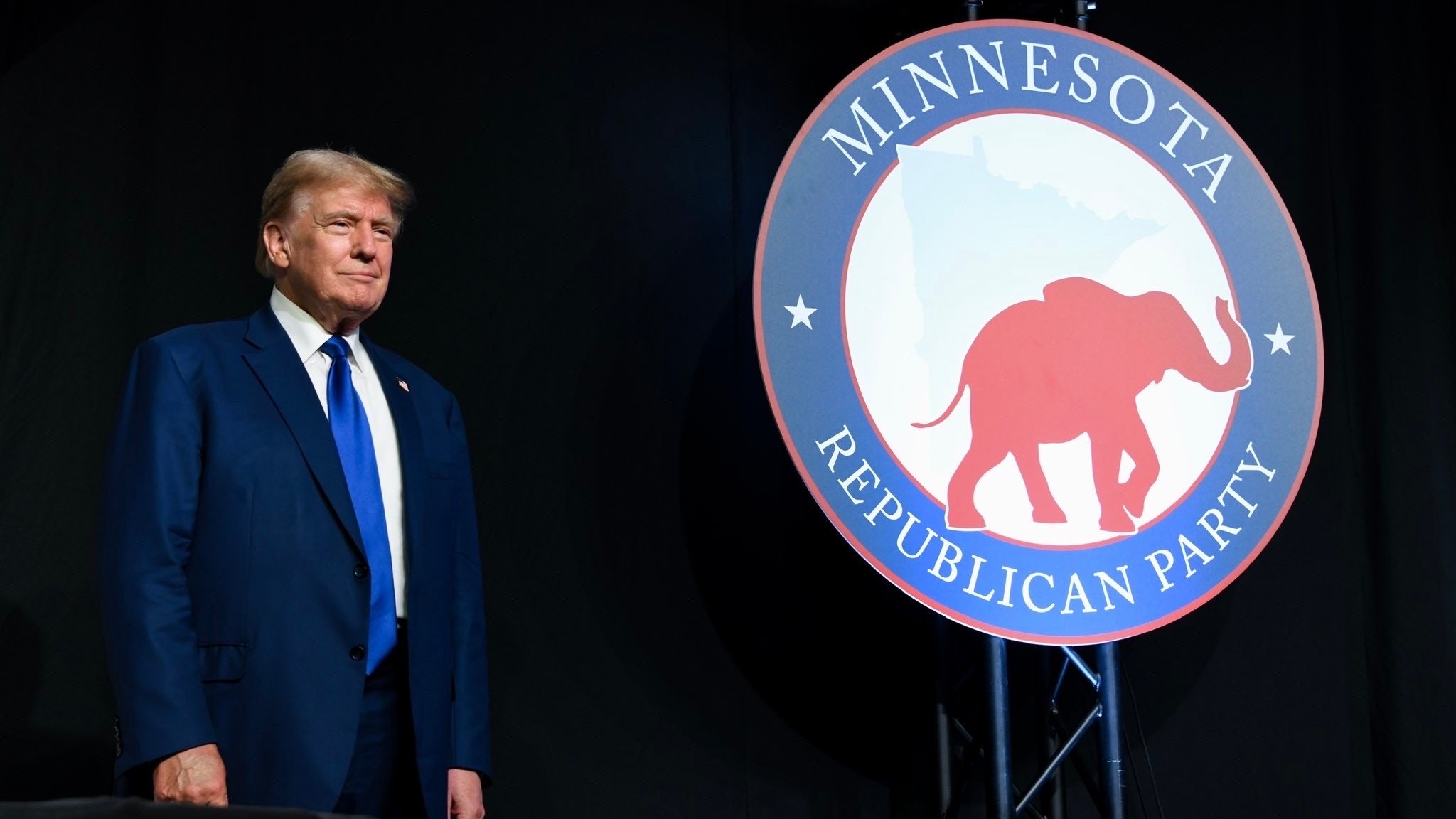
A Republican hasn’t carried Minnesota in a presidential election since President Richard Nixon’s 1972 landslide re-election, over a half-century ago.
But a new poll in Minnesota shows a competitive race between President Biden and former President Trump in their 2024 election rematch.
The president stands at 45% support among likely voters in Minnesota, with Trump at 41% in a poll conducted June 3-5 for the Star Tribune, MPR News and KARE 11.
CLICK HERE FOR THE LATEST FOX NEWS POLLING IN THE 2024 ELECTION
Former President Trump headlines the Minnesota GOP’s annual Lincoln Reagan fundraising dinner, on May 17, 2024, in St. Paul. (AP)
Democrat turned independent presidential candidate Robert F. Kennedy, Jr. stood at 6% support in the survey, with 2% backing “someone else” if the election were held today.
Trump was narrowly edged in Minnesota in the 2016 election by 1.5 points by Democratic presidential nominee Hillary Clinton. But four years later, Biden carried the state by seven points as he defeated Trump and won the White House.
“We’re going to win this state,” Trump predicted last month in a speech as he headlined the state GOP’s annual Lincoln Reagan fundraising dinner in St. Paul, Minnesota’s capital city.
The poll pointed to a significant enthusiasm gap, with 63% of Trump supporters saying they were “very enthusiastic” about casting a ballot for their candidate, compared to 31% of voters backing the president.
Eight hundred registered voters in Minnesota were surveyed in the poll, with an overall sampling error of plus or minus 3.4 percentage points.
TRUMP SWING THROUGH BLUE BASTION PAYS OFF AS HE TAPS POLITICAL ATM
Seven crucial swing states that decided the 2020 election (Arizona, Georgia, Michigan, Nevada, Pennsylvania and Wisconsin, which were narrowly won by Biden, and North Carolina, which Trump carried by a razor-thin margin) will likely once again in the 2024 rematch. But both campaigns see opportunities to expand the map.
At a closed-door Republican National Committee retreat for top-dollar donors earlier this spring at a resort in Palm Beach, Florida, senior Trump campaign advisers Susie Wiles and Chris LaCivita and veteran pollster Tony Fabrizio spotlighted internal surveys that suggested both “Minnesota & Virginia are clearly in play.”
“In both states, Donald Trump finds himself in positions to flip key electoral votes in his favor,” the survey, which was shared with Fox News, emphasizes.
And both states have sizable populations of rural White voters without college degrees who disproportionately support the former president.
President Biden delivers remarks at the Kempsville Recreation Center on Feb. 28, 2023, in Virginia Beach, Virginia. (Anna Moneymaker/Getty Images)
Biden’s campaign disagrees that either Minnesota or Virginia are up for grabs.
While noting that they are “not taking any state or any vote for granted,” Biden campaign battleground states director Dan Kanninen told reporters last month that “we don’t see polls that are six or seven months out from a general election, head-to-head numbers certainly, as any more predictive than a weather report is six or seven months out.”
Kanninen highlighted that the campaign has teams on the ground in both states engaging voters.
WHAT THE LATEST FOX NEWS BIDEN-TRJMP POLL IN VIRGINIA SHOWS
“We feel strongly the Biden-Harris coalition in both Minnesota and Virginia, which has been strong in the midterms and off-year elections, will continue to be strong for us in the fall of 2024,” he added.
And Biden campaign spokesperson Lauren Hitt, pointing to the president’s current fundraising dominance and ground-game advantage in the key battlegrounds, argued that “Trump’s team has so little campaign or infrastructure to speak of they’re resorting to leaking memos that say ‘the polls we paid for show us winning.’”
But the latest Fox News poll in Virginia indicated Biden and Trump are deadlocked in Virginia.
The survey, conducted June 1-4, showed the Democratic president and his Republican predecessor in the White House each with 48% support in a head-to-head match.
In a multi-candidate race, Biden stands at 42% and Trump at 41%, with Democrat-turned-independent Kennedy at 9% and Green Party candidate Jill Stein and independent Cornel West each at 2%.
It’s been two decades since a Republican carried Virginia in the race for the White House.
You have to go back to President George W. Bush, who won the commonwealth in his 2004 re-election victory.
“Let’s just begin by remembering where we were in 2020 when Joe Biden won Virginia by 10 points, and the fact that we’re having this discussion is a huge turn of events,” Virginia Gov. Glenn Youngkin said last week in a Fox News Digital interview in New Orleans, as he attended a Republican Governors Association (RGA) conference.
Youngkin emphasized that “we’re here in June and there’s still a lot of water to go under the bridge, but Virginia looks like it’s in play and that’s pretty exciting.”
Get the latest updates from the 2024 campaign trail, exclusive interviews and more at our Fox News Digital election hub.
Read the full article from Here


Illinois voting data shows voters had no choice of candidate in nearly 9-in-10 Democratic and Republican primaries for state and federal office in 2024.
Voters had no choice of candidate in nearly nine out of every 10 Republican and Democratic primary elections for state and federal office in 2024.
Analysis of Illinois voting data shows Democrats ran one or no candidate in 135 of the 155 primary elections for the U.S. House, Illinois Senate and Illinois House. That left voters with a choice between candidates in just 20 races.
Meanwhile, Republicans only ran one or no candidate in 137 of the 155 primary elections last year for non-judicial state and federal positions, giving voters of a choice in just 18 races.
In total, there were 155 primaries for the U.S. House of Representatives, Illinois Senate and Illinois House in 2024. Democrats did not run a candidate in 28 of these races while Republicans failed to run a candidate in 50.
And in the 107 Democratic primaries and 87 Republican primaries were only one candidate ran for the position, those candidates secured their spot on the general election ballot with a single primary vote.
To get on the primary ballot for Illinois Senate, the Illinois General Assembly mandates established party candidates to get 1,000 petition signatures from district party members. Illinois House candidates need 500 signatures. For U.S. House, either party’s candidates need signatures from 0.5% of all primary voters from their party in the district.
This lack of choice between candidates for Democratic and Republican party primaries also left general election voters with fewer choices on the ballot.
In the 2024 election cycle, 65 of the 155 non-judicial state and federal general elections had only one candidate on the ballot. That means in 65 districts, it only took one vote for a candidate to win a seat representing the entire district.
Illinoisans already suffer from a lack of choice in candidates. Research shows an average of 4.7 million Illinois voters had no choice in their state representative between the 2012 and 2020 election cycles.
Research shows more choice drives voter participation and makes legislators less susceptible to the influence of lobbyists and special interests. Lightly contested elections also tend to skew policies in favor of powerful special interests.
Illinois should consider reforms that will give voters more choices at the ballot box, such as making it easier for independents to enter the general election like they do in Iowa, Wisconsin and Tennessee.
Until that happens, Illinoisans will continue to see elections with too few choices and too much influence handed to those already in power.
Indiana
Indiana’s Curt Cignetti cashes in on title run with 8-year extension worth $13.2 million per year

Indiana coach Curt Cignetti is cashing in on his first national championship run — even more than initially expected.
Athletic department officials announced Monday that the two-time national coach of the year has signed a memorandum of understanding on an eight-year contract extension, paying him an annual average of $13.2 million — or an increase of about $1.6 million per year from what school officials said Cignetti would earn when he first agreed to the extension in October.
School officials released the document Cignetti signed Feb. 4.
He joins Georgia coach Kirby Smart and LSU coach Lane Kiffin as the only active Football Bowl Subdivision coaches to receive paychecks of $13 million or more. The payouts could be even higher if Cignetti earns bonuses for winning Big Ten or national coach of the year honors in addition to playoff appearances and conference titles. The 64-year-old Cignetti already has said he hopes to retire at Indiana.
The new deal calls for a base salary of $500,000 per year through the 2033 season and a $1 million retention bonus on Nov. 30 of each year, starting this fall. The remaining portion of the $105.6 million will be collected from outside, promotional and marketing income.
Cignetti initially agreed to an eight-year extension worth $92.8 million — an annual average of $11.6 million — but university officials agreed to modify the deal as the Hoosiers remained undefeated and pursued the first football national championship in school history.
It’s the third time Cignetti has received a raise since he took over the losingest program in FBS history in November 2024. All he’s done since arriving is produce the two best seasons in school history while becoming one of college football’s fan favorites for his quick quips and unique facial expressions. Players have embraced him, too, telling many of their favorite Cignetti tales.
Just ask tight end Riley Nowakowski, who recounted his favorite Cignetti story during the recent NFL scouting combine in Indianapolis.
“I think (Alberto Mendoza) was in the game, and he pulled like four runs in a row,” Nowakowski said, referring to last season’s victory over Illinois. “He kept pulling it, kept pulling it, kept pulling it, and then after the fourth time, it was a terrible read. So in the middle of the game, (Cignetti) tells our coach, ‘Get (Alberto) over here.’ Bert’s like, ‘What, it’s the middle of a game, what are you doing?’ And (Cignetti) goes, ‘We’re not paying you to run the ball, hand the ball off, right? We’re up like 70 points, but he’s pissed off, yelling at Bert, and (Cignetti) just turned back at me and gave me one of his little smiles, and he was just like, ’You like that now?’”
Cignetti wasted no time delivering on his promise to win after leading James Madison to the most successful transition from the Football Championship Subdivision to the FBS.
The son of Hall of Fame coach Frank Cignetti and a former Alabama assistant led Indiana to a school record 11 wins and its first College Football Playoff appearance in his first season with the Hoosiers.
Last season, he outdid that mark by producing the first 16-0 mark in major college football since the 1890s. The Hoosiers also won their first outright Big Ten crown since 1945, beat Miami on its home field to claim the national title and shed the label of having the most all-time losses in FBS history.
Mendoza’s older brother, Fernando, also became the first Indiana player to win the Heisman Trophy and is expected to be the No. 1 overall pick in April’s NFL draft.
The reward: A record nine players, including Mendoza and Nowakowski, attended the recent combine in Indianapolis while Cignetti got another pay raise and school officials continued to invest heavily in keeping the coach’s staff together.
Offensive coordinator Mike Shanahan and defensive coordinator Bryant Haines each agreed to three-year contract extensions worth about $3 million per year in December, making them two of the highest-paid assistants in the FBS. Haines won this year’s Broyles Award, which goes to the nation’s top assistant coach.
Indiana will begin next season with the longest winning streak (16) and longest home winning streak (15) in the FBS. Cignetti has never lost a home game with the Hoosiers, who open defense of their league and national titles at home against North Texas on Sept. 5.


Iowa State basketball coach TJ Otzelberger on prepping for Arizona
Iowa State basketball coach TJ Otzelberger on prepping for Arizona after loss to Texas Tech.
We’re heading down the homestretch.
Iowa State men’s basketball has two regular-season games left, followed by the Big 12 Tournament.
Iowa State enters the final week of the regular season with a 24-5 overall record and an 11-5 mark in Big 12 action.
The Cyclones have a NCAA Tournament resume-bolstering opportunity on Monday, March 2 with a road game against Arizona, before wrapping up the regular-season on Saturday, March 7 against Arizona State.
Plenty can still change with bracketology from now until Selection Sunday on March 15, but here is where experts are projecting Iowa State to land in the NCAA Tournament entering the final week of the regular season:
Iowa State basketball’s computer metrics as of Tuesday
Eugene Rapay covers Iowa State athletics for the Des Moines Register. Contact Eugene at erapay@gannett.com. Follow him on Twitter at @erapay5

Lawmakers again push to restore Shore Line East service to 2019 levels

Delaware Supreme Court upholds reforms to curb ‘DExit’ concerns

Florida High School Boys Basketball 2026 Playoff Brackets, Schedule (FHSAA) – March 2, 2026

Florida Continues Push to Beat Out Georgia for Top LB Recruit

Everyone Says Oahu’s Overcrowded. We Drove 20 Minutes Past Haleiwa And Found Beautiful Empty Beaches

Florida High School Football Rankings: Top 25 teams – Oct. 21

Cleary's 21 help Le Moyne down Central Connecticut State 69-64 in OT

How old is Bo Nix? What to know about Oregon quarterback ahead of 2024 NFL Draft

99th annual Pony Swim held in Virginia

Indiana Members Credit Union announced as new anchor tenant at Bottleworks District

Map: Earthquake Shakes Central California

Gas prices could jump as Middle East tensions threaten global oil supply

Pakistan calls troops, orders 3-day curfew as 24 killed in pro-Iran rallies

US says Kuwait accidentally shot down 3 American jets

House Republicans push Johnson to go to war with Senate over SAVE Act
-

 World5 days ago
Exclusive: DeepSeek withholds latest AI model from US chipmakers including Nvidia, sources say
-

 Massachusetts5 days ago
Mother and daughter injured in Taunton house explosion
-

 Denver, CO5 days ago
10 acres charred, 5 injured in Thornton grass fire, evacuation orders lifted
-

 Louisiana1 week ago
Wildfire near Gum Swamp Road in Livingston Parish now under control; more than 200 acres burned
-

 Technology1 week ago
YouTube TV billing scam emails are hitting inboxes
-

 Politics1 week ago
OpenAI didn’t contact police despite employees flagging mass shooter’s concerning chatbot interactions: REPORT
-

 Technology1 week ago
Stellantis is in a crisis of its own making
-

 News1 week ago
World reacts as US top court limits Trump’s tariff powers