South Dakota
South Dakota Wildfire Shuts Down Public Lands


South Dakota’s Black Hills are a natural wonder, with vast forests, unique rock formations, and stunning peaks. And now that region is under serious threat, with a major wildfire ravaging the area. In a harbinger of what may be to come this wildfire season, thousands of acres are ablaze and containment has challenged firefighting crews.
The Fire
The Qury Fire began on March 12, about 2 miles from the town of Custer, S.D., according to local authorities. On March 13, it merged with the Deer Fire to reach a size of 7,000 acres by that evening. The fire burned for several days without major progress on containment. The weather, particularly high winds, have made it more difficult for crews to contain the fire.
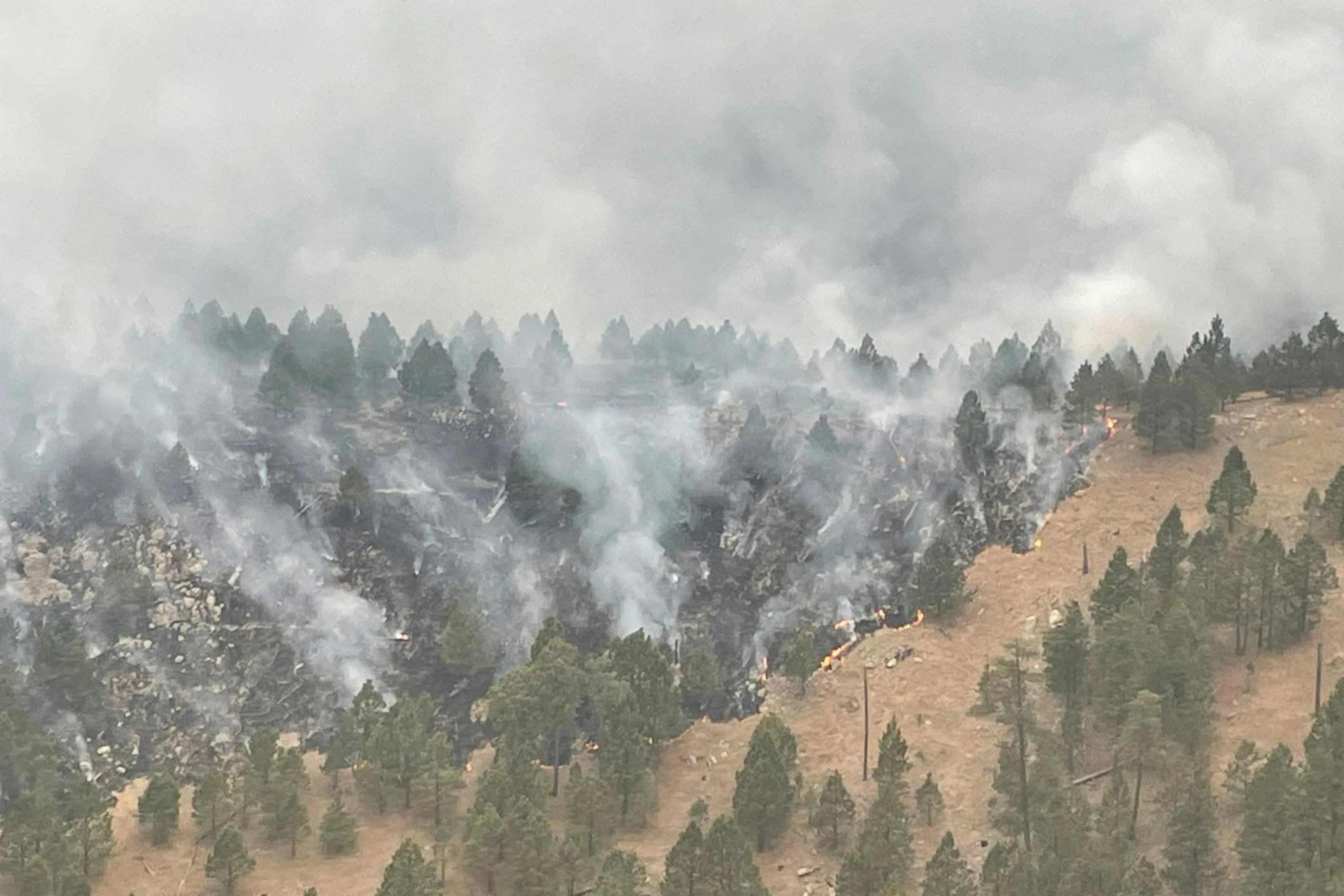
Only on March 17 did authorities announce that a staff of 350 personnel had contained 27% of the 9,059-acre fire. The cause of the fire is still under investigation.
Governor Larry Rhoden praised and thanked firefighting crews. “While progress is being made, there is still important work ahead,” he said on Facebook.
Where Is It?
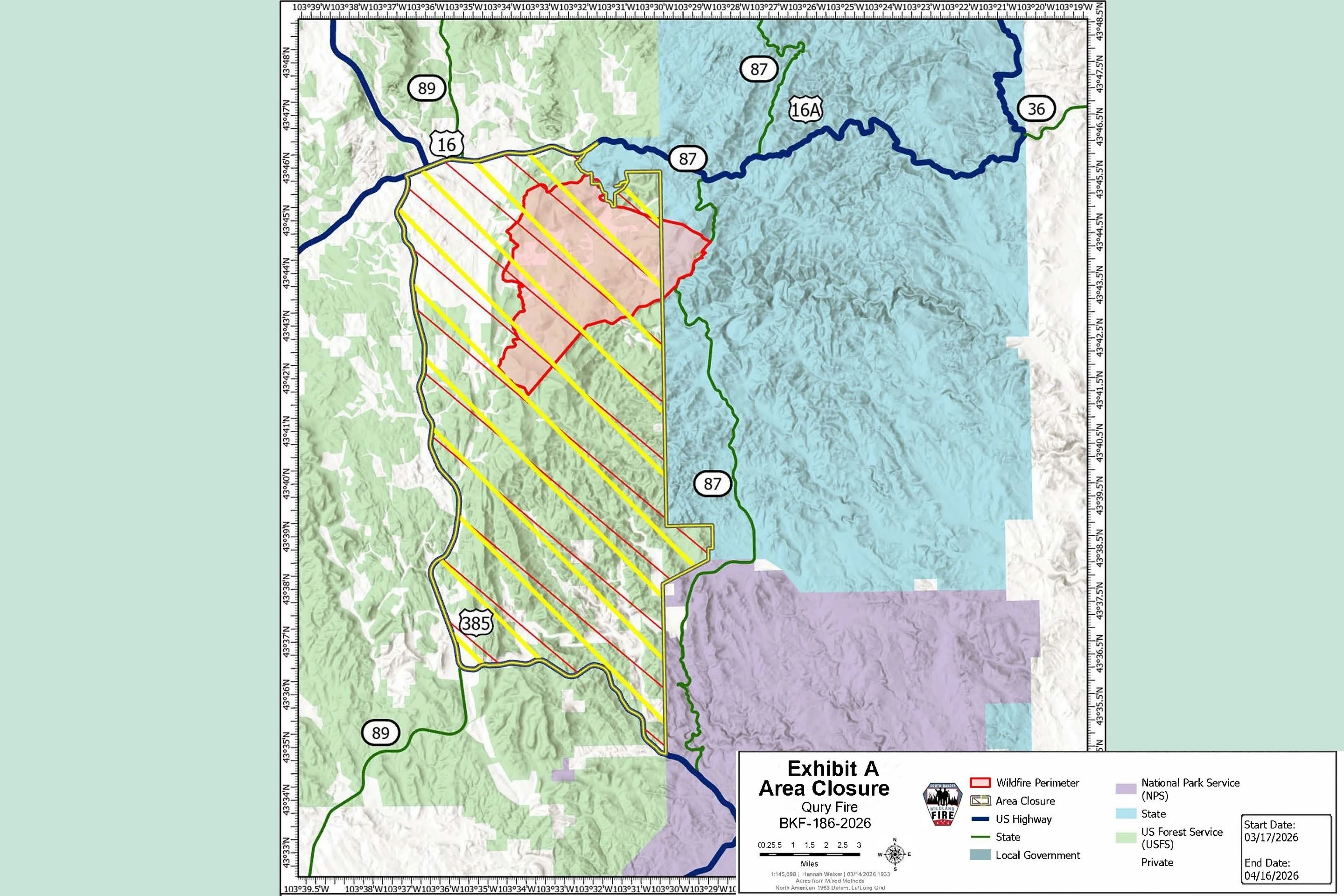
Custer, a town of about 2,300 people, lies in the heart of the Black Hills and is a primary gateway to outdoor recreation in the area. On March 17, the U.S. Forest Service (USFS) issued a closure notice for portions of Black Hills National Forest.
Until April 16, an approximately 28,000-acre area is closed to the public. The forest is a habitat for several threatened and endangered species, including the black-footed ferret, northern long-eared bat, and monarch butterfly.
Custer State Park, a popular site for camping and hiking, closed several roads, day-use areas, and trails. The park is home to large populations of bison and burros, but the park reported that the animals are currently located in the southeastern part of the park, far away from the active fire.
Why It Matters
Beyond the obvious damage to trees and wildlife, this fire is potentially a bad sign for this year’s fire season. The USFS says that typically, fire season in the Black Hills runs from May to October, so a fire of this size this early is unusual. Data suggests that on average, wildfires burn around 7,000 acres per year in the forest.
This recent winter was one of the warmest and driest on record for the area. Rapid City received just 6.5 inches of snow, about half the normal amount. Studies show that low snowpack and early-season snowmelt correlate with a greater risk of wildfires and longer fire seasons.
The possibility of an above-average fire season further calls into question the federal government’s plans to celebrate the Fourth of July holiday with fireworks at Mt. Rushmore, about 20 miles away from Custer. Critics of the plan have long-cited wildfire risk in their objections.
Custer State Park is also a major tourism attraction and local economic engine. In 2021, 2 million people visited, a figure higher than for many national parks. The full extent of damage to the park is not clear, and time will tell what it means for visitors during the peak summer season.


The South Dakota Symphony Orchestra has captured the national imagination with innovative programming, original productions, and artistic tendrils of community engagement. Now, they’re planning for the future. They are challenging themselves to answer the question: What’s next?
Music director and conductor Delta David Gier stopped by the SDPB studios for an update. SDPB’s Lori Walsh asked the maestro about the recent release of a professional recording of the SDSO’s “Giants in the Earth.”
DELTA DAVID GIER
Well, it may seem like old news for a lot of people, your listeners perhaps, because we did this opera, you know, a year ago, April, and then SDPB made the video production of it and aired it last fall.
But this is the commercial recording, which is being released internationally. It actually was released in Europe before it was released here because the record label is in the Netherlands.
So, yeah, it’s really exciting. It’s very high quality. You know, it’s just top-standard recording and it sounds great.
LORI WALSH
Tell us about what goes into releasing a recording like that. How intensive is that for you? Is that something that you pass on to other people and then it comes back to your hand, or are you intricately involved in it?
DELTA DAVID GIER
Well, I spent, you know, a year ago, actually. I was in New York with a recording engineer in the Dolby studio there, and, you know, we were making a lot of decisions. So I haven’t had much to do with it in the last year. And the release of it, the timing of the release, that’s all up to the recording company. When they feel like it’s the best time, when they can get the most traction in terms of press and all of that.
LORI WALSH
So what happens next to a recording like that? What are your hopes for it in the world? Because the performance and the community aspect of it is largely what you focus on as the music director and conductor of the South Dakota Symphony Orchestra.
Now it has a life beyond you. How important is a recording to you as a conductor?
DELTA DAVID GIER
Well, it’s important for posterity, first of all. I mean, there was no recording of this piece of music, a Pulitzer Prize-winning piece. And so part of it was due diligence. This story takes place right here where we live in South Dakota. It tells the story of the first Norwegian immigrants coming here, and nobody could ever hear this piece before, so that’s part of it, is just sort of an altruistic thing.
The other is to make it available for people here, and again, the video that’s available on your website to watch free of charge from anybody at any time, that’s great. This is something that people can, it’s a piece of history they can either own or like you say, you can stream it.
The other thing is, I hope that, well, I mean, there’s also the recognition beyond South Dakota. Like the last recording we released had a lot of really good press, I mean, BBC, Music Magazine said, you know …
LORI WALSH
The last recording, which would have been …
DELTA DAVID GIER
Atlas of Deep Time by John Luther Adams.
That was the piece that we commissioned for our 100th anniversary season. But you know, BBC Music Magazine referenced the excellent South Dakota Symphony Orchestra players. I mean, that’s really great validation coming from press like that. So we would hope for that.
And then lastly, I would say that I would hope that other, that opera companies, orchestras, now that they have a chance to hear it, that they would pick it up and do it. That it would begin to take on a life of its own.
LORI WALSH
It’s a starting line. It’s a finish line for you, and it’s a starting line for the piece in some way.
DELTA DAVID GIER
It’s like we’ve midwifed this piece. It’s out there in the world now.
LORI WALSH
Yeah, with an imprint on it that is undeniable for future performances and programming of Giants in the Earth.
DELTA DAVID GIER
The story is out there of what the South Dakota Symphony did. I mean, it’s in the liner notes of the CD, but it’s online, so yeah.
LORI WALSH
All right, so speaking of press, I was reading Joseph Horowitz, who is a scholar in residence for the South Dakota Symphony Orchestra.
DELTA DAVID GIER
Still is, actually.
LORI WALSH
Still is. And in the New York Times and in the American Scholar and both times, he’s really referencing heavily what is happening as he looks at 250 years of classical music in America and how often, in our reflections on America at 250, scholars left out any reference to the arts and what that means, what’s unique about American art, what’s unique about our canon.
Every time, he references the South Dakota Symphony Orchestra. I think he said, “The repertoire is brave and the vibe is exhilarating.”
DELTA DAVID GIER
There you go. What more could you ask for? Yeah, I mean, our personnel manager will often reference that, that the reason that players come to play in this orchestra as she’s trying to fill out the orchestra — It’s not the money, because we don’t pay that well, but it’s the repertoire that we play and what she calls the vibe.
It’s the hang. It’s the fact that we have a happy orchestra, which is actually rare in our industry, like a lot of union orchestras and a lot of discontent and grousing about this and that and the other, you don’t find that in our orchestra.
It’s a very happy bunch. We’re happy to be making music together and people enjoy playing with us. So, it’s good.
LORI WALSH
You’re asking the big question, which is what’s next?
DELTA DAVID GIER
Yeah, right.
LORI WALSH
You’ve done 100 years. You’ve done Lakota Music Project, which is ongoing, of course. You’ve done Giants in the Earth.
How do you envision the future?
DELTA DAVID GIER
Well, we just spent three days last week tackling that question. I have a new friend, his name is Tom Morris, and he’s about 80, I think, or so. He was 50 years at the top of the industry. CEO of the Boston Symphony, CEO of the Cleveland Orchestra, CEO of the Ohio Music Festival.
And he, through various channels, learned about the SDSO became intrigued with it, actually came to the production of Giants in the Earth last year, and that was the question he asked.
After the dress rehearsal, we went out for a drink, and he says, So what’s next? We got the whole nation’s attention now. Don’t squander this moment.
And so he actually put together a group of four people that came and spent three days with us last week, just exploring the question of what’s next for the SDSO.
And, you know, it was a huge validation because all four of these people who, like Tom, had been in the industry for decades and are retired now and giving back. They came free of charge, just, you know, they do this with other orchestras occasionally too, but they just said, you know, It’s extraordinary what’s happening here.
What they were enamored with — yeah, the programming and so on — but the tendrils that we send out into the community for every program that we do, like the impact.
So if you look, if you read that article in the New York Times that Joe Horowitz wrote a couple of weeks ago about classical music in America at 250, he talks about the troubles that some American orchestras are having.
The epicenter of it right now is the Boston Symphony. Yeah, financial troubles, but audience troubles and relevance issues. Just the whole classical music relevance issue. And basically, we don’t have that issue because we’re going deep into the community. And whether it’s education, and our education is K through higher ed, like universities to kindergarten, and everything in between. And we worked really hard to make sure that each one of our programs has those elements in it.
It’s different, different ethnic communities, Lakota Music Project, of course, but also our Bridging Cultures program with South Asian, Chinese, Hispanic, communities within our community and how we connect with them.
For example, our opening concert in the fall, it’s all rhapsodies, famous rhapsodies from our repertoire, but we have a new rhapsody, a Guatemalan rhapsody that’s being composed for us will premiere it by a Guatemalan composer, and right now we’re working on making connections with the Guatemalan community here in Sioux Falls, which I understand is the largest Hispanic population we have here.
So really looking forward to that, but we’ve done quite a bit of it, and it’s a matter of sitting down with the people of that community and asking the question, what’s most meaningful for you?
What’s most impactful for your community? How can we serve you? How can we partner together? We’re not trying to get anything out of that community. We’re trying to figure out ways that we can enrich the life of Sioux Falls by making music together.
LORI WALSH
How do you open the door for really innovative answers?
DELTA DAVID GIER
Right. It’s mostly listening, honestly. You go into the initial meeting like that, whether it’s with an ethnic community or principals of the high schools. Like Brian Maher put together this meeting. I walk in there and he’s talking about, you know, the orchestra engaging with the high schools and the principals are like, what? What are we talking? Math teachers, you know, whatever. What are you talking about? You know, so we’re going through this. And Tim Haslett from Roosevelt, the principal at Roosevelt said, at one point, Hey wait, you could build a program around the Holocaust for me, couldn’t you?
I said, you’re absolutely right, I could. Every 10th grader in Sioux Falls reads Romeo and Juliet. I can build a program around Romeo and Juliet to deepen their engagement with that.
These are the conversations. You gotta get through the bridge, or break the ice of What’s a symphony orchestra? What does this cultural institution do for the community? It’s not just an entertainment option for people who happen to kind of like that stuff. This is like history and all of that.
LORI WALSH
So how do you measure outcomes of different programs?
DELTA DAVID GIER
Well, that’s more difficult in terms of: sometimes it’s ticket sales, sometimes it’s number of students engaged. I think about one of the Joseph Horowitz programs we did, Copeland in Mexico, which we worked really hard to engage the Hispanic population here. And through the National Endowment for the Humanities, we had tickets available. And we had 1,000 vouchers out to the Hispanic community for free tickets to this concert. And over two concerts, we had 650 of them redeemed. So that’s pretty good. I think the metric changes depending upon who we’re engaging.
SDSU loading up a couple of buses to bring students to a concert after Joe and I have been in the classrooms up there for the last couple of weeks talking about Shostakovich or whatever. How many people stay for a post-concert discussion?
We did that for Shostakovich’s Seventh Symphony, and we had about 50 chairs set up on the third floor for this, and there were like 180 people that showed up because everybody wanted to talk about what they just experienced, you know. It’s a small kind of metric, but it’s like, yeah, okay, we struck a chord, so to speak.
LORI WALSH
So how you measure outcome is continuously measuring it and measuring in different ways. Different ways, different formats — from participation and raw numbers of ticket sales to the “vibe,” as we were saying. The people in the room who want to talk about something, the press coverage that you’re getting, the excitement that the orchestra is building, the way that you can sit in a room and hear innovative ideas from a community that you haven’t engaged with yet, whether that’s in a high school or whether it’s with a Spanish-speaking group. All of that and more.
DELTA DAVID GIER
And the desire to re-engage.
Like if we did Lakota Music Project once and never did it again, then that would not be a good metric. But the fact that we’ve been at it for over 15 years now and people invite us back and want to continue the engagement, that’s a good metric.
LORI WALSH
What’s next for you personally? What are you excited about? When somebody asks that question, What’s next, it’s easy to focus on the community, it’s easy to focus on the musicians, the quote-unquote happiness of the orchestra. How about you personally and professionally?
DELTA DAVID GIER
I’ve basically devoted the second half of my life to this, this orchestra in this community. So I’m pretty excited about where we are and where we can go.
I think that the outcome of these three days with these industry professionals last week was we’re doing really great stuff. You need to be, we, we need to figure out ways to, to basically, honestly, fund it so that you can do more and deeper. You know, it’s not doing more for the sake of doing more. It’s how can we do this deeper and better.

RAPID CITY, S.D. (KOTA) – The South Dakota Department of Health has confirmed three cases of cyclosporiasis as health officials across the country investigate a growing outbreak of the parasitic illness.
According to the department’s Infectious Disease Dashboard, two cases have been reported in Pennington County and one case in Clay County.
The South Dakota cases come as the U.S. Centers for Disease Control and Prevention reports more than 1,600 probable cases in 34 states. Nationwide, more than 140 people have been hospitalized.
Cyclosporiasis is caused by the microscopic parasite Cyclospora cayetanensis, which infects the intestines and can cause severe gastrointestinal illness. Symptoms include watery or explosive diarrhea, nausea, stomach cramps, bloating and fatigue.
Unlike many common stomach illnesses that clear within a couple of days, cyclosporiasis can stick around for weeks or even months if left untreated.
Health experts say the parasite has most commonly been linked to contaminated fresh produce, including lettuce, basil, cilantro and raspberries. The parasite can also spread through contaminated water, including swimming pools and splash pads if contaminated water is swallowed. Officials note that Cyclospora is resistant to chlorine and bleach, meaning it can survive in properly chlorinated pools.
Federal investigators continue to search for the source of the nationwide outbreak, while The Michigan Department of Health and Human Services said it identified lettuce and other salad greens as a potential source. The FDA said its traceback investigation is focusing on multiple produce items consumed by people who became sick.
Meanwhile, Taco Bell announced Tuesday that it has voluntarily and temporarily removed limited ingredients at select restaurants as a precaution while public health officials continue their investigation. The company said it is monitoring the situation and following guidance from health authorities. Federal officials have not identified Taco Bell or any other restaurant chain as the confirmed source of the outbreak.
The South Dakota Department of Health has not announced whether the state’s three reported cases are connected to the ongoing multistate outbreak.
Health officials recommend washing fresh produce thoroughly before eating it, although experts caution that washing may not completely remove the hardy parasite. Cooking fruits and vegetables can further reduce the risk of infection.
Anyone experiencing severe diarrhea or symptoms lasting longer than 48 hours should contact a healthcare provider. Early diagnosis and treatment can help shorten the illness and reduce complications.
See a spelling or grammatical error in our story? Please click here to report it.
Do you have a photo or video of a breaking news story? Send it to us here with a brief description.
Copyright 2026 KOTA. All rights reserved.
The South Dakota Lottery offers multiple draw games for those aiming to win big.
Here’s a look at July 15, 2026, results for each game:
Winning Powerball numbers from July 15 drawing
02-07-18-29-38, Powerball: 16, Power Play: 2
Check Powerball payouts and previous drawings here.
Winning Lotto America numbers from July 15 drawing
26-29-41-46-47, Star Ball: 09, ASB: 02
Check Lotto America payouts and previous drawings here.
Winning Dakota Cash numbers from July 15 drawing
01-09-10-16-33
Check Dakota Cash payouts and previous drawings here.
Winning Millionaire for Life numbers from July 15 drawing
01-05-18-23-33, Bonus: 05
Check Millionaire for Life payouts and previous drawings here.
Feeling lucky? Explore the latest lottery news & results
Are you a winner? Here’s how to claim your prize
- Prizes of $100 or less: Can be claimed at any South Dakota Lottery retailer.
- Prizes of $101 or more: Must be claimed from the Lottery. By mail, send a claim form and a signed winning ticket to the Lottery at 711 E. Wells Avenue, Pierre, SD 57501.
- Any jackpot-winning ticket for Dakota Cash or Lotto America, top prize-winning ticket for Lucky for Life, or for the second prizes for Powerball and Mega Millions must be presented in person at a Lottery office. A jackpot-winning Powerball or Mega Millions ticket must be presented in person at the Lottery office in Pierre.
When are the South Dakota Lottery drawings held?
- Powerball: 9:59 p.m. CT on Monday, Wednesday, and Saturday.
- Mega Millions: 10 p.m. CT on Tuesday and Friday.
- Lucky for Life: 9:38 p.m. CT daily.
- Lotto America: 9:15 p.m. CT on Monday, Wednesday and Saturday.
- Dakota Cash: 9 p.m. CT on Wednesday and Saturday.
- Millionaire for Life: 10:15 p.m. CT daily.
This results page was generated automatically using information from TinBu and a template written and reviewed by a South Dakota editor. You can send feedback using this form.
-
 Sports3 minutes ago
World Cup championship and third-place game: Start times and how to watch
-

 World15 minutes ago
Rule of Law in Hungary shows ‘radical change’ under Magyar, EU says
-

 News45 minutes ago
Where Wildfire Smoke Is The Worst Right Now—And What To Do About It
-

 Los Angeles, Ca2 hours ago
LADWP begins long-term repairs after West Hollywood water main rupture
-

 Detroit, MI3 hours ago
Livestream: Mayor Sheffield, Detroit health chief to address wildfire smoke threat
-
 San Francisco, CA3 hours ago
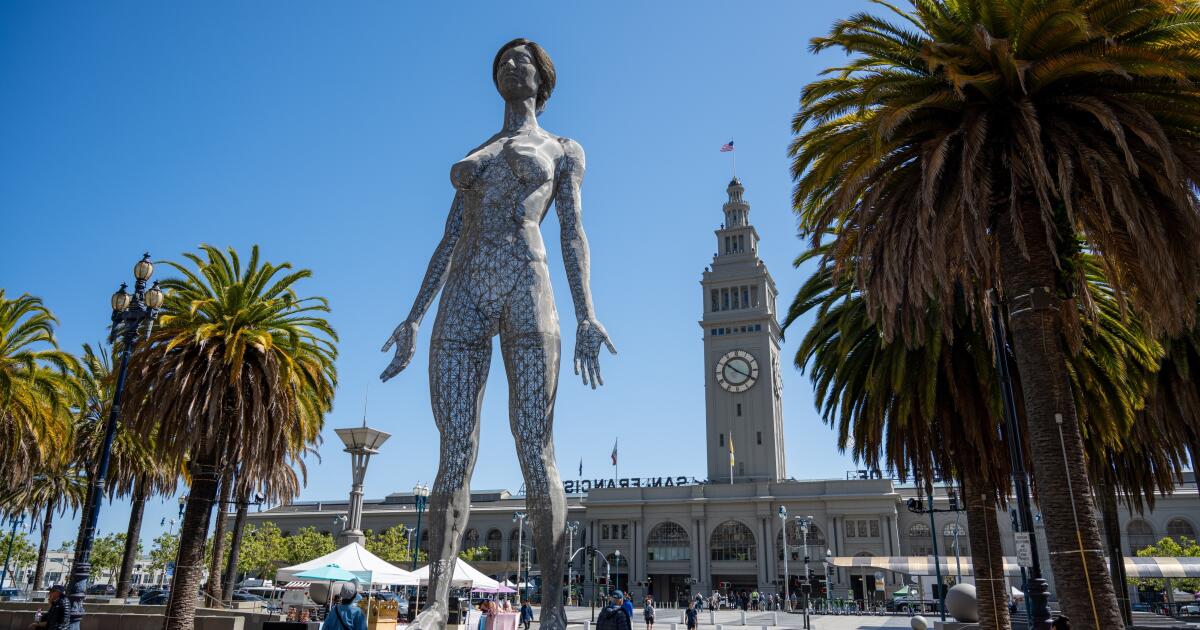
A sculpture of a giant naked woman goes on sale in San Francisco. Bring a crane
-

 Dallas, TX3 hours ago
No ‘straight answer’: Why Pioneer Cemetery is the latest battleground at City Hall
-

 Miami, FL3 hours ago
TSA hosts news conference ahead of World Cup third place match at Miami Stadium

