Nebraska
Special education, reading, computer science and other bills advance from Nebraska committee • Nebraska Examiner


LINCOLN — A Nebraska lawmaker is hailing the advancement of an Education Committee legislative package that she says is solution-oriented and provides support from all sides.
The assortment of nine bills, with the possibility for a tenth, is tied with a bow under Legislative Bill 1284, introduced by State Sen. Lynne Walz of Fremont. The bills relate to training teachers in reading instruction and computer science and technology; dyslexia research; special education; and more.
“We, as the Education Committee, just put together a package of bills that will really provide good solutions for kiddos, for families, for people who may be going into the teaching profession,” Walz told the Nebraska Examiner.
The State Board of Education is in favor of nearly every bill in the package and neutral on one (LB 985). Board President Elizabeth Tegtmeier said Friday she appreciates that lawmakers recognize the need to support and fund education.
“It’s great to partner with our lawmakers to improve education,” Tegtmeier said.
Here is a breakdown of the Walz package:
Computer science and technology
Walz’s LB 1284 would put $1.5 million into a Computer Science and Technology Education Fund for training and support. Public and private entities may also donate to the fund.
The Legislature could annually add $500,000 to the fund upon receipt of matching donations.
This year’s proposal builds off a 2022 law by State Sen. Terrell McKinney of Omaha that requires students to graduate with education in computer science and technology. Walz said her bill would address the needs of schools that lack teachers or need staff training.
“This is a step in the right direction,” Walz said.
Reading instruction and dyslexia

LB 1254, introduced by State Sen. Lou Ann Linehan of Elkhorn, would set aside $10 million annually to create reading improvement mentorship programs and employ regional coaches. These would help provide sustained training to teachers in kindergarten through third grade to teach reading.
“If you can’t read, you’re not going to survive in today’s world,” Linehan said.
She described a cycle in which young students who haven’t been taught reading get in trouble because they don’t want to be embarrassed, and some may avoid school. Linehan said the Nebraska Department of Education brought the bill to her.
A second bill on reading improvement is LB 1253, which would establish the Dyslexia Research Grant Program.
It is a one-time $1 million investment that would support Nebraska companies researching artificial-intelligence-based writing assistance for individuals with dyslexia. Linehan prepared the legislation with a group of University of Nebraska-Lincoln students.
‘Special Educators of Tomorrow’
Two bills aim to bring more special education teachers to Nebraska after lawmakers sparred last fall with officials from Omaha Public Schools over such shortages.

LB 1238, the Special Educators of Tomorrow Act, from Walz, would provide scholarships and loans to individuals who work with disabilities as direct support professionals to become special education teachers.
Individuals would need at least two years of experience as a direct support professional.
Scholarship recipients would also need to enroll or plan to enroll at an eligible institution to pursue a teaching career in special education. Loan recipients would agree to complete a special education program and a related major and commit to teach in Nebraska.
A recipient could receive an annual scholarship of up to $2,500 for up to two years and an annual loan up to $4,000 for up to three consecutive years.
Each year of full-time teaching after two years would shave $4,000 off such loans.
The bill includes an initial $1.5 million investment for a Special Educators of Tomorrow Fund and a $250,000 appropriation for each fiscal year after that, ending after the 2029-30 school year.
Special education forgivable loans
LB 964, from State Sen. George Dungan of Lincoln, would allow the Nebraska Department of Education to award up to 25 forgivable loans per eligible institution per academic year. This means the Nebraska State College System and the University of Nebraska system.
Each year, 20% of loans would be forgiven as the graduate, with a special education endorsement, teaches in Nebraska.

The graduate must begin teaching at a Nebraska K-12 school within one year of graduation.
“It just seemed like something we could do to get more people into the field,” Dungan said.
The Dungan and Walz proposals require loan recipients to repay loans if they do not satisfy their related bill requirements.
Dungan’s bill would also extend eligibility for Nebraska Career Scholarships to include teaching in special education.
Mental health and recruitment grants
LB 986, from Linehan, would rework the Teach in Nebraska Today Act as a grant program, doubling its impact from $5 million to $10 million. Teachers would qualify if they are within their first five years of teaching and have an annual income of less than $55,000.
Also included in the package is LB 1014, from Walz, which would enable school districts to employ school psychologists who work for a service agency.
Two other bills are considered “cleanup” for recent legislation:
- LB 1005 (Walz) would establish a funding mechanism to provide grants and loans for student teachers during their student teaching semesters.
- LB 985 (Linehan) would require that teachers endorsed to become certified in special education, mathematics, science, technology or dual credit also agree to complete a school year of full-time employment in their endorsement area.
Period poverty proposal a ‘maybe’
A tenth bill, LB 1050 from State Sen. Danielle Conrad of Lincoln, would require schools to provide access to menstrual products, including pads and tampons, in school bathrooms. The committee voted 4-1, one vote short of advancing the bill in the package. State Sen. Justin Wayne of Omaha has not taken a position on LB 1050 and could still add his vote.

The committee did successfully adopt an amendment to Conrad’s bill, narrowing its impact last week to a one-year pilot program capped at $250,000. As amended, school districts classified as “needs improvement” or those in which 40% of students are poverty stricken would have funding priority.
Local school boards could adopt policies related to the bill.
“I think it’s really thrilling that we have a good opportunity to move the bill forward in some fashion this year,” Conrad said last week. “I think that speaks volumes to the power of student organizing and young voices being involved in the process.”
The State Board of Education is in support of Conrad’s bill, as is Linehan, who said a woman she knows has shoplifted just once — for tampons, because “she couldn’t get them any other way.”
“Sometimes people just need a little push to do the right thing,” Linehan said of school districts.



Nebraska softball finalized its coaching staff on Wednesday. Head coach Rhonda Revelle signed an extension that runs through the 2031 season. The program also finalized several previously announced coaching changes.
Revelle earned the extension after leading Nebraska to one of its best seasons in history, bringing the team back to the Women’s College World Series for the first time since 2013. The Huskers totaled a school-record 52 wins in Revelle’s 34th season as Nebraska’s head coach, helping solidify her as the winningest coach in Nebraska athletics history.
“As we said when we had the privilege of naming the field at Bowlin Stadium in her honor, Rhonda Revelle is Nebraska Softball. Rhonda is not only a great leader of our softball program, but she is a world-class individual who elevates our entire athletic department in many ways. The trajectory of our program is at an all-time high coming off a record-breaking season and we are excited for the years ahead under the leadership of Rhonda and her outstanding staff.”
Revelle also re-worked the responsibilities of her coaching staff, elevating existing staff members and bringing in a slew of former players as assistants. This comes following the retirement of long-time assistant Lori Sippel in June.
Diane Miller has been elevated to associate head coach, and Mandie Nocita was promoted to assistant coach. Olivia Ferrell and Jordy Frahm also join the staff and will serve as assistant coaches. Hannah Coor and Hannah Camenzind have been added as graduate assistants. Lauren Camenzind will be a graduate manager for the Huskers.
Contact/Follow us @CornhuskersWire on X (formerly Twitter) and like our page on Facebook to follow ongoing coverage of Nebraska news, notes and opinions.

Nebraska Gov. Jim Pillen on Wednesday announced measures to further cut state spending, including a cut in state agency spending and a hiring freeze on most positions.
Pillen said in a news release that the measures are necessary after the state paid out $307 million more in state tax refunds than anticipated in fiscal year 2026, which ended June 30. Tax receipts have come in below projections in March, April and May, leading to a current expected deficit of $172 million.
That’s after lawmakers closed a $646 million budget hole in their most recent legislative session.
The governor has previously sought to cut spending to provide more property tax relief to Nebraska residents and had called for additional cuts during the current fiscal year.
“I am pleased with the progress we have made, but I’m not satisfied,” Pillen said in a news release.
Accompanying the release was a memo Pillen sent to state agencies, boards and commissions in which he called on them to “exercise additional fiscal restraint.”
Among the measures outlined in the memo:
- A freeze on creating any new positions or filling any vacancies without approval from the state budget office. The freeze does not apply to law enforcement or corrections positions.
- A 5% reduction in budgets for all state agencies.
- All agencies, boards and commissions must provide monthly cash flow projections.
- Agency leaders are directed to “concentrate” on eliminating redundant processes, services regulation and aid programs.
- Agency leaders are directed to reduce their agencies’ physical footprint and “consolidate teams and services.”
All state entities are required to submit their plans for reducing spending by the end of the month.
The memo also said agencies should “prepare for downward adjustments to appropriations” not only in the current fiscal year but also in the 2028 and 2029 fiscal years.

The U.S. Supreme Court has agreed to hear Nebraska’s lawsuit against Colorado over a proposed canal that would take water out of the South Platte River in Colorado and send it to a reservoir in Nebraska.
Nebraska claims Colorado is deliberately obstructing efforts to build the ditch, known as the Perkins Canal, even though everyone agrees Nebraska has the right to do so. The canal is necessary, Nebraska says, because Colorado isn’t sending enough water into Nebraska.
The Perkins Canal would divert water from the South Platte River near Ovid to a storage site somewhere in Nebraska. The South Platte River Compact, ratified by both states and Congress in 1923, requires Colorado to guarantee a flow in the river of 120 cubic feet per second at a water gauge near the state line during the irrigation season. The compact also authorizes Nebraska to build the canal and grants the right to use the power of eminent domain to acquire land on which to build it. Initial work was done on the canal more than a century ago, but the project was abandoned as unfeasible.
Nebraska resurrected the idea in late 2021, citing fears that urban development along Colorado’s Interstate 25 corridor and plans to expand water storage were causing Colorado to violate the terms of the 1923 compact.
The idea that Nebraska might actually build the canal has water users in the lower reaches of the river worried that doing so would disrupt the water augmentation process that underpins much of the crop irrigation along the South Platte, especially between Fort Morgan and the Colorado-Nebraska state line. It is designed to help Colorado meet the terms of the 1923 compact.
Colorado land owners have resisted Nebraska’s efforts to buy land in the Julesburg area so the canal can be built. Colorado Attorney General Phil Weiser and Gov. Jared Polis, while recognizing Nebraska’s right to build the canal, have nevertheless sworn to do all they can to protect Coloradans’ property and water rights. Seeing such rhetoric as subverting Nebraska’s right to build, Nebraska sued Colorado in the Supreme Court in July 2025, alleging that Colorado is obstructing Nebraska’s efforts to go ahead with the Perkins project. Nebraska also attacked Colorado’s water augmentation system, saying it doesn’t work.
To understand augmentation, it’s important to know that Colorado operates on the prior appropriation doctrine, meaning the oldest (senior) water right holders get their water first. During dry periods, senior users may place a “call” on a stream, forcing junior users to stop taking water to ensure the senior rights are fulfilled. When someone pumps water out of a river basin, it eventually pulls water out of nearby streams and rivers, which can illegally shortchange senior surface-right holders. In that case, the junior wells would have to be shut down until senior rights were satisfied
To avoid such shutdowns, called “curtailment,” Colorado devised a system called augmentation in which the water that is pumped during the irrigation season must be replaced during the winter months so it flows back through the aquifer into the river in the following irrigation season. Some augmentation is done simply by buying water rights from upstream users, increasing the amount of water in the river. The system is highly complex and requires detailed accounting of river flows.
In a prepared statement issued last week, after the high court agreed to hear the case, Colorado Attorney General Phil Weiser said Colorado is in compliance with the compact.
The court’s decision, he wrote, “merely opens the door for Nebraska to bring its claims against Colorado. Nebraska’s burden to prove those claims is incredibly high and we will vigorously defend Colorado’s full entitlements under the compact.”
Perkins Canal needed because Colorado is harming Nebraska
But Nebraska officials insist water augmentation isn’t doing what it was supposed to do. In its 55-page complaint to the U.S. Supreme Court, Nebraska calls the augmentation system illegal and a violation of the river compact.
“Colorado’s water administration system, including its augmentation plans, have harmed and will continue to harm Nebraska,” the lawsuit reads. “For example, many augmentation projects … allow junior well owners to pump water out of priority during the irrigation season, provided they pump or divert additional water during the non-irrigation season and apply it to recharge ponds. This method assumes that water will percolate back into the water table and make its way to the South Platte River in time to make whole downstream senior users.”
Kent Miller is general manager of the Twin Platte Natural Resources District, which includes most of the South Platte River in Nebraska. He’s said he’s watched the river since 1972 and is skeptical that augmentation even works.
“Those plans have not been working, and I base that on the fact that the Western Irrigation District rarely receives what it’s supposed to receive,” Miller said.
In May, U.S. Solicitor General John Sauer filed an amicus brief with the high court recommending that the court allow the suit to go ahead, but with conditions.
In its lawsuit, Nebraska addresses augmentation because of its complexity and insists that any mechanism Colorado uses to comply with the compact should be simple. In his amicus brief, Sauer recommended tossing the argument.
“Nebraska reads Article VIII (of the compact) as mandating that compliance mechanisms be ‘simple,’ and it alleges that Colorado has violated that requirement,” Sauer wrote. “But Article VIII imposes no such requirement; it merely authorizes Colorado officials to enforce the Compact without action by the Colorado legislature. Because Nebraska’s Article VIII claim is facially meritless, it should not be permitted to proceed further.”
Sauer further recommended disallowing arguments that Colorado is obstructing Nebraska’s efforts to build the canal, saying Nebraska offers no evidence of such obstruction.
In signaling its acceptance of the lawsuit on Monday, the Supreme Court said it wants to hear all of Nebraska’s complaints and let the justices judge for themselves whether parts of it lack merit. Colorado originally had 30 days to respond to the court’s action but, on July 2, requested a 60-day extension.
-
 Business2 minutes ago
California soccer fans sue StubHub after it fails to deliver expensive World Cup tickets
-
 Entertainment5 minutes ago
Lucas Museum to give free annual passes to South L.A. neighbors, host community preview day
-
 Lifestyle10 minutes ago
Meow Wolf taps famed L.A. animation house for its new Los Angeles venue
-
Politics17 minutes ago
Column: Trump decries ‘communism’ while his government takes ownership of companies
-
 Science20 minutes ago
‘I’d rather my house burn down than get cancer’: Herbicide use upends California’s fight to save forests
-
 Sports25 minutes ago
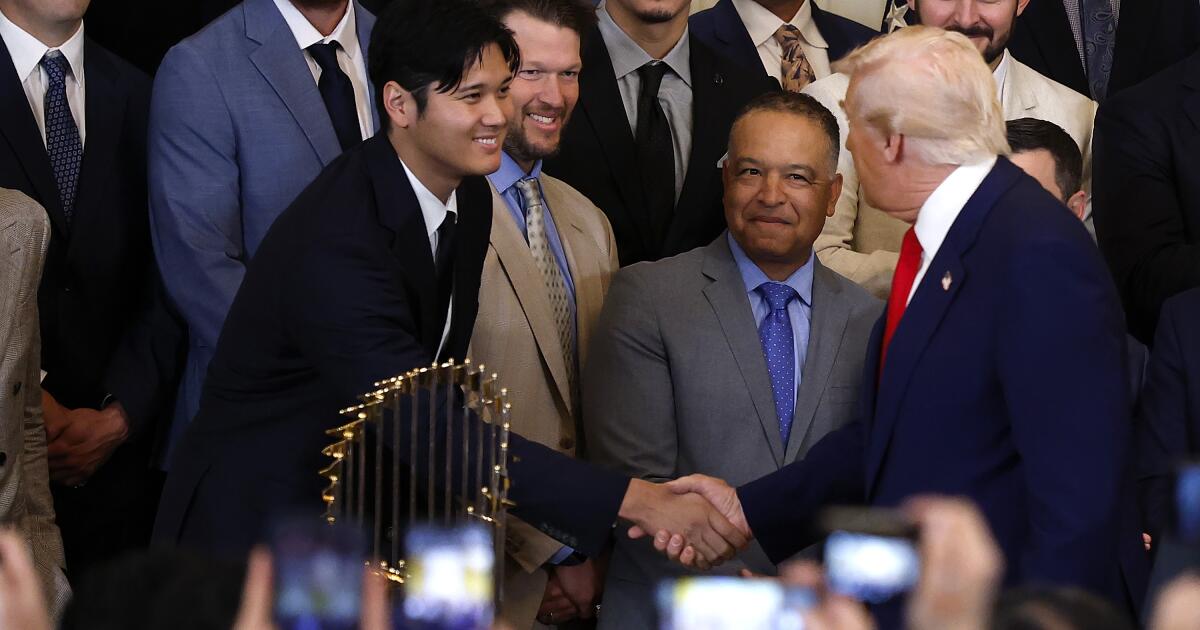
Dodgers scheduled to visit White House in late July to celebrate 2025 World Series win
-

 World35 minutes ago
Former US Olympian pleads not guilty in DC reflecting pool vandalism case
-
 News1 hour ago
Former Olympian pleads not guilty in reflecting pool vandalism charges


