Midwest
Muslim Dearborn mayor weighs in on residents’ complaints about mosque’s call to prayer


NEWYou can now listen to Fox News articles!
Dearborn, Michigan, Mayor Abdullah Hammoud responded to noise complaints about a mosque’s call to prayer, saying it’s “not an issue.”
Hammoud discussed the concern on the Nov. 3 episode of the “Not From Here” podcast. Local Dearborn citizens have complained in recent months that a nearby mosque has been broadcasting the call to prayer on loudspeakers multiple times a day, beginning as early as 5:30 a.m.
Though residents raised concerns during a September city council meeting, Hammoud insisted that the call to prayer under a certain decibel level is allowed under city ordinances and has been part of Dearborn life for decades.
DEARBORN’S MUSLIM MAYOR TELLS CHRISTIAN HE’S ‘NOT WELCOME’ IN DEBATE ON HONORING PRO-TERROR ARAB LEADER
Dearborn Mayor Abdullah Hammoud dismissed complaints against a local mosque’s call to prayer. (City of Dearborn screenshot)
“I would tell you is, you know, those complaining about the call to prayer, I mean it’s a very, very few, you still want to respect the wishes and, if you have a serious concern, I have to uphold the law across all boards,” Hammoud said. “But we’ve done decibel readings at these mosques, all within threshold, all within legal limit. And so for me, it’s not an issue.”
He continued, “We also have to uphold our constitutional rights to freedom of religion. And I would say this, you know, that’s the thing. I’m saying this as a Muslim. People, of course, are going to say this is a call to prayer, but like, you know, why are these complaints just coming forward now?”
“Yeah, elections are coming up,” host Jaafar Issa remarked.
DEARBORN MAYOR REFUSES TO APOLOGIZE FOR TELLING CHRISTIAN MINISTER HE WAS ‘NOT WELCOME HERE’
Dearborn Mayor Abdullah Hammoud said the mosque’s call to prayer did not violate city ordnance on noise levels. (Charly Triballeau/Getty Images)
Hammoud didn’t directly respond to that comment but shrugged and repeated, “Call to prayer has been happening since the 1970s in Dearborn.”
The city ordinance states that noise in residential areas cannot exceed 55 decibels at night (after 10 p.m.) or 60 decibels during the day (7 a.m. to 10 p.m.). Loudspeakers are prohibited between 10 p.m. and 7 a.m.
Hammoud also said that most mosques in the city do not make a call to prayer at “Fajr” or dawn and compared the sound to church bells.
Fox News Digital reached out to the mayor’s office for comment.
DEARBORN HEIGHTS POLICE DEPARTMENT TROTS OUT ‘OPTIONAL PATCH’ FEATURING ARABIC AND ENGLISH TEXT
Dearborn, Michigan resident Andrea Unger started a petition to pressure the city council to enforce a noise ordinance after two years of a local mosque broadcasting its calls to prayer over a loudspeaker. (Dearborn City Council via YouTube Screenshot)
Dearborn resident Andrea Unger, who has lived in the city for 40 years, told Fox News Digital last month that she had recorded the call to prayer for 30 consecutive days and found it consistently exceeded 70 decibels. She said she raised concerns with the police department and city council for the past two years, but the problem continued.
She added that some of her neighbors were hesitant to speak out, fearing they would be labeled anti-Muslim.
CLICK HERE TO DOWNLOAD THE FOX NEWS APP
“I have heard a lot of people say, ‘I’m glad you said something,’ because people are afraid they’ll get called names like ‘Islamophobic,’ like our mayor [Abdullah H. Hammoud] called [Dearborn resident and Christian minister] Ted Barham, because you disagree,” she said. “We’re not Islamophobic, we’re not anti-Muslim, we are not anti-Jewish. We just want to live in the community that it’s always been [before] something changed two years ago to allow this.”
Fox News’ Kristine Parks contributed to this report.
Read the full article from Here



Did you get a strange text claiming to be from the Illinois DMV, demanding money? It’s a trick, the Illinois Secretary of State’s Office says, with Alexi Giannoulias issuing an “urgent warning” about a new wave of threatening scam texts going out.
The unsolicited texts, which falsely claim to be from the Illinois Secretary of State or DMV, prompted the office to issue several messages about it this week, saying “scammers have recently escalated their tactics” with texts that look even more official with fake fines and regulations, deadlines or penalty dates.
“Many of the texts cite an upcoming enforcement date and list severe consequences to pressure recipients into acting quickly,” a press release from Giannoulias’ office said Tuesday. “These schemes are designed to create panic and trick individuals into surrendering money or personal information.”
Suburban police departments and even Chicago officials have also warned of the scam.
In a March 20 message posted to Facebook, the Oswego Police Department shared a photo of what one scam text may look like, saying “it includes a photo of what appears to be an official notice for a traffic violation hearing.”
“The document may look legit at first glance, even listing Illinois statutes, but there are some clear red flags,” the department said.
Below is a photo the department shared of what some of the texts may look like or contain:
The Illinois Secretary of State’s office says it will never send a text message demanding payment or threatening to suspend a license. The only time the office will send a text, Giannoulias said, is to remind someone of a scheduled DMV appointment.
“If you receive a message like this, remember it’s a scam – plain and simple. Do not click the link and please report the message to scamalert@ilsos.gov,” the release said.
Wednesday at 2 p.m., Giannoulias will hold a news conference about the scam, saying “don’t click it’s a trick.” Giannoulias is expected to break down how it works, and what to watch out for.
If you do receive a text, here’s what the Secretary of State’s office recommends:
-NEVER to click a link
-Do not reply
-Do not provide personal information
-Forward the message to the SOS’ scam alert email

(MIRROR INDY) — Standing by a pocket park that used to be a gas station on the north side, James Whitfield reflected on how his neighborhood has changed.
Whitfield, 77, moved to Highland Vicinity more than three decades ago. Back then, the neighborhood was mostly blue-collar families, but the demographics shifted as investors and more affluent families began buying and fixing up older homes.
As president of the neighborhood association, a post he’s held for the past 18 years — “Nobody wants the job, so I keep getting volunteered” — Whitfield helps organize cleanups and keeps residents informed about changes happening in the area, the latest of which is traffic-related.
The Department of Public Works is converting parts of 29th and 30th streets to two-way traffic as part of an effort to make the area more pedestrian-friendly. Changes will be near neighborhood assets such as the little park at 29th and Capital Avenue as well as large attractions like the Children’s Museum.
The $14 million project will include street resurfacing, sidewalk improvements and traffic calming elements, as well as a protected bike lane on 30th Street.
It comes as cities throughout the country have been converting one-way roads that act as mini highways for commuters back into slower-moving, easier-to-navigate neighborhood streets.
Whitfield isn’t necessarily opposed to the project, but he and many of his neighbors feel they weren’t properly informed — that a decision was made for them without their feedback.
“We didn’t even have input before it was already laid out,” Whitfield said.
A DPW spokesperson said the department held an open house in December 2021 and has been speaking publicly about the project to news outlets and on social media platforms. City engineers began presenting the concept to neighborhood organizations last year, including Highland Vicinity, Crown Hill and the Riverside Civic League.
Why the changes?
The two-way conversion project is part of a larger citywide effort to make neighborhoods across Indianapolis safer and more accommodating to pedestrians and cyclists — in line with city policies around Vision Zero and Complete Streets.
A roughly 2.5-mile stretch of 29th Street is slated for conversion, beginning at the White River on the west end and ending at Central Avenue in Mapleton-Fall Creek.
This section of 29th is classified as a high injury network by the Indianapolis Metropolitan Planning Organization. Since 2018, there have been 18 crashes involving serious injuries. Two of them were fatal.
A 2-mile section of 30th between the White River, right by the recently completed 30th Street bridge, and Meridian Street, will also be converted to two-way traffic.
Some residents are worried that the changes will lead to traffic congestion and increased crashes due to driver confusion.
“I think it’s going to cause a lot of accidents,” said Tonya Elliott, who recently formed a neighborhood watch group.
“For the elderly, it’ll be a little confusing,” said Gina Martin, who also lives in the neighborhood. “I know my husband will probably be like, ‘Wait a minute, what’s going on here?’”
The two-way conversion is the first of two major traffic projects coming to the area. The city also plans to convert Illinois Street and Capitol Avenue to two-way traffic between 21st and 38th streets.
Whitfield thinks the traffic changes will be “a major problem” for the Children’s Museum parking garage, which is located near the corner of 30th and Illinois streets. Right now, pedestrians cross one-way Illinois street to get from surface parking or the garage to the museum.
A museum spokesperson said it is in ongoing conversations with city officials to “understand the potential implications and timing of the proposed changes, with a continued focus on safety and accessibility for our visitors and the surrounding neighborhood.”

DPW spokesperson Kyle Bloyd said the project will enhance east-west connectivity between neighborhoods across the Riverside, near northwest side and Midtown areas.
“Restoring the streets back to two-way traffic will create a more balanced street network that calms traffic, supports transit operations, enhances pedestrian and bicycle access, and empowers local business activity,” Bloyd said.
What’s next?
Construction on 29th and 30th streets is expected to start in April at the western end of the project, between Riverside Drive and the I-65 interchange, and continue east until the project is completed. Indy DPW expects to finish by fall 2027.
Other city thoroughfares slated for two-way conversions include:
- Pennsylvania Street from I-65 to Fall Creek Parkway South Drive
- Delaware Street from I-65 to Fall Creek Parkway South Drive
- Alabama Street from Washington Street to Michigan Street
- New Jersey Street from Washington Street to Michigan Street
- East Street from Washington Street to 10th Street
- College Avenue from Virginia Avenue to Market Street
Work on those projects is expected to start in 2028 and last until 2032.
Mirror Indy, a nonprofit newsroom, is funded through grants and donations from individuals, foundations and organizations.
Peter Blanchard covers local government. Reach him at 317-605-4836 or peter.blanchard@mirrorindy.org. Follow him on X @peterlblanchard.


How a bill becomes a law in Iowa
The 2026 Iowa legislative session began Jan. 12. Republicans hold control of the House, Senate and governor’s office for the tenth consecutive year.
Some Iowa health insurance plans will see a tax hike under a bill headed to Gov. Kim Reynolds to be signed into law.
House File 2739 raises taxes on health insurance providers known as health maintenance organizations, or HMOs, to bring in millions of dollars to fill a shortfall in the state’s Medicaid budget.
That group includes companies that offer some of the state’s largest private insurance plans, like Wellmark, Sanford, Wellpoint and Aetna.
Fourteen Republicans across both chambers broke from their party to join Democrats and oppose the proposal, which put the GOP majority in the rare position of being at odds with business groups lobbying against tax hikes. But Republicans in each chamber had enough votes to pass the measure.
How much will health insurance taxes increase?
The taxes will increase from the current rate of 0.925% up to 3.5% between Jan. 1 and Sept. 30, 2026. Beginning Oct. 1, 2026, the tax would drop to 0.95%.
The tax increase would allow the state to access federal matching funds and is expected to bring in $123 million to shore up Iowa’s growing Medicaid budget deficit, which is expected to climb to $167.6 million in fiscal year 2027.
The bill also appropriates $89 million to cover the state’s current-year Medicaid budget deficit of $90.6 million.
Democrats warned Iowans will face higher insurance costs as a result of the bill.
Scott Sundstrom, a lobbyist for Wellmark, said at a March 18 public hearing that Wellmark estimates that its customers who are covered by the company’s plan will see a $115 tax increase per person. The company expects to pay $24.2 million more in taxes this year because of the increase.
Why are Iowa Republicans raising taxes?
Republicans have pointed to insurance companies’ profit margins and said health insurers — who have been highly critical of the bill — do not need to raise premiums to cover the cost of the tax increase.
GOP legislative leaders have said there’s a limited window to bring in matching federal funds because of Republicans’ sprawling tax and spending package dubbed the “One Big, Beautiful Bill.”
“This bill will bring investments that benefit our neighbors on Medicaid and those providing the services to them,” said Sen. Mark Costello, R-Imogene.
Here’s how every Iowa lawmaker voted.
How every Iowa House lawmaker voted on health care tax increase
The Iowa House voted 53-40 to pass the measure on March 19.
Ten Republicans joined every Democrat in voting against the bill: Reps. David Blom, R-Marshalltown; Mark Cisneros, R-Muscatine; Bill Gustoff, R-Des Moines; Thomas Jeneary, R-Le Mars; Judd Lawler, R-Oxford; Norlin Mommsen, R-De Witt; Jennifer Smith, R-Dubuque; Ray Sorensen, R-Greenfield; Ryan Weldon, R-Ankeny; and David Young, R-Van Meter.
Representatives voting yes
Andrews (R), Barker (R), Behn (R), Bergan (R), Bloomingdale (R), Boden (R), Bossman (R), Bradley (R), Collins (R), Determann (R), Dunwell (R), Fett (R), Fisher (R), Gearhart (R), Gehlbach (R), Grassley (R), Harris (R), Hayes (R), Henderson (R), Hermanson (R), Holt (R), Hora (R), Ingels (R), Johnson, C. (R), Jones (R), Kaufmann (R), Kniff McCulla (R), Larson (R), Latham (R), Lohse (R), Lundgren (R), Meggers (R), Meyer, A. (R), Mohr, G. (R), Moore, T. (R), Nordman (R), Rinker (R), Shipley, (R) Sieck (R), Siegrist (R), Sitzmann (R), Stone, (R), Thompson, M. (R), Thomson, C. (R), Vondran (R), Watkins (R), Wengryn (R), Wheeler (R), Williams (R), Wills, J. (R) , Wilz, H. (R), Wood (R), Wulf (R)
Representatives voting no
Baeth (D), Bagniewski (D), Blom (R), Brown-Powers (D), Cisneros (R), Cooling (D), Croken (D), Ehlert (D), Gjerde (D), Gosa (D), Gustoff (R), Jacoby (D), James (D), Jeneary (R), Johnson, R. (D), Judge (D), Konfrst (D), Kressig (D), Kurth (D), Lawler (R), Levin (D), Madison (D), Matson (D), McBurney (D), Meyer, B. (D), Mommsen (R), Nielsen (D), Olson (D), Ramirez (D), Scholten (D), Smith (R), Sorensen (R), Srinivas (D), Turek (D), Weldon (R), Wichtendahl (D), Wilburn (D), Wilson (D), Young (R), Zabner (D)
Representatives absent or not voting
Amos Jr. (D), Dieken (R), Gaines (D), Gerhold (R), Golding (R), Wessel-Kroeschell (D), Windschitl (R)
How every Iowa Senate lawmaker voted on health care tax increase
The Iowa Senate voted 26-19 to pass the bill on Tuesday, March 24, sending it to Reynolds.
Four Republican senators joined Democrats in voting against the bill: Sens. Mike Bousselot, R-Ankeny; Doug Campbell, R-Mason City; Charlie McClintock, R-Alburnett; and David Sires, R-Cedar Falls.
Senators voting yes
Alons (R), Gruenhagen (R), Costello (R), Dawson (R), Dickey (R), Driscoll (R), Evans (R), Green (R), Guth (R), Klimesh (R), Koelker (R), Kraayenbrink (R), Pike (R), Reichman (R), Rozenboom (R), Salmon (R), Schultz (R), Shipley (R), Sinclair (R), Sweeney (R), Taylor (R), Warme (R), Webster (R), Westrich (R), Whitver (R), Zumbach (R)
Senators voting no
Bennett (D), Bisignano (D), Blake (D), Bousselot (R), Campbell (R), Donahue (D), Dotzler (D), Drey (D), Hardman (D), Knox (D), McClintock (R), Petersen (D), Sires (R), Staed (D), Townsend (D), Quirmbach (D), Weiner (D), Winckler (D), Zimmer (D)
Senators absent or not voting
Garrett (R), Lofgren (R), Rowley (R), Trone Garriott (D), Wahls (D)
Marissa Payne covers the Iowa Statehouse and politics for the Register. Reach her by email at mjpayne@registermedia.com. Follow her on X at @marissajpayne.
Tim Webber is a data visualization specialist for the Register. Reach him at twebber@registermedia.com and on Twitter at @HelloTimWebber.

‘Urgent warning:’ DMV scam texts appear more official than before, Giannoulias says

Northside residents brace for 2-way street conversions

See which Iowa lawmakers voted to hike private health insurance taxes

Kansas firefighters rescue chubby cat trapped in massive recliner while trying to hide from the vet

Will Louisiana’s U.S. Senate candidates debate? Bill Cassidy says no to Moon Griffon.

Florida High School Football Rankings: Top 25 teams – Oct. 21

How old is Bo Nix? What to know about Oregon quarterback ahead of 2024 NFL Draft

Cleary's 21 help Le Moyne down Central Connecticut State 69-64 in OT

99th annual Pony Swim held in Virginia

Indiana Members Credit Union announced as new anchor tenant at Bottleworks District

LaGuardia Crash Timeline: Moments Before Air Canada Plane Collided With Fire Truck

Chicago alderwoman apologizes for ‘wrong place at the wrong time’ comment on slain student

Fake Euronews website targets Hungary election with false claims
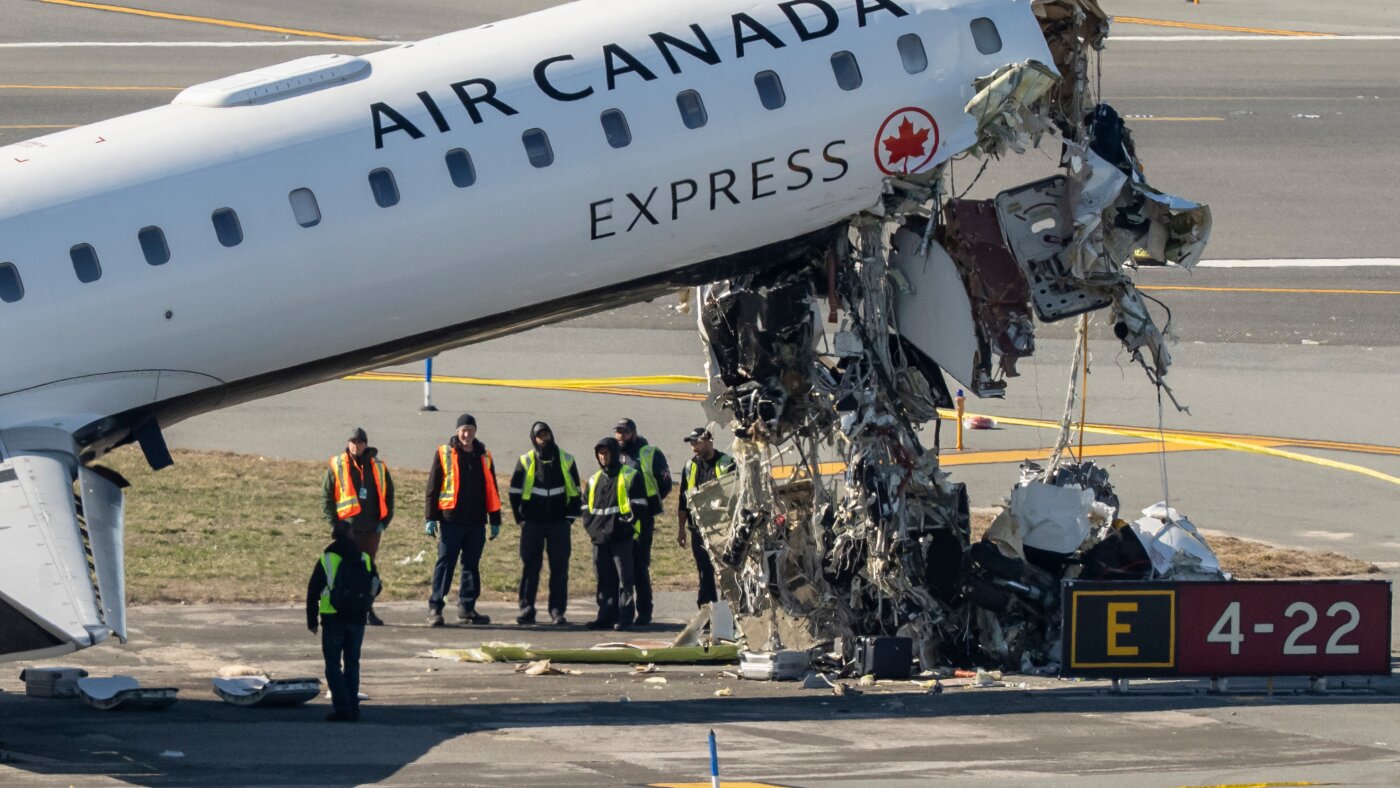
An air traffic controller was juggling extra roles during the LaGuardia plane crash

Iran War: Pentagon set to send thousands of elite 82nd Airborne troops to region | BBC News
-

 Detroit, MI6 days ago
Drummer Brian Pastoria, longtime Detroit music advocate, dies at 68
-

 Georgia1 week ago
How ICE plans for a detention warehouse pushed a Georgia town to fight back | CNN Politics
-

 Movie Reviews6 days ago
‘Youth’ Twitter review: Ken Karunaas impresses audiences; Suraj Venjaramoodu adds charm; music wins praise | – The Times of India
-

 Education1 week ago
Video: Turning Point USA Clubs Expand to High Schools Across America
-

 Sports4 days ago
IOC addresses execution of 19-year-old Iranian wrestler Saleh Mohammadi
-
 Science1 week ago
Industrial chemicals have reached the middle of the oceans, new study shows
-

 Science1 week ago
How a Melting Glacier in Antarctica Could Affect Tens of Millions Around the Globe
-

 Culture1 week ago
Test Your Memory of Great Lines From Classic Irish Poems