Minnesota
Minnesota warning as springs polluted with pesticides, analysis reveals


Pesticides have been found in high concentrations in ground and surface water sources in Minnesota, not only posing a risk to local wildlife but possibly also contaminating drinking water for many of the state’s residents.
In a new study, published in the journal Science of the Total Environment, Arnold and colleagues from the University of Minnesota Twin Cities in collaboration with the Minnesota Department of Natural Resources collected water samples from 15 natural springs and 75 unique wells across 13 Minnesota counties between 2019 and 2022. Samples were included from both urban and rural areas as well as water sources at various depths.
What they found was that water in natural springs were particularly susceptible to contamination with these insecticides.
Over 450,000 tons of pesticides are used in the U.S. every year, according to data from the Food and Agriculture Organization of the United Nations. Not only can these chemicals seep into surrounding ecosystems and affect plants and animals, but they may also harm human health.
ArtTim/roman023/Getty
The health impacts of these chemicals depend on the types of pesticide used, but several common agricultural chemicals have been associated with developmental and hormonal disruptions, as well as neurotoxic effects. Other studies have suggested that exposure to these chemicals may be as bad as smoking when it comes to increasing our risk of certain types of cancers. However, it is unclear how much exposure is required to see these effects.
Insecticides are a class of pesticide that target insects in both agriculture and urban pest control. Due to their widespread nature, these chemicals not only end up as residues on our food, but can also get swept away into surrounding lakes, rivers, and groundwater systems.
“We use so many of these chemicals in Minnesota. Basically, every corn and soybean seed is treated before planting,” Bill Arnold, a professor in the University of Minnesota’s Department of Civil, Environmental, and Geo- Engineering, said in a statement. “Many of these chemicals can be purchased at a local hardware store that can be used for spraying fruit trees, flea and tick control for your pets, and eliminating bedbugs.”
“We were surprised by the high levels of the chemical detected in the natural springs and in some cases the chemicals were observed at much deeper levels in wells than we expected going into this project,” Arnold said.
“Oftentimes people think a natural spring has water that is safe to drink. That’s not necessarily true, it depends on how deep that water is sourced.”
In light of these findings, the research team is working with county and state agencies to include insecticides in water treatment monitoring lists and to improve the treatment of stormwater in urban environments to facilitate the removal of the chemical pollutants.
Do you have a tip on a health story that Newsweek should be covering? Let us know via science@newsweek.com.
References
Gerken, J., Vincent, G. T., Zapata, D., Barron, I. G., & Zapata, I. (2024). Comprehensive assessment of pesticide use patterns and increased cancer risk. Frontiers in Cancer Control and Society, 2. https://doi.org/10.3389/fcacs.2024.1368086
Goedjen, G. J., Capel, P. D., Barry, J. D., & Arnold, W. A. (2024). Occurrence and distribution of neonicotinoids and fiproles within groundwater in Minnesota: Effects of lithology, land use and geography. The Science of the Total Environment, 176411. https://doi.org/10.1016/j.scitotenv.2024.176411



GULL LAKE, Minn. — Tick populations are moving
north
this season, and there’s been an increase in tick-bite-related emergency room visits, according to state health officials.
The deer tick — also known as the blacklegged tick — can carry not only Lyme disease and other pathogens, but also Powassan virus, a fairly recent discovery which has no treatment and can leave behind permanent neurological damage.
From 2008-2022, Cass and Itasca counties ranked highest for reported cases of Powassan — at six to seven cases each, according to the Minnesota Department of Health, with the west side of Gull Lake considered a prime spot for the disease. During that same time, Aitkin and Morrison counties had two to three reported cases, and Crow Wing County had one reported case.
Contributed / Minnesota Department of Health
Elizabeth Schiffman, supervisor of the Vector-borne Diseases Group at the Minnesota Department of Health, said this lakes area presents a whole host of risks, especially this time of year, thanks to early summer weather with the combination of tick season and increased outdoor traffic.
“Traditionally, we kind of say the end of May through about the middle of July is the highest-risk time of year for ticks and tick-borne diseases,” she said.
Schiffman said diagnostics for Powassan are tricky because by the time someone may feel symptomatic enough to seek treatment, they may have already had the virus pass through their system, and those who are symptomatic largely tend to have more generalized symptoms like fevers, headaches or muscle aches.
“We didn’t detect our first case in Minnesota until 2008, so it’s still relatively uncommon,” she said. “It’s also not one that’s regularly included in a lot of the tick-borne disease panels that most providers use from commercial laboratories, so diagnostics can be a bit more limited.”
Schiffman said the peak year for cases in Minnesota was 2024, with 14 cases. Last year there were eight. The diagnostic process comes after more obvious explanations have been ruled out, and usually involves some kind of serologic testing, or looking for antibodies. Polymerase Chain Reaction (PCR) testing is also available.
“The bacteria that causes Lyme disease is found in about one of three ticks,” Schiffman said. “And something like Powassan is found in just maybe, like, you know, a couple percent of ticks. It’s a much smaller, much smaller proportion of ticks that are infected.”
Matthew Aliota, a professor at the University of Minnesota Twin Cities in the College of Veterinary Science, studies arthropod viruses.

Contributed / U.S. National Park Service
“In the state overall, we think about 5% of ticks are positive,” he said, regarding the proportion of Powassan-carrying ticks.
Aliota said its relatively uncommon but can leave debilitating aftereffects.
“It’s a virus that can invade the central nervous system and go to your brain, with severe outcomes,” he said. “If you survive, you can have long-lasting impacts to kind of your overall functioning from a memory standpoint and from a cognitive standpoint.”
The virus ‘affected everything’
Teal Johannsen said her father, Jeffrey, was a hunter, builder and business owner when he caught Powassan near Gull Lake as an otherwise healthy and active outdoorsman. He died in 2023 at age 69.
“My dad was a very healthy, strong guy, and he pretty much was never sick until this happened, and then it was pretty much just a multi-system collapse for him,” Johannsen said. “The virus and the aftereffects of the virus just affected everything.”
Jeffrey suffered neurological consequences — more specifically, as Johannsen indicated doctors told her family,
encephalitis,
or swelling of the brain. She said her family worked tirelessly to get care that would alleviate his symptoms. They consulted neurologists, sleep experts and infectious disease doctors.
“He couldn’t eat, he couldn’t sleep, he slowly stopped being able to … he wouldn’t want to talk to anyone,” Johannsen said. “He had horrible, horrible anxiety, which was totally unusual for him. He had a really hard time leaving the house. He stopped being able to make eye contact with people. It just kind of slowly took over his ability to just function independently and be himself.”
The Johannsens were not unfamiliar with Minnesota wilderness, and certainly not Jeffrey. Johannsen said her father taught her tick safety, and she has early memories of him instructing her how to stay safe on the property.
“We would always go out in the woods together, and he taught me how to be careful for ticks, so it’s not like he was unaware of how to be out in the outdoors in Minnesota,” Johannsen said. “He knew how to watch out for ticks, but we had never heard of this, and we definitely didn’t know how devastating it could be.”
There is no treatment for the Powassan virus, so Johannsen said there’s a real emphasis to place on preventive measures like wearing long pants and close-toed shoes outdoors, as well as utilizing effective repellents. She and her mother, Susan Johannsen, are working to educate their family members who share their multi-residence Gull Lake area property, including purchasing the pesticide
Permethrin
for use on the grounds.
Schiffman said she usually refers people to the Environmental Protection Agency website for guidance on which repellents are most effective. Permethrin is one of the proven acting chemicals. When shopping in-store, Schiffman said there is usually an EPA registration indicator on the back of these products.
“It says EPA reg number, and then a little series of digits,” she said. “If it has that on the bottle, you know that repellent has been tested, you know it’s going to work the way it says it’s going to work if you’re using it according to the label direction. Some of them you need to reapply more often, like a sunscreen; some of them last a bit longer. So really, the quickest way I would say is to look for that EPA registration number on the label, and if you’ve got that, you’re on the right track.”
Johannsen said she’s also since learned not all ticks that can carry Powassan are full-grown.
“Not all ticks are like the visible ones that you see crawling around,” she said. “The nymph stages can be as tiny as a poppy seed, and they can also carry the virus and infect people; they’re able to break skin and cause infection that way.”
Johannsen said her father is very missed. He was a dedicated builder and loved his job so much that he often took it home, and to other people’s homes as well, given the nature of his work.
“He basically just always had jobs because people would spread the word of what a good job he did on their remodels or builds,” she said. “He was the kind of person that would walk into your house and do an assessment for free because he couldn’t help looking at all the little areas of improvement on your house.”
Johannsen said the property’s standing was evident of the real love and knowledge he possessed of his craft, as well as the level of care he operated with. He maintained the 100-year-old property with specialized needs for use by a lot of extended family. The Johannsens are slowly learning to pick up where he left off.
“He was the main property caretaker that was keeping the place running, because of his knowledge and skill set,” Johannsen said. “He could just basically build anything, fix anything, and so after he died, we’re kind of figuring out how to manage the property.”

Contributed / Lauren Bishop / CDC Division of Vector-Borne Diseases Rickettsial Zoonoses Branch

The capsule will be buried in Philadelphia on July 4. Here’s a look at what each state contributed to “America’s Time Capsule.”

‘America’s Time Capsule’ has been officially sealed. What’s inside?
All 50 states contributed items to “America’s Time Capsule,” which will be buried in Philadelphia on July 4 and will be opened 250 years later.
Some states sealed 10 items in “America’s Time Capsule,” sharing a broad look at their state with Americans in 2276, when the capsule is meant to be opened.
Some contributed only one, such as Montana’s beaded artwork by an Indigenous artist.
Minnesota sent two items: the executive order from Gov. Tim Walz creating the Minnesota250 Commission and the state flag.
The time capsule has been officially sealed in commemoration of the United States’ 250th birthday.
The 900-pound steel cylinder contains over 200 artifacts, records and objects to tell America’s story when it is opened 250 years later.
The capsule will be buried in Philadelphia on July 4 as part of the hundreds of events for America’s 250th anniversary that will take place nationwide.
America250, the official nonpartisan commission designated by Congress to organize the July 4 celebrations, spearheaded the work to design the capsule and collect relics. All 50 states in conjunction with numerous national organizations contributed items (ranging from a vial of sand to an Olympic gold medal) reflecting the people, places and moments that shaped their history.
California contributed a NASA photo, an AI prediction and a fusion superconducter segment. Arizona contributed a copper ingot and a laser-etched challenge coin. Maine contributed a whale bone and a woven bookmark. And Utah contributed tickets to their amusement parks and George Washington’s prayer medal.
“Now that America’s Time Capsule has been sealed, it carries with it a remarkable record of this moment in our nation’s history,” said Chair of America250 Rosie Rios. “This moment is as much about the future as it is the past. When it is opened in 2276, future generations will see the care, pride, and optimism with which Americans marked our 250th anniversary.”
Below is a list of an item contributed from each state and territory of the United States. Most states submitted multiple items, and the full list can be viewed on America250’s official website.
- Alabama: A series of poems written by author and professor James Matthew Wilson titled “America.”
- Alaska: A map of New Archangel, Alaska, when Russia sold Alaska to the United States in 1867.
- American Samoa: A set of two uncirculated quarters from 2009 and 2020 with images of American Samoa.
- Arizona: A laser nano-etching of the text and signatures of the Declaration of Independence and the U.S. Constitution on a coin.
- Arkansas: A diamond found at the Crater of Diamonds State Park, the only place in the United States where people can search for diamonds and keep what they find.
- California: A Claude AI prediction of what California will be like in 250 years on archival paper. This will serve as a “tangible representation” of AI in 2026.
- Colorado: A set of postcards selected to represent “what life was like in Colorado in 2026.”
- Connecticut: The Official Proclamation document for the state.
- The District of Columbia: A challenge coin with “Washington, D.C. 250” on one side and a building with flags and the Mayor’s name etched on the other.
- Delaware: A set of 12 notecards with writings and drawings from the state’s citizens to answer what Delaware is to them.
- Florida: The Florida Senate Booklet from 2024 to 2026, which describes the operations of the Senate.
- Georgia: A distinct medallion of The Masters Logo, which has a yellow silhouette of the United States with a red flagstick to mark where Augusta, Georgia is located.
- Guam: A Gualofan ornament pendant, which is a traditional ornament that has become a “modern expression of Chamorro identity.” The pendant represents the full moon.
- Hawaii: A letter from Governor Josh Green.
- Idaho: A star garnet, which is the state’s official gemstone found only in Idaho and one other place in the world. The garnet is meant to highlight the state’s geological heritage.
- llinois: A poem authored by Illinois Poet Laureate Mark Turcotte titled “Dear New Blood.”
- Indiana: The Indiana 250 Annual Report, which shares the mission and objectives of the commission working to celebrate July 4th.
- Iowa: Astronaut Peggy Whitson’s International Space Station medallion, which commemorates Whitson’s leadership as the first woman to command the International Space Station.
- Kansas: A document identifying Kansas250 commissioners and news items from the last year.
- Kentucky: A commemorative coin from the Sons of the Revolution, intended to serve as a reminder of how the American Revolution influenced Kentucky.
- Louisiana: A necklace with a Krewe of Bacchus pendant, a collectible from Mardi Gras, and glass beads.
- Maine: A whale bone from the North Atlantic right whale, which is one of the world’s most critically endangered large whale species.
- Maryland: A challenge coin with Governor Wes Moore’s name and a map of the state on it.
- Massachusetts: A set of archival prints, including a print of the Boston Massacre and a letter from John Adams and Benjamin Franklin to the Massachusetts Council.
- Michigan: The state stone, or the Petoskey stone, which is native to the shores of Lake Michigan and formed nearly 350 million years ago.
- Minnesota: The state’s flag.
- Mississippi: Four brass coins commemorating the U.S.’s largest rocket engine test site and the Birthplace of America’s Music, amongst other notable events.
- Missouri: A letter from Governor Mike Kehoe to Americans 250 years later.
- Montana: A beaded artwork created by a Arikara artist representing the state’s landscapes and heritage.
- Nebraska: An archival photo of the Vice Grip pliers, which symbolize the state’s commerce and history.
- Nevada: A set of gambling chips to reflect the history of casinos across the state, which legalized gambling during the Great Depression.
- New Hampshire: A print of a sticker depicting the center emblem of a flag carried by the Second New Hampshire Regiment of the Continental Army.
- New Jersey: A stainless steel plate with greetings to people in 2276, with “the hope that the values that guide us in 2026 — liberty, opportunity, cooperation, love and respect for one another — continue to shape society.”
- New Mexico: A hand-crafted red chile tile created by Mexican-American artist Jennel Juarez. The tile is one of New Mexico’s longstanding cultural symbols.
- New York: A written reflection from New York State.
- North Carolina: A copper disk engraved with an image of the North Carolina State Capitol Building.
- North Dakota: A commemorative coin representing the opening of the Theodore Roosevelt Presidential Library in Medora, North Dakota.
- The Northern Mariana Islands: A crescent-hewn symbol representing the Chamorro ancestors’ leadership and noble standing.
- Ohio: Fabric from the Wright Brothers’ flight honoring the state’s connection to the birth of aviation.
- Oklahoma: A belt buckle that features images that represent the “grit, determination and spirit” of the state.
- Oregon: A handcrafted pin created by Native American artist Lillian Pitt.
- Pennsylvania: A “Greetings from Harrisburg” letter from Governor Josh Shapiro.
- Puerto Rico: A rosary to represent the importance of faith in the island.
- Rhode Island: A holiday ornament meant to honor the state’s Revolutionary War legacy.
- South Carolina: A coin commemorating the work done by the state’s 250 Commission.
- South Dakota: A poetry book celebrating the state’s rivers, wildlife and homestead culture through a special edition of “This Far Country” authored by Joseph Bottum.
- Tennessee: An original poster designed by one of the state’s artists to highlight Tennessee’s agricultural history and cultural symbols, including its role in the Civil Rights movement and women’s suffrage.
- Texas: The state seal on a chiseled glass paperweight. The seal was designed in 1836 during the Texas Revolution.
- The U.S. Virgin Islands: A letter from Governor Albert Bryan, Jr.
- Utah: A set of 101 paper cards with different people that shaped Utah history.
- Vermont: A Battle of Hubbardton ornament. The battle was the only Revolutionary War battle fought entirely on what is now considered Vermont.
- Virginia: A challenge coin representing the state’s commemoration of America’s semiquincentennial.
- Washington: A letter from Washington State Lieutenant Governor Denny Heck to the future.
- West Virginia: A student essay authored by Alyssa Dalton titled “Remembering our Foundation” celebrating the nation’s 250th birthday. The essay was solicited from a statewide essay contest to recognize how “the young people… will continue to guide our state.”
- Wisconsin: An Eagle feather and photo of Old Abe, an American bald eagle who served with the Eighth Wisconsin Volunteer Infantry Regiment during the civil war.
- Wyoming: A letter from Governor Mark Gordon to future Americans.
Many of the capsule’s collections were specifically designed for the commemoration. For example, the Library of Congress contributed a molecular data storage device about 0.2 inches with synthetic DNA encoded with digital copies of the library’s items. It includes Thomas Jefferson’s rough draft of the Declaration of Independence, a 3D rendering of President Abraham Lincoln’s hand and an 1898 audio recording of the national anthem.
Companies such as Coca-Cola and Apple along with museums like the Smithsonian Institute also contributed items.
Minnesota
Minnesota cannabis store owners lament testing backlog: “It’s getting frustrating for everyone involved”

One of five cannabis testing sites in Minnesota is shutting down, citing exorbitant costs as the reason.
William Drexler is moving product he has around as he waits patiently for more. He says customers who come into Grey Area, on Grand Avenue in St. Paul, are looking for adult-use items, which he says are being held up by a backlog in testing.
“We haven’t had problems with drinks or edibles yet, but for the adult-use products that where we’ve seen the delays, like your pre-rolls, your flowers, we haven’t even gotten pens in yet,” Drexler said.
He says getting cannabis products in his store has been an issue since he got his license to sell them a few months ago.
“I’ve heard pretty much from every vendor that it’s testing that we are waiting on. That’s been the normal thing to hear, and week by week they may say, ‘it’s next week,’ and that can delay into the following week. So at this point I don’t think many of them are giving a date,” he said.
He anticipates getting those products will take even longer now that one of the testing sites is no longer testing.
In a statement, Legends Technical Services said, “under the current regulatory framework, we do not foresee an ability to continue to meet our client expectations in an economically viable manner. “
“We’ve already seen testing delays from the get go, so vendors aren’t really giving us time frames because they are probably hearing different time frames themselves,” Drexler said. “It’s getting frustrating for everyone involved.”
For now, Drexler contacts growers to see how long before his shelves are in full bloom.
“These companies here, it’s the same story kind of from them when we contact them. ‘Hey, we need more product. We’re hoping for new [product] soon, but it’s coming out of testing soon,’” he said.
WCCO has reached out to Minnesota’s Office of Cannabis Management for comment on the backlog.
-
 Science1 minute ago
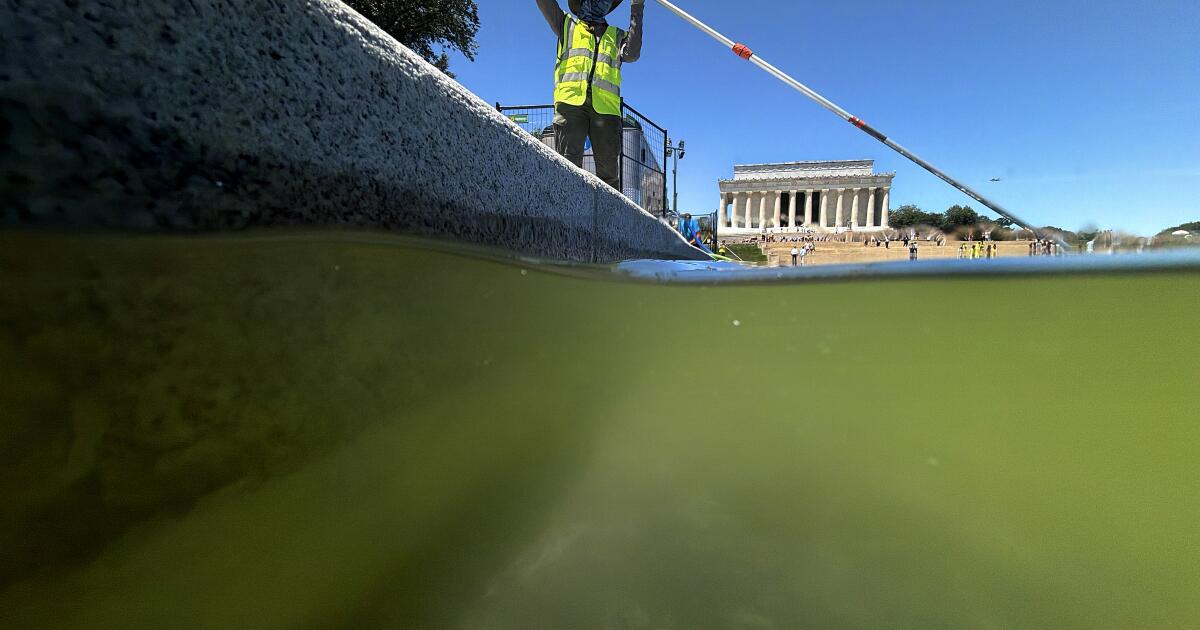
Here’s why the Lincoln Memorial Reflecting Pool went green so fast
-
 Sports4 minutes ago
Shohei Ohtani out of Dodgers’ lineup vs. Orioles for birth of his second child
-

 World17 minutes ago
Lebanese influencer organises World Cup event amid Israel’s attack on Leban
-
 News39 minutes ago
Air Force One, gifted to Trump from Qatar, arrives at Joint Base Andrews
-

 New York2 hours ago
Video: Fans Show Up to the Parade in Their Best Knicks-Themed Attire
-

 Los Angeles, Ca2 hours ago
Victims sought after man allegedly points gun at passing cars in Santa Clarita Valley
-

 Detroit, MI2 hours ago
Best barbershop in Metro Detroit: Finalists for this year’s Vote 4 The Best
-

 San Francisco, CA3 hours ago
How to watch San Francisco Giants vs. Miami Marlins

