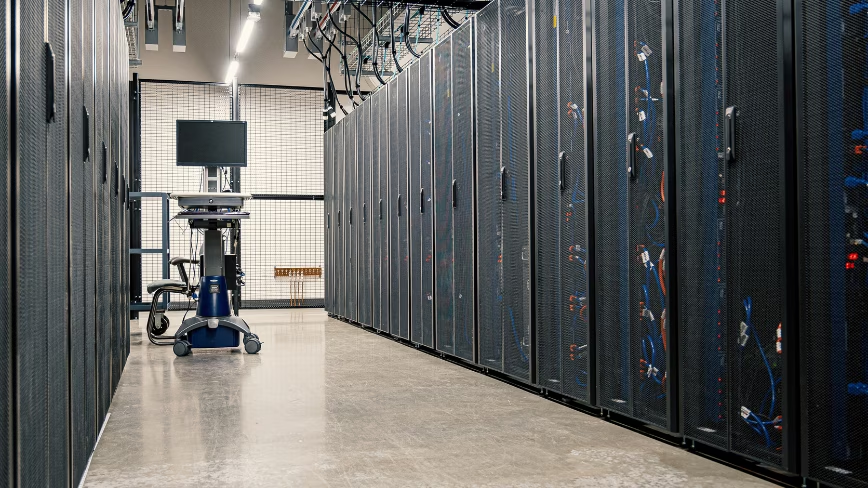
Core42, the cloud subsidiary of Abu Dhabi’s G42 Group, has leased 20 megawatts in a converted office building in downtown Minneapolis. The company building the Stargate UAE campus is now filling American offices-turned-data-centres, part of a broader pattern in which the same AI systems emptying offices are generating the demand to fill them with servers.
The building at 1001 Third Avenue South in downtown Minneapolis used to be an office. Now it is a data centre, and its anchor tenant is not a Silicon Valley hyperscaler but Core42, the cloud and AI infrastructure subsidiary of Abu Dhabi’s G42 Group. The lease, reported by Bloomberg on Wednesday, covers 20 megawatts of capacity in a facility converted from commercial office space by Legacy Investing, a Virginia-based developer that has spent more than 70 million dollars transforming the property. The deal is a small piece of a much larger pattern: the UAE’s most ambitious AI company is building a network of American data centres while simultaneously constructing the largest AI compute facility outside the United States, and the buildings it is filling were, until recently, home to the kind of white-collar workers whose jobs AI is designed to replace.
Advertisement
The tenant
G42, led by CEO Peng Xiao and backed by Abu Dhabi’s national security adviser Sheikh Tahnoon bin Zayed Al Nahyan, has become the UAE’s principal vehicle for AI infrastructure investment. The company is building the Stargate UAE campus, the international flagship of the 500 billion dollar Stargate joint venture between OpenAI, SoftBank, Oracle, and Abu Dhabi sovereign investment vehicle MGX, across approximately 19 square kilometres of desert south of Abu Dhabi. The first phase, a 200 megawatt compute cluster powered by Nvidia Grace Blackwell GB300 systems, is scheduled to come online by the end of 2026, with full build-out designed to reach one gigawatt of capacity at a projected cost exceeding 30 billion dollars. The project has already attracted geopolitical threats, with Iran warning of retaliatory strikes against Gulf infrastructure including commercial data centres.
Core42’s US expansion extends well beyond Minneapolis. The company signed a ten-year lease with TeraWulf for more than 70 megawatts of data centre infrastructure at the Lake Mariner facility in upstate New York, with an option for an additional 135 megawatts. G42 has also announced a one billion dollar data centre investment in Vietnam and established Core42’s European headquarters in Dublin. The Minneapolis lease adds a relatively modest 20 megawatts to a portfolio that is scaling globally, but its significance lies less in the capacity than in the location: a converted office building in the centre of an American city whose downtown vacancy rate, like those of most mid-sized US cities, has climbed steadily since the pandemic.
The conversion
The 💜 of EU tech
The latest rumblings from the EU tech scene, a story from our wise ol’ founder Boris, and some questionable AI art. It’s free, every week, in your inbox. Sign up now!
Legacy Investing acquired 1001 Third Avenue South in 2019 and has since invested heavily in converting the six-storey property from office to data centre use. The company spent more than 70 million dollars on improvements in 2025 alone, expanding the building’s capacity from approximately two megawatts to 21 megawatts. In January 2026, Cloud Capital and Bahrain-based asset manager Arcapita acquired the property for 235 million dollars through a joint venture, reflecting the premium that data centre conversions now command over traditional office valuations.
Advertisement
The economics of office-to-data-centre conversion have become compelling enough to reshape urban real estate markets. US utilities plan to spend 1.4 trillion dollars by 2030 to power the AI boom, and the demand for data centre capacity has outstripped the supply of purpose-built facilities. Converting existing office buildings offers developers a faster path to market than ground-up construction, provided the building’s structural load capacity, power infrastructure, and cooling systems can be upgraded to support the density of modern compute hardware. Not every office qualifies. The buildings that do, typically those with reinforced concrete construction, proximity to fibre networks, and access to sufficient electrical capacity, have become some of the most sought-after properties in commercial real estate.
The pattern
G42’s American data centre strategy reflects a broader shift in how sovereign AI ambitions are materialising in the United States. The company is not simply building compute capacity abroad. It is establishing a physical presence inside the American power grid, the American fibre network, and American commercial real estate markets. The Minneapolis lease, the TeraWulf deal in New York, and facilities in California and Texas create a distributed infrastructure footprint that positions Core42 as a provider of what the company calls sovereign cloud and AI infrastructure: compute capacity that can serve both G42’s own AI workloads and those of its customers, including the US-based companies that require data residency within American borders.
The race to secure data centre capacity has drawn startups, sovereign wealth funds, and hyperscalers into direct competition for the same constrained resources: power, land, cooling, and fibre connectivity. In Minneapolis, Legacy Investing’s conversion of an office building into a 21 megawatt facility illustrates how developers are working around those constraints by repurposing existing urban infrastructure rather than competing for greenfield sites in the exurban corridors where most large-scale data centres are built. The approach has limits. Twenty megawatts is a fraction of the capacity that a purpose-built hyperscale facility delivers, and the structural constraints of an existing building make future expansion difficult. But for a tenant like Core42, which needs distributed US presence rather than concentrated scale, the urban conversion model offers something that a greenfield campus in rural Virginia does not: proximity to enterprise customers and the network interconnection density of a major metropolitan area.
The context
The geopolitics of UAE-linked AI infrastructure in the United States remain sensitive. G42 severed its ties with Chinese technology companies in 2024 under pressure from the US government, a prerequisite for receiving access to advanced American AI chips. Microsoft invested 1.5 billion dollars in G42 as part of that realignment, and the company has since positioned itself as a bridge between American AI technology and Gulf capital. OpenAI’s decision to pause its Stargate UK project over energy costs and regulatory concerns has made the UAE’s willingness to build at scale and speed more strategically valuable, and G42’s ability to secure chip imports for the Stargate UAE campus has been treated by the US government as a test case for whether AI infrastructure can be deployed in allied nations without compromising national security.
The financial dynamics of AI infrastructure investment have produced valuations and capital commitments that would have been inconceivable five years ago. Oracle’s stock fell 50 per cent despite a Wall Street buy consensus as concentration risk from its OpenAI dependency spooked investors. Alphabet raised its full-year 2026 capex estimate to between 180 and 190 billion dollars. The International Energy Agency predicts that energy use from data centres will double by the end of 2026. Into this environment, a 20 megawatt lease in a converted Minneapolis office building registers as a footnote. But the tenant signing the lease is the company building the largest AI compute facility outside the United States, and the building it is moving into is one of hundreds of American offices being repurposed to house the infrastructure that is making the offices themselves obsolete. The conversion is not just architectural. It is economic. The same AI systems that emptied the office are now filling it with servers.
Minnesota is serious about its lakes. Their “Land of 10,000 Lakes” slogan isn’t an exaggeration. In fact, the true count is 11,842, based on their definition of what constitutes a lake, which Wisconsin likes to argue about with them. Regardless of whose definition you use, Minnesota has a lot of lakes to choose from, which means you can still find a little slice of solitary lakeside serenity if you know where to look. One of those places is Greenleaf Lake.
Idyllic Greenleaf is only about 1.5 hours from Minneapolis, and it’s never crowded — in fact, there’s a good chance you’ll have it all to yourself. Most of the bigger, more popular lakes, like Red Lake, Leech Lake, and Lake Superior’s shoreline, are in Minnesota’s northern half, several hours from the Twin Cities. But there’s no need to wander so far from urban amenities and the well-connected airport, when you can enjoy an idyllic day on Greenleaf Lake instead.
Advertisement
The state recreation area that protects this beautiful lake started as a grassroots effort to establish a state park within 30 miles of every Minnesotan. After years of work, the agreements, land acquisition, and funding all finally fell into place, and the park was transferred to the state in 2009. Almost 20 years later, the park is still an unassuming and peaceful place for a day trip from Minneapolis for those who don’t need much to enjoy the outdoors.
Enjoying Greenleaf Lake State Recreation Area
The first thing to know about Greenleaf Lake State Recreation Area is that this park embraces its primitive natural habitat. There are actually two lakes in the park, Greenleaf and Sioux, but there aren’t many facilities here beyond the peaceful, natural surroundings. The park’s entrance and only parking area is at Greenleaf Lake, which has a small boat launch, a fishing pier, and a few picnic tables, all surrounded by trees and vegetation. Enjoy a lazy morning of boating and fishing for panfish, pike, walleye, and largemouth bass on the lake, followed by a delicious picnic lunch while you read away the afternoon with only the birds to keep you company. Minnesota may be known for having some of the friendliest people in America, but you’re unlikely to run into more than a handful here. Quiet solitude awaits at this park.
Advertisement
The park’s one hiking trail begins at the parking area and winds just a mile through an open field and into a small forest south of Greenleaf Lake, before you’ll have to turn around and return the way you came. Bring insect-repellent clothes and spray to protect your skin, as bugs can be overwhelming in the warm seasons, and ticks are always a possibility in the woods. One Google reviewer described the trail as unwalkable due to the bugs. The rest of the park, including Sioux Lake, isn’t easily accessible. Most visitors won’t ever see Sioux Lake because there are no trails to it.
The lack of park facilities has turned off some visitors and contributed to some poor reviews on Tripadvisor. The people that leave Greenleaf Lake five-star reviews on Google are the ones that just enjoy being out in nature. If you prefer a Minnesota state park with more amenities, consider Lake Bemidji State Park instead.
Advertisement
Planning your day at Greenleaf Lake
While Minneapolis is one of America’s best cities for getting around without a car, you’ll need one to explore beyond the metro area. Getting to Greenleaf Lake State Recreation Area is easy with GPS, but don’t rely on following park signs once you get close. Visitors report there aren’t any on the small backroads that lead to the park. The entrance road is nothing fancy, a narrow dirt road that leads to a small parking area. If you’re visiting just to get your park passport stamp, it’s not actually at the park. It’s at the DNR office in Hutchinson.
Before arriving at Greenleaf Lake State Recreation Area, be sure to stop for a restroom break. There are no facilities, sometimes not even a porta-potty, at the park. The closest convenience stores are in Litchfield, Dassel, or Hutchinson, each about 15 to 20 minutes from the parking area at Greenleaf Lake. If you’re a seasoned backpacker and are prepared to do your business in the woods, make sure you follow Leave No Trace principles.
The mayor of Minneapolis and his staff are defying a community survey by recommending a group to develop a site at George Floyd Square that did not receive the most support in that survey.
It still received positive feedback, and the city council will have final say, but for now, Mayor Jacob Frey and city staff feel that the Minnesota Agape Movement is best suited to handle future development of the former gas station at 38th and Chicago, now known as The Peoples’ Way.
But according to a survey of community stakeholders, the group Rise & Remember garnered the most strongly positive reactions overall.
Since the city shared this development, the mayor’s office has declined multiple interview requests, as we try to learn his reasoning. We also had other questions about what seems like a contradiction in how he’s felt about community being involved in this process so far.
Advertisement
Minneapolis City Council overrides mayor’s veto of George Floyd Square pedestrian mall study
For example, following a city council override of his veto as they pushed for a 38th & Chicago plan that community surveying found was not wanted in February 2025, the mayor lashed out at council members.
“Today’s short-sighted decision by the council has ignored community wishes and is a colossal waste of both time and money,” Mayor Frey said that February day last year.
As we continued to try to get clarity surrounding the mayor’s decision to move forward with Agape, a city spokesperson shared the following:
City staff has taken community input, including the survey results, into consideration for this Peoples’ Way recommendation. Community input was one of multiple factors, such as relevant experience, we considered for the evaluation criteria outlined in the RFQ. One of the things we heard from community was a desire for the applicants to collaborate on a project since they all bring strengths to the table. Agape is ready and willing to collaborate with all stakeholders and community in a development process.
Advertisement
Within the city’s announcement about the recommendation, the mayor shared the following:
George Floyd Square carries significant meaning for Minneapolis and for people around the world,” said Mayor Jacob Frey. “We’re looking forward to partnering with Agape and the community as we take this next step together to continue building toward the long-term vision for the Square.
This development is already getting council pushback — members will have final say and the Business, Housing, and Zoning Committee will first address it on June 2, with plans for the full council to June 11.
Council member Jason Chavez, whose ward includes part of George Floyd Square, sent the following statement:
Mayor Frey promised a decision on the future of the People’s Way in May 2025 and instead took an extra year to make a decision. He also chose to disregard the data and the community’s preference.
Advertisement
I have concerns about fairness, transparency, and accountability about the entire process. The results of the city-commissioned survey showed that the Rise and Remember proposal received the most support, was most closely aligned with community values, and received the most strongly positive reactions overall. Mayor Frey sat on the results of this survey for over a year.
In an interview with 5 EYEWITNESS NEWS, council member Soren Stevenson, whose ward also partly falls in George Floyd Square, says his community is ready to move forward and has frustrations with how things have been handled thus far.
“There was such an opportunity to listen to what the community had asked for, and we’re not there,” Stevenson said about this most recent development.
“It’s been, it’s been really confusing and troubling for community members to understand, like, am I giving you my feedback because you want it and you’re going to use it, or am I giving you my feedback, so that you can check the box that feedback has been gotten?” Stevenson added.
Quincy Street isn’t just at the center of Art-A-Whirl, it’s at the heart of the Arts District in northeast Minneapolis. The road itself, however, is falling apart. And the only thing bumpier than the exposed brick is the reaction to the city’s plans to fix it.
“It’s known as like the most quirky, cobblestoney, potholey street,” said Kristin Olson, owner of Studio Q.
She and others working along the street have come to appreciate its crumbling characteristics. It forces cars to drive slowly, which is helpful given the amount of foot traffic in the area.
It’s also the very reason city leaders want to remake it.
Advertisement
Recent project renderings include adding sidewalks and trails to improve accessibility. Putting in a new road will help fix drainage issues. The city even wants to use bricks instead of asphalt to retain the area’s image.
“Totally hear that and understand it and we also want that, but the rest of the street is working as is,” said Olson.
Her studio has three private parking spots that her clients rely on.
The road project would convert private parking along Quincy Street into public parking, a major sticking point for artists needing direct access to their vehicles outside their studios.
“We save those for people who have mobility needs or people who are bringing in a lot of equipment,” said Olson.
Advertisement
Many of her clients have multiple vehicles for photoshoots at her studio.
“If we as a studio don’t have access to these three spots for our teams, those clients are going somewhere else,” she said.
The fight to keep Quincy Street’s character has been going on for a few years, with the pushback ramping up as the 2027 construction date nears. The latest renderings include loading zones for the businesses along the street, but artists like Charlie Haumersen don’t feel it’s enough.
“Just having access to the building is really important,” Haumerson said.
He, and many of the tenants on the block, also worry the city’s desire for change will have ramifications beyond just the road.
Advertisement
“We think of it as sort of a form of cultural erasure. Even though we’re just building a street, it might pave the way artists to have to leave,” he said.
Olson is hopeful that the city will slow down its plans and continue to come up with solutions that find a middle ground with the neighbors. It’s unclear if the city plans to make further changes to its latest redesign.