


The survey, released last week by the Milwaukee Jewish Federation, found that 43% of Jewish adults said they identified as Zionist, while 42% said they did not. A much higher share, 69%, said they feel somewhat or very “emotionally attached to Israel.” At the same time, 52% of respondents agreed that “Israel regularly violates the human rights of the Palestinian people.”
Milwaukee, WI
Handful of Chicago Sky games will air on local TV in Milwaukee


Milwaukee fans can catch WNBA games on local television for four contests this season, with WMLW airing Chicago Sky games as well as 30-minute specials on the team called “Sky Unguarded.”
Now known as “The M,” the over-the-air channel will broadcast games on Sundays, including May 25 (against the Los Angeles Sparks, 5 p.m. CT), June 22 (against Atlanta, 2 p.m.), July 6 (against Minnesota, 6 p.m.) and Aug. 8 (against Phoenix, 5 p.m.).
The Sky lost their first game of the season against Caitlin Clark and the Indiana Fever on May 17. The 2021 WNBA champion Sky feature a number of high-profile players, including Angel Reese, Courtney Vandersloot and Kamilla Cardoso.
The “Sky Unguarded” news magazine program airs at 4:30 p.m. May 25, 1:30 p.m. June 22 and 10:30 a.m. Aug. 30.
The channel can be found using an over-the-air antenna on 49.1 or 58.3, and Spectrum customers can find the channel on 7, 8, 608, 982 or 1007. DirecTV customers can find the channel at 49, and AT&T customers can locate The M on 7 or 1007.
The WNBA’s surge in popularity in recent years has led to expansion, with a new team in San Francisco this year and teams coming for Toronto and Portland. A group in Milwaukee has also explored submitting a bid for a future team.

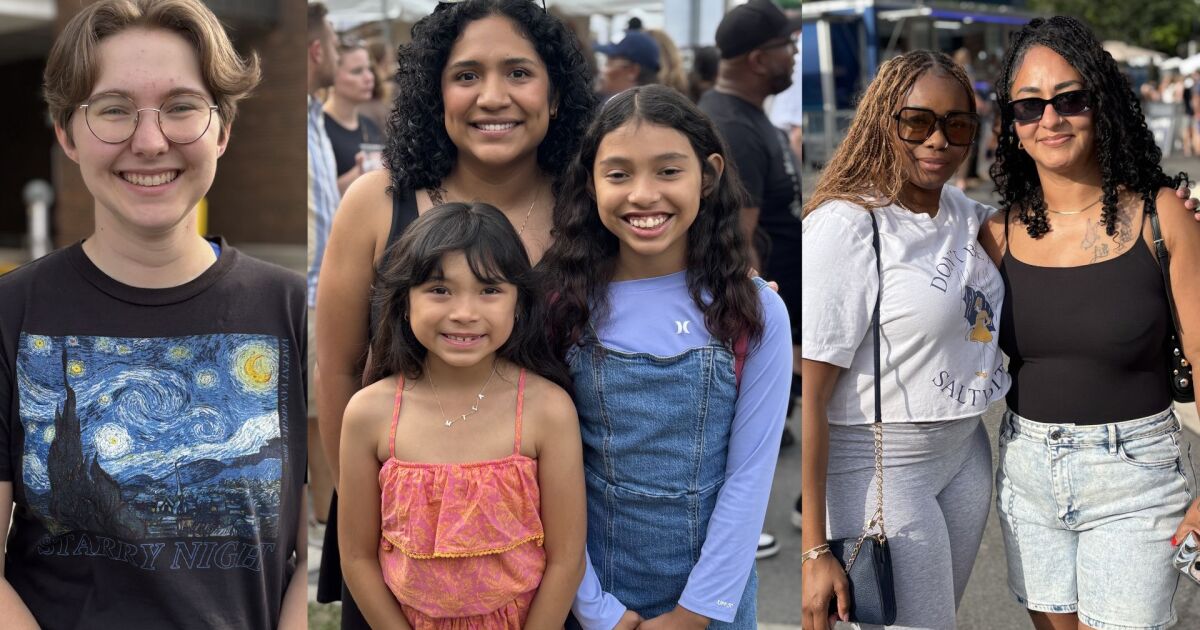
MILWAUKEE — Bastille Days and Festa Italiana are filling downtown Milwaukee with live music, food and large crowds this weekend.
For many, events like these are a summer tradition.
“The festivals for the summertime-they’re something to do like almost every single day and almost most definitely every single week,” Natara Riley said.
But some festivalgoers say outside of these big events, downtown’s entertainment scene isn’t what it used to be.
“I grew up partying on Water Street. I won’t go there no more at all,” Leandra Wohner said.
“I think it’s the city is not upkeeping the entertainment that people need to have fun. So when something does happen, like Bastille Days or other festivals, a lot of people tend to go to it because there’s not a lot of room for like activities for people,” Riley said.
Watch: Festivalgoers say Milwaukee’s summer events fill a gap in downtown entertainment
It’s a weekend of festivals in downtown Milwaukee
Festivalgoers say events like these give people a chance to enjoy live music, support local vendors, and try new foods — all in an environment they feel is well organized.
“I feel like it’s safe. They block off the roads, especially where there’s a lot of people walking around, and you know, parking wasn’t hard to find either. So it’s very-I want to say-I feel like it’s very well put together,” Dana Garcia said.
For those who may be hesitant about coming downtown, Emma Maertz offered this encouragement.
“If you never give it a chance, you never discover all the wonderful little vibrant things out here on the streets, and so I’d say give it a chance. You know, come down, see what it’s like, walk around, try out a street festival, park a few blocks away, and explore a new area,” Maertz said.
Let’s talk:
Hey there! At TMJ4 News, we’re all about listening to our audience and tackling the stuff that really matters to you. Got a story idea, tip, or just want to chat about this piece? Hit us up using the form below. For more ways to get in touch, head over to tmj4.com/tips.
It’s about time to watch on your time. Stream local news and weather 24/7 by searching for “TMJ4” on your device.
Available for download on Roku, Apple TV, Amazon Fire TV, and more.
Report a typo or error // Submit a news tip
Milwaukee, WI
Survey finds less than half of Jews in Milwaukee identify as Zionists | The Jerusalem Post

Yet another survey has found that fewer than half of Jews in an American city identify as Zionists, this time in Milwaukee, the childhood home of Golda Meir, the Zionist icon and former Israeli prime minister.
The results join a growing number of similar data points generated by Jewish groups that point to evolving, and at times seemingly contradictory, views about Israel among American Jews. A survey released in February by Jewish Federations of North America, an umbrella group, found that 37% of Jews identified as Zionist even as 88% believed that “Israel has the right to exist as a Jewish, Democratic state.”
The findings cut across North American Jewish communities of different regions and sizes and are prompting Jewish leaders to reexamine their assumptions at a time when Israel is shedding support among Americans of all backgrounds.
“A year ago I really would have had a knee-jerk reaction where I was stuck on the word, because I am a Zionist,” Miryam Rosenzweig, the Milwaukee federation’s president and CEO, told the Jewish Telegraphic Agency about her views on the survey. “What I needed to overcome and understand is that, as a brand, it’s tarnished.” The word, she said, “is tainted.”
‘The values are still there’
Yet, Rosenzweig insisted, for her Jewish community, “the values are still there.”
The Milwaukee area is home to an estimated 27,500 Jews who attend more than a dozen synagogues and six Jewish schools. The local federation operates a number of programs directly and supports a wide range of education, cultural, religious and security initiatives meant to strengthen the Jewish community. (It also gives to a number of national Jewish organizations, including a small grant to 70 Faces Media, JTA’s parent company.)
The local survey, completed by 980 families, was conducted between December 2024 and March 2025, at a time when criticism over Israel’s handling of the war in Gaza was sharply mounting. More than 100 hostages taken when Hamas attacked Israel on Oct. 7, 2023, triggering the war, were still in captivity at the survey’s start, while dozens were released during a temporary ceasefire midway through the survey period.
Conducted by researchers at Brandeis University and the University of Chicago’s NORC social research firm, the survey is the federation’s first deep dive into its Jewish population since 2011. It was conducted by email, mail and phone, with options to complete the survey online or over the phone, and has an overall margin of error of 6.5%.
The survey asked about a wide range of topics and, Rosenzweig said, has illuminated unique challenges for the federation, including the region’s aging Jewish population and its relatively lower average household income when compared to similarly sized Jewish communities.
High levels of Jewish ‘participation’
The data also offered unique bright spots, such as high levels of what Rosenzweig classified as Jewish “participation.”
Three-quarters of Jewish children in the area’s interfaith households are being raised Jewish, for example, and nearly one in four of all Jewish children in Milwaukee are enrolled in a Jewish day school or yeshiva, higher than the national average.
But it is the Zionism question that has seized public interest, in part because it was asked at all.
For decades, according to Matthew Boxer, a researcher at Brandeis’s Cohen Center for Jewish Studies who led the Milwaukee study and has worked on many others, local federations conducting population studies would ask about topics such as emotional attachment to Israel, but largely refrained from directly asking their communities whether they identified as Zionists.
That changed with the 2020 Chicago federation survey, also led by Boxer’s team, which found that 40% of the region’s Jewish adults self-identified as Zionist while 80% agreed with the statement “It’s important for Israel to be a Jewish state.”
Since then, Boxer said, around a dozen federations have opted to ask some version of the Zionism question on their surveys. Recently released findings from the federations in Boston and St. Louis found similar results to Chicago’s and Milwaukee’s; new survey results in Austin, Texas, and Orange County, California, are expected later this year. (Some have decided against including the question, too.)
The findings have functioned as something of a Rorschach test for American Jews. Those who are deeply critical of Israel say the fact that a minority of American Jews identify as Zionists prove that American Jewish groups should roll back their support for and engagement with Israel. Those who want to preserve the historic relationship urge looking beyond the label and focusing on the fact that a significant majority of Jews are aligned in their support for traditional tenets of Zionism.
In an essay for JTA published after the national federations group released its survey, Mimi Kravetz, JFNA’s chief impact officer, concluded that most Jews still believe in the “historic definition” of Zionism, while conceding that the term has gone through “definition creep.” She urged federations to “open pathways for learning and belonging,” and avoid “responding with anger when the moment calls for steady leadership.”
For Rosenzweig, who came to Milwaukee in 2019 after years working with Jewish young professionals at Detroit’s federation, polling her community about Zionism was a no-brainer even when they were first conceiving the survey before Oct. 7. “We have to ask the question,” she said.
“The demographic study is not meant to answer what we want to hear,” she said. “We need to know where they stand, where do people agree and disagree?”
While the survey found a split on Zionist identification, it found broad consensus on other issues, sometimes ones that are in tension with each other. For example, 84% of Milwaukee Jews somewhat or strongly agreed with the statement, “I consider it important for Israel to be a Jewish state.” At the same time, 88% agreed that “Israel should be a democratic state for all of its citizens, regardless of religious identity.”
Two ideas could coexist
Rosenzweig said she believes the two ideas could coexist. “Our community can support Israel and support Israel’s right to exist and be a Jewish state, and they’re concerned for the human dignity of Palestinians. It’s not binary,” she said. “And I think that’s really an important message about who American Jews are.”
Rabbi Noah Chertkoff, who leads the Reform Congregation Shalom in the suburb of Fox Point, said he wasn’t surprised by the survey results on Zionism but cautioned against drawing too many conclusions from them.
“I proudly identify as a Zionist, but I also recognize that the word itself has been badly distorted and, at times, deliberately defamed by people more interested in vilifying Jews than engaging seriously with Jewish history, Jewish belief and the Jewish people’s own understanding of our story,” he wrote in an email to JTA.
Chertkoff added that his own congregants have expressed both “real anguish” over Oct. 7, as well as concerns for democracy in Israel and “the suffering of civilians on all sides of the conflict.” He added that the survey should be read as a “mandate”: “If we want the next generation to inherit a durable connection to Israel and Zionism, we cannot rely only on inherited labels.”
Rabbi Lex Rofeberg, a Milwaukee native who runs the alternative Jewish engagement network Judaism Unbound from his current home in Rhode Island, said he believed the survey is surfacing more than mere confusion over the word Zionism.
“As a person who would self-identify as ‘not a Zionist,’ I hope that Jewish organizations in Milwaukee, and beyond, would respond to this finding not by trying to shift my beliefs, or by insisting that I don’t really know what I’m opposing,” he wrote in an email. “I’d hope instead they’d recognize the reality that ‘I’m not a Zionist’ is a sincere, deeply-held belief for a lot of Jews all around the world, and that includes just over 40% of Jews in the greater Milwaukee area.”
Jewish institutions, he suggested, “should respond to lower support for Zionism not with ‘how do we re-brand Zionism’ but rather ‘how can we create meaningful Jewish experiences for folks who are actively not Zionists?’”
Jewish Milwaukee, which Rofeberg calls “awesome” and credits with having “shaped me as a person and a Jew,” could achieve this, he insists.
What the federation does with this new information is still to be determined. Rosenzweig is currently drafting “a very extensive strategic plan,” she told JTA, but said it was too early for specifics. She does hope to focus on points of commonality, rather than trying to convince half of the local Jews they are, or should be, Zionists.
For inspiration, Rosenzweig has been dusting off Milwaukee’s community survey from exactly a century ago. (Meir had already moved to Palestine by way of Denver at the time.) Back then, she said, the community was roughly the same size it is now, and its Jewish funding arms were raising roughly the same amount of money, adjusted for inflation.
“It was talking about the ‘Campaign for Palestine,’ in 1926, because the Jews of Eastern Europe had nowhere to go,” Rosenzweig said. “They were worried about it then. And so today, we’re responding to the moment. And yes, it looks dark. There were dark days, and we survived because we came together. We know how to do this.”


Drone view of the Milwaukee County Courthouse
Check out a bird’s‑eye view of the Milwaukee County Courthouse from a drone
A Milwaukee County Board supervisor wants the public to weigh in on the county’s multi-million dollar project to revamp the the county’s downtown courthouse complex.
In early July, the county updated its project estimate to $897 million to overhaul the crumbling downtown courthouse complex, roughly doubling initial projections.
Supervisor Justin Bielinski, who has been the biggest opponent to the project on the board, authored a resolution calling for a contingent referendum on the Nov. 3 ballot. The referendum would ask voters whether they would require County Board approval for any additional financing needed for the construction phase of the courthouse project.
The resolution, which will go before the finance committee on July 23, also asks for the transfer of $18,000 from the appropriation for contingencies to the Milwaukee County Election Commission to offset the cost of the referendum.
“A capital project of this size is likely to require substantial long-term borrowing, debt service, and future budget commitments by Milwaukee County, which may place upward pressure on the property tax levy to service the debt issued to finance the project,” Bielinski’s resolution says.
The more than 320,000-square-foot Courthouse Complex is almost 100 years old and is home to the county’s criminal courts, County Jail as well as the Sheriff’s and District Attorney’s offices. The existing judicial buildings have been called “severely outdated” and “functionally obsolete,” creating public safety and security concerns over the years as its maintenance backlog exceeds $75 million.
Upon the release of new project estimates, County Executive David Crowley argued he expects his administration’s funding approach to cover the increased costs of the courthouse project and cut the cost to county property tax payers by more than $400 million by tapping other sources.
Crowley has described the project as urgent.
“The Public Safety Building has well surpassed the end of its life. The question in front of us isn’t whether we replace it, but when we will do it and how responsibly we can get it done,” Crowley said in a statement July 2.
The design phase of the new courthouse complex began in late 2024 and with initial timelines expecting to wrap up in 2028 and demolition set to start that year. Construction is expected to take place between 2029 and 2032.
So far, the county has allocated roughly $38.6 million between fiscal years 2024 and 2026 for the preliminary planning, design and consulting work for the project. Approximately $858 million will be needed for the remaining construction.
The county’s adopted capital budget for 2026 was limited to the approved bonding cap of $56.8 million, which leaves $63.3 million in requested bonding authority unfunded, Bielinski’s resolution says, adding that substantial borrowing for the project could limit the county’s ability to finance other major infrastructure needs, such as parks, transit, bridges, roads as well as other public facilities.
“Because of the magnitude and potential countywide fiscal impact of this project, Milwaukee County voters should have a voice through a contingent referendum before the County makes a final construction-phase funding commitment for the [courthouse] project,” the resolution said.
-
 Politics6 minutes ago
Trump administration clears path for controversial Mojave Desert water pipeline
-
 Sports14 minutes ago
World Cup fans flock to In-N-Out, Erewhon and Trader Joe’s for a taste of California
-

 World24 minutes ago
Hundreds of thousands evacuated as Typhoon Bavi barrels towards China
-
 News51 minutes ago
With the white nationalist group Patriot Front, what you see is not what you get
-

 New York2 hours ago
How ‘The Wire’ Star Jamie Hector Spends a Hot Day in Brooklyn
-

 Los Angeles, Ca2 hours ago
Burglars ransack Sherman Oaks condo building during fumigation
-

 Detroit, MI2 hours ago
Metro Detroit weather forecast, July 10, 2026 — 11 p.m. Update
-

 San Francisco, CA3 hours ago
Classical music series helps reconnect downtown San Francisco community

