Milwaukee, WI
Brewers 2024 top 20 prospects: Jackson Chourio leads deep system


The Milwaukee Brewers’ system is loaded with star power and depth, setting the team up to keep their run of contention rolling for another five years or more. They had a hugely promising 2023 draft class and have continued to add prospects with the trades of Corbin Burnes and Luis Urías, while their international scouting department keeps hitting on big-bonus players and their player development staff has become one of the best in the industry at making material changes to help players move up.
GO DEEPER
Top 100 MLB prospects 2024: Keith Law’s rankings, with Jackson Holliday at No. 1
Brewers 2024 top 20 prospects
(Note: Seasonal ages as of July 1, 2024. Scouting grades are on the traditional 20-80 or 2-8 scouting scale.)
1. Jackson Chourio, OF (2024 top 100 ranking: 2)
Bats: R | Throws: R | Height: 5-11 | Weight: 165 | Seasonal age in 2024: 20
Chourio came into the year as my No. 3 prospect, behind the two eventual Rookie of the Year winners, but then got off to a slow start when the Brewers started him in Double-A Biloxi despite just 31 games in High A and six in Double A the year before. Whether he was pressing or just adjusting to the tougher level, when the sun rose on June 1st, Chourio was hitting .254/.308/.418 and had punched out in a quarter of his plate appearances. The rest of the season, he hit .297/.353/.492 with a 15 percent strikeout rate and spent the final week with Triple-A Nashville. That week went pretty well, as Chourio put 21 balls in play, eight of them with exit velocities of 100 mph or better, peaking at 107.2 mph, and just five below 91 mph. Chourio still finished fifth in the Double-A Southern League in steals and tied for fourth in homers, and has barely begun to fill out physically, getting to that power and hard contact with strong wrists and incredible bat speed.
It’s a simple swing with just enough loft in that follow-through for line-drive power, and he projects to hit for high averages as well. He’s a plus runner and at least a 60 defender in center already, likely to end up more. You can make a case for him over Jackson Holliday, as Chourio also plays a position up the middle, offers plus defense, has more speed, and is overall a twitchier, more athletic player. I think Holliday has the higher floor, between his position and better feel right now for the strike zone, but, as with the top-two prospects Gunnar Henderson and Corbin Carroll last year, I think both of these guys are superstars.
2. Jeferson Quero, C (2024 top 100 ranking: 12)
Bats: R | Throws: R | Height: 5-11 | Weight: 215 | Seasonal age in 2024: 21
Quero spent the entire 2023 season in Double A at age 20, the youngest catcher to get even 300 PA at either of the top two levels of the minors. He showed big progress across the board, including a massive improvement in his conditioning from 2022 to 2023. He’s in way better shape now to handle a full season of work behind the plate, so while he always had the hands and arm for the position, he’s a lot more consistent and could end up a 60 defender there all around. At the plate, he’s got great feel for the barrel, with a swing that’s short to the ball and long through contact, with future 20-homer seasons a possibility when he’s in his mid-20s. He can swing too hard at times but gets away with it because he has such good barrel control within the zone.
He did have a reverse platoon split last year, struggling especially when lefties threw him changeups, while right-handers would attack him with spin down and away that he’s still learning to lay off. Other than running, he’s got the potential for above-average or better tools across the board, and he’s already advanced as a catcher for his age. The Brewers don’t need a catcher now, just like they don’t need a center fielder, but they have a future two-way star here in Quero.
3. Tyler Black, IF (2024 top 100 ranking: 44)
Bats: L | Throws: R | Height: 5-10 | Weight: 205 | Seasonal age in 2024: 23
Black is the sort of player you love if he’s on your team and hate if he’s in the other dugout, as he plays hard all the time, and will fight for every out and every ball or strike until the game ends. Drafted 33rd overall in 2021 out of Wright State, Black has real plate discipline and great feel for the barrel, with a .400+ OBP at High A, Double A, and Triple A over the last two seasons. His hands are quick and he’s short to the ball and through contact, so the swing is more conducive to low line drives and some groundballs than to power. He’s a 70 runner who should be able to play center and is adequate at second, although since shoulder surgery his arm hasn’t been great and the left side of the infield might be out of reach. It’s an unusual profile for first base, but I think he can produce a .400 OBP with 10-15 homers and a ton of value on the bases, which would be enough offense for the position even without huge power, and then the only real question would be if his height holds him back. His floor is a super-utility guy who still gets 400-500 PA a year playing all over the diamond, but I’m in the camp that says he’s a starter at second, in left or — if he’s not with Milwaukee — in center, and he’ll be a favorite of hometown fans once they see how he plays.
4. Joey Ortiz, SS (2024 top 100 ranking: 58)
Bats: R | Throws: R | Height: 5-9 | Weight: 190 | Seasonal age in 2024: 25
Before he was traded to the Brewers in the Corbin Burnes deal, I wrote that Ortiz should be someone’s starting shortstop now, but he has the misfortune to play in an organization that has shortstops coming out of its ears — which should make him a very valuable player for hot stove purposes, as he can step into a big-league role right away. He’s a plus defender at short with a strong and accurate arm, while he remade his swing and his body during the pandemic, returning much stronger and with a swing that drives the ball effectively to the gaps and gives him a chance for 15-20 homers a year. His exit velocity peaked around 115 mph in Triple A last year, and he makes contact at consistently high rates, under 20 percent strikeout rates everywhere he’s played except for his 34 scattered PA in the majors. A .280/.340/.450-ish hitter who adds 5 or so runs of value on defense is a pretty valuable player, I think, and while there’s no further ceiling or projection here, that ought to be enough to get him a starting job.
5. Brock Wilken, 3B (2024 top 100 ranking: 71)
Bats: R | Throws: R | Height: 6-4 | Weight: 220 | Seasonal age in 2024: 22
Wilken was the Brewers’ 2023 first-round pick from a loaded Wake Forest team that had two first-rounders and three more guys taken in the second/third rounds last year, and that might have as many as five first-rounders this upcoming year. Even with a big slump in the middle of last spring, Wilken still hit 31 homers for the Deacons — whose home park is homer-friendly — and shows 55 power right now, with excellent balance and hip rotation that point to the potential for more down the road. He’s a hitter first with very high barrel rates in college and solid ball/strike recognition, so he’s comfortable running deep counts. I’m not saying he’s Jeff Bagwell, but that’s the archetype of the young hitter who hits the ball pretty hard, knows the strike zone, and has to grow into more power, so I could see Wilken becoming a 25-homer guy who still posts high OBPs. He’s a solid-average defender at third with a 55 arm, capable of making some difficult plays but needing more consistency on routine ones, with some concern that as the game speeds up he might have trouble maintaining the glove. Even at first base, where the Brewers do have a long-term need anyway, his bat should still make him a solid regular or more.
6. Jacob Misiorowski, RHP (2024 top 100 ranking: 90)
Bats: R | Throws: R | Height: 6-7 | Weight: 190 | Seasonal age in 2024: 22
I don’t typically put pure relief prospects on my top 100; the exceptions have been, well, exceptional, most recently Josh Hader, who has produced over 11 WAR in six-plus seasons in the majors. Misiorowski is working as a starter now and should continue to do so, but the delivery screams reliever, as he can’t repeat it and won’t get close to average command the way it all works now. He also boasts one of the best two-pitch combinations in baseball, with his fastball and slider at least 7s and you could make an argument either or both is an 8. He can touch 100 mph and regularly works in the upper 90s with high spin and excellent carry on the pitch. The slider has tilt, angle, depth, and tight rotation, running 84-90 when I saw him in a start in May. He doesn’t have a viable pitch for lefties yet, and the delivery, with visible effort, a high elbow, and a head-whack at release, is not conducive to strike-throwing or durability; he walked over 13 percent of batters on the whole in 2023, including 15 percent in his final stop in Double A. The Brewers are handling him carefully, as he didn’t face more than 20 batters or throw more than 97 pitches in any outing last year, which is the right approach even if you think his future is in the bullpen, as he still needs to work on throwing strikes, figuring out the right weapon for lefties, and maybe not throwing 100 percent on every pitch because his stuff moves so well. Multi-inning relief work is coming back into fashion, finally, and Misiorowski certainly has the potential to be a very good reliever in that role, and I could see him posting a couple of 3 WAR seasons that way if his control improves.

Robert Gasser spent all of last season in Triple A for Milwaukee. (Brad Krause / Four Seam Images via Associated Press)
7. Robert Gasser, LHP
Bats: L | Throws: L | Height: 6-0 | Weight: 192 | Seasonal age in 2024: 25
Gasser had a rough start to 2023, his first full year in the Brewers’ organization after they acquired him in the Josh Hader trade, but he came on strong in the second half and looks once again like a solid fourth starter. He dominates lefties but continues to have a platoon split, with all 12 homers he allowed last year coming to right-handed batters. He has an average or even above-average changeup, but he doesn’t use it enough, preferring his cutter in those situations even though that pitch only seems to get chase swing rather than swings in the zone. His fastball has average velocity with good arm-side run and his sweeper actually sweeps, hard and down away from lefties, generating a lot of swings right over the top. He does have to change his pitching plan against righties to get to that starter ceiling.
8. Luis Lara, OF
Bats: B | Throws: R | Height: 5-7 | Weight: 155 | Seasonal age in 2024: 19
It’s hard to know when to believe listed heights and weights, but Lara’s 5-7, 155 looks right — he is one of the smallest players I saw all year in the minors, maybe the smallest, and I definitely thought I was looking at a bat boy when I first saw him. (I could also pass for the bat boy, other than the grey hair.) Lara hits, though, rarely whiffing, striking out just 14.4 percent of the time in Low A and 19 percent of the time in High A, and only had a little trouble with changeups last year. He hits a lot of line drives and the contact quality is good enough to support a projection of a plus hit tool. He could also be plus defense in center with a solid walk rate — you might need an electron microscope to see his strike zone — and that would add up to an above-average regular.
9. Carlos Rodriguez, RHP
Bats: R | Throws: R | Height: 6-0 | Weight: 206 | Seasonal age in 2024: 22
Rodriguez was born in Nicaragua and went to junior college in Florida, from which the Brewers drafted him in the sixth round in 2021. He works with a bunch of 50-55 pitches, lacking a real out pitch (even though he was second in the Double-A Southern League with 152 strikeouts), competing well and working deep into games. His changeup is his most effective pitch, as he keeps his arm speed on it, although he can leave it up too often for hitters to square up. He has the stuff and delivery to be a fourth or fifth starter if he throws more strikes, especially with his 90-94 mph fastball.
10. Eric Brown, Jr., SS
Bats: R | Throws: R | Height: 5-10 | Weight: 190 | Seasonal age in 2024: 23
Brown was the Brewers’ 2022 first-round pick out of Coastal Carolina. His full-season debut was underwhelming, as he hit .265/.362/.347 in 63 games in High A, stealing 37 bags in 42 attempts, before a right thumb injury and fractured scapula curtailed his season. He’s a 70 runner and should stay at shortstop, but the swing’s kind of a mess, with all sorts of extra hand movements and a big leg kick and balloons and fireworks, any of which is fine if there’s consistent quality contact. Brown doesn’t whiff much, especially against fastballs, but he doesn’t make much hard contact at all and when the pitchers’ stuff got better his timing issues killed him, whether with velocity or quality sliders. He also put the ball on the ground or popped it up too often. I love the underlying athlete here, but I think it’s time to clean up the swing so he can square up the ball enough to be a regular.
11. Cooper Pratt, SS/2B
Bats: R | Throws: R | Height: 6-4 | Weight: 195 | Seasonal age in 2024: 19
Pratt may have been a victim of the obsession with present exit velocity in the sport, as he slipped to the sixth round, where the Brewers took him and gave him a well over-slot bonus to sign him. He’s a very instinctive player with a great internal clock, plus arm, and quick transfer. At the plate he’s got a smooth, simple swing that produces a ton of contact. The dispute before the draft was whether he’d ever get to power, as he doesn’t hit for power now and his batted-ball data doesn’t point to big future power. I see a 6-4, 195-pound kid with a lot of room to gain strength and hit the ball harder, enough to continue to hit for high averages given his contact rate and get him to 15-20 homers. He’s a shortstop and a capable one now, but he could outgrow it and end up at third or second.
12. Yophery Rodriguez, OF
Bats: L | Throws: L | Height: 6-1 | Weight: 185 | Seasonal age in 2024: 18
Rodriguez mashed in the Dominican Summer League and showed plus power already, with plus speed and the pure athleticism to stick in center field, although he’s more tools than baseball skills or instincts right now. His routes in center need work and the speed hasn’t translated into value on the bases yet (such as with his 63 percent success rate as a base-stealer last year). He was stronger than the average 17-year-old in the DSL and that may have covered up some of his deficiencies at the plate, as he could make very hard contact when he did square something up. He’s years away but also the furthest along of Milwaukee’s DSL group and could see Low A this year.
13. Josh Knoth, RHP
Bats: R | Throws: R | Height: 6-1 | Weight: 190 | Seasonal age in 2024: 18
Knoth was Milwaukee’s second pick in the 2023 draft, a high school righty from Long Island, N.Y., who was up to 95 mph with good carry at the top of the zone and a potentially plus curveball with high spin and hard two-plane break. His delivery has effort to it with a head-snap at release and so far he hasn’t shown much of a third pitch. Health will be the biggest factor for him in the next year or two.
14. Daniel Guilarte, SS/2B
Bats: R | Throws: R | Height: 5-11 | Weight: 160 | Seasonal age in 2024: 20
Guilarte is a disciplined hitter who hit .269/.377/.314 in his full-season debut last year while fighting nagging wrist and hamstring injuries that particularly affected his ability to drive anything, which was already something of a question after 2022. He still hasn’t homered yet in pro ball and needed to add strength even before the weak showing in 2023. He is good enough to potentially stick at short if the injuries don’t hold him back. He’s missed time in each of his two years in the system with some kind of injury, so adding strength may also be critical to keeping him on the field. He has the feel to hit and middle infield potential to be an everyday guy.
15. Bradley Blalock, RHP
Bats: R | Throws: R | Height: 6-2 | Weight: 200 | Seasonal age in 2024: 23
Blalock returned last year after missing 2022 while recovering from Tommy John surgery, then went from Boston to the Brewers at the trade deadline for infielder Luis Urías. He’s 90-94 mph, touching 96, with a slider that pushes plus and a solid-average changeup, coming right over the top to drive the fastball down in the zone. He throws a ton of strikes and has the three pitches to start if he can handle a full season’s workload.

Eric Bitonti was one of the youngest players in last year’s draft. (Mark J. Rebilas / USA Today)
16. Eric Bitonti, 3B
Bats: L | Throws: R | Height: 6-4 | Weight: 218 | Seasonal age in 2024: 18
Bitonti was one of the youngest players in the 2023 draft class, turning 18 in November. He came to pro ball showing a short swing that produces plus power already. He was a shortstop and pitcher in high school, with a 65 arm in the field, although Milwaukee’s already moving him to third, which was always going to be his ultimate position. He’s more power than hit right now, swinging and missing too often for a high school hitter on the showcase circuit, but with big upside from the power and the possibility of plus defense at third.
17. Logan Henderson, RHP
Bats: R | Throws: R | Height: 5-11 | Weight: 194 | Seasonal age in 2024: 22
Henderson got healthy and had a fantastic year in Low A, striking out 35 percent of batters he faced and walking just 8.6 percent. He’s mostly fastball/changeup, 90-94 mph on the heater without much movement, while the changeup is plus, and he doesn’t have a clear third pitch. The slider is a 45 if you love it, and he has a cutter that might be the better option. It’s a reliever-ish delivery but he pounds the zone and I wouldn’t move him unless he suddenly gets homer-prone because the fastball is kind of flat. The command and control are too good to give up on him as a back-end starter even if it’s still fastball or changeup 90 percent of the time.
18. Mike Boeve, 3B
Bats: L | Throws: R | Height: 6-2 | Weight: 210 | Seasonal age in 2024: 22
Boeve struck out just 4.3 percent of the time last spring for Nebraska-Omaha, with a short, slappy swing that produces a ton of groundballs, which continued even into Low A after he signed. He’s big enough to hit the ball harder, and he is clearly sacrificing contact quality just to avoid striking out. He looks like a great candidate for a swing change, even just to get him to put the ball in the air a little more.
19. Dylan O’Rae, SS/2B/OF
Bats: L | Throws: R | Height: 5-7 | Weight: 160 | Seasonal age in 2024: 20
O’Rae just turned 20 this week, and he may rival Lara for the title of Smallest Brewers Prospect, as he’s listed at 5-7, 160. He’s a plus runner who can play center or second base, probably moving off shortstop in the near future. At the plate he doesn’t whiff and doesn’t chase, hitting the ball on the ground with no power (just eight doubles and one triple in 68 pro games so far). It’s an unusual profile, as guys with this little power have a hard time becoming regulars without elite defense or positional value, but his speed might make him one of those in center.
20. Luke Adams, 3B/1B
Bats: R | Throws: R | Height: 6-4 | Weight: 210 | Seasonal age in 2024: 20
Adams has easy plus power and will take his walks, probably taking too many of them and failing to go after pitches he could hit. On defense, did I mention he’s got easy plus power and will take his walks? He’s at third base now, but even first is going to be a stretch. He could end up a low-average, three true outcomes type of hitter who bounces around the majors because of the power, although it’s hard to see him becoming more than a bench guy.

GO DEEPER
MLB 2024 farm system rankings: Keith Law ranks all 30 teams, Orioles are new No. 1
Others of note
• The Brewers picked up right-hander Coleman Crow this winter from the Mets for Tyrone Taylor and Adrian Houser, even as Crow continues to recover from Tommy John surgery. He’s got a high-spin slider and two-seamer along with enough changeup to be a swingman or long reliever but probably not a full-time starter.
• Shortstop Filippo Di Turi is from Venezuela, not Italy, che peccato, but he’s a solid or better defender and has a simple swing from each side of the plate, potentially a high-contact OBP guy who provides value up the middle.
• Infielder Jadher Areinamo is a plus defender at second with a complicated swing and a leak over his front side, projecting maybe as a utility infielder.
• Shortstop Gregory Barrios was overmatched by Low-A pitching last year, but the 19-year-old Venezuelan can really pick it at short and his defense will buy him a lot of time for the bat to catch up.
• Second baseman Oliver Dunn is 26, but he may have a major-league roster spot waiting for him after the Brewers acquired him as a Rule 5 pick (via trade with the Phillies). Dunn can run, he can hit a little, has some sneaky pop, and he’s fine at second base with experience at third and in the outfield. He seems like a great last-guy-on-the-bench player given his speed and versatility.
2024 impact
Chourio’s going to give the Brewers an interesting dilemma, as he’ll probably be ready for the majors by midseason, but Milwaukee might have more center fielders than breweries at this point, so someone’s going to have to move and they may still look to deal from their surplus. Ortiz should be their starting shortstop on Opening Day. Gasser could be their fifth starter. Black should get MLB at-bats this year, but right now I don’t see a regular spot for him as his arm is short for third base. If they want to move Misiorowski to relief, he could pitch in their bullpen right now and probably strike out a third of the guys he faces. Let the kids play!
The fallen
Freddy Zamora was the Brewers’ 2020 second-round pick out of the University of Miami, but he hasn’t shown any ability to make hard contact in three injury-plagued years in the minors, slugging just .361 as a 24-year-old last year in Biloxi.
Sleeper
This system is loaded in every way, including with players who look like they’re about to take a big step forward. I’ll go with Lara, and not just because he’s about my size.
(Top photo of Jackson Chourio: David Durochik / Diamond Images via Getty Images)



American barbecue is rooted in the South, in the culture of Black Americans who learned the art through practice, dedication and intuition. Although Milwaukee doesn’t have a specific BBQ style, we have something that still stands tall – a blending of traditions that celebrate the mysterious, transformative power of smoke.
Tell us who you’d pick to be a Betty this year!
1501 W. CENTER ST. | 8718 W. LISBON AVE.
Ashley’s has an old-school barbecue pit, where chicken and cuts of pork and beef are smoked over hickory wood and charcoal. Thomas Ashley Jr. went from BBQ hobbyist to restaurant owner in 1960, using $350 he had borrowed from friends to open Ashley’s. His son Darnell runs the concept now and has expanded the Ashley’s footprint a few times in the past 14 years, pushing through losses that have included devastating restaurant fires. While the Center Street location is geared strictly to takeout (and is cash only), there’s the sit-down Ashley’s Que Too on the West Side with a more expansive menu and soul food on Sundays. Darnell also took over the local institution next door to Que Too, Champion Chicken, where he put in a bar and carries on the tradition of broasted chicken.

Darnell combines his dad’s legacy and what he’s learned over the years to develop the Ashley’s style – dry and wet rubs on meats that are also served sauced (tangy and sweet). The sliced shoulder dinner with white bread is what you want to order, or the slab of pork ribs – these are the fall-off-the-bone kind but still have a bit of chew. For a side, make it creamy – coleslaw or potato salad. $14-$33.
7412 W. GREENFIELD AVE.
When Mark Timber took over Double B’s on 74th and Greenfield in 2014, the community’s response made it clear that Stallis needed a BBQ joint. Timber used a smoker that was already on-site to jump-start the BBQ menu and soon added a food truck. Now Timber and his wife, Judy, are passing the torch over to new owners committed to keeping Double B’s just as it is. “We decided we were getting a little long in the tooth for day-to-day operations,” Timber said in April. The couple were planning to stay on for a bit to keep things “consistent and predictable,” he said.


That’s good, because some things can’t be tampered with. The brisket is moist and tender, with a dark, crusty, delicious ribbon of bark. Burnt ends – sticky bites of caramelized brisket and, yes, fat – are topped with French’s fried onions. And you won’t need sauce with the SmokeHouse wings and their juicy meat and charred, crispy skin. Before you get to those bigger-ticket items, you need to try the bacon ball appetizer – a pork, beef and bacon meatball, smoked, wrapped in bacon and deep-fried. Great balls of fire! Picking a side isn’t difficult – it’s the seven-cheese mac and cheese. The cavatappi holds onto the sauce, and the crusty cheddar crumb topping finishes the dish off just right. $13-$32.
Food Trucks
Mobile BBQ joints, often towing their fragrant smokers, offer a distinct, immersive dining experience. Here are five local ones to look for:
Brisket with an excellent bark, moist pulled pork. Look for specials like smoked lamb curry (so good!). Regular pop-ups at Hawthorne Coffee Roasters.
Outstanding brisket, pulled pork and pepper-crusted smoked turkey. The surprise standout? Crispy-skin pork belly with sweet-sour sauce. Pop-ups at Ope! Brewing and a regular this year at AmFam Field’s Alley Food Truck Park.

Owner Mike “Pops” Hester built this enterprise from scratch 22 years ago. His meats – smoky, succulent brisket and pulled pork – get everything they need from the dry rub. “This is how people find you,” he says. “They don’t want no barbecue sauce. They want to find out what you know.” Pops knows a lot! Appleton Avenue and Good Hope Road, Menomonee Falls. Thurs-Sat 9:30 a.m.-5 p.m.

The 10-year-old is a fixture on Fridays outside Woodman’s in Menomonee Falls (11 a.m.-5 p.m.). Matt Pagel’s pulled pork (get the sandwich with fried onion strings), brisket and smoked jerk chicken are all good.
Owner Alex Obradovich has been smoking his meats using fruitwood since 2012. His sizable menu includes the customary (brisket, St. Louis-style ribs, pulled pork) and the unexpected (spicy smoked Polish sausage, pulled chicken, pit ham). The brisket is the charm (moist, so smoky, good bark), with a side of thick, smoky baked beans. Locations in West Allis and Franklin.
Where There’s Smoke
The East Side storefront (2311 N. Murray Ave.), with exposed brick and a century-old walnut bar, adds character to the tasty food served up at Smokin’ Jack’s Bar-B-Que, which opened in early 2026. Owner Jack Holt applies the low-and-slow method to his meats and blends traditions, too.
I’m a sauce-on-the-side kind of person, and both his beef brisket (hickory smoked for a respectable 12 hours) and pulled pork are flavorful au naturel. If you want sauce, Holt offers two kinds of Texas-style sauces, along with creamy, peppery Alabama white, and competition glaze (thin, sweet and sticky a la Kansas City), which is the best of the four.
As good as the brisket and pork were, the real standout was The Smokey Bird, a smoked chicken thigh sandwich topped with pickles, red cabbage slaw and a lick of sweet BBQ sauce on a toasted bun.
’Que Demystified
The lowdown on “low and slow,” a rib primer, and other distinctions
Dry versus wet rub
Both are used for their impact on the texture and flavor of the meat. Dry refers to a mixture of spices, herbs, salt and more applied anywhere from an hour to a day before cooking. The rub helps create that much-desired crust (aka bark) on the meat’s surface. In contrast, pitmasters use a wet rub (dry spices, maybe sugar or honey, and a liquid like oil, vinegar or mustard) to add moisture to, say, chicken.
Spareribs
Fatty and flavorful, spareribs come from the belly side of the pig’s ribs and include the cartilage, sternum bone and rib tips.
St. Louis-style ribs
These are pork spareribs that have the tough parts (cartilage, sternum, tips) removed.
Babyback ribs
Shorter than spareribs and a leaner cut, these come from the top of the ribs closest to the spine, under the loin muscle.
Brisket
This cut of beef comes from the animal’s breast or lower chest – dense muscle tissue. Pork brisket (cut from the chest, as with beef) also exists, but it’s not a standard cut, so you rarely see it.
“Low and slow”
Refers to using indirect heat or hardwood smoke at a low temperature (200-275 degrees) for a longer period of time. That combination renders fat and breaks down connective and muscle tissue to tenderize the meat. Smoke is more deeply infused and a crusty bark develops.
The Sides That Matter
These accompaniments are staples with BBQ meats – and for good reason.

Mac and Cheese: A creamy, rich and mild counterpoint to all charred, spiced, saucy meat. Try: Pop’s BBQ truck
Baked Beans: Think harmony. Beans (navy, sometimes others) cooked in sauce – thick, sweet-savory, sometimes with smoky add-ins like bacon – hold their own with the robust meats in their midst. Try: SmokeHouse beans, Double B’s, 7412 W. Greenfield Ave., West Allis
Potato Salad: The trio of cool, creamy and tangy balances out the hot, smoky meat. Plus, mayo’s acidity cuts the fat. Try: Dill pickle potato salad, Just Smokin’ Barbeque, 20316 W. Main St., Lannon
Slaw: Mayo- or vinegar-based cabbage slaw provides a cool crunch that is so good on a pulled pork or beef brisket sandwich. Try: Smokin’ Jack’s Bar-B-Que
Cornbread: There’s the more dense, savory Southern style, and the sweet, cake-like interpretation in Northern parts. A nice compromise is a little sweet, golden crusted and moist. Try Double B’s
Styles of Sauce
It can be hard to keep them straight, the iconic regional sauces, but here they are in a nutshell
- Texas: tangy and warmly spiced, deepened by the tomato, Worcestershire and cider vinegar
- Kansas City: a thick, sweet-savory base of molasses and ketchup gives it a sticky texture
- Carolina: includes three – vinegar-pepper, tomato-vinegar and mustard (“Carolina Gold”)
- Memphis: the rub is king, sauce (thin, ketchup-based) served on the side
- Alabama: tangy, mayo-based white

This story is part of Milwaukee Magazine’s June 2026 issue.
Find it on newsstands or buy a copy at milwaukeemag.com/shop.
Be the first to get every new issue. Subscribe.
Milwaukee, WI
Brewers, Salvation Army pack hundreds of lunches for Milwaukee children through Feed the Kids program
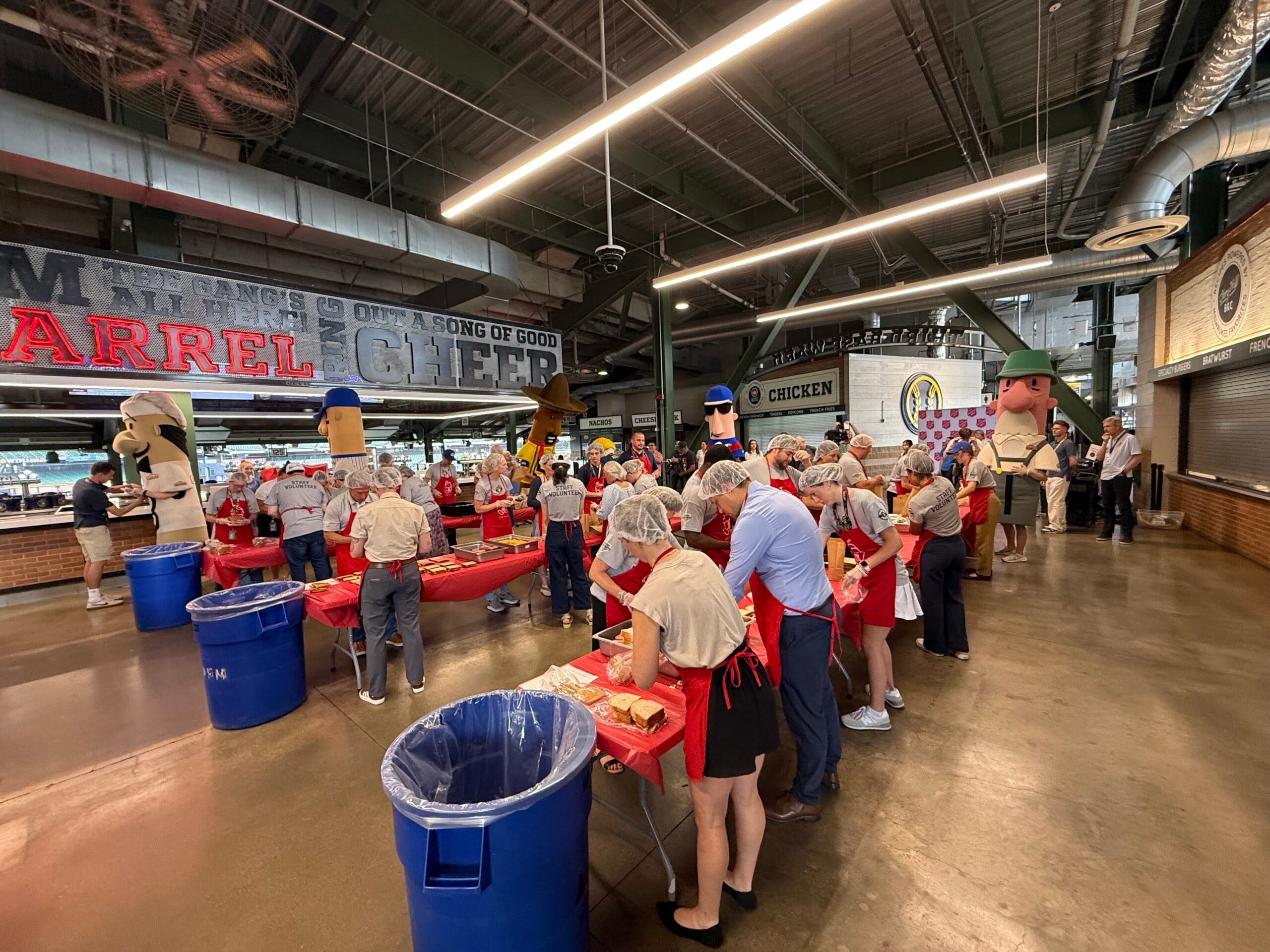
MILWAUKEE—- The Milwaukee Brewers and The Salvation Army teamed up Monday to help fight childhood hunger by packing hundreds of lunches for children across Milwaukee County.
Brewers front office staff, volunteers, and community leaders assembled 600 lunches at American Family Field as part of the annual Feed the Kids summer meals program.
Each lunch includes a turkey sandwich with cheese, fruit, vegetables, and milk. The meals will be distributed to children on weekdays through August 21st at six locations throughout Milwaukee County while school is out for the summer. The locations include Salvation Army Citadel Corps, Cold Springs Corps, Tiefenthaler Park, Westlawn Gardens, Salvation Army Distribution Center, and Carver Park. The Salvation Army also reminds attendees that all meals must be eaten on-site in accordance with USDA policy.
Milwaukee Mayor Cavalier Johnson, The Salvation Army of Milwaukee County Area Commander Major Beverly Gates, and Brewers players Andrew Vaughn and Chad Patrick joined volunteers during the event.
“While school is out, many children lose access to the meals they depend upon during the school year,” Major Beverly said. “Feed the Kids helps to fill that void, making sure that children have something nutritious to eat and reminding them that they are valued, that they’re important and that they’re supported.”
The Feed the Kids program began in 1990 and has provided more than 2.8 million meals to children facing food insecurity across Milwaukee County.
“I think just the act of making a sandwich may not seem like a lot, but really, for the kids across Milwaukee, it means a ton,” Mayor Johnson said. “For kids in Milwaukee and for kids in cities, the hunger really spikes when they’re no longer in school, when they don’t have, you know, that sort of structured programming around them. So the work that you’re doing today, it may seem pretty simple making a sandwich, but it really goes much farther than that.”
Organizers say the program helps fill the gap for families who rely on school meal programs during the academic year, ensuring children continue to have access to nutritious lunches throughout the summer.

Cincinnati Reds (39-43, fifth in the NL Central) vs. Milwaukee Brewers (50-31, first in the NL Central)
Milwaukee; Monday, 7:40 p.m. EDT
PITCHING PROBABLES: Reds: Nick Lodolo (2-2, 5.59 ERA, 1.52 WHIP, 38 strikeouts); Brewers: Robert Gasser (1-3, 4.50 ERA, 1.27 WHIP, 31 strikeouts)
LINE: Brewers -156, Reds +126; over/under is 8 1/2 runs
BOTTOM LINE: The Milwaukee Brewers begin a four-game series at home against the Cincinnati Reds on Monday.
Milwaukee is 50-31 overall and 26-17 at home. The Brewers have gone 35-13 in games when they record at least eight hits.
Cincinnati has gone 20-21 in road games and 39-43 overall. The Reds have a 27-6 record in games when they scored at least five runs.
The matchup Monday is the fourth time these teams match up this season.
TOP PERFORMERS: William Contreras has nine home runs, 31 walks and 50 RBIs while hitting .301 for the Brewers. Brice Turang is 10 for 44 with a double, a triple and three RBIs over the past 10 games.
Elly De La Cruz has 13 doubles, two triples, 12 home runs and 38 RBIs for the Reds. Spencer Steer is 7 for 39 with three home runs over the last 10 games.
LAST 10 GAMES: Brewers: 5-5, .239 batting average, 3.30 ERA, outscored opponents by two runs
Reds: 4-6, .215 batting average, 4.45 ERA, outscored by seven runs
INJURIES: Brewers: Coleman Crow: 15-Day IL (forearm), Brandon Lockridge: 10-Day IL (knee), Brian Fitzpatrick: 60-Day IL (elbow), D.L. Hall: 15-Day IL (pectoral), Quinn Priester: 60-Day IL (wrist), Carlos Rodriguez: 15-Day IL (shoulder), Logan Henderson: 15-Day IL (back), Rob Zastryzny: 15-Day IL (shoulder), Angel Zerpa: 60-Day IL (forearm)
Reds: Eugenio Suarez: day-to-day (hand), Blake Dunn: 10-Day IL (elbow), Tony Santillan: 15-Day IL (oblique), Ke’Bryan Hayes: 10-Day IL (back), Emilio Pagan: 15-Day IL (hamstring), Nick Lodolo: day-to-day (wrist), Graham Ashcraft: 60-Day IL (forearm), Brandon Williamson: 60-Day IL (shoulder), Hunter Greene: 60-Day IL (elbow)
___
The Associated Press created this story using technology provided by Data Skrive and data from Sportradar.
-

 Boston, MA2 minutes ago
Boston Pops surprise travelers at Logan Airport with July 4th preview performance
-

 Denver, CO4 minutes ago
Denver Broncos Crack Top 10 in NFL Uniform Rankings
-

 Seattle, WA10 minutes ago
PHOTOS: Visiting all 12 stops during this year’s West Seattle Garden Tour
-

 Milwaukee, WI20 minutes ago
Milwaukee Barbecue: A Legacy of Smoke
-

 Atlanta, GA25 minutes ago
Georgia Haitian communities face sudden July 27 deportation deadline
-

 Minneapolis, MN32 minutes ago
Broken A/C leaves 75-year-old cancer patient sweltering at north Minneapolis apartments
-

 Indianapolis, IN35 minutes ago
Jazz saxophonist Jared Thompson shares journey of self-acceptance and artistry
-

 Pittsburg, PA40 minutes ago
Trash pickup schedules adjusted in Pittsburgh-area communities due to impending heat wave

