Michigan
Michigan lawmakers respond to school shooting in Iowa

It’s happened again. Multiple people were wounded in a school shooting in Perry, Iowa Thursday morning. One student died, and five others were injured. The suspected shooter is a teenager from the school district. He died from a self-inflicted gunshot.
Following the shooting, the Michigan Firearm Safety and Violence Prevention Caucus issued a statement expressing the need for more thorough safety measures at schools.
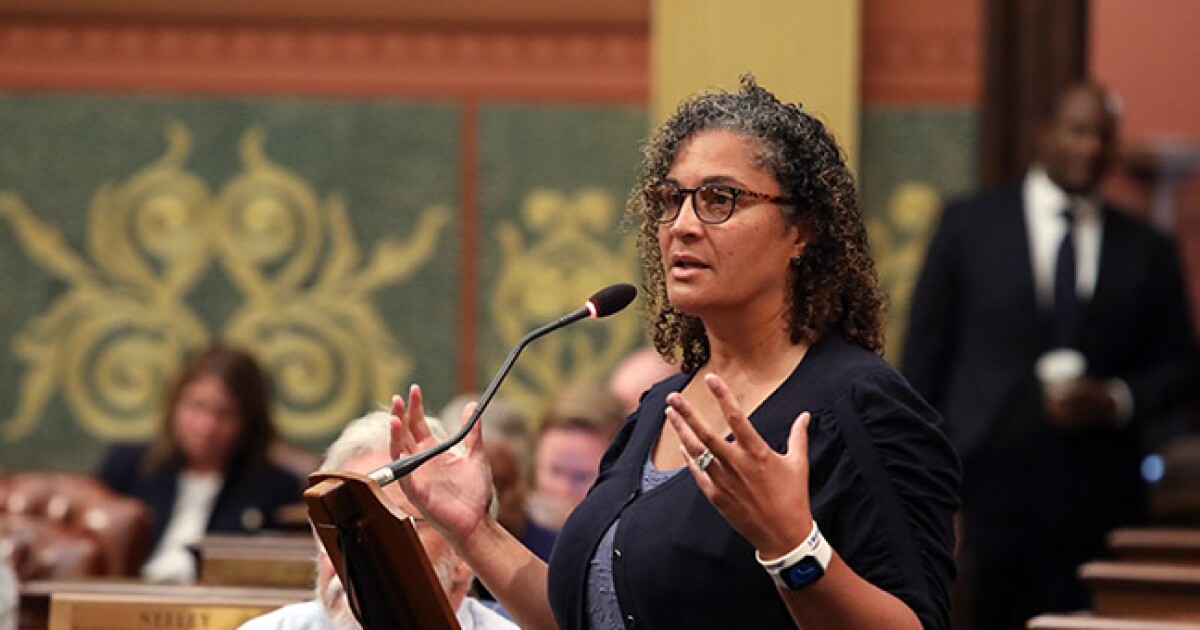
33rd District State Representative Felicia Brabec is chair of the caucus. The Pittsfield Township Democrat says she’ll continue to advocate for legislation in Michigan to better protect residents from gun violence.
“When these things happen, they feel very personal. And making sure that I can do everything that I can as a representative to be able to set in place framework that keeps residents safe, I take very seriously.”
Brabec says she’ll continue working with law enforcement, gun safety advocates and other groups to pursue legislation surrounding gun violence prevention.
Non-commercial, fact based reporting is made possible by your financial support. Make your donation to WEMU today to keep your community NPR station thriving.
Like 89.1 WEMU on Facebook and follow us on Twitter
Contact WEMU News at 734.487.3363 or email us at studio@wemu.org



Supreme Court rejects Trump’s birthright citizenship executive order
The Supreme Court struck down limits on birthright citizenship, a centerpiece of President Donald Trump’s immigration policy.
Immigration has been a defining force in creating the nation’s identity over the last two and a half centuries and continues to shape the country and Michigan as the United States looks beyond its 250th birthday on Saturday.
That was on display in Southwest Detroit during a recent weekend event, as hundreds gathered for the unveiling of a state historical marker honoring a Latina activist.
“Michigan is defined by the efforts and cultures from the waves of immigrants who began to arrive when we were still a territory,” said Laurie Kay Sommers, a folklorist and historic preservationist based in Okemos, who has been writing about Michigan history and culture since the 1970s.
While the state was once shaped by waves of German, Irish, Dutch and Polish immigrants who arrived in the 19th century seeking job opportunities, especially as the auto industry exploded, immigration continues to play a key role in the state’s population.
Immigration is the sole reason the state’s population is growing, according to U.S. Census Bureau figures, adding 55,000 residents in the 21st century. Population counts are a key factor in determining how much federal aid flows to states, counties and communities through hundreds of federal programs, according to the Project on Government Oversight, a nonprofit government watchdog based in Washington, D.C.
“All the growth in Michigan between 2020 and 2025 is attributable to immigration,” demographer Kurt Metzger said. “In other words, we’ve gotten more people from other parts of the country than the rest of the country got from us.”
According to the American Immigration Council, about 7% of Michigan’s population was born in another country, while another 7% are native-born U.S. citizens but have at least one immigrant parent. Metro Detroit’s immigrant population is even higher at 10.7%.
The Trump administration has sought to rein in immigration, specifically those who’ve entered the country illegally. Heightened immigration and customs enforcement since the start of Trump’s second term, as well as executive orders, have led to court cases and clashes with activists across the country.
Trump touched on the dangers of illegal immigration during his June 24 remarks at the opening ceremony of the Great American State Fair in Washington, D.C., marking the start of celebrations for the nation’s 250th anniversary.
“We inherited the worst, most dangerous, most wide open and insecure border in history, and we have quickly turned into the strongest, most secure border in the history of our country,” said Trump, according to video of his remarks posted online by Fox News.
“We are removing murderers, gang members, drug dealers and dangerous criminals by the thousands. They came in through a ridiculous open border.”
How immigration has evolved in Michigan
Still, how Michigan immigrants are reshaping Michigan continues to evolve.
In Detroit, a city once made up of a wide range of immigrants, the southwest side is one of the city’s last ethnic enclaves. Home to thousands of Latinos, it reflects how the contributions of immigrants and their descendants have shaped Michigan even before it became a state in 1837.
The Smithsonian was one of the sponsors of an event Saturday that recognized part of southwest Detroit’s commercial corridor, full of Latino businesses, which is now listed on the National Register of Historic Places.
In a separate event, about 100 people attended the Sunday unveiling of a State of Michigan historical marker in honor of Dr. Lucile “Luci” Cruz Arellano Gajec, a community organizer, author and historian, who died in 2008.
“It’s well-deserved and long overdue,” said Tobi Voigt, director of museums for the State of Michigan Historical Center, at the unveiling of the historical marker at 4000 W. Vernor.
Latino businesses in southwest Detroit are just one example of the way “Main Street” businesses in Metro Detroit rely on immigrants to own and operate restaurants, hardware stores, dry cleaners and pharmacies, to name a few professions, according to a recent study by nonprofit Global Detroit that explored the immigrant impact on the economy. Global Detroit said it advocates for “equitable local, regional and statewide economic growth through immigrant inclusion.”
The April report, called “Job Creators: How Immigrant and Diverse Entrepreneurs Drive Metro Detroit’s Prosperity,” found that while immigrants comprise 10.7% of Metro Detroit’s population, they make up 12.5% of the workforce, 18.4% of area business owners and 23.8% of “Main Street” business owners.
Like many immigrant business owners, Gias Uddin Talukder, a Bangladeshi immigrant, saw a niche that he could fill to help others in his community. In 2013, Talukder started Bengal Auto Sales, a used-car dealership in Hamtramck, to serve other Bangladeshi immigrants who have formed a community on the border of Hamtramck and Detroit.
“I want to be known as more than just a businessman; I want to be involved in lots of activities,” Talukder said in an interview with the nonprofit New Economy Initiative.
He has given cars away to those in need and has raised thousands of dollars for various charities.
The largest number of immigrant business owners in Metro Detroit were born in Iraq, according to the Global Detroit report. Organizations such as the Chaldean Chamber of Commerce and the Chaldean Free Loan Fund have invested millions of dollars to support start-up businesses within the Chaldean community, as well as services for immigrants and refugees.
The West Bloomfield-based Chaldean chamber said an estimated 59% of Chaldean households own at least one business.
“Immigrants are critical drivers of the small business economy and are well-represented among the region’s business owners despite their small share of the population,” the Global Detroit report said. “The facts rebut tropes that immigrants take jobs from U.S.-born workers. Immigrants expand the economy.”
Changing demographics
Still, data shows that the mix of those who come to Michigan from other countries is changing.
As the six-county Metro Detroit area continued to lose both Black and White residents in the last five years, the region experienced double-digit increases in the Asian and Latino populations.
In 2023, the region’s Asian population of 261,532 residents surpassed the Latino population’s total of 250,215. The latest Census data doesn’t fully capture the impact of Middle Eastern immigrants because, until recently, they were categorized as White. In 2024, President Joe Biden’s administration created the designation of Middle Eastern or North African (MENA) as a new federal race category.
The enduring influence of previous waves of immigration is felt in every part of the state, said Sommers, the Okemos-based historic preservationist. Whether it is the French names of cities like Detroit or Calumet, the former Finnish churches in the Upper Peninsula or the many local bakeries on the west side of the state that sell Dutch or Czech pastries, the impact can last through food and historical architecture.
“Much of Michigan’s surviving 19th and early 20th century buildings were built by immigrant carpenters, brick layers, iron workers,” Sommers said. “Much of the interior artistry of major architectural landmarks were decorated by immigrant artisans.”
Same immigration concerns, but a different century
Immigration at times has also created a backlash in the form of anti-immigration policies, nativist rhetoric and sometimes violence.
Much of the language and immigration policy of the Trump administration echoes the early 20th-century battles to halt the influx of Southern and Eastern Europeans, among others, said Ashley Bavery, an associate professor of history at Eastern Michigan University.
“There’s a lot of rhetoric about how immigrants are going to pollute the good Nordic and Protestant stock of America, and America is going to turn into something, kind of racially, that wasn’t right,” Bavery said. “They’re going to be too many Catholics and too many Russians and Poles, just to name a few.”
The Trump administration has justified its immigration enforcement efforts as an attempt to collar and expel criminals — whom Homeland Security Secretary Markwayne Mullin has termed “the worst of the worst” — who entered the country illegally while deporting undocumented immigrants it has encountered.
There were federal laws a century or more ago that limited the flow of immigration. In Detroit, during the 1920s and throughout the Great Depression, the city’s police chief teamed up with a local federal representative of immigration services to conduct what they called “a deportation war,” Bavery said.
Bavery is the author of a 2020 book, “Bootlegged Aliens: Immigration Politics on America’s Northern Border,” that looks at the labeling of immigrants as criminals, among other things. The book examines the policies applied to combat “bootleggers,” the smugglers of Canadian alcohol across the Detroit River during Prohibition, who sometimes would also transport a handful of immigrants on the boats along with the illegal booze.
23.8% of ‘Main Street’ businesses owned by immigrants
The April report by Global Detroit found that while immigrants account for 18.4% of all the business owners in the region, they are 23.8% of the business owners of so-called “Main Street” businesses. Those include supermarkets and grocery stores, convenience stores, pharmacies, gas stations, as well as hotels and motels.
Behind Iraq, India ranks as the second most common country of origin for business owners in Metro Detroit, followed by Romania.
Still, the report found that barriers remain for many immigrant entrepreneurs, especially in accessing loans and grants.
“The region’s economic success will depend, in part, on its ability to spark, attract, retain and nurture a wide range of businesses from a diverse group of business owners,” the report said.
laguilar@detroitnews.com

ROSCOMMON, Mich. (WNEM) – Power outages are starting to pop up around mid-Michigan as severe thunderstorms roll through the area.
Consumers Energy is reporting these outages:
- Roscommon County: 1,305 customers affected
- Ogemaw County: 5,989 customers affected
- Iosco County: 840 customers affected
- Clare County: 390 customers affected
- Gladwin County: 1,187 customers affected
- Arenac County: 732 customers affected
- Bay County: 222 customers affected
So far, DTE Energy is reporting 94 outages in Huron County.
Click here for the Consumers Outage map and here for DTE.
Stay with TV5 for more updates.
Subscribe to the WNEM TV5 newsletter and receive the latest local news and weather straight to your email every day.
Copyright 2026 WNEM. All rights reserved.
Michigan
Whitmer says she will pull Michigan National Guard from D.C. if troops used in Trump’s Safe and Beautiful Mission

Michigan Gov. Gretchen Whitmer says that the Michigan National Guard soldiers heading to Washington, D.C., will only support the America 250 Mission and threatens to pull them if they participate in patrols under President Trump’s Safe and Beautiful Mission.
In a letter to Maj. Gen. Paul Rogers on Monday, Whitmer urges Rogers to “take all necessary measures” to ensure that soldiers only provide public safety and security during events celebrating the 250th anniversary of the United States.
“If the National Guard is unable or unwilling to ensure the Michigan National Guard is only supporting the America 250 Mission, appropriately defined – and is unable or unwilling to communicate consistent with that fact – then I will end Michigan’s support for the America 250 mission,” Whitmer wrote to Rogers.
The Safe and Beautiful Mission was created under the Trump administration to deploy the National Guard to D.C. in August 2025 as part of a push to crack down on crime in the nation’s capital, despite data showing that crime had declined in recent years.
At the time, local police data showed that violent crime in the area had been declining after a spike in 2023. However, Mr. Trump criticized that data, calling them “phony numbers.”
The deployments drew criticism from officials who opposed the federal government sending the National Guard to multiple cities. In one case, Illinois and Chicago sued the Trump administration to block the deployment of troops. That suit has since been dismissed, with a judge declaring the administration’s orders to no longer be operational.
“Several governors have deployed their National Guard soldiers to support this [Safe and Beautiful] mission. As you know, I have not deployed – and will not deploy – the Michigan National Guard to support the D.C. Safe and Beautiful Mission,” Whitmer said.
CBS News Detroit reached out to the Joint Task Force for comment on Monday and has not heard back.
-

 Politics5 minutes ago
The Many Ways Trump Is Trying to Tip the Scales for the Midterms
-

 Lifestyle35 minutes ago
Map: See Taylor Swift’s NYC Hotspots Ahead of Her MSG Wedding
-

 Education40 minutes ago
Opinion | 13 George Washington Interpreters on Embodying an Icon
-

 Technology47 minutes ago
Mystery box shows are complicated for everyone — even the actors
-

 World50 minutes ago
After 1,000 days of war: Many Israeli children carry trauma into summer break
-

 Politics1 hour ago
Trump admin axes ‘Green New Scam’ appliance rules as Europe bakes in brutal heat
-

 Health1 hour ago
5 of America’s greatest medical breakthroughs revealed as the nation marks 250 years
-

 Sports1 hour ago
USA World Cup star calls lack of appeal process for teammate’s red card ‘bogus’

