Michigan
Michigan DNR confirms black bear roaming Downriver communities in furthest southeast sighting ever


FLAT ROCK, Mich. (WXYZ) — A black bear has been confirmed roaming the Carleton, Rockwood, and Flat Rock area — the furthest southeast the Michigan DNR has ever recorded a bear sighting in the state.
Watch Jeffrey Lindblom’s video report:
Two black bear sightings confirmed in southern counties
Residents near Woodruff Road first spotted the animal on a trail camera, with many initially mistaking it for a large cat. The Michigan DNR has since confirmed two black bear sightings in the area since Sunday, along with tracks to match.
Dale Hicks, a Rockwood resident, was among the first to spot the animal.
“I looked, and I said there’s a big cat by the double gate,” Hicks said.
WXYZ-TV
Neighbor Carolann Foerch said she was surprised to learn the animal had passed through her property.
“It was here and apparently walking through our back yard. He says, there’s a bear out there!” Foerch said.
WXYZ-TV

Foerch, who is originally from northern Michigan, said she welcomed the unusual visitor.
“I love the bear, you betcha,” Foerch said.
Fellow resident Corry Stanley summed up the reaction many neighbors shared.
“Guess it was a real bear,” Stanley said.
WXYZ-TV

Jan Saintamour, another Rockwood resident, called the sighting “kind of cool. Kind of odd.”
WXYZ-TV
What the DNR says
Cody Norton, a bear specialist with the Michigan DNR, said the sighting is unprecedented for the region.
“This is the furthest southeast we’ve seen,” Norton said.
WXYZ-TV
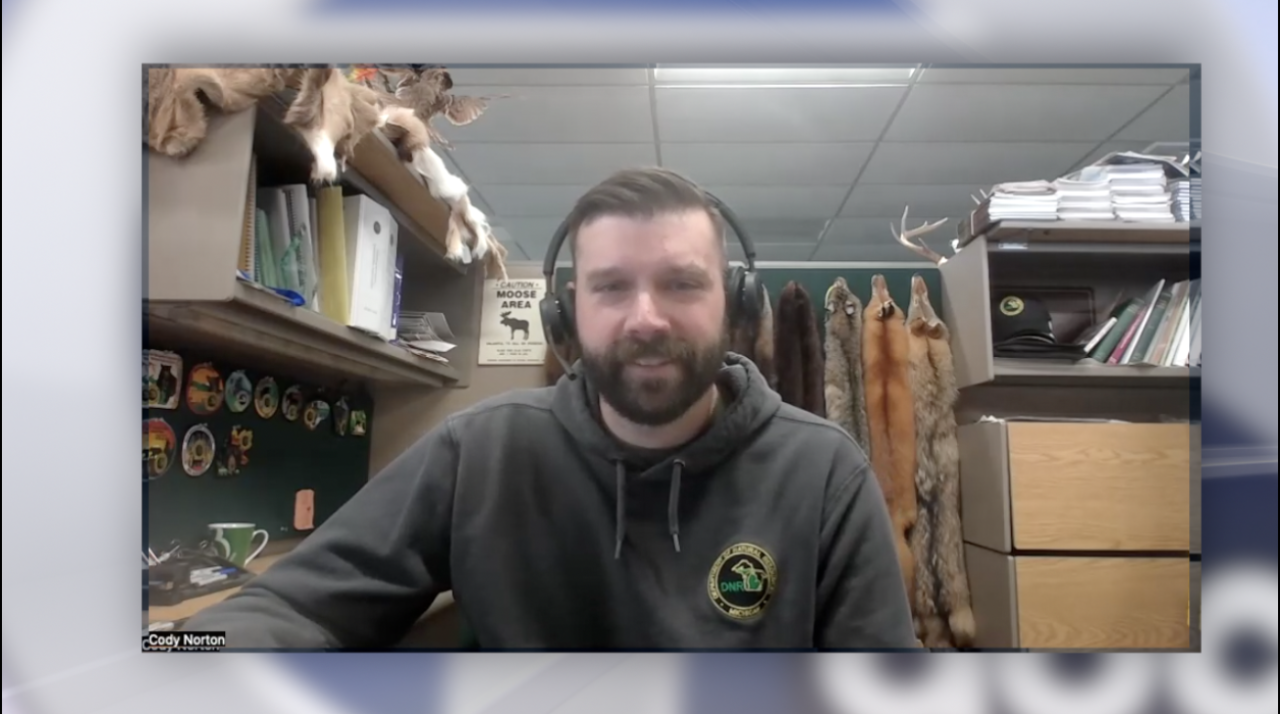
Norton described southeastern Michigan as far more developed than other parts of the state, making the bear’s appearance in the area without any reported sightings along its path especially unusual.
The DNR reports approximately 12,000 bears living across Michigan’s Upper and Lower peninsulas. Norton said the lower peninsula bear population has grown significantly in recent years.
“Our bear population in the lower peninsula has grown about 60-percent,” Norton said.
As bear numbers have risen, the animals have begun moving into areas further west and south. Norton said younger male bears in particular tend to wander in search of territory not already claimed by dominant males.
“They are able to survive and make a living in habitats we previously thought wouldn’t be suitable for bears,” Norton said.
Norton said bears would have historically inhabited this area before development pushed them out, and that as populations continue to grow, sightings in unexpected places like southeastern Michigan are likely to increase.
“Their world revolves around food,” Norton said.
What to do if you see the bear
The DNR says residents do not need to be overly concerned.
“I don’t think anyone should be too worried about this individual bear roaming around in this area,” Norton said.
Norton said there has not been a bear-related human fatality in Michigan since 1930. He added that residents do not need to worry about walking pets or letting animals outside.
However, there are steps residents can take to avoid unintentionally attracting the bear to their property:
- Secure garbage cans
- Manage bird feeders
- Do not leave pet food outside
If you do encounter the bear, the DNR advises against running. Instead, make yourself appear large, make noise, and slowly back away to a safe location.
As of now, the bear does not appear to be bothering anyone or displaying aggressive behavior. The DNR says it will continue to leave the bear alone unless it begins acting aggressively or causing property damage.
Hicks, for his part, said he plans to keep an eye out.
“I’m going to look at it and take pictures of it,” Hicks said.
—————————————————————————
This story was reported on-air by a journalist and has been converted to this platform with the assistance of AI. Our editorial team verifies all reporting on all platforms for fairness and accuracy.





Dusty May is leaving Michigan for the Dallas Mavericks. What now?
Free Press sports writer Tony Garcia breaks down the “shocking” news of Michigan basketball coach Dusty May leaving for the NBA.
Barely three months since students flooded downtown Ann Arbor and chanted “Tt’s great … to be … a Michigan Wolverine” as they celebrated Michigan basketball’s first NCAA championship in 37 years, you’d be hard-pressed to find anyone on the school’s campus who feels great about anything in the athletics department.
Instead, the university found itself in a much different and darker place Monday, July 13, when it faced new legal accusations that replaced all that happy singing with the deafening silence emitted through a barrage of “no comment” statements.
An amended lawsuit from former Wolverines linebackers coach Chris Partridge alleges former school president Santa Ono worked to hide details of the football team’s sign-stealing scandal and that athletic department leaders knew about ex-coach Sherrone Moore’s affair with staff member Paige Shriver years before it led to his firing.
And Warde Manuel – the athletic director who orchestrated that jubilation three months ago and even more jubilation three years earlier, when Michigan football won its first title in a quarter-century – finds himself in the eye of the storm as he faces the end of his highly successful but troubled tenure.
Manuel is named in Partridge’s lawsuit, which claims he knew about Moore’s relationship with Shriver “for years without taking action to protect the employee.”
He’s also a focal point of an investigation that began in December, run by Chicago law firm Jenner & Block and costing the school nearly $12 million. The Free Press has learned that higher-ups have been briefed on the findings. The U-M Board of Regents is expected to discuss that investigation at a Thursday meeting in Traverse City.
On Sunday, Yahoo Sports reported that Manuel’s future is “in doubt” based on the findings of that investigation. On Monday, Manuel told the website: “The president [Domenico Grasso] and I have had several great conversations over the past couple of days. There are no plans for me not to continue to be the athletic director for the near future.”
The near future. As in the ax may swing at any moment in the near future.
It’s impossible to say what exactly will happen to Manuel once the investigation findings are released and discussed by regents. But it’s also impossible to imagine Manuel emerges unscathed from years of scandal within the school’s prized football program.
Can anyone imagine Jenner & Block lawyers facing regents after nearly $12 million has been shelled out and saying: “Yeah, you know the guy who’s been in charge of all this? Yeah, we got nothin’ on him.”
So it’s not hard to see Manuel getting blamed in the investigation. The question is how much blame does he get – and what kind of punishment does the university want to dole out? Also, how much can the investigation truly divulge about Manuel’s role while the school contends with lawsuits from Partridge and Shriver?
Cleaning house always sounds good. But anyone who’s ever actually cleaned a house, inside out and from top to bottom, can tell you it’s no easy chore. It’s actually messy, difficult work that often reveals other structural problems, whether you’re talking about an actual house or an entire athletic department.
The closest example Michigan might follow with Manuel could come courtesy of its most hated rival. Ohio State basically gave then-AD Gene Smith a slap on the wrist in 2018 by suspending him without pay for two weeks after he and then-football coach Urban Meyer mishandled domestic-assault allegations against former assistant coach Zach Smith.
The big difference between than Manuel’s situation is twofold: First, U-M’s investigation is examining the entire department; second, he’s coming off a huge high that vaulted him into rarefied air – an AD with national titles in football and basketball on his résumé.
Does Michigan really want to get rid of the guy who proved he can hire a championship hoops coach, won the school an NCAA Tournament title and helped refill those NIL and donor coffers, just as new football and basketball coaches are about to start their first seasons in Ann Arbor?
As for Manuel deciding to step aside on his own? He’s 58 and under contract through 2030. He has too much road in front of him to imagine a quiet resignation – to decide he’s done as much as he can – after 10 years on the job.
Nah. It’d be a lot easier to imagine the man who played defensive lineman under U-M legend Bo Schembechler saying to Grasso, the regents, and the rest of an ungrateful administration: You’re gonna have to fire me.
If that’s the case, you can also imagine a new contingent on Manuel’s behalf joining the growing briefcase-carrying group that’s flooding downtown Ann Arbor these days and chanting to itself: “It’s great … to sue … the Michigan Wolverines.”
Contact Carlos Monarrez at cmonarrez@freepress.com and follow him on X @cmonarrez.

Michigan health officials are investigating a growing outbreak of cyclosporiasis that has sickened 2,640 people, with early evidence pointing to lettuce or salad greens as a possible source.
The Michigan Department of Health and Human Services said Monday (July 13) that while the investigation is ongoing, no specific type of lettuce, grower, or supplier has been identified.
Other food items also have not been ruled out.
“Although we do not have a definite product identified as the source of the outbreak, we want to let Michiganders know what we have learned so far so they can take steps to protect their families,” said Dr. Natasha Bagdasarian, the department’s chief medical executive. “Early information has shown lettuce as a common product that regularly comes up during the investigation.”
What is Cyclospora?
Cyclospora is a parasite that infects the intestines and can cause watery diarrhea, nausea, and stomach cramps.
The illness is typically spread by consuming food or water contaminated with the parasite.
Michigan usually reports only 40 to 50 cases of cyclosporiasis each year, making the current outbreak unusually large.
What investigators know
State health officials said they have completed more than 1,000 interviews with infected individuals while working with local, state, and federal partners to trace the source of the outbreak.
“We really need that kind of coordination to happen at the national level,” Bagdasarian said. “As soon as other states get their numbers to the CDC, we hope they can take a broader look to see whether these outbreaks are related.”
Because symptoms can take up to two weeks to develop after exposure and food distribution networks are complex, officials said the investigation could take time.
Officials emphasized there is no evidence linking the outbreak to swimming or other recreational water activities. Instead, investigators continue to focus on contaminated produce as the likely source.
Previous cyclospora outbreaks in the United States and Canada have been linked to bagged salad mixes, fresh cilantro, basil, raspberries, snow peas, and green onions.
Health officials said the investigation has been complicated by cyclospora’s long incubation period, with symptoms often taking up to two weeks to develop after exposure.
“That means investigators have to ask people about foods they ate, restaurants they visited, and grocery purchases from two to six weeks earlier,” Bagdasarian said.
How to protect yourself
As a precaution, the department is urging residents, restaurants and commercial kitchens in affected counties to take extra care when handling lettuce and salad greens.
Health officials recommend purchasing whole heads of lettuce instead of bagged, pre-washed lettuce or salad kits, discarding the outer two to three leaves before preparation and thoroughly washing the remaining leaves under clean running water.
When possible, greens should be cooked to at least 158 degrees Fahrenheit (70 degrees Celsius), which kills the parasite.
The department also recommends washing all fresh produce under running water and peeling fruits and vegetables when possible.
People at higher risk of severe illness or dehydration, including older adults, young children, organ transplant recipients and people undergoing chemotherapy, are encouraged to take extra precautions.
“Produce may have been grown on the other side of the country, possibly even in other countries, then processed somewhere else before coming into Michigan,” Bagdasarian said. “Many suppliers also distribute produce to multiple grocery stores and restaurant chains, making it harder to pinpoint the source.”
When to seek medical care
Anyone experiencing frequent watery diarrhea should contact a health care provider and specifically request testing for cyclospora, as routine stool tests may not detect the parasite.
The illness is typically treated with antibiotics, along with rest and fluids to prevent dehydration.
The Michigan Department of Health and Human Services said it will continue providing updates as the investigation progresses.
Copyright 2026 by WDIV ClickOnDetroit – All rights reserved.
Michigan
Michigan Sen. Gary Peters backs Democratic Rep. Haley Stevens in contentious race to succeed him

GRAND RAPIDS, Mich. — Outgoing Michigan Sen. Gary Peters is endorsing U.S. Rep. Haley Stevens as his successor, adding to a growing effort by the Democratic establishment to help her defeat progressive favorite Abdul El-Sayed in next month’s primary.
Peters, who is retiring after 12 years in the Senate, said Stevens “will be ready on day one to fight for Michigan.” The endorsement, which was announced Monday, marks a reversal for Peters, who told The Associated Press in late May that he intended to stay neutral in the race.
But since then, Democratic leaders have increasingly rallied behind Stevens as the Aug. 4 primary approaches and concerns grow that El-Sayed is too far left to succeed in November. Holding the Michigan seat is viewed as critical to Democrats’ hopes of reclaiming the Senate majority.
Stevens, a four-term House member, has campaigned as a more moderate Democrat focused on manufacturing issues in the critical battleground state. El-Sayed, who has never held elected office, is running on a more progressive platform that includes Medicare for All and campaign finance reform. He’s also been outspoken about the war in Gaza, which has been a fault line within the party.
Concerns about Michigan have only intensified after Democrats’ attempt to flip a Senate seat in Maine was thrown into turmoil when nominee Graham Platner withdrew from the race following a sexual assault allegation last week. Democrats there must now choose a new nominee to face Republican Sen. Susan Collins.
Peters’ endorsement also comes after state Sen. Mallory McMorrow dropped out of Michigan’s Democratic primary earlier this month, transforming the race into a head-to-head contest between Stevens and El-Sayed.
“Senator Peters knows what it takes to win in Michigan, and he knows what Michigan needs from our next U.S. Senator: grit, effectiveness, hard work, and Michigan common sense,” Stevens said in a statement. “I am honored to have his support.”
Michigan U.S. Senate candidates, Abdul El-Sayed, left, and Rep. Haley Stevens, D-Mich., are displayed on a television during a debate inside the spin room at WoodTV studios on Tuesday, July 7, 2026, in Grand Rapids, Mich. Credit: AP/Kristen Norman
Peters won two Senate races in Michigan and led Senate Democrats’ campaign arm during the 2022 and 2024 election cycles.
His endorsement adds to Stevens’ growing support from the Democratic establishment, with the race being viewed nationally as a broader fight over the party’s direction.
Senate Democratic leader Chuck Schumer of New York has also backed Stevens, along with Sen. Ruben Gallego of Arizona and Sen. Catherine Cortez Masto of Nevada. El-Sayed has support from Sen. Bernie Sanders of Vermont and, more recently, Sen. Chris Van Hollen of Maryland.
The campaign has grown increasingly contentious in recent weeks.
El-Sayed has attacked Stevens over tens of millions of dollars in outside spending supporting her campaign, including by the American Israel Public Affairs Committee. Stevens has criticized El-Sayed for not disclosing his personal financial records.
During a July 7 debate, each accused the other of running a negative campaign.
“Abdul has spent this entire campaign attacking me,” Stevens said.
The Democratic winner will likely face Republican Mike Rogers, a former member of the U.S. House running uncontested for his party’s nomination, in what is expected to be one of the country’s most expensive and closely watched Senate races.
-
 Lifestyle5 minutes ago
Why your favorite international artist might be reconsidering their next U.S. tour
-

 Technology17 minutes ago
Nintendo’s Switch 2 bundle that includes a game is $50 off
-

 World23 minutes ago
Inside Israel’s mission to train civilians to stop the next Oct 7-like terror attack
-

 Politics29 minutes ago
Trump reveals who he’s eyeing to replace Lindsey Graham
-

 Health35 minutes ago
Notable figures who died from the same heart condition linked to Lindsey Graham’s death
-

 Sports41 minutes ago
Folarin Balogun admits that red-card reversal affected USA World Cup teammates: ‘A lot of outside noise’
-

 Technology47 minutes ago
Humanoid robots perform live surgery in world first
-
 Business53 minutes ago
A ‘next generation studio’ for YouTube creators

