Midwest
Michigan man serving jail time after repeatedly telling judge 'kiss my a–'

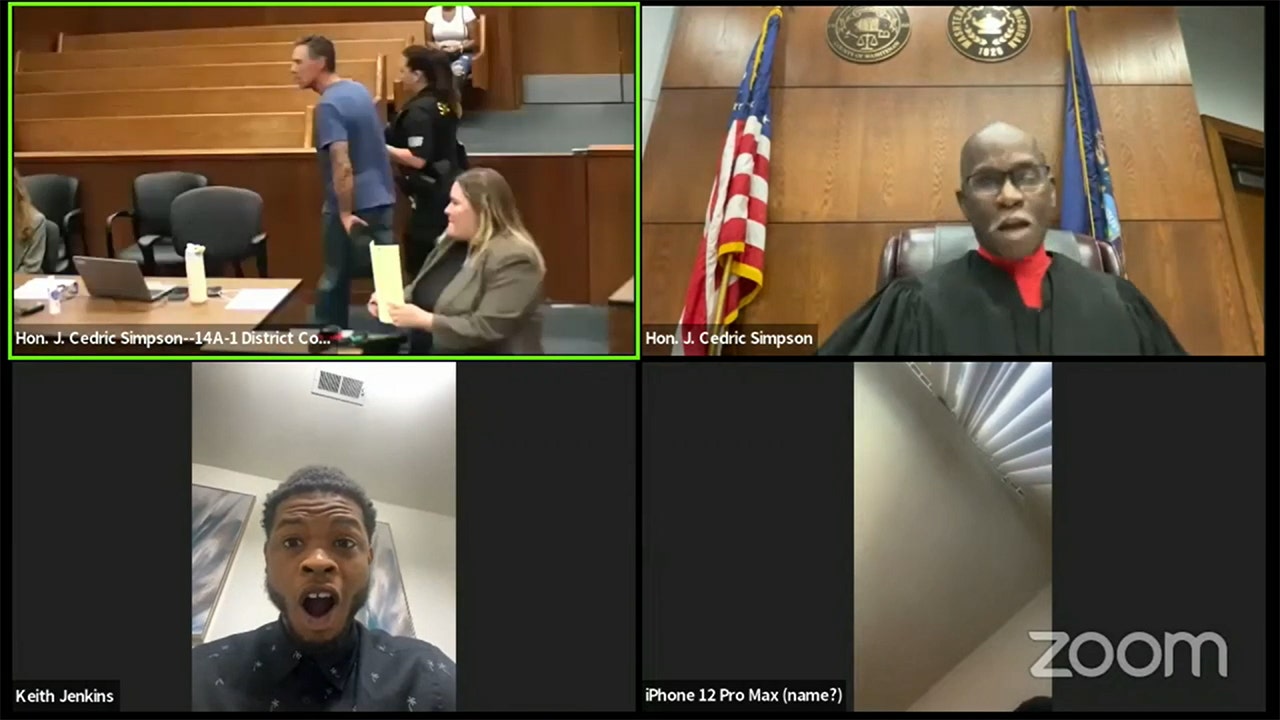
A man in Michigan is facing months of jail time after repeatedly shouting expletives at the judge overseeing his trial.
Darrell Jarrell appeared in a Washtenaw County court on Wednesday in the case of a simple misdemeanor trespassing charge.
However, just before Judge Cedric Simpson adjourned the court, Jarrell spoke up: “I’m tired of this state, I’m ready to leave this state as soon as possible.”
MICHIGAN JUDGE ASTONISHED AT HOW MAN SHOWS UP TO VIRTUAL HEARING FOR DRIVING WITH SUSPENDED LICENSE CHARGE
Defendant Darrell Jarrell launched into a series of profanities in a Michigan courtroom before Judge Cedric Simpson could adjourn. (YouTube/Hon J Cedric Simpson)
Jarrell added, “You guys can kiss my a–.”
Simpson attempted to restore order despite the disgruntled defendant’s outburst, warning him against further comments.
“F— you!” Jarrell shot back.
Simpson told Jarrell that he was in contempt of court and immediately issued a misdemeanor charge for 93 days.
Jarrell repeated the profanity, to which Simpson repeated the misdemeanor charge. This happened multiple times until the bailiff physically removed Jarrell from the courtroom.
JUDGE REVEALS ANOTHER TWIST IN THE CASE OF MICHIGAN VIRAL ZOOM VIDEO DRIVER WHO PLEADED CLERICAL ERROR
The two exchanged retorts a total of six times, which would add up to 558 days in prison.
Simpson then proceeded to the next case without concern, telling the waiting defendant that he shouldn’t be concerned about the other man’s outburst.
Simpson dealt with a similarly bizarre defendant earlier this year when Corey Harris, 44, who was charged with driving with a suspended driver’s license, dialed into a virtual court hearing while behind the wheel of a car.
Judge Cedric Simpson dismissed concerns of a defendant in a separate trial who watched the debacle unfold over a virtual connection. (YouTube/Hon J Cedric Simpson)
“Mr. Harris, are you driving?” Simpson asked the defendant.
“Actually, I’m pulling into my doctor’s office actually,” Harris said. “Just give me one second. I’m parking right now.”
“OK, so maybe I don’t understand something. This is a driving while license suspended [case],” Simpson told the public defender. “And he was just driving, and he doesn’t have a license.”
“I don’t even know why he would do that,” the judge said. “So, the defendant’s bond is revoked in this matter.”
Simpson ordered Harris to turn himself in to the Washtenaw County Jail by 6 p.m. that day.
Fox News Digital’s Louis Casiano contributed to this report.
Read the full article from Here


What does it look like to carry your culture with you? When Minneapolis architect and photographer Patricia Mutebi posted a casting call on TikTok in December, she was looking for a way to map how immigrants and diaspora communities in Minnesota keep their heritage close.
She initially planned to photograph Twin Cities residents in their homes, but Operation Metro Surge, the federal immigration enforcement crackdown in Minnesota, forced her to reconsider the safety of her subjects.
“I didn’t think that people would feel comfortable letting a stranger into their home, trying to take pictures of them,” Mutebi said. “From January all through April, I photographed those who were comfortable coming into the downtown [Minneapolis] area.”
The result is “Threads of Us,” a portrait exhibit featuring 20 Hmong, Thai, Indian, African, Pakistani and Indigenous people who have built a life in the Twin Cities.
After seeing the exhibit, spend the rest of the weekend at the annual Taste of Minnesota, revisit soul music of the 1990s at the Dakota or watch Saturday’s World Cup matches at a street fair in Minneapolis.
Finding home in Minnesota
In “Threads of Us,” Mutebi asked each person she photographed the same question: What does home look like after you’ve left it behind?
“Each person I photographed taught me something new about perseverance and resilience,” Mutebi said. “They’ve come into a new place that doesn’t necessarily welcome them openly, but they’re choosing to show up as their authentic self regardless. Nothing could honestly beat that.”
Mutebi understands the feeling. She was born in Uganda, studied architecture in Kenya, and moved to Minnesota in 2019.
“I have friends here who have families that know how to cook Kenyan food, and whenever I go visit them, there’s a smell that just hits me, and I’m taken back to a time when I was an undergrad,” she said. “In the first house that I bought, I have this gallery wall that shows the journey I’ve traveled. It has art from Kenya, from Uganda, and pictures of friends and family. That’s the most treasured thing I have.”
She also draws inspiration from architects like Burkinabé-German designer Diébédo Francis Kéré, whose work centers on Indigenous materials and community-led design across Africa.
He “didn’t try to bring the Western world with him,” Mutebi said. “He was designing for the culture — where it sat, and using the materials they have to help people understand that we have these resources already.”
For “Threads of Us,” participants arrived in traditional clothing — from Hmong vests and Ethiopian habesha dresses to Ghanaian kente cloth and Pakistani shalwar kameez. They brought meaningful objects, including wedding garments, family heirlooms, Oromo beadwork, Somali incense burners and Ethiopian coffee ceremony sets. Each item served as a tangible bridge to their families and homelands.
“I found people who have photographed cultures in the most beautiful way and have captured joy without trying to modernize the culture,” Mutebi said. “I want to photograph people where they’re at and how they move through life without trying to change them one way or another.”
Threads of Us, now on view at The Residency by Modern Day Me in Minneapolis, is Mutebi’s first exhibit — but she’s already thinking about what comes next. She was recently selected for the cohort of the Little Africa residency program, where she will partner with local African-descent business owners to tell their stories through photography.
“Unless you’re Indigenous, you came from somewhere,” Mutebi said. “I want people to take the time to think about what it means to them and how they can show up in the places they are now.”
Date: Friday, July 3 through Friday, July 17.
Time: 10 a.m. to 5 p.m. Monday through Friday
Location: The Residency by Modern Day Me, 401 N. 1st Ave., Minneapolis
Cost: Free
For more information: Visit patriciamutebi.studio/portfolio/threadsofus

Taste of Minnesota
Spend your Fourth of July weekend at the Taste of Minnesota, where 18 local musicians and more than 100 food vendors will take over downtown Minneapolis for the annual two-day festival.
The main stage will feature grunge-pop band Gully Boys, hip-hop artist Nur-D, singer-songwriter Dessa, and DJ Sophia Eris. The North Star Stage will spotlight emerging acts, including Frankie Torres, Adam David Bohanan, and Solana and the Sunsets.
Date: Friday, July 3 and Saturday, July 4
Time: 4 to 10 p.m. on Friday. Noon to 10 p.m. on Saturday
Location: At the intersection of Nicollet Mall and Washington Avenue
Cost: Free. RSVP here.
For more information: Visit tasteofmn.com
A night of ’90s soul
If music from the 1995 film “Waiting to Exhale” still has a place on your playlist, head to the Dakota this Friday for the Ladies of Soul tribute show.
Local singers Solorah, Ashley Commodore and Monique Blakey will perform the soundtrack from start to finish, revisiting songs by Whitney Houston, Toni Braxton, Mary J. Blige, Brandy and Aretha Franklin.

World Cup watch party
Catch the knockout rounds between Canada and Morocco and Paraguay and France at the World Cup Street Fair in Minneapolis this Saturday.
Utepils Brewing will show both games on large indoor and outdoor screens, while the street fair will feature food trucks, art vendors, mini soccer games and DJ sets between kickoffs.


IMPD Chief Chris Bailey gives briefing following mass shooting
IMPD Chief Chris Bailey addresses the problem of youth with guns downtown following a mass shooting that killed two teens and injured 5 on July 5, 2025.
Two years ago on the Fourth of July, an 11-year-old visiting Indianapolis was struck in the back by a bullet fired into the air. Jataevious Ragsdale – who recovered quickly – was visiting family in Indianapolis for the holiday.
Had he been struck differently by the bullet, Ragsdale may not have had the chance to experience Fourth of July again. Falling bullets have killed other children, like 13-year-old Noah Inman in Hammond in 2017 and 4-year-old Marquel Peters in Atlanta in 2010.
Holidays like Fourth of July and New Year’s Eve often prompt individuals to celebrate by firing their gun in the air, something the Indianapolis Metropolitan Police Department strongly advises against doing.
“Every bullet that goes up comes down,” Downtown District Commander Shane Foley said. “So if people think that’s not dangerous, they’re wrong.”
This story continues below the image.
Those who choose to fire their gun into the air can risk causing serious damage, Foley said, and doing so can lead to an arrest and prosecution. Criminal consequences for firing into the air include criminal recklessness, battery, vandalism and even homicide depending on the damage done.
“People think of it as a harmless act, but those bullets coming down may very well hurt somebody, damage property, hurt animals,” he said.
Bullets shot into the air can travel more than a mile before falling. Smaller rounds can fall at roughly 300 feet per second and larger rounds can descend at nearly 500 feet per second. Speeds of 150 to 170 feet per second can break skin, while 200 feet per second can penetrate a human skull. That’s what happened to 4-year-old Marquel, who was sitting next to his mother in an Atlanta church for New Year’s Eve services.
IMPD respects Hoosiers’ Second Amendment rights, Foley said, but says people must handle firearms safely so others don’t get hurt.
While it may be hard to distinguish gunfire from fireworks during the Fourth of July weekend, Foley said, anyone who sees someone firing a gun in the air should immediately call police.
The simple advice he offers to those thinking of shooting their gun in the air on the Fourth of July?
“Don’t do it. It’s illegal.”
This story continues below the image.
Holiday comes in the wake of last year’s mass shooting
Fourth of July 2026 follows a mass shooting in downtown Indianapolis on July 5, 2025 that happened hours after thousands gathered for a fireworks show. Two teenagers died and five other people were injured in the shooting. Police arrested at least 11 individuals throughout the night for charges ranging from weapons possession, criminal recklessness and battery.
“Reckless or disruptive behavior will not be tolerated” during Indianapolis holiday festivities, Deputy Chief Matthew Thomas said.
Foley said there will be a “very strong public safety presence downtown” over the weekend. Officers will patrol on foot, bikes and undercover, using safety cameras and drones to monitor what’s happening in the city.
“We will not allow the actions of a few individuals to negatively impact the experience of thousands of families,” Thomas said.
Mia Thurow is the breaking news and criminal justice reporting intern for the Indianapolis Star. She can be reached at mthurow@gannett.com.

This forecast is outdated and inaccurate. Get the latest forecast here.
CLEVELAND (WJW) — (WJW) — The National Weather Service has extended its EXTREME HEAT WARNING for all of Northeast Ohio.
It will remain in effect until 8 p.m. on Friday, July 3, in Ashland, Ashtabula, Crawford, Cuyahoga, Erie, Geauga, Holmes, Huron, Lake, Lorain, Mahoning Medina, Ottawa, Portage, Richland, Sandusky, Stark, Summit, Trumbull and Wayne counties; and until 10 p.m. Friday, July 3, in Carroll, Coshocton and Tuscarawas counties.
The heat waves continues! An EXTREME HEAT WARNING will remain in effect through 8 p.m. Friday. Heat indices could top 105 degrees during the hottest time of day on Friday.
Once again, there will not be much relief from the heat and humidity overnight. Tonight lows will be in the mid to upper 70s again. Feeling warmer with the higher humidity. Mostly clear skies.

Friday will be the last sweltering summer day before the heat starts to back off for the Fourth of July holiday weekend. There is the chance of rain and storms Friday evening, around 7pm that could go through the late evening. This may impact some 4th of July celebrations on Friday. Any storm that pops up we’ll have to watch for the potential of gusty winds, heavy downpours and large hail.

This is what the radar could look like by the time some Fireworks celebrations are expected Friday evening. We have a level 2 out of 5 chance of any storm turning severe, meaning that 1 or 2 have the chance.


The upper-level ridge, or heat dome, will start to breakdown on Friday. This means two things. The first is it will go from being very hot and humid to being very warm and humid. The second thing is the chance of rain and threat of storms will return.

The Fourth of July holiday weekend will be far from a washout! There will be more dry time than time with downpours and storms. However, clusters of downpours and storms will move through Northeast Ohio at times. This means some Fourth of July events, backyard BBQs, pool parties, and firework shows could be impacted by rain and storms.
With all the heat and humidity around, any downpours or storms that develop could be strong and produce gusty winds, small hail, torrential rain, and lightning. Here’s the latest 8 Day Forecast:

Keep up with FOX 8 News for the latest weather updates.
-

 Atlanta, GA3 minutes ago
Mets celebrate America’s 250th with four-game series in Atlanta
-
Minneapolis, MN10 minutes ago
‘Threads of Us’ explores how Minnesota immigrants hold onto home
-

 Indianapolis, IN13 minutes ago
Police advise against celebrating Fourth of July by shooting in the air
-

 Pittsburg, PA18 minutes ago
Fireworks Near Me: July 4th Events Around USC, Pittsburgh For 2026
-

 Augusta, GA25 minutes ago
As temps rise, Augusta officials open May Park cooling center
-

 Washington, D.C27 minutes ago
What’s that noise? What you need to know about D.C. flyovers Friday and Saturday – WTOP News
-

 Cleveland, OH33 minutes ago
Extreme heat warning ends Friday evening: What to expect
-

 Austin, TX40 minutes ago
Texas May Have the Best Defensive Back Class in America

