Kansas
Wyandot Nation of Kansas Pursues Federal Recognition

Judith Manthe was about 10 years old and her cousin about 18 when the girls’ grandmother took them aside and spoke of prophecy.
The conversation took place outside, on some of the large rocks near a creek on family farmland near Piper, Kansas.
“She sat us down,” Manthe recalled. “And she said, ‘You two are going to be the ones that bring this tribe back to fruition.’ “
The older of the two, Janith English, later became principal chief of the Wyandot Nation of Kansas for 25 years. She spent those years carefully chronicling the tribe’s history.
English documented its time in Ontario, Canada, as the Wendat Confederacy. She recorded its time in Michigan and Ohio. She tracked treaties agreed to and dissolved. And then, crucially for this region, she documented the tribe’s pre-Civil War journey to Kansas and how it came to be the namesake of Wyandotte County.
Manthe took over as principal chief three years ago.
The tribe’s 400 members are now ready to reclaim its station.
The Wyandot Nation of Kansas is renewing an effort for federal recognition. It’s a complicated process, and despite having many factors in its favor, accomplishing it could take years.
“What is motivating me is our youth,” Manthe said. “It’s basically for the youth, to get them educated.”
Federal status can enable access to federal funding, which can include scholarships and access to higher education.
Federal recognition entails the United States acknowledging a tribe as a separate government entity. It denotes tribal sovereignty, a nation’s right to self-governance.
It can be achieved through an act of Congress, a federal court ruling or administratively by petitioning and passing the scrutiny of the Bureau of Indian Affairs.
Currently, 574 tribal nations are federally recognized.
The process is inherently cruel.
It includes convincing non-natives, such as members of Congress, to support the tribe. It depends on asking permission from a federal government that worked for centuries to erase the indigenous, to annihilate nations by dividing them, by taking their lands.
Those efforts were largely successful.
You might assume that familiarity with the tribe and its role in the Kansas City region would be strong, given that everything noted as “Wyandotte” has a connection.
Yet, even highly visible signs of the area’s indigenous roots in downtown Kansas City, Kansas, can be misleading.
For example, bold black lettering attached to the limestone masonry of the 7th Street Casino spells out “WYANDOTTE NATION.”
But the Kansas Wyandots aren’t affiliated with the gambling operation. The casino, in a former Scottish Rite Temple, is owned and operated by the Wyandotte Nation of Oklahoma.

They’re a related band, considered brothers and sisters, but separate.
There are four bands of the Wyandot, a fact that can be explained by tracing the history of the tribal confederacy being split as it was moved throughout what is now Canada and the United States.
The Oklahoma Wyandots are federally recognized.
The Wyandots that live in Canada are recognized by the Canadian government.
The Wyandots in the Detroit area also seek federal status.
The Wyandots of Kansas have no interest in the casino. It’s not why they seek federal status, Manthe said.
But they are deeply connected to land next to the casino, the Huron Cemetery, that lies to the north, tucked on a rise of land that overlooks the Missouri and Kansas rivers.
“Huron” traces to what the French called the Wyandot and despite the cemetery’s name, it’s not the term that the tribe uses.
The cemetery, where hundreds of Wyandot and Union soldiers are buried, was once the site of a standoff staged by three Wyandot — the Conley sisters — Eliza “Lyda,” Helena and Ida.
Around 1910, plans were announced to sell the land off, to dig up and remove the tribal members buried there.
In response, the women built a wooden shack in the cemetery, their fort. For two years the women refused to allow anyone onto the property.
Lyda was an attorney. She took their case all the way to the U.S. Supreme Court, where she argued on behalf of the Wyandot of Kansas.
She lost the case. But eventually, the cemetery was saved.
The shotgun that the sisters used during their standoff is on display at the Wyandotte County Museum. Helena’s rattlesnake bone necklace is also showcased there.
But the cemetery isn’t controlled by the Wyandot of Kansas. It’s held in a trust by the federal government.
If any local Wyandot wanted to be buried there, permission would be granted through the Oklahoma band. And cremations are the only thing possible. Digging in the cemetery could disturb unmarked graves, of which there are believed to be many.
The history contained at the site, including family lineages, will be crucial in obtaining federal recognition.

Manthe keeps her documents safeguarded, including proof of payments as Wyandot land was taken and the nation came down the Missouri River by steamboat and was dropped off near Westport, in 1843.
“We have letters that our ancestors had written,” she said, “saying that we never wanted to lose our tribal status.”
Seeking Support from Those Who Sought Your Genocide
The process of gaining federal recognition can take decades.
Recorded proof of an unjust and painful past is crucial, said Tai S. Edwards, director of the Kansas Studies Institute and a history professor at Johnson County Community College.
“The same entities that wanted to eliminate you as a tribal nation are now whose records you have to use to prove who you are,” Edwards said.
Moreover, non-natives must be convinced, Edwards said.
Even beginning the process can be emotionally wrenching.
“You have to have what non-natives view as convincing documentation from a bureaucracy that was functioning for centuries to eliminate your ability to do this,” Edwards said. “And that is the hardest problem.”
But ultimately, it can also be healing.
Federal recognition forces the U.S. government to admit to its role in past actions.
The least cumbersome route is through an Act of Congress, and this is how several tribes have recently been able to gain federal status in recent years, the last during the Trump administration.
The Wyandots have the good fortune of having U.S. Rep. Sharice Davids of Kansas in office.
Davids is an enrolled member of the Ho-Chunk Nation of Wisconsin. Her maternal grandfather, a U.S. Army veteran, was born into the Mohican Nation Stockbridge-Munsee Band in Oneida, Wisconsin.
But because the process is long, members of Congress often cycle out of office before enough consensus can be built for tribal recognition.
In 2019, the Little Shell Tribe of Chippewa Indians were granted federal recognition through an amendment pushed through by Montana congressional members. The action was included in a defense bill.
Efforts for the Chippewa to reach federal status dated back to the 1930s, according to reporting by CNN.
Chris La Tray is an enrolled Chippewa member and the Montana Poet Laureate.
He wrote an article titled, “For All My Relations,” after the federal status was achieved.
Edwards says non-natives must understand an indigenous perspective.
La Tray wrote of his happiness, but also his “deeply mixed feelings.”
“The entire process is a bitter irony when one considers that the Little Shell will finally ‘get’ federal ‘recognition’ at the behest of a spending bill for a military that has only tried to eradicate us, signed by a president actively pursuing the very policies that disenrolled and dehumanized our ancestors, and made us ‘landless Indians’ in the first place,” La Tray wrote.
La Tray recounted tribal history in the piece and noted that the same bill that included the Little Shell Restoration Act also gave funding to support operations at the U.S.-Mexican border.
At the time, the Trump administration was separating migrant families arriving there, detaining them. Many of those families had indigenous blood, arriving from Mexico and Central America.
La Tray recounted the tribal history, documenting the similarities to then-current policy.
Federal status is also restorative, a fact that La Tray addressed in the same article.
“But we are a sovereign nation who are now in a position to deal in strength with another nation who surrounds us on all sides. A nation we must never forget rarely has our best interests in mind.”
Assimilation As an Act of Survival
Louisa Libby slowly walks the cemetery pathway, stepping off into the grass to point out specific graves.
Libby is the Second Chief of the Wyandot of Kansas.

Nubs, flush to the ground, are all that is left of many headstones. A fist-sized piece of granite lays under one tree.
On the southern end of the site is a marker, flat against the ground. It notes that a prior survey completed in 1895 and 1896 detected a large grave in this part of the cemetery. It’s the final resting site of Union soldiers killed in the Battle of Westport in October 1864.
They were a Black unit. Racism wouldn’t have allowed their burial elsewhere. The Wyandot were integral to the free state township of Quindaro, which is named for a Wyandot woman.
On the northern end of the cemetery, there are more headstones. A line of pink granite headstones stands out. The graves are the burial plots of the Conley sisters.
To Libby, the ancestors who are no longer buried there, disturbed from their rest by the greed and the disrespect of development, also fill her thoughts.
The tribal history is clear on this point. When surrounding roads were widened decades ago, graves were disturbed. Bones were disrespectfully dumped in the river, Libby said.
Former Principal Chief English once found a femur sticking out of the sloping hillside that backs up to the Kansas City, Kansas, Public Library. The bone was delicately handled, honored and reburied.
That section needs a retaining wall. A zig zagging old wooden staircase is blocked off. It’s too dangerous to be secure.
But a small round metal marker is also nearby, emblazoned with a buffalo, noting a significant step in the cemetery’s and the Wyandot’s story.

It’s marked: “U.S. Department of the Interior, Sept. 3, 1971, National Register of Historic Places.”
Manthe’s fifth great-grandfather played a crucial role in how the nation survived.
He was Chief Tarhe, born near Detroit in 1742.
Chief Tarhe is credited with guiding the tribe through difficult periods, wars where tribal members were slaughtered and subsequent treaties.
Manthe is proud of her bloodline. It was Chief Tarhe who made the difficult decision that ultimately brought her to this place, as a new chief in a new era.
“He told all of them that you’re not going to win this battle,” she said. “They’re going to keep bringing people in and they’ll just wipe you off the face of the earth. You need to assimilate. You need to start living white or we will be destroyed.”
For several years, Manthe has worked to establish positive relationships with the other bands of Wyandot.
The past includes protracted legal battles over where the Oklahoma band would locate the casino and how the cemetery would be affected.
Now, security guards from the casino note when visitors arrive at the cemetery. They keep a watchful eye. One guard recently noted with dismay the condition of some graves, vandalized through the years and disrespected.
Manthe has brought family members with her to attend naming ceremonies in Oklahoma and celebrations to note green corn coming into the fields.
She’s also attended cultural sessions, learning how to fletch feathers to an arrow, shape arrowheads from flint, weave baskets and create intricate beading.
At each full moon, Manthe connects by Zoom with other Wyandot women around the nation.
“We have got to keep our history alive,” Manthe said. “We have got to promote our history because if you forget it, you’re going to relive it.”
Mary Sanchez is senior reporter for Kansas City PBS.


WICHITA, Kan. (KSNW) — Colorado-based chicken restaurant Birdcall is expanding into Kansas.
The company announced Friday its plans to expand into Kansas and five other Midwestern states over the next five years. Birdcall plans to add six to eight fast-casual restaurants in Wichita and Topeka.
“The Midwest represents a tremendous opportunity for Birdcall,” CEO Mark Lohmann said. “From our award-winning chicken sandwiches and other handcrafted menu offerings to our commitment to innovation and community, we believe Birdcall offers an experience that resonates with today’s guests and is a natural fit for the region.”
Other locations announced are:
- Indiana – 10 to 15 restaurants across Indianapolis, Bloomington, Evansville and Fort Wayne
- Missouri – Up to 18 restaurants across St. Louis, Columbia, and Kansas City
- Nebraska – Seven to 10 restaurants across Omaha and Lincoln
- Ohio – Up to 20 restaurants across Cleveland, Cincinnati, Columbus and Toledo
- Wisconsin – 10 to 15 restaurants across Milwaukee, Madison and Appleton
Birdcall’s menu features a variety of chicken sandwiches, chicken fingers and nuggets, salads, tater tots, fries, and more. The restaurant also makes its own in-house sauces and serves up draft beer and house-made margaritas, with happy hour specials.
The company said each restaurant will use self-service kiosks and occupy about 2,300 square feet, with indoor and outdoor seating that can serve up to 150 people.
Birdcall currently operates 17 restaurants across Colorado, Arizona and Texas.
For more Kansas news, click here. Keep up with the latest breaking news by downloading our mobile app and signing up for our news email alerts. Sign up for our Storm Track 3 Weather app by clicking here. To watch our shows live on our website, click here.

KSHB 41 reporter Ryan Gamboa covers Miami County in Kansas and Cass County in Missouri. He also covers agricultural topics. Share your story idea with Ryan.
—
A video shared by a viewer, shows a resident speaking at the Osawatomie, Kansas City Council meeting being escorted out by police on Thursday evening.
The video shows a man holding a “Hell No Alcove” sign, while commenting about a blighted property, which according to public records is owned by Pacific Apartments, LLC, operating out of the same address as Alcove Development in Lawrence, Kansas.
KSHB 41
Alcove Development is behind the effort to build a $1 billion, 283-acre data center development in Osawatomie’s northland property.
The video, shared by a viewer, goes on the show two law enforcement officers approaching the individual, who is Lee Brewer, at the podium, after he begins to yell, while the crowd joins in behind him. Lee Brewer reached out to KSHB 41 late Thursday night, identifying himself as the person who was escorted out.
Osawatomie, Kansas Police Chief Dave Stutteville is seen in the video also approaching the man.
Fabian Rosales/KSHB
KSHB 41 Miami County Reporter Ryan Gamboa reached out to the Police Chief, City Manager, and Mayor Nick Hampson for comment late on Thursday night and is waiting on a response.
Residents in contact with Gamboa attending the meeting shared the meeting was still in session after 9:30 p.m.
Thursday night’s meeting was the city and Alcove Development’s attempt at sharing potential benefits of a data center for the community.
Gamboa has long covered the data center project in Osawatomie, Kansas — and neighbors to the project have voiced their opposition to the proposed development.
Brian Luton/KSHB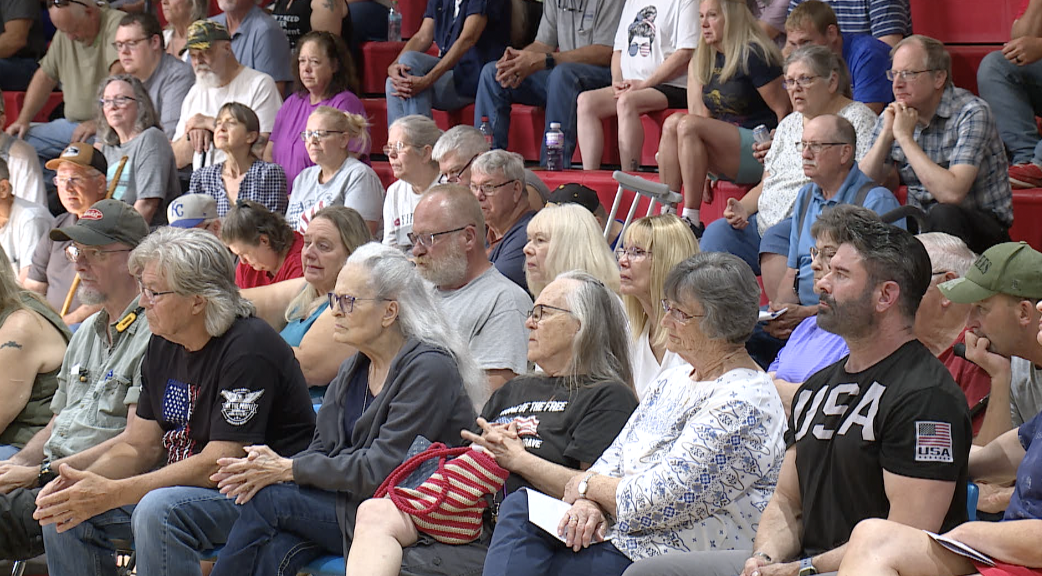
This is the first time Alcove Development has approached the public, but not the first time it has worked with the city of Osawatomie.
In late 2025, Alcove Development approached the city with the project and weeks later, a pre-development agreement was signed giving Alcove exclusive rights to the development for three years.
But city council meeting records from 2023 show, the city of Osawatomie entered into a pre-development agreement with Alcove Development to redevelop a property known as Old Swenson School.
Alcove Development had six months to asses the condition of the property and determine a course of action for redevelopment, and the overall agreement would last 18 months, according to public records.
Will Shaw/KSHB
The pre-development agreements states, Alcove would consider asking for tax breaks on the project, including utilizing the Low-Income Housing Tax Credit.
At the time, the property had sat in disrepair since 2016, according to the records, and was frequently found in violation of city code.
If the re-development were to fall through, the city would be on the hook to purchase the property from the developer for $25,000, with unclear total costs for infrastructure improvements.
KSHB 41

KSHB 41 will follow up on the status on this project at a later date.
Earlier this week, Miami County Reporter Ryan Gamboa, sat down with Donna Ingram who doesn’t live far from the data center site.
Ingram expressed her concerns about the amount of infrastructure that would be built to operate a data center, and how it might overtake the land around her home.
Ryan Gamboa/KSHB

She expressed concerns because the City of Osawtomie changed the public comment guidelines of a promise town hall with the developer.
“Watching this process play out is disheartening,” Ingram said in an interview on Monday. “A town hall was promised that didn’t come to fruition… I don’t believe it’s the definition. This is a city council meeting. We’re the ones that are gonna live next to it. We’re the ones that live in the path of the infrastructure.”
The city told KSHB 41 on Monday in a statement, they changed the format to prioritize the voices of city taxpayers, as county taxpayers have dominated the public comment periods over the past couple of months.
Brian Luton/KSHB

Mayor Nick Hampson also told Gamboa in an earlier interview he was hoping to have a productive “town hall” — instead, the first meeting with the public and the developer of the project was during a formal and regularly scheduled city council meeting.
The city also required residents to submit questions ahead of time, and the city would filter questions to the developer, while limiting public comment to three minutes.
“We have been and will continue to hear from the residents that are in the county and closest to this project,” Hampson told KSHB 41 in an email on Monday.

Miami County, Kansas
Residents shared a record to KSHB 41, submitted to the city for a formal investigation into 1009 Pacific Avenue in Osawatomie, which is owned by a company operating out of Alcove Development’s address.
The dilapidated property is the a former school house, that sits with broken windows, and other parts of the building breaking down.
The Miami County Republic reporting on Thursday, the city launched an investigation into the building.
Ryan Gamboa/KSHB
Residents cite the buildings deteriorating condition and potential danger to the public, and lack of property maintenance.
Lee Brewer issued a comment regarding the incident at Thursday night’s meeting, stating he was escorted out after the Mayor closed public comment, and he was not on the list.
Brewer told KSHB 41, he has a time -stamped email of pre-submitted questions ahead of the meeting. KSHB 41 asked Brewer to review the email, and is waiting for an answer.
I am severely disappointed in our Mayor and the city council. They told us we were required to send in an email with our questions and our address to prove we were citizens of the town by Wednesday the 24th at noon. I have my email which is timestamped at 10:26 a.m. Wednesday the 24th. They shut me down and first told me I didn’t put the email in and then once I was kicked out of there I was told by people coming out that they were told I turned in my email too late. I’m not a math teacher but last time I looked at my clock 10:26 a.m. falls just over an hour and a half before noon. I mean correct me if I’m wrong. I thought because the mayor and I were having decent conversations on Facebook Messenger, whereas I would ask him questions and he would answer to the best of his ability. And I would thank him I thought we were pretty cordial. So to basically call me a liar in front of the entire town on video recording, take away my freedom of speech My first amendment right, and have me removed from a public building was completely wrong I am very disappointed in our city council and mayor. When I approached the podium all I was trying to do was point out that resolution number 1169 in Osawatomie Kansas refers to Alcove development LLC being the owner of the old Swenson School at 1009 Pacific. As I pointed out in these earlier messages to you Alcove has left this building dilapidated in ruins and a danger to our community. Our great city council and mayor seem to have other plans for me being able to speak though.
Lee Brew, via Facebook to KSHB 41 News
KSHB 41 reached out to Alcove Development late on Thursday night, and is waiting on a response.
—


Editor’s note: This article has been updated to clarify information about cleanup information.
WICHITA, Kan. (KSNW) — A tanker transporting 8,000 gallons of ethanol crashed in El Dorado on Thursday.
It happened at the intersection of Kansas Avenue and South Main Street.
According to dispatch, the vehicle overturned, causing the fluid to leak out and spill into the storm sewer system.
City Manager David Dillner said traffic is being diverted in the area while crews work to clean up the ethanol.
Nearby residents have been evacuated to the El Dorado Civic Center due to the pungent smell of the fuel, Dillner said.
No injuries have been reported.
This is a developing story.
For more Kansas news, click here. Keep up with the latest breaking news by downloading our mobile app and signing up for our news email alerts. Sign up for our Storm Track 3 Weather app by clicking here. To watch our shows live on our website, click here.
-

 West Virginia1 minute ago
West Virginia First Foundation advances key initiatives at second quarterly board meeting
-

 Wyoming8 minutes ago
At 6,000-year-old crossing, Gov. Gordon OKs Wyoming’s first-ever designated pronghorn migration route – WyoFile
-

 Crypto11 minutes ago
SpaceX Lands Nasdaq-100 Spot Weeks After Record IPO
-

 Finance16 minutes ago
Hong Kong vows stronger exchange with reforms, bond futures and gold push
-

 Fitness23 minutes ago
Health Watch: Fitness Friday – exercise and dementia
-
Movie Reviews31 minutes ago
Film review: ‘Tuner’ mixes classical music, crime, and Dustin Hoffman | The Jerusalem Post
-

 World41 minutes ago
Rescuers comb Venezuelan quake rubble, thousands reported missing
-

 Lifestyle1 hour ago
Former Vice President Mike Pence believes Washington is more ‘swampy’ under Trump


