Kansas
Kansas City will lose nearly half its bus routes under transit agency's drastic cost-cutting plan

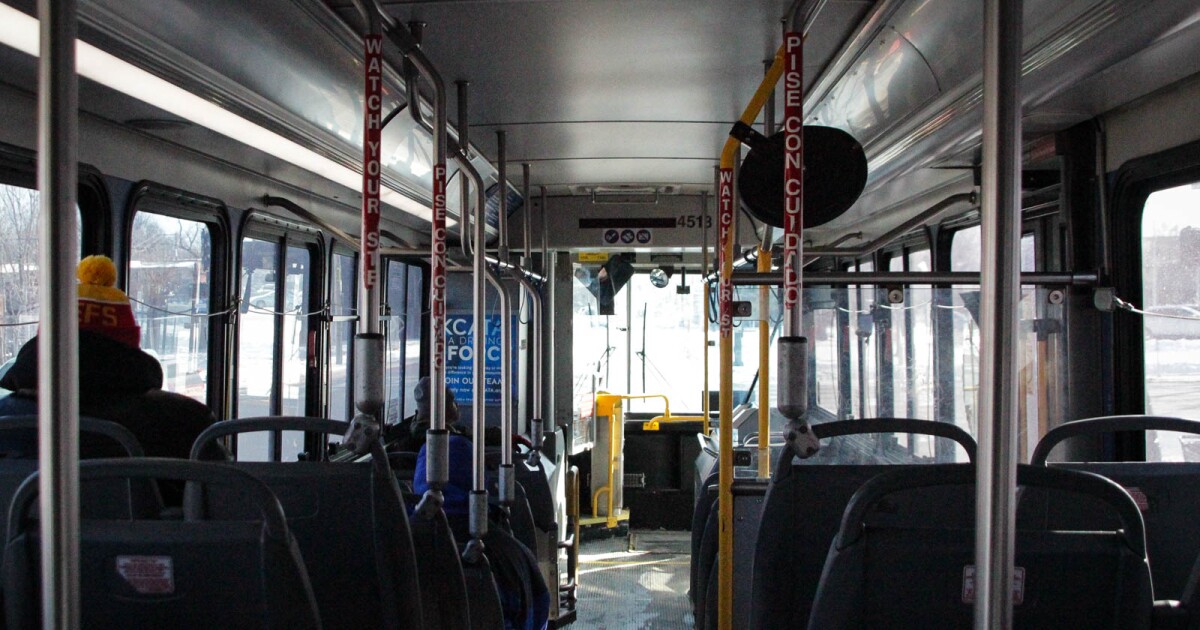
The Kansas City Area Transportation Authority is bracing for drastic cuts to service if Kansas City passes its proposed budget, according to documents obtained by KCUR.
To maintain the current status quo for its Kansas City operations — which already includes long wait times and the fewest bus routes the agency’s had in decades — the KCATA needs about $117 million. The city plans to give the agency $71 million in its 2025-2026 budget.
Without any more funding, KCATA will cut 13 of its 29 routes in Kansas City, Missouri. Those cuts would affect more than 6,500 people, about 18% of the city’s total weekday ridership.
Anthony Cunningham is a leader with Sunrise Movement KC, a climate activist organization that’s been pushing the city to increase funding for KCATA for years. Cunningham relies on the bus and says fewer and less frequent routes will make it harder for him and other riders to get to work, school, the grocery store and doctor’s appointments.
“These proposed cuts to our bus and paratransit services are excessive, and are a slap in the face to poor and working-class Kansas Citians who rely on these services every single day,” Cunningham said.
The agency will also stop service at 11 p.m. instead of 1 a.m., and will only operate seven routes on the weekends, about a third of what it currently operates on weekends. The agency will also run fewer buses on its remaining 16 routes, leaving riders waiting even longer.
The proposed route cuts are:
- #9, 9th Street
- #11, Northeast Westside
- #19, Crossroads
- #21, Cleveland Antioch
- #23, 23rd Street
- #25, Troost Local
- #27, 27th Street
- #28, Blue Ridge
- #29, Blue Ridge Limited
- #57, Wornall
- #63, 63rd Street
- #71, Prospect Local
- #75, 75th Street
Savannah Hawley-Bates
/
KCUR 89.3
The agency would lay off about 28% of its total workforce, or about 171 staff members. That includes 130 drivers as well as maintenance and administrative staff. It would also reduce quarterly attendance bonuses and overtime bonuses.
The agency’s plan assumes the city will cut the on-demand transit service IRIS, which costs the KCATA about $7.6 million. But the city council has not yet introduced cutting the rideshare program.
Reginald Townsend, chair of KCATA’s board, said that the agency is committed to working with local, state and federal partners to secure more funding.
“Our focus remains on providing safe, efficient, and accessible transportation options that support the economic vitality and mobility needs of our communities,” Townsend said. “While ridership remains strong, we recognize the need to make strategic adjustments to right-size the agency.”
Nic Miller is president of the Amalgamated Transit Union Local 1287, the union that represents KCATA’s bus drivers. He said his members are angry and terrified because they don’t know what will happen to their jobs.
“It’s very hard for me, as a president, not to have the answers,” Miller said. “It’s hard for the company not to have the answers when all the answers rely upon the city. So now everyone’s just kind of left in limbo.”
Kansas City has not decreased its funding to KCATA in the past few years, but operational costs have risen drastically since 2021 due to inflation and increases in wages, security costs, marketing and paratransit. The agency’s total operating cost went from about $84 million in 2021 to $113 million last year.
If the KCATA’s costs this year mirror last year’s, its funding will fall $28 million shy of expenses, a gap that it covered last year with a sales tax reserve and federal COVID relief funds. But KCATA expects that it will need about $117 million to maintain the status quo of bus service due to rising costs, making the real funding gap about $32 million.
Other U.S. transit agencies are facing similar financial crises. In 2024, the Mid-America Regional Council released a study comparing Kansas City’s bus system to 10 peer cities and four aspirational cities, like Minneapolis and Denver. It found that KCATA had the second-lowest operating expense per passenger trip, while still ranking as the second-most productive agency.

Carlos Moreno
/
KCUR 89.3
Kansas City Council members discussed the funding gap with KCATA CEO Frank White III at a business session last week. Melissa Robinson, 3rd district councilmember, said many of her constituents use public transportation to get to work. She said she worries that if bus lines get cut, economic mobility will decrease and crime will increase because of poverty.
“If we’re wanting to be real about crime prevention, real about homicide prevention, real about helping people to achieve their economic potential, we should not be cutting their lifeline,” Robinson said.
“I implore us to give our KCATA the same opportunities that we give our men and women in blue, our firefighters. We give them what they need in order to do their jobs. Transit is no different.”
Johnathan Duncan, Crispin Rea, Eric Bunch, and Darrell Curls also spoke against cutting bus lines.
Many of the people who attended each of the city’s three public listening sessions called bus funding a top priority, and urged city council to increase funding for KCATA. The city is set to approve the budget at the next council meeting on March 20.
Council members Rea and Bunch introduced a budget amendment to redirect $2 million from the Public Mass Transportation tax that was meant for LED streetlights to the KCATA.
That money could be enough to save the #25, #27 or #71, each of which cost about $2 million to run. But unless the city council amends the budget to provide more money to KCATA, most of the service cuts would still be necessary.

Savannah Hawley-Bates
/
KCUR 89.3
Kansas City gives nearly all of the 3/8th-cent KCATA sales tax to the transit agency. But about 15 years ago, it began decreasing the amount it gives the agency from its half-cent public mass transportation tax.
In this year’s proposed budget, only about two-thirds of the tax, or about $30.4 million, will go to the KCATA, with the remainder going to traffic safety and infrastructure.
At the business session, Mayor Pro Tem Ryana Parks-Shaw told White she still has “heartache” from route cuts the KCATA made several years ago that affected her district, the 5th, but didn’t seem to save any money in the long run.
“Kansas City taxpayers just continue to add to an inefficient program,” Parks-Shaw said. “Before we even put a bus on the street, we pay $19 million (in administrative costs) off the top. And that’s the piece that is unsustainable.”
White said the agency is considering introducing a “functionally free” fare model, instead of the zero fare model it’s currently using. Under the new system, only those who could afford to pay fares would.
He said that could give KCATA about $10-13 million in revenue, but it would take the agency more than a year to implement.
In the past few years, Independence, Blue Springs, Gladstone, Raytown, Liberty, Parkville and Riverside have cut their funding to the agency. White told city council he was working to bring those municipalities back on the system. Without their funding, Kansas City bears the brunt of the agency’s $19 million in administrative costs.
White said the KCATA is working toward becoming more of a regional transportation authority, as it was created to be, and is seeking more funding from Missouri and Kansas.
“It’s a crisis created by the city,” said Miller, the transit union president. “I believe that the city just wants to privatize the company. KCATA has pretty much exhausted all of its funds. The only thing that they can really start to look at now is reducing service, which is what the city wants them to do.”
The KCATA will hold two public meetings about the proposed cuts. The first will be Thursday from 5-7 p.m. at the East Village Transit Center at 12th and Charlotte Streets. A virtual meeting will be held Friday from 12-1 p.m. over Zoom.



SPRINGFIELD, Mo. (KY3) – MoDOT reopened the westbound lanes of I-44 in Springfield around 9 a.m. after a deadly pedestrian crash on Thursday.
Police say a pedestrian was hit and killed on I-44 near the Kansas Expressway exit around 5 a.m. Police have not identified the victim.
Emergency officials closed the interstate for about three hours. Crews exited traffic off the Kansas Expressway and the West Bypass.
To report a correction or typo, please email digitalnews@ky3.com. Please include the article info in the subject line of the email.
Copyright 2026 KY3. All rights reserved.

LAWRENCE, Kan. — Kansas basketball coach Bill Self is returning for a 24th season with the Jayhawks.
The program released a statement from Self on Wednesday confirming his return for another year with the program he has led to 21 regular-season conference championships, four Final Fours and a pair of national championships.
“With renewed clarity and the ongoing support from our administration, I remain focused and committed to Kansas Basketball competing for a national championship,” Self said. “I look forward to seeing and hearing the best fans in college basketball next season at Allen Fieldhouse.”
The 63-year-old Self has a record of 840-272, not including the 15 wins that were vacated by the NCAA, putting him 12th on the career list.
He passed Phog Allen as the winningest coach at Kansas with a 77-69 win over Michigan State on November 12, 2024, and finished with a record of 633-167 while leading one of college basketball’s most storied programs.
Kansas’ season ended March 22 against St. John’s and fellow Hall of Fame coach Rick Pitino in the second round of the NCAA Tournament. The Jayhawks rallied from a 13-point deficit with 7 1/2 minutes left, tying it with 13.1 seconds to go, only for the Red Storm’s Dylan Darling to hit a layup as time expired to end their season.
The Jayhawks have not survived the opening weekend of the tournament since 2022, when Self won his second national title.
“I’ve gone through some stuff off the court, so I’ll get back and get with family and visit and see what’s going on,” Self said following the loss in San Jose, California. “I love what I do. I need to be able to do it where I’m feeling good and healthy to do it fairly well. I’ll get back home and it will all be discussed.”
Self’s health has been a factor to monitor.

He was hospitalized just before the Big 12 Tournament in 2023 after feeling unwell, and had two stents inserted into his heart, which forced him to miss the NCAA tourney. Self had two more stents inserted last year, and this past January, he missed a game at Colorado after doctors advised him not to travel following a precautionary trip to the hospital.
“When you get to be doing it as long as I’ve done it, I looked at it in five-year increments. Now I’m probably looking at it in more two-year increments, so to speak,” he said. “So I try to focus on this season and try to get us to a second weekend — which we failed at — so I’ll go back now and break it down and see where that leads.”
Self won national titles at Kansas in 2008 and 2022. And he’s been especially good at Allen Fieldhouse, historically one of college basketball’s toughest venues. He is 27-6 against top-10 opponents at home, and his 131-81 record against Top 25 opposition is the third-best winning percentage among Division I coaches.
He also has sent 43 players to the NBA, and more could be on the way. Darryn Peterson is expected to be among the first three players to hear his name called in June, while Flory Bidunga and others could also be selected in the upcoming NBA draft.
Self was selected to the Naismith Memorial Basketball Hall of Fame in 2017.

The Minnesota Twins were defeated 3-1 by the Kansas City Royals, who used home runs by Kyle Isbel and Isaac Collins, two hitters not known for their power, on an unseasonably warm day in front of a sellout crowd of 39,320 in Kansas City’s home opener.
The temperature at first pitch on Monday was 85 degrees.
In the first game at Kauffman Stadium since the Royals moved in the fences 8 to 10 feet, all four runs scored on home runs. However, all three home runs also would have been out with the old dimensions.
Kris Bubic (1-0) picked up the win for Kansas City. He allowed one run on two hits in six innings. John Schreiber pitched the ninth for his first save.
Simeon Woods Richardson (0-1) took the loss for the Twins.
Both Woods Richardson and Bubic were effective, though neither was brilliant. Woods Richardson allowed just two runs but on five hits. Bubic walked three. Both starters allowed baserunners in all but one inning.
Bubic was the third straight Royals starter to pitch at least six innings with one or fewer runs allowed after Michael Wacha allowed no runs in 6 innings Saturday and Seth Lugo allowed no runs in 6 1/3 innings on Sunday.
Matt Wallner opened the scoring in the second inning for the Twins with a 424-foot home run that nearly reached the fountains in right-center.
The Royals answered with two runs in the bottom of the inning when Isbel’s homer landed in the Royals bullpen in right field. Isbel managed only four home runs in all of 2025.
Collins then extended the lead to 3-1 with a 400-foot blast into the Twins bullpen in the seventh. It was Collins’ first hit this season, having started the season 0-for-8.
Up next
After an off-day Tuesday, the Twins and Royals resume the three-game series Wednesday.

Masters 2026: Hole-by-hole description, history and ranking at Augusta National

Are the TSA lines at DC area airports back to normal now?

Cavaliers Owner Dan Gilbert Trolls Fans With Hilarious April Fools’ Day Post

Tommy’s Travel Forecast: A wet Easter weekend

Explosive Kentucky wide receiver earns Alabama offer, locks in official visit

Florida High School Football Rankings: Top 25 teams – Oct. 21

How old is Bo Nix? What to know about Oregon quarterback ahead of 2024 NFL Draft

Cleary's 21 help Le Moyne down Central Connecticut State 69-64 in OT

99th annual Pony Swim held in Virginia

Indiana Members Credit Union announced as new anchor tenant at Bottleworks District

Map: 4.6-Magnitude Earthquake Shakes Northern California

What you need to know: 5 key takeaways from Trump’s Iran address
Will the Iran war threaten the EU's green transition?

Appeals court rejects HUD homelessness overhaul saying it would be “disastrous”

GOP leaders endorse Trump’s shutdown-proof move to end DHS funding lapse
-

 South-Carolina4 days ago
South Carolina vs TCU predictions for Elite Eight game in March Madness
-

 Culture1 week ago
Do You Know the Comics That Inspired These TV Adventures?
-

 Miami, FL1 week ago
Jannik Sinner’s Girlfriend Laila Hasanovic Stuns in Ab-Revealing Post Amid Miami Open
-

 Education1 week ago
Video: Trader Joe’s Dip Head-to-Head Taste Test
-

 Culture1 week ago
Wil Wheaton Discusses ‘Stand By Me’ and Narrating ‘The Body’ Audiobook
-

 Minneapolis, MN1 week ago
Boy who shielded classmate during school shooting receives Medal of Honor
-

 Tennessee1 week ago
Tennessee Police Investigating Alleged Assault Involving ‘Reacher’ Star Alan Ritchson
-

 Vermont4 days ago
Skier dies after fall at Sugarbush Resort