Indiana
Will Indiana see the northern lights tonight, Dec. 8? It’s possible


Watch as Indiana night sky dazzles with beautiful aurora
Indiana residents were lucky to watch beautiful northern lights in several cities across the state.
The northern lights could return once again to skies over Indiana late Monday night, Dec. 8, nearly a month after colorful auroras dazzled not only the Hoosier State, but Florida, too.
Over the weekend, scientists with NOAA’s Space Weather Prediction Center caught a powerful coronal mass ejection (CME) expected to collide with Earth’s upper atmosphere sometime Monday.
Federal forecasters on Dec. 8 released an aurora forecast map that includes nearly a dozen U.S. states with chances to see the northern lights directly overhead. The southern-most viewing line slices just north of Indiana, but that doesn’t rule out Indiana’s chances.
Article continues after photo gallery.
A different forecast model by the Geophysical Institute at the University of Alaska paints a rosier outlook. It predicts the northern lights might be viewable low on the horizon as far south as Louisville.
Space weather, of course, is notoriously difficult to predict. Hoosiers might step outside late Monday night to find beautiful auroras of purple, pink and green, or they might gaze up and see diddly squat. Here’s what stargazing Hoosiers should know.
What states could see the auroras tonight, Dec. 8, 2025?
At least ten U.S. states have a chance to see the northern lights directly overhead on Monday, Dec. 8, according to NOAA’s aurora forecast map. They include:
- Alaska;
- Washington;
- Idaho;
- Montana;
- Wyoming;
- North Dakota;
- South Dakota;
- Minnesota;
- Wisconsin;
- Michigan.
When are the northern lights tonight, Dec. 8, 2025? What time?
Auroras could be visible in more states than those listed above, according to the University of Alaska at Fairbanks, Geophysical Institute website, which tracks the phenomenon.
Beginning at 10 p.m. ET, Monday, Dec. 8, until 1 a.m. Tuesday, Dec. 9, the institute predicts high aurora activity will be seen in cities that include:
- Vancouver, British Columbia;
- Helena, Montana;
- Minneapolis, Minnesota;
- Toronto, Ontario;
- Montpelier, Vermont.
According to its map of aurora activity, the institute shows the northern lights could also appear low on the horizon on Dec. 8 as far south as Indianapolis, including cities in these other U.S. states:
- Iowa;
- Illinois;
- Indiana;
- Kentucky;
- Ohio;
- Pennsylvania;
- New York;
- Maine and across New England.
What’s Central Indiana’s weather forecast? Will auroras be visible?
Seeing the auroras as far south of Indianapolis, of course, depends on if the weather cooperates.
Skies Monday, Dec. 8, will be partly cloudy in Central Indiana, according to meteorologists with the National Weather Service in Indianapolis. The low is expected to be around 22 with light and variable winds around 5-7 mph, so be sure to wear warm clothing if you plan to stay outside for some late night sky watching.
Why is space weather hard to predict?
When a solar storm happens, it sends particles flowing from the sun that get caught up in Earth’s magnetic field, causing colorful auroras to form as they interact with molecules of atmospheric gases.
Experts have long struggled to accurately forecast exactly when and where the phenomenon will occur. Even the best predictions can only accurately be made a few days or even hours in advance.
Unlike terrestrial weather, scientists who forecast celestial events like the aurora rely on observations of the 93-million-miles-away sun to make their predictions.
When is the best time to see the northern lights?
If the weather is clear, the best auroras are usually visible within an hour or two of midnight, according to NOAA. The best way to see the northern lights is to get away from any cities and travel to dark locations free of light pollution.
The agency also maintains an aurora dashboard that should help skywatchers track the phenomenon.
Where to see auroras in Indiana
In an earlier interview with IndyStar, Dr. Aarran Shaw, who serves as director of Holcomb Observatory and teaches Physics and Astronomy at Butler University, said the further north in Indiana you travel, the better the odds you have of spotting auroras, and near Gary, close to Indiana Dunes State Park, is usually ideal for stargazing.
“I believe Beverly Shores, close to Gary, is an International Dark Sky location which would be a prime spot for viewing the Aurora,” Shaw said. “Similarly, I believe there is another dark sky location just northeast of South Bend, just across the Michigan border.
Need help finding stars, planets and constellations? Try these free astronomy apps
The following free astronomy apps can help you locate stars, planets, and constellations.
Indiana’s best places to stargaze
If possible, head to Beverly Shores, near Gary, which is an International Dark Sky location and therefore an excellent place for stargazing.
You can also travel to Kemil Beach at Indiana Dunes State Park and Dr. T.K. Lawless County Park in Michigan, which also are designated dark sky locations, according to DarkSky International.
John Tufts covers trending news for IndyStar and Midwest Connect. Send him a news tip at JTufts@Gannett.com. Find him on BlueSky at JohnWritesStuff.



BLOOMINGTON, Ind. (WISH) — A Bloomington man was arrested Wednesday in Indianapolis on an attempted murder charge after police say he fired seven to eight rounds into a white GMC SUV occupied by three adults and four children last month in Bloomington before fleeing the area.
A news release issued Thursday from the Bloomington Police Department said members of the Indianapolis Metropolitan Police Department’s special weapons and tactics team took Kafern P. Johnson, 32, into custody near the intersection of West 84th Street and Allison Avenue in Indianapolis without incident.
The arrest came more than two weeks after the June 23 shooting in the 1000 block of North Summit Street. That’s in a residential area next to Crestmont Park in Bloomington.
Monroe County Central Emergency Dispatch received 911 calls at 7:41 p.m. June 23 reporting gunfire in the area.
Responding patrol officers and detectives determined Johnson had fired into the SUV following a verbal fight with the vehicle’s driver. Police said the dispute stemmed from an argument over a relationship.
No injuries were reported despite the number of people inside the vehicle.
Following his arrest, Johnson was taken to an IMPD facility for questioning and later booked into the Marion County jail. On Thursday morning, he was booked into the Monroe County jail.
The release said Johnson could face felony charges of attempted murder, criminal recklessness with a firearm, and pointing a firearm. No formal charges have yet been filed, according to online court records.
Bloomington police asked anyone with additional information to call 812-349-3324.
This story was formatted for WISHTV.com using AI-assisted tools. Our editorial team reviews and edits all content published to ensure it meets our journalistic standards for accuracy and fairness.

Fairfield native, David K. Wells, 69, and his wife Aileen, were found dead inside their home in Newburgh, Indiana, Monday night. Warrick County Sheriff Michael Wilder said that deputies responded to the residence just before 8:00 p.m. after dispatch received a call around 7:40 p.m. from a friend of the family requesting a welfare check. When officers didn’t get an answer at the door, they entered through the back of the home and found the couple deceased. Officers cleared the home and waited for detectives to arrive. Investigators also obtained a search warrant to do a further examination of the residence. Authorities were able to notify family members and conduct interviews to gather additional information. Sheriff Wilder said investigators believe the couple had been dead for less than 24 hours before they were found. He also said there is no indication of any forced entry or an intruder. Sheriff Wilder has not made a formal determination as to what happened. Autopsies for the couple were scheduled for yesterday morning to help determine a cause. David Wells grew up in Fairfield and graduated from Fairfield High School in 1975. He had a long career in television commercial production in Evansville and had more recently operated the Cigar! Cigar! tobacco store in Evansville.

INDIANAPOLIS (WRTV) — Indiana saw a significant decline in veteran homelessness last year, despite the total number of homelessness rising across the state.
According to the U.S. Department of Housing and Urban Development (HUD) annual estimation of the homeless population, known as the Point in Time (PIT) count, Indiana saw an 18.7% decline in veteran homelessness in 2025 compared to the year before.
That marked the second-largest decline of any state by percentage.
Helping Veterans and Families (HVAF) of Indiana specializes in assistance for veterans facing homelessness. CEO Emmy Hildebrand told News 8 the formula that’s finding success is the same that works with any at-risk group: housing and wrap-around services.
Hildebrand said that the formula needs support from the state.
“There is no state funding supporting homeless services in our state,” Hildebrand said. “And very little local funding outside Indianapolis.”
Safety net programs have faced budget cuts, with lawmakers eliminating funding for the Housing First program in 2025. It supported organizations helping people secure stable housing.
And housing advocates have criticized Indiana’s public camping ban as essentially making it illegal to be homeless.
HVAF client Terri Massey, a 34-year-old Navy veteran, said the stigma of being homeless was the most difficult challenge to overcome.
“I’m still trying to provide for my kids,” Massey said “I’m (not) out here being lazy or not trying to do better.”
Massey was working, supporting her children, but found herself sleeping in cars and hotel rooms because she didn’t have stable housing. “Going to that work, working 10 hours, leaving, going to sleep in my car.”
HVAF helped place Massey in a permanent apartment. HVAF also placed Massey in a different kind of “bootcamp” years after her time in the military, learning job skills. She’s looking for a job, but thankful to do it from a place she can call home.
“I am beyond grateful and thankful. I literally pray and thank God every day,” Massey said. “Because for the longest I felt like I was alone. And I had to figure everything out by myself. I didn’t.”
It’s estimated that seven percent of Indiana’s homeless are veterans. Hildebrand said there are federal funds for organizations working with veterans, which support HVAF’s programs.
Still, finding permanent housing is a struggle.
According to the National Low Income Housing Coalition, for every 100 extremely low-income households in Indiana, just 34 rental homes are affordable and available.
“There are so many people on the bubble that are just one emergency away from living in their car, staying with friends and family, or living on the streets because we don’t have the appropriate system here in Indiana,” Hildebrand said.
Hildebrand said lawmakers assured her they would work to support homeless services, but she hasn’t seen any drafted legislation that might be introduced in the next legislative session.
Across the country, about one in 25 people experiencing homelessness previously served active duty in the armed forces, according to numbers from HUD. Veteran homelessness declined 56% between 2009 and 2025.
-
Sports1 second ago
London descends into disorder as Morocco fans flood streets after World Cup elimination by France
-

 Technology5 minutes ago
Google turns old phones into cloud servers
-
 Business12 minutes ago
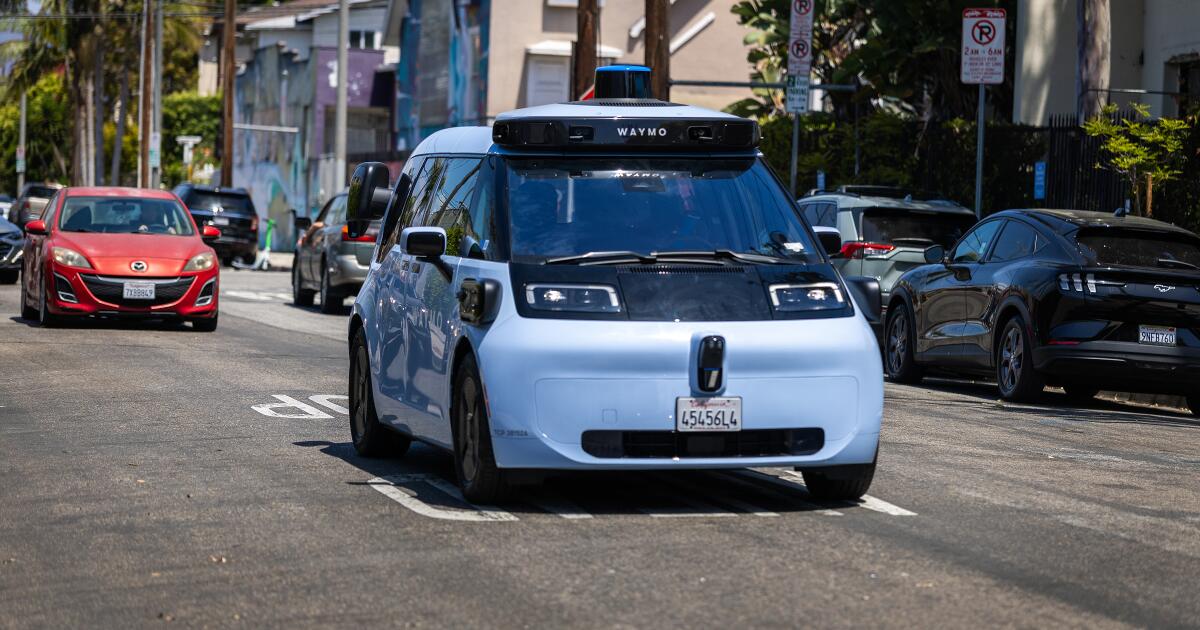
Waymo is starting robotaxi service in San Diego
-
 Entertainment15 minutes ago
‘Children of Blood and Bone’ author won’t see film after feud with star Amandla Stenberg
-
 Lifestyle20 minutes ago
After her son’s death, she found a new purpose. ‘He’s whispering: Mom, this is your path’
-
 Politics27 minutes ago
Iran ceasefire is ‘over,’ Trump says, and orders additional strikes
-
 Science30 minutes ago
Diarrhea-causing cyclosporiasis exceeds 1,000 cases in U.S. What Californians should know
-
 Sports35 minutes ago
Arthur Fery’s fairy-tale Wimbledon run puts British wild card on brink of history

