Indiana
Students, faculty feel 'walled off' from Indiana University climate plan, sustainability projects

Indiana University said it’s reorganizing its sustainability offices to better implement the university’s climate action plan. But some students and faculty at IU Bloomington said they’ve been cut out of the process to make the university a cleaner, greener place.
How IU chooses to move forward could determine whether students, faculty and staff have a role in helping the university reach its climate goals.
Hands-on learning opportunities on campus take a hit
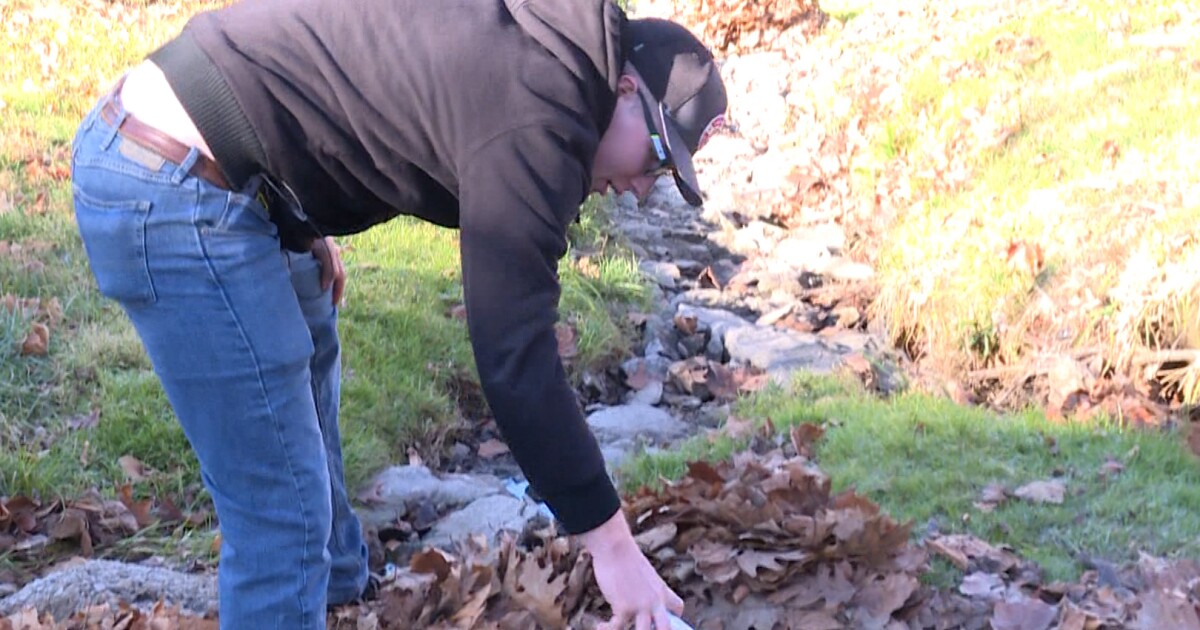
Sophomore Will Gardiner grew up playing in a nearby creek in Fort Wayne. Now he’s studying environmental science at IU Bloomington. He points out a sinking stream in Dunn Meadow on campus.
“It’s almost as if all the water goes right underneath and then right where that bridge is where the other side of the stream is. A little bit further up it shows right back up, it comes right out,” Gardiner said.
Gardiner said getting more hands-on experience would help him find a job and narrow down what he wants to do. But there aren’t enough good internships to go around for the more than 2,000 students in the IU Bloomington O’Neill School of Public and Environmental Affairs.
Since Gardiner is spending at least two summers working or taking classes — the pressure is on for the summer before his senior year.
“I pretty much have one real opportunity to get a good, solid internship in before I’m out of school. So you want to make it count,” he said.
Students used to get more of that hands-on experience right on campus. Professor Kelly Eskew is the director of education for the Kelley Institute for Environmental and Social Sustainability in IU’s business school.
She was also president of a now defunct advisory board which used to tackle sustainability projects on campus through seven working groups — only two of which are now active. Eskew herself chaired one where a company trained students to do waste audits.
“The goal was that we would repeat that work year over year, using students to take a look at what our trash looks like here at Indiana University. And that has completely fallen away. It’s really a terrible waste of a wonderful — no pun intended — but it’s a missed opportunity,” she said.
Students and faculty ‘walled off from the process’
Losing the board means faculty also lost a way to share their expertise as IU tackles possibly the most ambitious sustainability project ever — its climate action plan. Though the university held at least one public forum at each campus, the planning committee meetings weren’t open to the public. And at least for now, implementation committee meetings aren’t either.
“I think it’s kind of a tragic loss,” said Michael Hamburger, professor of earth and atmospheric sciences at IU.
“There is so much expertise and so much energy and enthusiasm about engaging with these issues. And more and more of many faculty and students feel walled off from this process, with many of the operations being handled in in secrecy and kind of behind closed doors,” he said.
That includes the new chief sustainability officer position — which oversees the climate plan for all of IU’s campuses.
Hamburger said faculty wanted an independent role hired through a national search — able to hold the campus accountable to its climate commitments and maybe more ambitious ones. Instead it reports to Capital Planning and Facilities and was posted internally. IU refused to explain why.
Reorganization makes the future of IU’s sustainability offices uncertain
While some faculty worry about all of these changes, Jessica Davis, the new chief sustainability officer, said she’s excited to get to work.
“We got a lot to do but it’s all very good, very exciting and really personally rewarding to be able to work on and serve the institution this way,” Davis said.
The climate plan implementation committee on IU Bloomington’s campus held its first meeting in January.
Davis admits her team has been more insular lately — that’s because the university was busy reorganizing all of its sustainability offices under the climate action plan.
“And ultimately it’s our job to implement and manage the climate action plan, as well as try to standardize the sustainability experience across IU to the best of our ability. So because that triggered a significant reorganization for us, now the provost’s office is working on what a new model might look like,” she said.
While things may be in flux right now, Davis said the implementation committee is working on a list of projects that students and faculty can get involved with. She said anyone on campus can always talk to their representative on the committee or request an audience with the committee.
Expert: IU isn’t an anomaly, but shouldn’t ignore opportunities for students
Like it or not — the way IU has organized its sustainability initiatives is not unusual, said Bridget Flynn. She works for Second Nature, a company that helps universities track their greenhouse gas emissions and find climate solutions.
They said having the chief sustainability officer position tied to facilities is very common — though today more of those roles are getting pushed up the hierarchy.
“More of those positions are reporting directly to the president or to a VP or like a CFO. Or a creation of a cabinet level position,” Flynn said.
Join the conversation and sign up for the Indiana Two-Way. Text “Indiana” to 765-275-1120. Your comments and questions in response to our weekly text help us find the answers you need on climate solutions and climate change at ipbs.org/climatequestions.
Flynn said no matter how they choose to reach their climate goals, universities should try to involve students as much as possible. Even if IU decides to, say, hire a contractor to make their buildings more energy efficient, students could write requests for proposals or evaluate bids.
Flynn said change will take time — there are a lot of stakeholders involved and that involvement is important.
“In order to have people feel like they were really part of the process and see themselves in the plan and implementation. And that it really represents the desires of the campus,” she said.
Rebecca is our energy and environment reporter. Contact her at rthiele@iu.edu or follow her on Twitter at @beckythiele.



WESTFIELD, Ind. (WISH) — Police have arrested someone in connection to a homicide earlier this month in the Hamilton County city.
In a Friday night social media post, the Westfield Police Department announced the arrest but gave no details, including who was arrested or what preliminary charges the person may face.
“Due to the active nature of this case, limited details are available for release at this time,” the post said.
As WISHTV.com previously reported, James “Matt” Lushin, 47, was found dead shortly after 7:25 p.m. March 12 with trauma at his home in the 3900 block of Westfield Road, also known as State Road 32.
Social media posts from the scene showed police tape and emergency vehicles at a red brick house between Shady Nook Road and Gray Road.
Lushin’s obituary said the Kokomo native was a key partner with the real estate investment company, FLF Property. The obituary also said, “Matt was also a respected and accomplished member of the international poker community. He traveled the world competing in tournaments and built an impressive and successful career.”
Police have previously said the death was believed to be isolated, posing no ongoing threat.
Officials have not released a specific cause or manner of death.

Just three days before Selection Sunday in March of 2020, the NCAA announced that March Madness, like so many other events that spring, would be cancelled due to the new virus upending life. The decision marked the first time in tournament history that the final weeks of the college basketball season would not be played, squashing Atlanta’s plans to host the Final Four.
When the following year rolled around, the NCAA decided that March Madness would not succumb to the virus once more.
With a vaccine only on the horizon and hundreds of Americans still dying each day, the organization announced in November of 2020 that while the tournament would go on, it would certainly not be business as usual. All 67 games, NCAA officials said, would be held in one location. Central Indiana was the first choice as Indianapolis had been on tap to host the Final Four April 3-5.
The plan, said NCAA senior vice president of basketball Dan Gavitt in a November 2020 IndyStar article was to present “a safe, responsible and fantastic March Madness tournament unlike any other we’ve experienced.”
In January the NCAA made it official: All games would be played in and around Indianapolis in a modified version of a bubble.
Holding the tournament in one place just made sense, NCAA officials told IndyStar. Unlike in a typical year when a winning team would travel multiple times before the championship, this system would minimize travel, which could inadvertently expose players and coaches to the virus.
Two months later when the tournament kicked off on March 18, 55 of the 67 games were scheduled to be played in Indianapolis venues, such as Gainbridge (then Bankers Life) Fieldhouse, Lucas Oil Stadium, Indiana Farmers Coliseum and Butler’s Hinkle Fieldhouse. Purdue’s Mackey Arena and IU’s Assembly Hall also hosted games.
While the first Covid vaccine had arrived a few months earlier, few people outside of first responders and the most vulnerable had been immunized, so in an effort to avoid large crowds, the Indianapolis sites all capped tickets at 25% capacity. That meant only 17,500 people could attend games at the largest venue, Lucas Oil Stadium. The college arenas allowed far smaller audiences, with IU limiting attendance to 500 people.
A week before the tournament began Marion County Public Health Department officials and Mayor Joe Hogsett asked attendees to make smart public health choices, such as social distancing and obeying the face masks mandate. Referees donned masks as much as possible as did coaches and players on the bench.
The NCAA regularly tested athletes, administering 28,311 tests Covid tests during the tournament, 15 of which came back positive.
Post-mortems after the tournament asked whether the NCAA had made the right call. Two high profile deaths occurred in the aftermath of the tournament — one a University of Alabama superfan who had traveled to Indy for the games and the other a St. Elmo bartender. But proving a direct link between their deaths and the tournament would prove impossible, and some public health experts said the NCAA had done everything it could to protect athletes and fans short of canceling the event.
A study conducted by IU, Regenstrief researchers and others that appeared in August 2021 in the Journal of the American Medical Association found that while mask wearing had theoretically been compulsory, about a quarter of attendees at the games were either not wearing masks or doing so inappropriately. Still, in an IndyStar article about the study Indiana Sports Corps president Ryan Vaughn termed the event “a resounding success.”
The following year, with a vaccine widely available and far fewer daily deaths from the virus, the tournament returned to a typical schedule, concluding in New Orleans’ Ceasars Superdome. More than 69,00 fans attended the final games, according to the NCAA. Local authorities had lifted the mask requirement by this point.
“Last year was about survival. Just having championships in any way, single site, keep everybody safe and be successful,” Gavitt said in an NCAA news release in late April 2022. “I think this year was about advancing.”
Indiana
Federal legislation that Braun calls ‘crazy’ is aimed at Bears and Indiana – Indianapolis Business Journal


Man arrested in plot to firebomb Palestinian activist’s home after undercover op

Video: We Analyzed the Deadly Crash at LaGuardia

PWHL players bond with women’s hockey pioneers at Detroit clinic | NHL.com

Fielder may resign from Board of Supervisors, possibly over illegal leak

Dallas Mayor Eric Johnson says he trusts latest City Hall repair estimates

Florida High School Football Rankings: Top 25 teams – Oct. 21

How old is Bo Nix? What to know about Oregon quarterback ahead of 2024 NFL Draft

Cleary's 21 help Le Moyne down Central Connecticut State 69-64 in OT

99th annual Pony Swim held in Virginia

Indiana Members Credit Union announced as new anchor tenant at Bottleworks District
Man arrested in plot to firebomb Palestinian activist’s home after undercover op

WATCH: Senate hearing goes silent after Angel Father confronts top Dem over daughter’s death

US diplomat Marco Rubio denounces settler violence, tolls in Hormuz strait

Iran-linked hackers have breached FBI Director Kash Patel’s personal emails | CNN Politics

Live: CPAC 2026 Day 2
-

 Detroit, MI1 week ago
Drummer Brian Pastoria, longtime Detroit music advocate, dies at 68
-

 Movie Reviews1 week ago
‘Youth’ Twitter review: Ken Karunaas impresses audiences; Suraj Venjaramoodu adds charm; music wins praise | – The Times of India
-

 Sports7 days ago
IOC addresses execution of 19-year-old Iranian wrestler Saleh Mohammadi
-

 New Mexico5 days ago
Clovis shooting leaves one dead, four injured
-
 Business1 week ago
Disney’s new CEO says his focus is on storytelling and creativity
-

 Technology6 days ago
YouTube job scam text: How to spot it fast
-

 Tennessee4 days ago
Tennessee Police Investigating Alleged Assault Involving ‘Reacher’ Star Alan Ritchson
-

 Texas1 week ago
How to buy Houston vs. Texas A&M 2026 March Madness tickets