Indiana
Bill tracker: Lawmakers approve I-465 speed limit change, Braun signs property tax relief


Watch: Indiana public school teachers rally at Indiana Statehouse
Shaina Terano, a teacher at Belzer Middle School in Lawrence Township, discusses what her students could lose with SB 1, the proposed property tax reform bill.
The General Assembly had a big week. Lawmakers handed off multiple marquee bills to Gov. Mike Braun, from property tax reform to Medicaid changes.
That’s because we’re in the home stretch. Lawmakers intend to wrap up by the end of this week, though it’s possible they’ll need until April 29 ― the deadline dictated by law ― to sort out how to cut $2 billion from the budget following a dismal revenue forecast last week.
IndyStar is tracking the prominent bills that are moving through the legislative process and that would impact a wide variety of Hoosiers.
Here are some of the major bills that have advanced, and what happened to them last week.
House Bill 1001: State budget
Lead author: Rep. Jeff Thompson, R-Lizton
What it does: This bill funds Indiana’s government, health care programs like Medicaid, public K-12 schools and colleges for the next two years. The Senate Republicans recently pitched their version, which is broadly similar to the House’s proposal but does not remove the income cap for private school vouchers and contains some transparency requirements of their elected colleagues in the executive branch.
Status: The bill passed the Senate by a 40-9 vote on April 15. The House disagreed with the Senate’s version, so they will negotiate a final budget in a conference committee
Senate Bill 2: Medicaid eligibility
Lead author: Sen. Ryan Mishler, R-Mishawaka
What it does: The bill adds far more stringent and regular government reviews of the eligibility of Medicaid recipients and adds work requirements in order for someone to be eligible for the Healthy Indiana Plan, the state Medicaid expansion plan. In addition, if the federal government allows, it limits enrollment in the Healthy Indiana Plan.
Status: The Senate gave final approval to the bill on April 17 by a 37-10 vote. It now heads to Braun’s desk.
House Bill 1004: Price-controlling hospitals
Lead author: Rep. Martin Carbaugh, R-Fort Wayne
What it does: This is one of the key bills seeking to control health care costs in Indiana. This bill does it by penalizing hospitals if they charge prices higher than a certain benchmark. While the House wanted this benchmarking to start right away, the Senate’s version of the bill begins with a two-year price freeze. Both chambers’ versions of the bill eventually threaten to strip hospitals’ nonprofit status for overcharging, but the Senate’s version invokes this threat years down the line.
Status: The Senate approved the bill on April 15 by a 29-19 vote. The House disagreed with the Senate’s version, so they will negotiate a final budget in a conference committee.
House Bill 1461: Road funding and I-465 speed limit
Lead author: Rep. Jim Pressel, R-Rolling Prairie
What it does: The bill offers a platter of tools local governments could use to beef up their road budgets. The bill also makes it easier for the state to establish more toll roads, and increases the speed limit on I-465 from 55 to 65 miles per hour.
Status: The House voted 68-17 to agree to the Senate’s changes to the bill. It now heads to Braun’s desk.
House Bill 1393: Illegal immigration notices
Lead author: Rep. Garrett Bascom, R-Lawrenceburg
What it does: The bill requires county jails to report individuals to their county sheriff if the person is arrested for a felony or misdemeanor and there is probable cause to believe the person lacks permanent legal status. It then requires county sheriffs to report the person to proper authorities.
Status: The House gave final approval to the bill by a 58-19 vote on April 16. It now heads to Braun’s desk.
Senate Bill 289: Banning DEI
Lead authors: Sen. Tyler Johnson, R-Leo, Sen. Gary Byrne, R-Byrneville
What it does: This bill bans all state spending on diversity, equity and inclusion initiatives — from trainings to diverse hiring initiatives — at state agencies, educational institutions and health profession licensing boards.
Status: The bill passed the House by a 67-27 vote on April 15. The Senate then disagreed with the House’s version, so they will negotiate a final budget in a conference committee.
House Bill 1006: Prosecutors
Lead author: Rep. Chris Jeter, R-Fishers
What it does: The bill creates a prosecutor review board to investigate complaints against prosecutors that have publicly refused to prosecute certain criminal laws. The Senate amended the bill on April 8 to remove language that would have allowed “noncompliant” prosecutors to be denied funds previously available under a House version of the bill, which Democrats saw as an attack on Marion County Prosecutor Ryan Mears.
Status: The House gave final approval to the bill by a 61-21 vote on April 17. The bill now heads to Braun’s desk.
House Bill 1002: Education deregulation
Lead author: Rep. Bob Behning, R-Indianapolis
What it does: The bill aims to loosen restrictions for Indiana schools and education systems, including by nixing the education credential requirement for the Indiana secretary of education, changing the timing of when teachers are paid and removing certain training and professional development requirements.
Status: The Senate passed the bill by a 31-18 vote on April 15. The House then disagreed with the Senate’s version, so they will negotiate a final budget in a conference committee.
House Bill 1008: Illinois-Indiana boundary commission
Lead author: House Speaker Todd Huston, R-Fishers
What it does: The bill creates a bipartisan group that would explore how Illinois counties could effectively secede from their state and join Indiana by redrawing state lines.
Status: The bill passed the Senate by a vote of 36-13 on April 16 and the House voted 64-23 to agree to the Senate’s changes on April 17. The bill now heads to Braun’s desk.
Senate Bill 482: Chronic absenteeism
Lead author: Sen. Stacey Donato, R-Logansport
What it does: The bill prohibits a public school from expelling or suspending a student because they are chronically absent or habitually truant and expands the number of days for a school to hold an attendance conference about a student’s absences from five days to 10. It also requires the Department of Education to establish best practices for student discipline on chronic absenteeism.
Status: The bill passed the House by an 82-15 vote on April 15. The Senate then disagreed with the House’s version, so they will negotiate a final budget in a conference committee.
Senate Bill 516: IEDC transparency changes
Lead author: Sen. Brian Buchanan, R-Lebanon
What it does: The bill would require the Indiana Economic Development Corporation make mandatory notifications to local governments if the quasi-government agency seeks to purchase 100 acres or more in a community and provide annual reports on Innovation Development Districts, like the LEAP project in Boone County. Additionally, the bill creates a new entrepreneurship and innovation office and a new role of president of the IEDC.
Status: The Senate unanimously gave final approval to the bill on April 16. The bill now heads to Braun’s desk.
House Bill 1007: Small nuclear reactors
Lead author: Rep. Ed Soliday, R-Valparaiso
What it does: The bill provides a state tax credit for expenses incurred in manufacturing small modular nuclear reactors in Indiana. The bill could result in costs shifted to utility customers to pay back project expenses before construction starts.
Status: The bill passed the Senate by a 36-13 vote on April 15. It now goes back to the House, which will decide whether to agree to the changes.
The following bills have either been signed by the governor or finished the legislative process.
Senate Bill 1: Property taxes
Lead author: Sen. Travis Holdman, R-Markle
What it does: The bill saw a massive overhaul when it passed the House and now includes local government finance reforms in addition to property tax relief. Senate Bill 1 limits how much local governments can raise their property taxes, provides new property tax credits for Hoosier homeowners and allows most cities and towns to establish their own local income tax rates. It also requires school districts to share tax dollars with certain charter schools.
Status: Braun signed the bill into law April 15 after the Senate voted 27-22 to agree with the House’s changes.
Senate Bill 10: Student voter ID
Lead author: Sen. Blake Doriot, R-Goshen
What it does: The bill bans college students from being able to use their student IDs as a form of acceptable voter identification at the ballot box.
Status: Braun signed the bill into law on April 16. It goes into effect July 1.
House Bill 1041: Transgender athlete ban
Lead author: Rep. Michelle Davis, R-Whiteland
What it does: This is virtually the same bill lawmakers passed in 2022, which banned transgender girls from participating in girls’ K-12 sports. This year’s bill extends that ban to collegiate athletics.
Status: Braun signed the bill into law on April 16. It goes into effect July 1.
Senate Bill 451: Income tax cut
Lead Author: Sen. Travis Holdman, R-Markle
What it does: The bill would further decrease Indiana’s individual income tax rate if state revenues grow by more than 3.5% compared to previous years.
Status: Braun signed the bill into law on April 16. It goes into effect July 1.
House Bill 1208: Sheriff’s commissary fund
Lead author: Rep. Greg Steuerwald, R-Avon
What it does: The bill would tighten oversight of commissary funds of county jails, requiring more stringent reporting and training. The bill comes in the wake of the scandal involving former Clark County Sheriff Jamey Noel, who last year was sentenced to 15 years in prison related to taking improper payments from the fund.
Status: Braun signed the bill into law on April 10. It goes into effect July 1.
House Bill 1137: Red Flag expungement
Lead author: Rep. Ben Smaltz, R-Auburn
What it does: The bill would allow for a judge to seal and expunge someone’s “red flag” record if a court determines the person to no longer be dangerous. It would only allow a law enforcement officer acting within their job duties to see the sealed record. Currently, if a person’s weapons are seized and a court determines they are not dangerous the case remains public, which advocates say has cost people jobs and other opportunities.
Status: Gov. Braun signed the bill into law on April 3. It goes into effect July 1.
Senate Joint Resolution 21: Constitutional Convention
Lead author: Sen. Andy Zay, R-Huntington
What it does: The resolution is part of a multi-state effort to compell the U.S. Congress to call a convention to amend the U.S. constitution, specifically to enact term limits for people who serve in the U.S. House or U.S. Senate. However, any aspect of the constitution could potentially be amended under such a convention.
Status: The resolution passed the Indiana House on March 17 by a 66-30 vote after being passed earlier in the session by the Indiana Senate. It goes into effect immediately because resolutions do not require the signature of Gov. Mike Braun.
There was no movement on the following bills last week.
Senate Bill 475: Physician noncompetes
Lead author: Sen. Justin Busch, R-Fort Wayne
What it does: Lawmakers tried in 2023 to outlaw noncompete agreements for Indiana doctors — contracts that prevent doctors from taking jobs at competing hospitals within a certain radius. The compromise that year was to only apply this to family doctors. This year, Senate Bill 475 attempts the ban for all physicians, again, hoping it will encourage competition and reduce prices in the health care market.
Status: The bill passed the House on April 9 by a 71-23 vote, but then on April 10, the bill’s author disagreed with the House’s changes. The bill will go to conference committee.
Senate Bill 143: Parental rights
Lead Author: Sen. Liz Brown, R-Fort Wayne
What it does: The bill restricts government entities, including school districts and the Indiana Department of Child Services, from intruding on parental rights or keeping information from parents, unless there is a compelling governmental interest.
Status: The Senate officially agreed to the House’s changes on April 8. The bill is now on Braun’s desk.
Senate Bill 4: Water pipeline oversight
Lead author: Sen. Eric Koch, R-Bedford
What it does: The bill prohibits the construction, operation, purchase, sale and lease of a long-haul water pipeline unless the Indiana Utility Regulatory Commission signs off on it. However, the Citizens deal to provide water to the LEAP district in Lebanon is exempted from those rules.
Status: The Senate agreed to the House’s changes by a 45-2 vote on April 8. The bill is now on Braun’s desk.
The following bills are now dead.
House Bill 1531: Immigration enforcement penalties
Lead author: Rep. JD Prescott, R-Union City
What it does: The bill gives the governor power to withhold funding from local governments if the attorney general determines the entity does not comply with federal immigration enforcement. It says federal immigration law can be enforced by local, state and federal officials. The bill also prohibits employers from knowingly hiring someone who is not legally allowed in the U.S.
Status: This bill died after it failed to receive a hearing in the Senate’s Committee on the Judiciary. Republican Sen. Liz Brown, who leads that committee, released a statement on March 31 in which she expressed reservations about how to enforce the bill.
Senate Bill 11: Social media for minors
Lead author: Sen. Mike Bohacek, R-Michiana Shores
What it does: The bill requires parental consent for social media use for people under age 16, and allows Indiana’s attorney general to sue social media operators that don’t comply.
Status: This bill died in the House after it failed to receive a hearing before the deadline for bills to pass legislative committees on April 10.
Senate Bill 523: Chaplains in public schools
Lead author: Sen. Stacey Donato, R-Logansport
What it does: The bill would allow public schools to hire or bring in on a volunteer basis religious chaplains, with an eye toward alleviating the burden on school counselors.
Status: This bill died in the House after it failed to receive a hearing before the deadline for bills to pass legislative committees on April 10.
Senate Bill 13: Spinning
Lead author: Sen. Jim Tomes, R-Wadesville
What it does: The bill makes intentional and reckless skidding while driving, known as “spinning”, a Class B misdemeanor and increases the penalties further if the spinning endangers, injures or kills another person. If the bill becomes law, a person found spinning could have their vehicle seized in a civil forfeiture.
Status: This bill died in the House after it failed to receive a hearing before the deadline for bills to pass legislative committees on April 10.
Senate Bill 518: Sharing property tax dollars with charter schools
Lead author: Sen. Linda Rogers, R-Granger
What it does: The bill would require all traditional public-school districts, including Indianapolis Public Schools, to share property tax revenue with charter schools in their attendance boundaries, if 100 or more kids leave the traditional district for charter schools, starting in 2028.
Status: The language from Senate Bill 518 was amended into Senate Bill 1, the signature property tax relief bill.
Senate Bill 284: Shrinking early voting
Lead author: Sen. Gary Byrne, R-Byrneville
What it does: The bill would have shrunk Indiana’s period for early in-person voting from 28 days to 14 days. It died on Feb. 19 after Byrne said he did not have the support to advance the bill.
Status: Died in the Senate on Feb. 19 after the author did not open it for amendments by the deadline.
Senate Bill 201: Closing Indiana’s primaries
Lead author: Sen. Mike Gaskill, R-Pendleton
What it does: By requiring voters to register with a political party in order to vote in that party’s primary, this bill would have made Indiana a closed-primary state. It died on Feb. 19 after Gaskill said he did not have the support to advance the bill.
Status: Died in the Senate on Feb. 19 after the author did not open it for amendments by the deadline.
House Bill 1432: Online gambling
Lead author: Rep. Ethan Manning, R-Logansport
What it does: The bill would have allowed people to play online poker and other casino games virtually and allow the Hoosier Lottery to operate virtually as well.
Status: The bill died after not receiving a hearing in the House Ways and Means Committee before the Feb. 17 deadline.
Contact IndyStar state government and politics reporter Brittany Carloni at brittany.carloni@indystar.com. Follow her on Twitter/X @CarloniBrittany.
Contact IndyStar state government and politics reporter Kayla Dwyer at kdwyer@indystar.com or follow her on Twitter @kayla_dwyer17.
Contact senior government accountability reporter Hayleigh Colombo at hcolombo@indystar.com.
Sign up for our free weekly politics newsletter, Checks & Balances, by IndyStar political and government reporters.



INDIANAPOLIS — Hundreds of Hoosiers gathered at the Indiana Statehouse Saturday morning as part of nationwide ‘No Kings’ events to voice their concerns about the current administration.
WATCH FULL STORY BELOW
Hundreds gather at Indiana State Capitol for ‘No Kings’ protest
“I’m out here today because what’s happening in our government is completely trash,” Donna Sipes told WRTV. “It’s wrong. We need to do something about it.”
“I’m tired of every single day when the TV comes on to see what stupid thing he’s done next,” Lindi Marti said.
WRTV
Attendees noted the growing popularity of the demonstrations.
“This is my fourth one to come to. I didn’t come to all of them when it was really cold, but I’m glad to see that they are getting a lot more people out here every time,” Marti added. “It seems like there’s more and more coming.”
Demonstrators highlighted specific foreign policy concerns, including the administration’s handling of the war in Iran.
“We’re bombing the heck out of them. We’re killing civilians,” Marti’s husband said. “We’re getting ready to send our Marines.”
WRTV

Others focused on the administration’s handling of immigration.
“That’s what I’m concerned about,” Reverend Kenny Little told WRTV. “Little kids, they’re taking them away from their family. And I’m just one of those people, I think everyone got rights.”
Indiana medical students also attended the rally to speak out against changes to the healthcare system.
“We’re really worried about the attacks on the health care system in general, but with Medicaid… current estimates range from anywhere from 325,000 to 450,000 Hoosiers will lose coverage by 2032,” Wade Catt said with concern.
WRTV
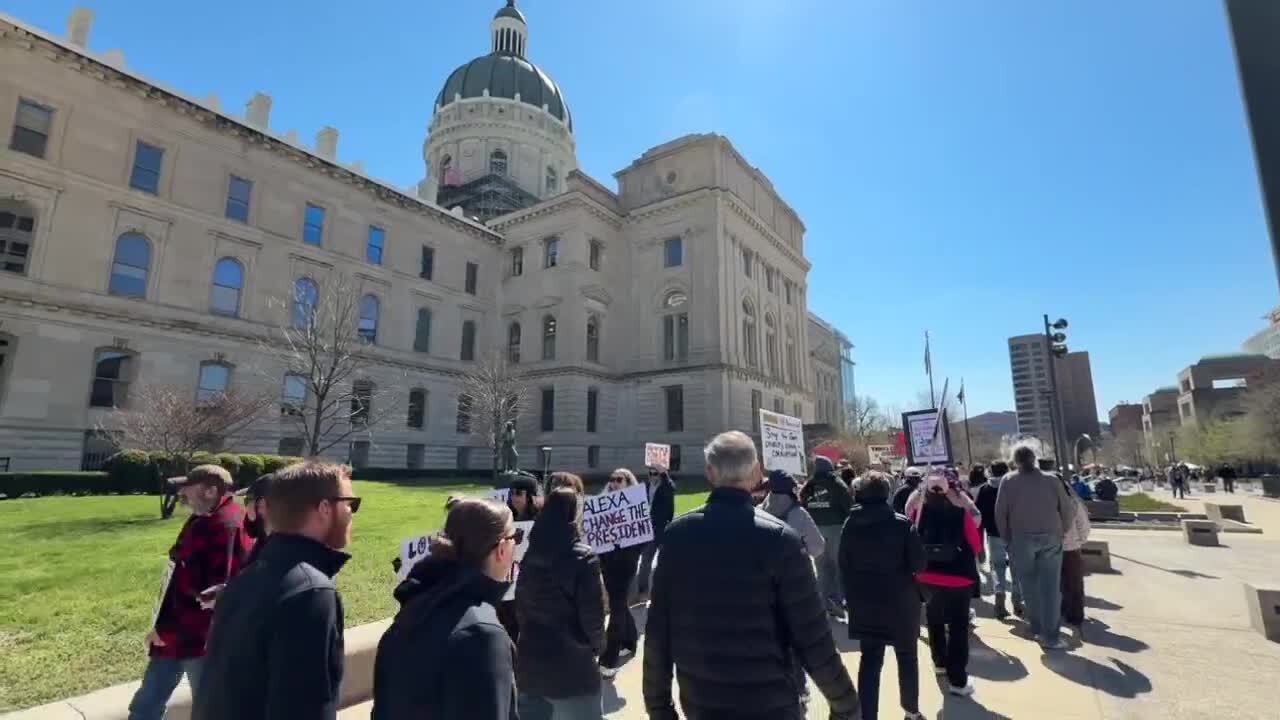
With midterm elections approaching later this year, attendees emphasized the importance of now taking action at the ballot box.
“If we don’t vote, then things are gonna not, they’re gonna stay the same,” a protester said.
Meanwhile, Indiana Lieutenant Governor Micah Beckwith says he’s happy to see Hoosiers exercise their First Amendment right to protest.
However, he takes issue with the idea that President Trump is acting like a king. Beckwith says the fact that people have the freedom to protest is proof that the president is not acting like a tyrant.
He acknowledges that bridging the gap between the sides is probably an uphill battle, but believes communication is key.
“I think when you sit down with people face to face, you’re confronted with humanity. There’s another human sitting across that table from you and talking to you. And so, all I have to say, I think that’s probably the thing I would encourage all Hoosiers to do is say, ‘Hey, if you don’t agree with somebody or if you don’t like somebody, why don’t you try grabbing coffee with them? And give it 30 minutes, and just see what happens.’ I bet most of the time people will walk away with a much softer heart and spirit towards that person before they came in,” Beckwith said.
Beckwith is currently on a 92-county tour of the state. He says all sides are welcome to attend his events.
__

INDIANAPOLIS (WISH) — Police say one “young man” is dead after a shooting at the 1200 block of Rue Rabelais at about 7:19 p.m. according to the Indianapolis Metropolitan Police Department.
That is near the intersection of 56th Street and Binford Boulevard.
Police say the victim was taken to Riley Hospital where he later died. Investigators say they are still working to identify the victim.
There was no known information about a suspect. Police did say that they believe this is a targeted incident.
There was no other information immediately available.
This story has been updated with information from the Indianapolis Metropolitan Police Department.

This story contains descriptions of distressing circumstances involving children.
INDIANAPOLIS (WISH) – A mother and her boyfriend were accused of causing the death of a 4-year-old-boy found dead in a basement closet on Monday.
Indianapolis Metropolitan Police Department arrested Angel Lovely, 37, and Nicholas Bergdoll, 36, on preliminary charges of neglect of a dependent causing death. The Marion County Prosecutor’s Office by Friday had not filed formal charges.
A sibling found the 4-year-old dead on Monday, according to investigators. Lovely and Bergdoll were in the home at the time but told police they were asleep when he died.
Born premature with cerebral palsy, the 4-year old couldn’t walk, was nonverbal, and ate through a feeding tube. Lovely claimed she would rarely put the child in the closet, only “when he won’t stop screaming” or when she “needed a break.”
But when investigators interviewed Lovely’s three other children, they said that the boy “stays in the closet all day,” and that “mom locks him in the closet” and “does not pay attention to him.”
An exact cause of death hasn’t been determined, but the child was found with blood in his mouth. Lovely said he’d been aspirating.
One of Lovely’s children told investigators they heard the 4-year-old gagging but didn’t say anything because it wasn’t unusual.
A neighbor living on Monticello Drive, Michelle Johnson, told News 8, “It’s horrible. It breaks my heart.”
Johnson had seen the other children outside the home but never knew there was a boy in a wheelchair living there. She said if she suspected they were being neglected, she would have called police or the Indiana Department of Child Services.
“We’re supposed to be a village and raise kids together,” Johnson said. “That’s really heartbreaking.”
Bergdoll told police, according to the investigators’ report, that he didn’t agree with putting the child in the closet: “I am not going to tell her how to f****** raise her kids.”
“I’m sickened,” IMPD Public Information Officer Tommy Thompson told News 8 in an interview.
“Think about putting yourself in that situation. Every day, do you want to be in a closet? Locked up, no light?”
Court records show the Department of Child Services had removed the boy from Lovely’s care because of medical neglect, but she regained custody last year against DCS recommendations.
Thompson, the neighbor, hopes the tragedy can be an opportunity for others to speak up when they see a child who can’t speak up for themselves. “Maybe you’ve got to make that tough phone call. Reach out. The city has resources.”
Johnson wishes she would have known what was happening so she could have said something. “Children don’t have a voice and we’re supposed to be their voice.”
Help is available for victims of domestic violence, child abuse, and sexual assault. Below is a list of suggested resources, both national and local:

Decorated Illinois guard Josh Gesky met with Saints ahead of draft
Hundreds gather at Indiana State Capitol for ‘No Kings’ protest

Body recovered from retention pond after reported drowning in Iowa Colony
![~!@[WATCHLIVE!TV]>> NOW Portland Thorns FC vs Kansas City Current Match 𝐋𝐈𝐕𝐄 Free Streams ON Tv Channel](https://i2.wp.com/unicornriot.ninja/wp-content/uploads/2018/09/LiveChannel334x212v2.png?w=80&resize=80,80&ssl=1 "~!@[WATCHLIVE!TV]>> NOW Portland Thorns FC vs Kansas City Current Match 𝐋𝐈𝐕𝐄 Free Streams ON Tv Channel")
~!@[WATCHLIVE!TV]>> NOW Portland Thorns FC vs Kansas City Current Match 𝐋𝐈𝐕𝐄 Free Streams ON Tv Channel

2026 top-50 recruit Chris Washington Jr. drawing interest from Kentucky Basketball

Florida High School Football Rankings: Top 25 teams – Oct. 21

How old is Bo Nix? What to know about Oregon quarterback ahead of 2024 NFL Draft

Cleary's 21 help Le Moyne down Central Connecticut State 69-64 in OT

99th annual Pony Swim held in Virginia

Indiana Members Credit Union announced as new anchor tenant at Bottleworks District

JD Vance says he was ‘obsessed’ with UFOs, believes aliens are actually ‘demons’
The EU's recipe for trade deals : easy on beef, tough on wine

Photos: ‘No Kings’ protests across the country

Jeffries declines to break with indicted Democrat after ethics panel’s guilty verdict

Hundreds of thousands march through London in stand against the far right
-

 Sports1 week ago
IOC addresses execution of 19-year-old Iranian wrestler Saleh Mohammadi
-

 New Mexico7 days ago
Clovis shooting leaves one dead, four injured
-

 Tennessee6 days ago
Tennessee Police Investigating Alleged Assault Involving ‘Reacher’ Star Alan Ritchson
-

 Technology7 days ago
YouTube job scam text: How to spot it fast
-

 Minneapolis, MN3 days ago
Boy who shielded classmate during school shooting receives Medal of Honor
-

 Science1 week ago
Record Heat Meets a Major Snow Drought Across the West
-

 Politics1 week ago
Schumer gambit fails as DHS shutdown hits 36 days and airport lines grow
-

 Texas1 week ago
How to buy Houston vs. Texas A&M 2026 March Madness tickets