Illinois
Many challenges ahead as Illinois unifies early childhood programs, report finds


Parents of young children in Illinois often find themselves navigating a complex, fragmented system as they try to get quality day care, preschool or services for babies and toddlers with developmental delays.
Gov. J.B. Pritzker created a state agency to untangle this mess. But a new report shows that won’t be easy given the depths of the problems in the early childhood system and the obstacles to improving it.
Come July, the new Illinois Department of Early Childhood will be fully responsible for the state programs that offer home visiting, early intervention, subsidized day care and preschool. It will also license and provide quality ratings for early learning programs. Prior to the agency’s creation, these programs and services, as well as the grants that pay for them, were handled by three different state agencies.
Teresa Ramos, the secretary of the new agency, said that by unifying all these services under one umbrella, “Illinois will be better positioned to address the complex challenges facing Illinois’ early childhood ecosystem.”
The report lays out the state of the early childhood system so the new agency can measure progress, said Lily Padula, a policy and research associate at The Civic Federation who authored the report.
Families found it challenging to navigate their early learning options across three state agencies, Padula said. For example, some parents had to fill out duplicate forms. And several different government agencies and organizations — some local, some statewide — monitor quality, making it hard to get an overall picture of where quality programs exist.
She also points to broader issues that the agency will have to contend with. One of the biggest: Quality day care and preschool programs are not equally distributed across the state. According to the report, almost three-quarters of Illinois counties are child care deserts with no licensed providers. In 2023, licensed providers could only serve a third of children 5 and under, the report said.
The lack of providers can be at least partly attributed to this fact: Early child care providers and their staff are not well-paid. That contributes to turnover. Workers typically do not want to spend money and time getting more education for low-paid jobs, and often leave the industry after just a few years.
Padula said the state has increased the amount of money it is putting into early childhood programs by 40% over the past five years, but there’s still a significant gap between how much government funding child care providers get and the true cost of providing quality child care.
Ramos said states across the country are struggling with many of these same issues around access and workforce shortages. She points out that even as Illinois has increased funding for early childhood programs, the Trump administration is threatening to make child care less affordable. As recently as Friday, a court prevented the federal government from withholding child care subsidies from Illinois and five other states.
Many child care operators run on tight margins and some fear they could go out of business. Pandemic-relief money that helped them offset operational costs is gone, and many rely on the child care subsidies the Trump administration is targeting.
That’s on top of the “complex and overlapping funding streams” that child care providers often have to piece together, according to the report.
The agency also is charged with improving home visiting and early intervention services, which sends therapists and workers to help babies and toddlers with developmental delays.
But there are significant delays in getting children services, particularly in rural areas. White children are far more likely than children of color to have their needs identified and addressed.
Padula said the creation of the new agency should help officials focus on and tackle the many problems in the early childhood system, but “the challenges are real and progress takes time.”
Getting more young children access to better programs and services is essential, she said. When children don’t have access to early childhood programs, it affects their school trajectory. Currently, less than a third of children show up for kindergarten ready in all areas, according to the state’s assessment — a percentage that has been increasing but still is relatively low.
“These kids… are substantially less likely to meet academic standards in the future, and you can see those disparities between race, income, English Language Learner status, disability and geography across the state,” Padula said. “Being able to increase access to services can help kids become ready for kindergarten and increase future academic success.”


The Illinois Republican Party filed its quarterly campaign finance report on the July 15 deadline. The party reported having just $223K in the bank. The next day, the party sent a letter to the Illinois State Board of Elections saying they were “reconciling” their records after a leadership change, and then noted that their actual end balance was $101K higher than it had reported the day before.
But that bit of found money was basically the end of the “good news” for the GOP last week.
Republicans no longer have a pet billionaire. Bruce Rauner and Ken Griffin have fled the state. The legions of wealthy business titans who once contributed and raised money have either retired to sunnier climes or passed away. Several prominent party members have publicly shunned labor unions and their hefty political war chests, although the state GOP legislative leaders have at least tried to rebuild ties to trade unions and even the Illinois Education Association. But the heavily gerrymandered legislative map combined with the current political climate means they’ll mostly receive scraps.
And, yes, the House Democrats are struggling this month with scandals, including a state representative who resigned under pressure and another who was indicted. I’m not trying to downplay that at all. But Democrats have the national political environment, the local infrastructure and tons of cash behind them. The Republicans have little to none of that.
The GOP’s gubernatorial candidate, Darren Bailey, raised $1.3 million in the second quarter, which ended June 30. That sounds like a lot, but he spent almost all of that on direct mail fundraising costs. The huge expenditures do give him a prospect list for future fundraising, but he ended the quarter with a mere $128K in the bank. That was still a whole lot more than the rest of the statewide ticket.
Attorney General nominee Bob Fioretti, a perennial candidate, raised $31K, spent $39K and had $28K on hand at the end of the quarter along with almost $15K in recent debt. Secretary of State candidate Diane Harris raised $6K, spent a bit over $4K and had a paltry $1,816.42 in the bank. Treasurer candidate Max Solomon, who ran as a write-in during the primary because the party failed to recruit anyone, raised less than $3K, reported no spending and ended the quarter with less than $8K. Comptroller candidate Bryan Drew raised $30K and received $47K in in-kind contributions from a company owned, ironically, by independent gubernatorial candidate Collin Corbett, spent less than $3K, ended with $54K and had $25K in debt from earlier this year.
Man, that’s just downright pathetic.
But I suppose it doesn’t really matter anyway unless we see a massive sea-change in national opinion in the coming months or the federal government finds a way to not certify certain election results. Regardless of where individual candidates are at this moment, they’ll have the money to compete. Unlike the Republicans, the Dems do have a pet billionaire (JB Pritzker) and, I assume eventually for most of them, organized labor.
The Republican legislative leaders have tried to scrape and claw as much as they can, but they’re vastly outgunned. Senate Republican Leader John Curran raised just $75K in the second quarter. He spent $71K and reported having a bit more than $3 million in the bank. His caucus committee reported having $160K in the bank.
Leader Curran has three Republican-held districts to defend in the Chicago media market that have all trended Democratic in the last three cycles. Depending how bad things get, he could be defending a couple, two or three more.
The Senate Democrats have a ton of money to do whatever they want. Senate President Don Harmon has about $20 million in his personal campaign account and $1.7 million in his caucus account.
Over in the House, Republican Leader Tony McCombie has at least four Democratic-trending or swingy districts to defend and just $1.3 million in her personal campaign account and another $363K in her caucus account so far.
In contrast, House Speaker Chris Welch had $11.4 million in his personal account and $1.2 million in his caucus account. Like Senate President Harmon, he has more than enough money already, but more is never enough when there’s so much out there, so those numbers will likely rise by November.
Rich Miller also publishes Capitol Fax, a daily political newsletter, and CapitolFax.com.

BLOOMINGTON — Springfield’s Alex Eickhoff nearly had a magical Thursday as he tied for second place in the 95th annual Illinois State Amateur Championship at Crestwicke Country Club.
Eickhoff, a 2020 Hillsboro High School graduate and former standout on the Southern Illinois University Edwardsville’s men’s golf team, shot a 4-under-par 68 in Thursday’s third round and followed that with an even-par 71 to finish the three-day, four-round event 1-over 285. He tied for second with Bloomington’s Logan Stauffer.
Eickhoff briefly took the lead through nine holes of his fourth round when he sat at 1-under par. Chicago’s Charlie Kulwin finished both of Thursday’s rounds under par and finished 2-under 282. He was the lone golfer to finish under par for the tournament.
Eickhoff was The State Journal-Register’s Small School Boys Golfer of the year twice in his high school career: once as a freshman in 2016-17 and again as a senior in 2019-20. After high school, he golfed for the University of Minnesota for two years before transferring to SIUE.
He began the tournament with a 3-over 74 on Tuesday and shaved off a stroke Wednesday with a 2-over 73. He closed out the event with an even-par 71 in Thursday’s final round.
Other area golfers who made the cut were Springfield’s Charles Hoogland (7-over 291, tied for 20th) and Jacksonville’s Brady Kaufmann (8-over 292, 25th).
The last golfer from The State Journal-Register’s coverage area to win the Illinois State Amateur was Jay Davis. Davis, a Jacksonville Routt graduate, won the 1991 and ‘92 tournaments.
Contact Ryan Mahan: 788-1546, ryan.mahan@sj-r.com, Twitter.com/RyanMahanSJR.
Illinois
Illinois awards AD Josh Whitman a new contract worth more than $31 million over the next 10 years

CHAMPAIGN, Ill. — Illinois has extended athletic director Josh Whitman’s contract through 2036, committing more than $31 million over the next 10 years on the heels of a series of standout seasons for the department and its teams.
The university’s board of trustees approved the new deal for Whitman at its regular meeting on Thursday. The fifth-longest tenured AD among the four power conferences will make $2.15 million during the 2026-27 school year, a salary increase of more than 40%.
Whitman is scheduled to receive $100,000 raises annually before a $200,000 bump to $3.15 million in the final year of the agreement and a $500,000 retention bonus each June 30 that he remains on the job at Illinois.
The contract also includes additional incentives of up to $500,000 annually related to performance goals set by the university chancellor and three automatic one-year extensions through 2039 if certain Illini football and men’s basketball performance measures are met.
Whitman, a former Illinois football player, was hired in 2016. This was the fifth time his contract has been amended. The men’s basketball team reached the NCAA Final Four in April for the first time in 21 years. The football team won 19 games over the last two seasons, a program record for that span. Illini athletics also set a revenue record for a fourth consecutive year and topped $200 million for the first time in 2025-26, according to the board of trustees meeting memo.
-

 Kentucky3 minutes ago
Two-vehicle crash injures one in Pike County, Kentucky, troopers say
-
 Louisiana9 minutes ago
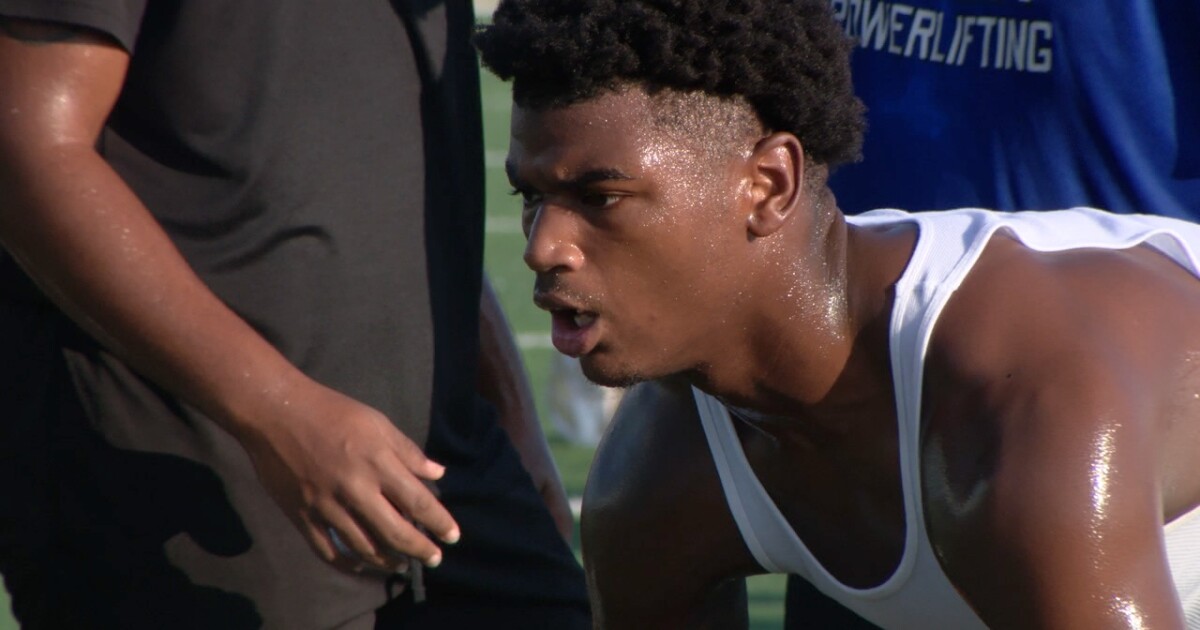
Lafayette Renaissance edge rusher Ansinneo Charles commits to Louisiana
-

 Maine15 minutes ago
Maine Trust announces 2 hires in Augusta, Waterville
-

 Maryland21 minutes ago
What Doesn’t Change in Chevy Chase, Maryland
-

 Michigan27 minutes ago
Huntington Bank to close 13 Michigan branches by the end of August — see full list here
-

 Massachusetts33 minutes ago
Massachusetts RMV under fire after illegal immigrant trucker kills state trooper
-

 Minnesota39 minutes ago
Thousands expected to attend Minnesota Yacht Club festival in St. Paul
-

 Mississippi45 minutes ago
Mississippi Lottery Mississippi Match 5, Cash 3 results for July 17, 2026

