Illinois
Four Downs and Bracket: Northern Illinois is beauty, Texas the beast and Shedeur Sanders should opt out


Davis Warren: ‘Standard hasn’t changed’ after Michigan loss to Texas
Michigan Wolverines quarterback Davis Warren said the reigning national championship team’s “standard hasn’t changed” after losing 31-12 to Texas.
First Down
This is the danger of overreaction, of penciling in favorites and roaming blissfully unaware through the minefield that is the college football regular season.
A week ago, Notre Dame had a clear path to the College Football Playoff. Now there’s wild uncertainty under the Golden Dome after a 16-14 loss to Northern Illinois.
A week ago, Irish quarterback Riley Leonard gutted out a big win at Texas A&M, fighting a defense full of elite athletes and going head-to-head with Mike Elko, his former coach at Duke. Fast forward to an unusually chilly September Saturday afternoon in South Bend, Indiana, with little ol’ Northern Illinois staring back from the other side of the ball.
Leonard threw two interceptions, averaged one lousy yard per carry and the Irish looked like a team in disarray — a week after strutting like a playoff team.
When will we ever learn?
This is the beauty of college football, and its perfectly imperfect fall Saturdays. Sometimes it’s not so much about bluechips and big NIL deals as it is want. Who wants it more?
A roster full of blue chip recruits with strapping, rising 30-something coach Marcus Freeman building what seems like a national power, or a bunch of MAC castoffs with tough love coach Thomas Hammock, who looks more like John Candy than John Heisman.
He was blubbering on the field at Notre Dame Stadium as the sun set over Touchdown Jesus, yet speaking so poignantly about players doing the right things, and listening and taking coaching. Football is more than NIL deals, he said.
You better believe it is. More times than not, it’s about who wants it more.
Like gutty and gritty Northern Illinois quarterback Ethan Hampton, who threw for 198 yards and had a few key runs ― including converting a key fourth-down run on the game-winning drive. Prior to this season, he had nine career passing touchdowns against eight interceptions.
Or running back Antario Brown, who was 13 when his mother was shot and killed outside their apartment in Savannah. After rushing for nearly 1,300 yards last season, he could’ve left NIU for a Power Four team and earned a sweet NIL deal.
But he stayed with the school who first recruited him, much like he did when leaving high school despite an offer from South Carolina.
HIGHS AND LOWS: Michigan mess and Texas triumph lead Week 2 winners and losers
Or Hammock, a star running back at NIU in the early 2000s who bounced around in college football and the NFL coaching running backs, before his alma mater asked him to come home in 2019. And then back him over and over despite some rough spots, including a three-win season in 2022.
So yeah, he was weeping in the biggest moment of his coaching career. So were his players as they dove into the stands to celebrate with the few hundreds who made the 150-mile drive east to witness history.
This is college football. Not daily pontificating or weekly overreactions or looking down a three-month road and declaring no one is beating Notre Dame. Until Northern Illinois does.
And picks up a cool guarantee game check worth $1.4 million in the process, thank you.
Second Down
Of all the critically bad decisions to chance for college football administrators, there are defining moves that somehow continue to be made through emotion.
Hiring a head coach shouldn’t be a heart over head proposition, but here we are, and the strange scenario continues to play out when it shouldn’t. From beloved assistant coach to head coach — to overwhelmed by the moment.
All because emotion clouded judgment in the hiring process, and the ”players’ coach” or “the importance of transition” or “you know what you’re getting” meant more than finding the right coach.
Speaking of a clouded process, it may be time to give Michigan coach Sherrone Moore an early invite to the waiting room of bad decisions.
Because after Michigan’s 19-point home loss to Texas (it wasn’t that close), Moore looks a lot like Bobby Williams at Michigan State. Or Randy Shannon and Manny Diaz at Miami, Ron Prince at Kansas State and Matt Luke at Ole Miss.
And that’s just a handful of assistant coaches who got their first power conference head coaching job when elevated at their respective schools — and were then engulfed by it all. They were “players’ coaches” who were hired in the heat of the moment and amid the fanfare of player support, after the previous coach either took another job, retired or was fired.
Williams followed Nick Saban (left for LSU), Shannon followed national championship coach Larry Coker (fired), Diaz followed Mark Richt (retired), Prince followed Bill Snyder (retired) and Luke followed Hugh Freeze (fired).
Only Diaz, now coaching Duke, got a second chance as a Power Five conference head coach.
Now here we are with Moore, who won four games as an interim coach last year during Michigan’s national championship season while former coach Jim Harbaugh was suspended. But that was with a loaded team, built over the years by Harbaugh and built specifically to peak during the 2023 season.
Moore took over, and had to find a quarterback (he didn’t land one from the transfer portal despite the deep group of candidates), and replace the entire offensive line and wide receiving corps.
After an uninspiring season opening win over Fresno State, the Wolverines looked outcoached and outclassed against Texas. Michigan had 284 yards — 78 on the last drive of the game against Texas backups — converted only 3-of-12 third downs and had three turnovers.
Moore looked shellshocked from the first drive of the game, when a questionable holding call negated a Texas touchdown. The Longhorns then missed a short field goal.
Then it got worse for Moore and Michigan, which had four win streaks snapped with the loss: 16 consecutive wins overall, 23 consecutive home wins, 28 consecutive wins in August and September, and 23 consecutive non-conference home wins.
The Wolverines were an operational mess on both sides of the ball. Quarterback Davis Warren was shaky in his second start, and the play calling was uninspiring.
The run game — the anchor of Harbaugh’s Michigan teams — rushed for 80 yards on 23 carries, and has produced 228 yards in two games. The defense wasn’t much better, giving up nearly 400 yards before the Longhorns shut it down in the fourth quarter to salt away the win.
“I liked our poise and I liked our composure,” Texas coach Steve Sarkisian said after the game.
A team, and a coach, that wasn’t distracted in a critical moment.
Third Down
Here we go again. Another one-possession game, another loss for Arkansas.
And another excuse to turn up the heat on embattled Hogs coach Sam Pittman.
Just in case you’ve forgotten what the last two years of Arkansas football looked like, turn on the DVR and watch Arkansas give away a big road win Saturday at No.16 Oklahoma State. The Hogs led by 14 at halftime and eight in the fourth quarter, yet couldn’t get out of Boone Pickens Stadium with an important non-conference win.
This one ended in the second overtime with Arkansas failing to convert on fourth-and-1 from the OSU 6. It also ended as the 15th one-possession loss under Pittman since 2000. Fifteen.
More: Biggest nonconference games of 2024 College Football Playoff race
They’ve ended in every conceivable way: from Saturday’s loss of a yard when the Hogs needed only one, to holding Mississippi State to 205 total yards and losing 7-3 when Pittman admitted he “didn’t know what to do” when faced with the decision of kicking a long field goal or punt.
Then there was the missed game-winning field goal against Texas A&M when the kick hit the top of the upright. Yes, the top. In a stretch last season that included three losses by one possession against Brigham Young, LSU and Ole Miss, Arkansas had a combined 35 penalties.
The latest unsettling loss to Oklahoma State, a game the Hogs had control of deep into the second half, shines more concern on the one-possession losses. it also underscores losses for Arkansas in nine of its last 10 games against power conference teams — the only win in overtime at Florida.
“I’ve had success,” Pittman told me in July. “I’m not concerned about ‘Oh, he’s a failure.’ Hell no, I’m not a failure. And I’m not going to do something different because I’m worried about a job.”
Fourth Down
it’s time for Shedeur Sanders to hear some harsh truth. And it has to come from his coach, and father, Deion Sanders.
It’s time to opt out. Of the season.
I’m half joking, but imagine being Colorado star quarterback Shedeur Sanders, an elite NFL draft prospect and possibly a Top five overall pick, knowing the beatdown is coming, week after week, while playing behind a horrific offensive line.
Why stand tall and absorb those hits and take that physical pounding for what looks like a three- or four-win team? What exactly is the sense of this exercise?
The Colorado offensive line gave up 56 sacks last season ― that’s right, 56 ― and after two games against North Dakota State and Nebraska, this year’s group looks worse. Why in the world would Deion (the coach or the dad) throw his son behind this mess of an offensive line, knowing it could lead to the only thing that could prevent his son from being one of the first players selected in the draft?
OK, so opting out of the season is too harsh. Let’s start with opting out of games when you’re down four touchdowns.
The Bracket
First round byes:
(1) Georgia, (2) Ohio State, (3) Miami, (4) Oklahoma State
First round games:
(12) Liberty at (5) Texas
(11) Penn State at (6) Alabama
(10) Missouri at (7) Oregon
(9) Southern California at (8) Ole Miss



Illinois
As Illinois enters 10th year under Evidence-Based Funding model, equity remains an elusive goal

Article Summary
- After nine years of funding schools under the Evidence-Based Funding model, wealth-based disparities in per-pupil spending have largely evened out, but residents of low-wealth districts still pay significantly higher property tax rates.
- Since the adoption of EBF, annual state funding of public schools has increased by more than $3 billion. But 63% of districts are still funded at less than 90% of their adequacy target.
- School district officials in both rich and poor districts credit the EBF system focusing resources where they are needed most and providing more certainty in funding.
This summary was written by the reporters and editors who worked on this story.
SPRINGFIELD — Illinois has made progress in recent years boosting funding for schools that serve some of the state’s poorest communities and leveling out some, but not all, of the wealth-based disparities in per-pupil instructional spending.
But as Illinois enters the 10th year of financing schools under the Evidence-Based Funding model — a formula adopted in 2017 that was supposed to improve both the adequacy and equity of the state’s school finance system — wide disparities still exist in the property tax system that funds more than half the cost of K-12 education.
An analysis of school finance data by Capitol News Illinois covering the nine-year period from 2017 to 2025 shows homeowners in the lowest-wealth districts pay tax rates that are double those in the wealthiest districts.
The findings are largely consistent with those of other researchers who follow school finance issues nationally.
“Given the design of EBF and the evidence basis on which it was built, this is about what I would expect. I mean, it’s actually a little better than I would have expected,” Bruce Baker, a school finance researcher at the University of Miami, said in an interview. “To a significant extent, it leveled out the resources, but it, by no stretch of the imagination, brought the state to equal educational opportunity.”
Evidence-Based Funding
The Evidence-Based Funding formula came about after years of negotiations among legislators and stakeholders who were searching for a way to reform what many considered to be the most inequitable school funding system in the country.
“I have always talked about Pennsylvania and Illinois as being kind of the equity trainwreck states,” Baker said. “Connecticut has taken Illinois’ place in that role.”
At that time, according to State Report Card data, Illinois was spending about $7 billion a year funding public schools, less than one-fourth of the total $28.4 billion being spent by the state’s public schools. Federal funding provided another $2.1 billion, or 7.5% of the total.
But more than two-thirds of the total, $19.3 billion, came from local revenues, primarily property taxes.
Meanwhile, there were vast disparities across the state’s school systems, both in terms of the taxes they levied on property within their boundaries and the money they spent educating their students.
The aim of the new formula was to improve both the adequacy and equity of school funding in Illinois. That involved establishing an “adequacy target” for each district, using research-based evidence to estimate the cost of educating each student in a district.
The formula was predicated on the idea that some students are more expensive to educate than others. That meant the adequacy target had to account for such things as the poverty rate within a district, the percentage of its students from non-English speaking backgrounds, the number of students receiving special education services and regional cost of living differences, among other factors.
“A district that’s 60% to 70% kids from low-income households, 20 to 30% non-English speaking kids, that school or district might need 40%, 50% or even 100% more in spending per pupil than a district that has no kids from low-income families and no kids who are English learners,” Baker said. “The per-pupil spending really needs to be differentiated based on the costs to achieve common outcomes.”
The law then called for increasing state funding each year by at least $300 million and earmarking the bulk of that money for the districts furthest below their adequacy target, with the goal of eventually getting all districts up to at least 90% of adequacy.
It also called for funding $50 million each year in property tax relief grants to reduce levies in certain high-tax districts. Districts are awarded grants based on a formula spelled out in statute. Districts are expected to use the grant funds to abate taxes they would otherwise levy.
At Gov. JB Pritzker’s urging, lawmakers did not fund the grants in the fiscal year that just ended June 30 but instead passed a bill calling for the Illinois State Board of Education’s Professional Review Panel to file a report assessing the impact of the program.
That report was released in March. It found that from 2015 through 2023, total property taxes collections grew in almost every district in the state, although the growth was slightly lower in districts that had received the grants than those that did not.
Lawmakers renewed the grant program for the fiscal year that began July 1 but extended the period in which districts must use the funds to abate taxes to three years.
In the years since the EBF formula was adopted, overall annual state funding for schools has increased more than $3 billion, to an estimated $10.8 billion in the fiscal year that just began.
Out of 850 elementary, high school and unit school districts in the state, according to ISBE’s EBF distribution data, the number of districts that are funded at or above 90% of their adequacy target has grown from 194 in fiscal year 2018 to 313 in 2026.
Open chart in a new tab
But after nine years under the EBF model, that still leaves 537 districts, 63% of the total, funded at less than 90% of adequacy. ISBE reported during this year’s budgeting process that it would take an additional $3 billion to get all districts up to at least 90% of adequacy.
“We need more, and I have tried very hard, as you know, in very tight budget circumstances,” Pritzker said during a recent news conference. “We nevertheless increased funding for K-12 schools.”
But an analysis of school finance data covering the first eight years of the EBF formula shows the state has made only modest progress to improve the equity of its school finance system, either in terms of the taxes people pay to fund their local schools and the amount of resources those districts devote to classroom instruction.
Tax inequity
One of the hopes of the new funding system was that as state funding for schools increased, local districts would become less reliant on local property taxes.
At the time EBF went into effect, there were vast disparities among districts in terms of their relative wealth and the tax rates they levied.
According to data from the Illinois Local Education Retrieval Network, or ILEARN, in fiscal year 2017, the year before EBF took effect, district wealth ranged from a low of $20,449.57 in taxable property valuation per pupil to a high of $2.47 million.
Property tax rates among the districts also varied widely, from a low of $1.14 per $100 of equalized assessed valuation, or EAV, to a high of $21.82.
According to the data, people in the poorest 10% of districts in the state paid an average tax rate of $5.39 per $100 of EAV. That was more than double the average tax rate in the wealthiest 10% of districts, which was $2.50 per $100 of EAV.
Using a statistical tool known as regression analysis, the data showed that for every $10,000 increase in a district’s per-pupil property wealth, there was a corresponding $0.028 decrease in its property tax rate. And while other factors also influenced a district’s tax rate, property wealth explained 21% of the variation.
By 2025, the eighth year of the EBF formula, data from school districts’ annual financial reports showed those disparities had eased only slightly.
There was still wide variation in tax rates among school districts, from a low of $19,580 to a high of $3.3 million.
From 2017 through 2025, the average tax rate among the poorest 10% of districts fell considerably, to $4.81 per $100 of EAV. But that was still more than twice as high as the average tax rate among the wealthiest 10%, which was $2.40 per $100.
Open chart in new tab
Differences in per-pupil property wealth still explained about 21% of the variation in tax rates but the relationship was not as severe. In 2025, for every $10,000 increase in property wealth, there was a corresponding $0.018 decrease in tax rates.
Spending inequity
One area where Illinois appears to have made more progress is in directing new resources to districts serving large numbers of high-needs students.
The EBF formula is predicated on the idea that some students are more expensive to educate than others. The additional cost of educating those students — including low-income students, English language learners and students receiving special education services, among others — is used as a factor in calculating each district’s adequacy target and, eventually, how much new money they receive each year.
To measure how effectively Illinois was directing resources to high-need districts, CNI compared each district’s instructional expenses per-pupil with its percentage of low-income students, as reported in the ISBE’s annual Report Card data.
ISBE defines instructional expenditures as “the direct costs of teaching pupils or the interaction between teachers and pupils.” Low-income students are defined as those “who receive or live in households that receive Supplemental Nutrition Assistance Program or Temporary Assistance for Needy Families benefits; are classified as homeless, migrant, runaway, Head Start, or foster children; or live in a household where the household income meets the U.S. Department of Agriculture income guidelines to receive free or reduced-price meals.”
In 2017, the year before EBF took effect, there were wide wealth-based gaps in instructional spending across all school districts in Illinois.
At that time, instructional spending averaged about $7,320 per pupil statewide. The average among elementary districts was below that level, at $6,822, while high school districts the average was $9,224.
Within elementary districts, however, the wealthiest 10% — those with the lowest percentage of low-income students — instructional spending per-pupil was 39% higher than it was among the poorest 10%.
Among high school districts, the wealthiest districts spent 29% more on average than the poorest districts.
Among unit districts, however, there was little difference in spending levels between wealthy and poor districts.
By 2025, the eighth year of the EBF program, the spending picture had changed considerably.
Open chart in new tab
First, the infusion of $3 billion in additional annual state funding boosted instructional spending across the board. That year, the statewide average was $10,601 per pupil, a 45% increase over 2017 levels.
In addition, many of the wealth-based disparities had been erased.
Among unit districts, the poorest 10% of districts actually spent about 29% more per-pupil on instruction than the wealthiest. Among elementary districts, spending levels were about even between rich and poor districts.
Among high school districts, however, wealth-based disparities persisted. There, the richest 10% of districts continued to spend about 29% more per-pupil on instruction than the poorest districts.
Chris Johnson, deputy superintendent at New Trier Township High School District in northern Cook County, one of the wealthiest districts in the state, acknowledged in an interview that his district is fortunate to have more than adequate resources. But he said that is not the fault of the EBF system.
“We were 91% funded by local property taxes, and so we have a long history of our community generously committing to support our schools,” he said.
In 2025, New Trier ranked third in the state among high school districts for per-pupil instructional spending, at just over $21,000. Its property tax base was also among the highest, at nearly $1.9 million per pupil, and it had one of the lowest property tax rates, at $1.92 per $100 of equalized assessed valuation.
As a result, New Trier receives very little state funding through EBF, which is designed to prioritize the neediest districts. But Johnson, who wrote his doctoral dissertation on the implementation of EBF, said he supports the system and believes it is performing as it was intended.
“It’s brought more money to Illinois school districts, and it’s done it in an equitable way that focuses on the districts that need the most support,” he said.
“What I found in my dissertation was that the function codes — the ways the district spent the money in their budgets — were aligned with the rationale for passing law,” Johnson said. “So, the categories in school district budgets related to instruction grew at a faster rate than expenditures related to some of the administrative and other expenses.”
One district official in a smaller rural school district said the EBF model was probably more useful in helping larger districts quantify their needs. “But like for ours,” he said, “it tells us that we need a 0.2 school psychologist and a 0.1 social worker. I can’t do a point one person.”
Overall, that official said the biggest benefit the EBF system has provided his district is greater certainty that state funding will arrive on time.
“I like the guaranteed money, you know. Making sure they’re gonna send us some money,” he said.
Some lawmakers, however, have expressed growing frustration with the slow progress being made in bringing all districts up to adequate funding levels.
Sen. Graciela Guzmán, D-Chicago, introduced legislation this year calling on the state to fund all districts at 100% of their adequacy target. Although the bill never advanced out of committee, it did receive serious discussion during one committee hearing in May.
“If the state says that a service is required, the state should fund it,” Guzmán said during that hearing. “And then if the state has defined what adequate education looks like, the state should also fund that. So, if we’re serious about equity, property tax relief and supporting public schools across Illinois, then we have to stop treating underfunding as if it is normal.”
How we reported this story
This story is based on analysis of publicly available data from several datasets maintained by the Illinois State Board of Education.
Information about school district property valuations and tax levies for fiscal year 2017 was obtained from the Illinois Local Education Agency Retrieval Network, or ILEARN. According to ISBE, there is a two-year lag in reporting that data. Therefore, the FY 2017 data was obtained from the FY 2019 report.
Property valuation and tax levy data for fiscal year 2025 was obtained from individual districts’ annual financial reports filed with ISBE. At the time this analysis was performed, data was available from 746 of the state’s 850 elementary, high school and unit districts.
Information about school districts’ instructional spending and low-income population was taken from annual report card data, available from ISBE’s Report Card Data Library.
Capitol News Illinois is a nonprofit, nonpartisan news service that distributes state government coverage to hundreds of news outlets statewide. It is funded primarily by the Illinois Press Foundation and the Robert R. McCormick Foundation.

Illinois will get $1.1 million of a $45 million, 45-state settlement with money transfer app Cash App’s parent company, which was accused of misleading customers about the app’s security.
Block Inc. will face $55 million in civil penalties and also have to pay customers nationwide somewhere from $75 million to $120 million as part of the settlement, which includes the Consumer Financial Protection Bureau.
In a statement, Illinois Attorney General Kwame Raoul said the settlement holds the company accountable and requires it to “change its harmful practices.”
“Block told Cash App users their money was safe and falsely implied that the app worked like a bank, with the same protections,” Raoul said. “Block was aware that fraud on its platform was rising sharply and failed to warn users, strengthen protections or provide real help to users when things went wrong.”
A company spokesperson confirmed the settlement and said the company has made “significant investments in consumer protection, customer service, and compliance.”
“We share the commitment of the attorneys general to addressing industry challenges and continue to invest in operations and technology to promote a safe and healthy financial ecosystem,” the spokesperson said in a statement provided to the Sun-Times Wednesday night.
The lawsuit accused the company of not preventing fraud, and even of having systems that made it easier to commit that fraud. Minimal identity verification allowed someone to create fake or multiple accounts, and the company had no phone support line. Instead, customers who had been defrauded often were provided by those fraudsters with fake online customer support phone numbers, the suit alleged.
As part of the agreement, the company must offer at least 13.5 hours of human-staffed phone lines per day as part of 24-hour support, as well as reimburse customers for fraudulent transactions, stop marketing the app as safe and educate users about the dangers of fraud.

SERENA, Ill. – An 8-year-old girl has died after she was struck by lightning while outside in the backyard of her home in LaSalle County over the Fourth of July weekend.
Girl killed by lightning strike
What we know:
The LaSalle County Coroner’s office said it was called to emergency department at OSF St. Elizabeth Hospital in Ottawa on the evening of July 3 after the child was brought in following the lightning strike.
A forensic autopsy was conducted on Sunday. Preliminary findings determined the girl died from injuries caused by the lightning strike.
What we don’t know:
Officials have not yet released the child’s identity.
The incident remains under investigation by the LaSalle County Coroner’s Office and the LaSalle County Sheriff’s Office.
The Source: The information in this report came from the LaSalle County Coroner’s Office.
-
 Business3 minutes ago
California soccer fans sue StubHub after it fails to deliver expensive World Cup tickets
-
 Entertainment6 minutes ago
Lucas Museum to give free annual passes to South L.A. neighbors, host community preview day
-
 Lifestyle11 minutes ago
Meow Wolf taps famed L.A. animation house for its new Los Angeles venue
-
Politics18 minutes ago
Column: Trump decries ‘communism’ while his government takes ownership of companies
-
 Science21 minutes ago
‘I’d rather my house burn down than get cancer’: Herbicide use upends California’s fight to save forests
-
 Sports26 minutes ago
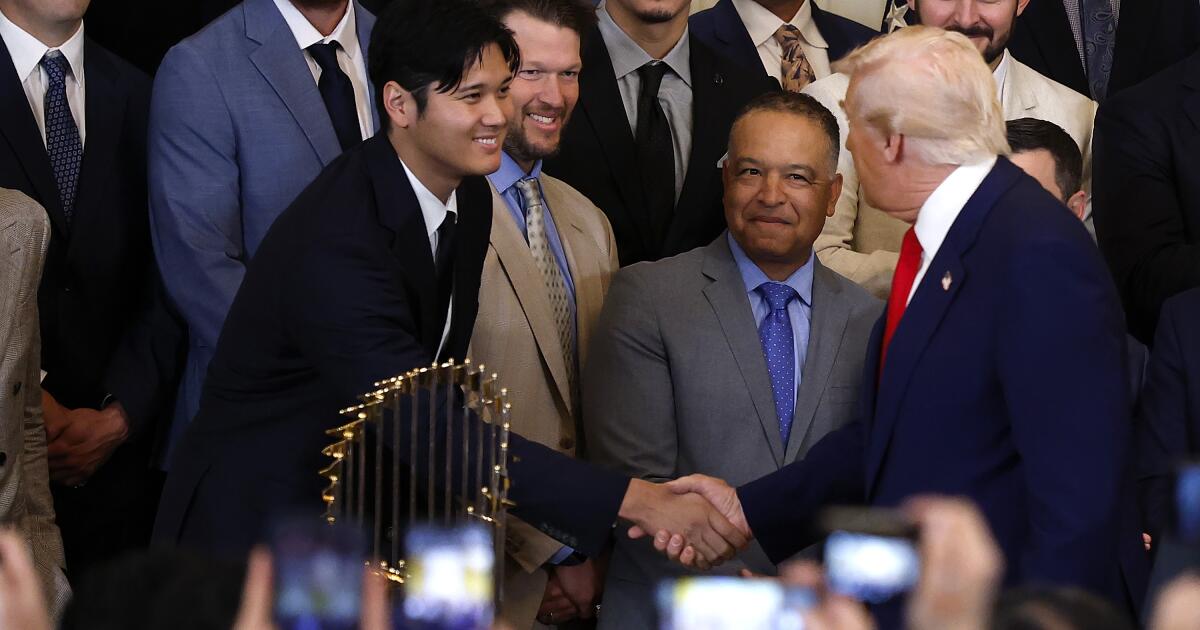
Dodgers scheduled to visit White House in late July to celebrate 2025 World Series win
-

 World36 minutes ago
Former US Olympian pleads not guilty in DC reflecting pool vandalism case
-
 News1 hour ago
Former Olympian pleads not guilty in reflecting pool vandalism charges


