Illinois
Daywatch: How Illinois hospitals ranked for safety


Good morning, Chicago.
Illinois ranks 30th in the nation for hospital safety, down two spots from the fall, according to new ratings released by the nonprofit Leapfrog Group today.
In all, 22% of Illinois hospitals earned A grades for safety from Leapfrog, compared to nearly 25% in the fall.
Illinois hospitals earning top marks include University of Chicago Medical Center and Rush University Medical Center. Five Endeavor Health hospitals in Evanston, Highland Park, Glenview, Elmhurst and Arlington Heights also earned As, as did six Northwestern Medicine hospitals in Huntley, DeKalb, Winfield, Geneva, Lake Forest and McHenry.
No Illinois hospital got an F grade this spring, though 15 hospitals across the state earned D grades.
Read the full story from the Tribune’s Lisa Schencker.
Here are the top stories you need to know to start your day.
Subscribe to more newsletters | Puzzles & Games | Today’s eNewspaper edition
Illinois pot businesses could gain tax benefits, easier loan access under DEA reclassification
Cannabis company owners in Illinois welcomed the news Tuesday that the federal government is expected to reclassify marijuana as a drug with medicinal value and lower potential for abuse.
The change will not be immediately noticeable to most consumers in Illinois, where medical and recreational use already are legal under state law. But it may have a huge impact on weed businesses, allowing them greater ability to take tax deductions for business expenses and making it easier to get loans.

‘He’s like a Talented Mr. Ripley’: Serial scammer Joey Cipolla faces sentencing for life of fraud
Cipolla is facing his most significant prison sentence yet today, after pleading guilty in November to a multi-pronged scheme: stiffing people on luxury auto sales over eBay, rip-offs in the leasing of aircraft out of DuPage County Airport, and using more than $1 million in fraudulently obtained COVID-19 relief funds to fund his over-the-top lifestyle.

Encampment opposing war in Gaza at DePaul launches, as university leaders meet with Foxx on response to student protests
Student groups at DePaul University, a longtime locus of student organizing in solidarity with Palestine, launched an encampment in protest of the war in Gaza Tuesday, joining demonstrations on campuses across the country amid midterms at the private Catholic university.

Democrats say they will save Speaker Mike Johnson’s job if Republicans try to oust him
House Democrats will vote to save Republican Speaker Mike Johnson’s job should some of his fellow Republican lawmakers seek to remove him from the position, Democratic leaders said Tuesday, likely assuring for now that Johnson will avoid being ousted from office like his predecessor, former Rep. Kevin McCarthy.

United Methodists begin to reverse longstanding anti-LGBTQ policies
United Methodist delegates voted to delete mandatory penalties for conducting same-sex marriages and to remove their denomination’s bans on considering LGBTQ candidates for ministry and on funding for gay-friendly ministries. Still to come later this week are votes on the core of the bans on LGBTQ clergy and same-sex marriage in church law and policy, which may draw more debate.

Bankrupt Etta restaurants bought for $4 million by Texas fintech entrepreneur, who plans to grow the brand
A Texas financier has purchased the bankrupt Etta restaurant group for $4 million, with plans to expand the Chicago brand nationwide.
Abel Uribe / Chicago Tribune
Narcan nasal spray. (Abel Uribe/Chicago Tribune)
DuPage County overdose deaths down 24% in 2023
For the first time in the past decade, overdose deaths in DuPage County took a significant downturn in 2023, decreasing 24% from the year before, according to a new coroner’s office report.
Chicago Pride Parade
Brian Cassella/Chicago Tribune
Mayor Brandon Johnson marches in the 52nd annual Chicago Pride Parade on June 25, 2023. (Brian Cassella/Chicago Tribune)
LGBTQ+ community members call on Mayor Brandon Johnson to rescind plan to scale back Pride Parade
Organizers of the annual Chicago Pride Parade and allied groups are calling on Mayor Brandon Johnson to rescind the city’s plan to downsize the event this June.
The city last month cited “safety and logistical concerns” when it said this year’s parade would be limited to 125 groups, a decrease of more than a third from last year.

Local runner Kayla Jeter seeks to make an impact with her 100-mile challenge on women and the Black community
Warmer days in Chicago mean a few things: Our marquee season — summer — is on the way, yearslong road work resumes and recreational runners hit the paths and pavement.
Tribune writer Shakeia Taylor has long admired the commitment of anyone who can get outside and run without a reason or destination, people for whom the running itself is the point.
Ohio native Kayla Jeter is one of them.

Column: Chicago White Sox rotation in flux as fans tune out after a horrific April
Maybe Garrett Crochet should cherish his time in the Chicago White Sox starting rotation. He might not be long for the role, writes Paul Sullivan.

Chicago Opera Theater and Symphony Center Jazz announce seasons
Chicago Opera Theater announced a scaled-back 2024-25 season on Tuesday, its first programmed by new general director Lawrence Edelson. The company will oversee just two staged productions in its 51st season, both of which will receive three performances rather than the two that have long been COT’s standard.
The nonclassical arm of the Chicago Symphony also announced its Symphony Center Presents Jazz lineup for the 2024-25 season.

Swadesi Cafe offers Chicago a Western coffee shop experience that’s distinctly Indian
Swadesi Cafe in the West Loop opened on March 26 and offers customers the sense of sipping chai at home but with a modern menu that beautifully marries French and Indian culinary styles.

Itching to catch the next eclipse? Get your passport ready
If you’ve developed a raging case of umbraphilia — the love of eclipses — you’ll have three chances over the next four years to see the moon blot out the sun.


The Illinois Republican Party filed its quarterly campaign finance report on the July 15 deadline. The party reported having just $223K in the bank. The next day, the party sent a letter to the Illinois State Board of Elections saying they were “reconciling” their records after a leadership change, and then noted that their actual end balance was $101K higher than it had reported the day before.
But that bit of found money was basically the end of the “good news” for the GOP last week.
Republicans no longer have a pet billionaire. Bruce Rauner and Ken Griffin have fled the state. The legions of wealthy business titans who once contributed and raised money have either retired to sunnier climes or passed away. Several prominent party members have publicly shunned labor unions and their hefty political war chests, although the state GOP legislative leaders have at least tried to rebuild ties to trade unions and even the Illinois Education Association. But the heavily gerrymandered legislative map combined with the current political climate means they’ll mostly receive scraps.
And, yes, the House Democrats are struggling this month with scandals, including a state representative who resigned under pressure and another who was indicted. I’m not trying to downplay that at all. But Democrats have the national political environment, the local infrastructure and tons of cash behind them. The Republicans have little to none of that.
The GOP’s gubernatorial candidate, Darren Bailey, raised $1.3 million in the second quarter, which ended June 30. That sounds like a lot, but he spent almost all of that on direct mail fundraising costs. The huge expenditures do give him a prospect list for future fundraising, but he ended the quarter with a mere $128K in the bank. That was still a whole lot more than the rest of the statewide ticket.
Attorney General nominee Bob Fioretti, a perennial candidate, raised $31K, spent $39K and had $28K on hand at the end of the quarter along with almost $15K in recent debt. Secretary of State candidate Diane Harris raised $6K, spent a bit over $4K and had a paltry $1,816.42 in the bank. Treasurer candidate Max Solomon, who ran as a write-in during the primary because the party failed to recruit anyone, raised less than $3K, reported no spending and ended the quarter with less than $8K. Comptroller candidate Bryan Drew raised $30K and received $47K in in-kind contributions from a company owned, ironically, by independent gubernatorial candidate Collin Corbett, spent less than $3K, ended with $54K and had $25K in debt from earlier this year.
Man, that’s just downright pathetic.
But I suppose it doesn’t really matter anyway unless we see a massive sea-change in national opinion in the coming months or the federal government finds a way to not certify certain election results. Regardless of where individual candidates are at this moment, they’ll have the money to compete. Unlike the Republicans, the Dems do have a pet billionaire (JB Pritzker) and, I assume eventually for most of them, organized labor.
The Republican legislative leaders have tried to scrape and claw as much as they can, but they’re vastly outgunned. Senate Republican Leader John Curran raised just $75K in the second quarter. He spent $71K and reported having a bit more than $3 million in the bank. His caucus committee reported having $160K in the bank.
Leader Curran has three Republican-held districts to defend in the Chicago media market that have all trended Democratic in the last three cycles. Depending how bad things get, he could be defending a couple, two or three more.
The Senate Democrats have a ton of money to do whatever they want. Senate President Don Harmon has about $20 million in his personal campaign account and $1.7 million in his caucus account.
Over in the House, Republican Leader Tony McCombie has at least four Democratic-trending or swingy districts to defend and just $1.3 million in her personal campaign account and another $363K in her caucus account so far.
In contrast, House Speaker Chris Welch had $11.4 million in his personal account and $1.2 million in his caucus account. Like Senate President Harmon, he has more than enough money already, but more is never enough when there’s so much out there, so those numbers will likely rise by November.
Rich Miller also publishes Capitol Fax, a daily political newsletter, and CapitolFax.com.

BLOOMINGTON — Springfield’s Alex Eickhoff nearly had a magical Thursday as he tied for second place in the 95th annual Illinois State Amateur Championship at Crestwicke Country Club.
Eickhoff, a 2020 Hillsboro High School graduate and former standout on the Southern Illinois University Edwardsville’s men’s golf team, shot a 4-under-par 68 in Thursday’s third round and followed that with an even-par 71 to finish the three-day, four-round event 1-over 285. He tied for second with Bloomington’s Logan Stauffer.
Eickhoff briefly took the lead through nine holes of his fourth round when he sat at 1-under par. Chicago’s Charlie Kulwin finished both of Thursday’s rounds under par and finished 2-under 282. He was the lone golfer to finish under par for the tournament.
Eickhoff was The State Journal-Register’s Small School Boys Golfer of the year twice in his high school career: once as a freshman in 2016-17 and again as a senior in 2019-20. After high school, he golfed for the University of Minnesota for two years before transferring to SIUE.
He began the tournament with a 3-over 74 on Tuesday and shaved off a stroke Wednesday with a 2-over 73. He closed out the event with an even-par 71 in Thursday’s final round.
Other area golfers who made the cut were Springfield’s Charles Hoogland (7-over 291, tied for 20th) and Jacksonville’s Brady Kaufmann (8-over 292, 25th).
The last golfer from The State Journal-Register’s coverage area to win the Illinois State Amateur was Jay Davis. Davis, a Jacksonville Routt graduate, won the 1991 and ‘92 tournaments.
Contact Ryan Mahan: 788-1546, ryan.mahan@sj-r.com, Twitter.com/RyanMahanSJR.
Illinois
Illinois awards AD Josh Whitman a new contract worth more than $31 million over the next 10 years

CHAMPAIGN, Ill. — Illinois has extended athletic director Josh Whitman’s contract through 2036, committing more than $31 million over the next 10 years on the heels of a series of standout seasons for the department and its teams.
The university’s board of trustees approved the new deal for Whitman at its regular meeting on Thursday. The fifth-longest tenured AD among the four power conferences will make $2.15 million during the 2026-27 school year, a salary increase of more than 40%.
Whitman is scheduled to receive $100,000 raises annually before a $200,000 bump to $3.15 million in the final year of the agreement and a $500,000 retention bonus each June 30 that he remains on the job at Illinois.
The contract also includes additional incentives of up to $500,000 annually related to performance goals set by the university chancellor and three automatic one-year extensions through 2039 if certain Illini football and men’s basketball performance measures are met.
Whitman, a former Illinois football player, was hired in 2016. This was the fifth time his contract has been amended. The men’s basketball team reached the NCAA Final Four in April for the first time in 21 years. The football team won 19 games over the last two seasons, a program record for that span. Illini athletics also set a revenue record for a fourth consecutive year and topped $200 million for the first time in 2025-26, according to the board of trustees meeting memo.
-

 Kentucky3 minutes ago
Two-vehicle crash injures one in Pike County, Kentucky, troopers say
-
 Louisiana9 minutes ago
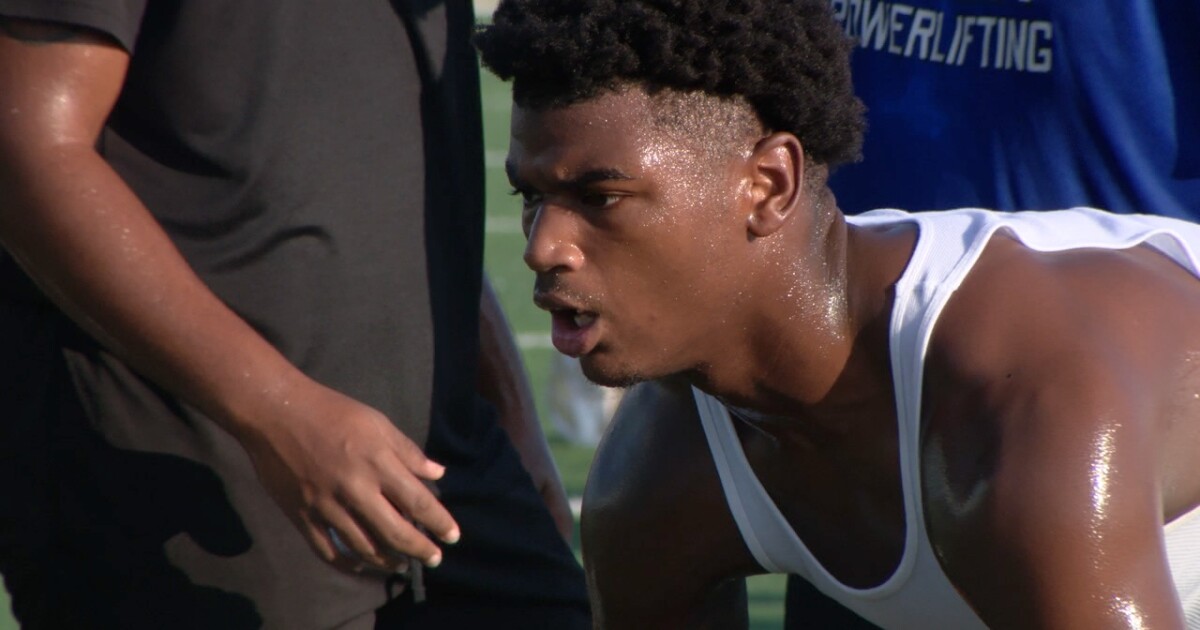
Lafayette Renaissance edge rusher Ansinneo Charles commits to Louisiana
-

 Maine15 minutes ago
Maine Trust announces 2 hires in Augusta, Waterville
-

 Maryland21 minutes ago
What Doesn’t Change in Chevy Chase, Maryland
-

 Michigan27 minutes ago
Huntington Bank to close 13 Michigan branches by the end of August — see full list here
-

 Massachusetts33 minutes ago
Massachusetts RMV under fire after illegal immigrant trucker kills state trooper
-

 Minnesota39 minutes ago
Thousands expected to attend Minnesota Yacht Club festival in St. Paul
-

 Mississippi45 minutes ago
Mississippi Lottery Mississippi Match 5, Cash 3 results for July 17, 2026

