Midwest
First on Fox: Republican launches second straight bid to flip Democrat-held Senate seat in key battleground

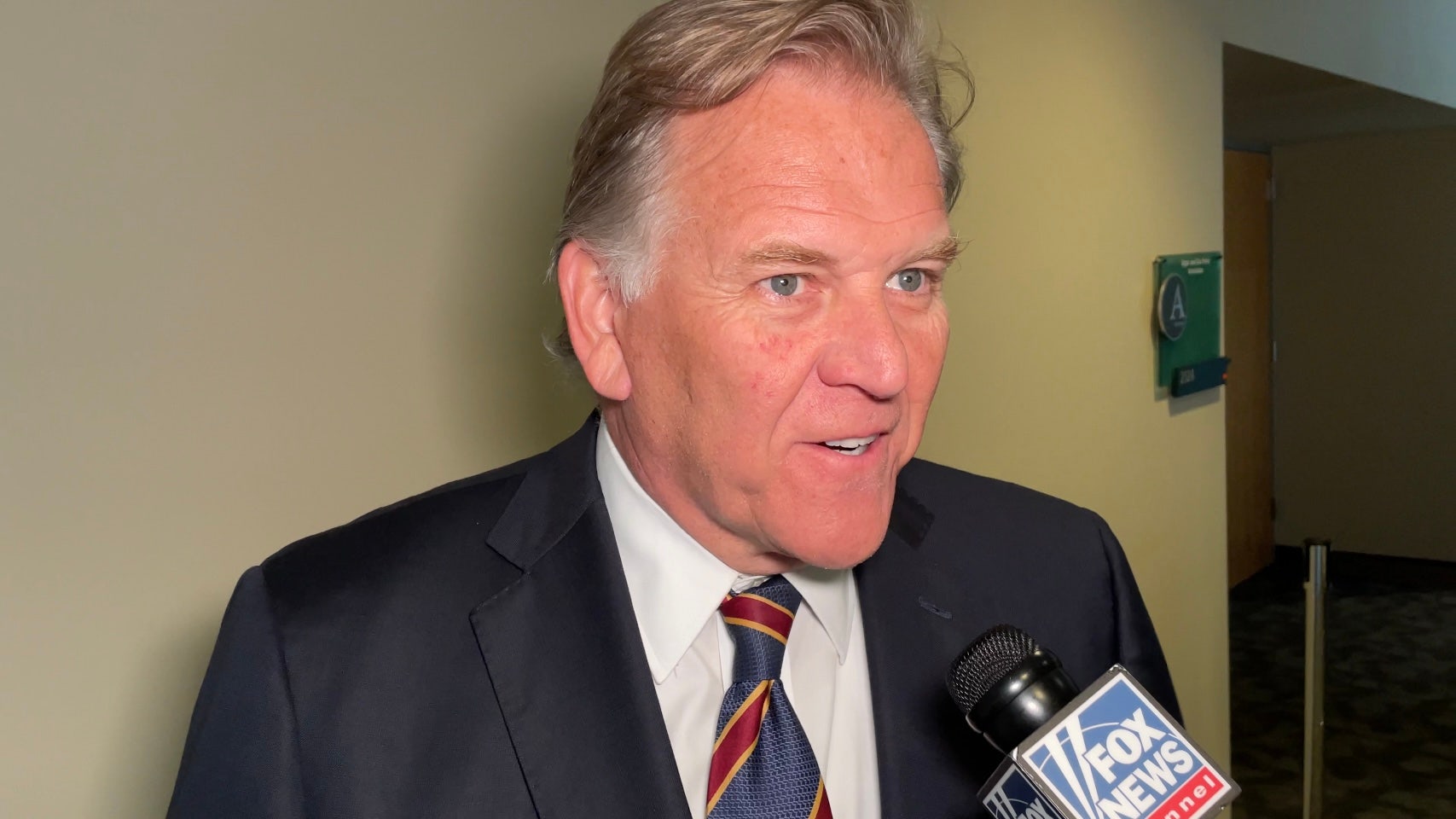
EXCLUSIVE – Former Rep. Mike Rogers, who was the GOP Senate nominee in Michigan in last year’s election, is launching a second straight Republican run for the Senate in the crucial Great Lakes battleground state.
Rogers, a former FBI special agent who later served as chair of the House Intelligence Committee during his tenure in Congress, announced his candidacy in the 2026 Senate race to succeed retiring Democratic Sen. Gary Peters in a video that was shared nationally first with Fox News.
“As your next senator, I won’t just represent Michigan, I’ll fight for it,” Rogers emphasizes in his video announcement.
Highlighting his long career in the military, the FBI, and as an elected state and federal lawmaker, Rogers says that he is “running to serve as your next senator because service is what I’ve always done. Michigan, let’s get to work.”
A LIKELY BRUISING SENATE BATTLE IN BATTLEGROUND MICHIGAN HEATS UP AS THIS CANDIDATE ENTERS THE RACE
And in his video, Rogers also spotlights his support for President Donald Trump, saying “I’ll stand with President Trump, and we will deliver on the mandate given to him by the American people….for me it will always be America and Michigan first.”
Rogers won the 2024 GOP Senate nomination in Michigan but narrowly lost to Rep. Elissa Slotkin, the Democrats’ nominee, in last November’s election in the race to succeed longtime Democratic Sen. Debbie Stabenow, who retired. Slotkin, who vastly outspent Rogers, edged him by roughly 19,000 votes, or a third of a percentage point.
WILL THIS BLUE STATE REPUBLICAN END THE GOP’S 20-YEAR LOSING STREAK IN HIS STATE?
The Senate seat in Michigan is one of three held by the Democrats that the National Republican Senatorial Committee (NRSC) is planning to heavily target as it aims to expand the GOP’s current 53-47 majority in the chamber. The other two are in New Hampshire, where longtime Democratic Sen. Jeanne Shaheen is retiring rather than running for re-election in 2026, and Georgia, where the GOP considers a first-term Democratic Sen. Jon Ossoff vulnerable.
Former Rep. Mike Rogers, a Republican Senate candidate in Michigan, is interviewed by Fox New Digital, in Grand Rapids, Michigan on April 2, 2024. (Fox News – Paul Steinhauser)
Minutes after his announcement, Rogers was endorsed by Senate Majority Leader Sen. John Thune of South Dakota, the top ranking Republican in the Senate.
“Mike Rogers is the conservative leader that Michigan needs in the U.S. Senate,” Thune said in a statement.
And Rogers was also immediately backed by Sen. Tim Scott of South Carolina, the chair of the National Republican Senatorial Committee (NRSC), the Senate GOP’s campaign arm.
“Michigan is a battleground state, and with Mike as our candidate, I know we will add this seat to President Trump’s Senate Majority in 2026,” Scott said in a statement.
Michigan Republican Senate nominee Mike Rogers speaks at a campaign event on Monday, Nov. 4, 2024, in Flint, Mich. Rogers on Monday launched a second straight run for the Senate. (AP Photo/Paul Sancya)
While Rogers is the first major Republican to enter the Senate race in Michigan, he may not have the field to himself.
Longtime Republican Rep. Bill Huizenga told Fox News last week that as soon as Peters announced earlier this year that he wouldn’t seek re-election, “my phone started to ring and it hasn’t stopped ringing.”
LONGTIME HOUSE REPUBLICAN WEIGHS SENATE BID IN KEY BATTLEGROUND
Huizenga, who was first elected to the House in 2010 and represents Michigan’s 4th Congressional District, which covers parts of the southwestern part of the state, highlighted that he’s getting “encouragement” to seek the Senate from “grassroots folks,” as well as donors.
Republican Rep. Bill Huizenga of Michigan speaks at a campaign rally for now-President Donald Trump, on Nov. 1, 2024 in Portage, Michigan (Bill Huizenga campaign)
As for his timetable, Huizenga said: “I’m still going to do my evaluation here, and need to kind of push through on the fundraising and need to make sure that I’m able to get the support that I really need to have to be able to do this kind of run.”
Rogers, in an interview Monday morning with Fox News Digital, pointed to his potential primary rivals and said “I think they all understand the importance of being unified going into next year.”
And he emphasized that” we’ve done a lot of back work trying to make sure that around the state of Michigan, people were ready to go, Washington D.C. people ready to go.”
Asked about the quick endorsements by Thune and Scott, Rogers said “having the majority leader and the chairman of the National Republican Senate committee is huge for us. And it just sends a very clear message: let’s go and we’re in this to win this.”
ONLY ON FOX NEWS: SENATE REPUBLICAN CAMPAIGN CHAIR REVEALS HOW MANY SEATS HE’S AIMING FOR IN 2026
An endorsement by Trump, whose sway over the GOP is stronger than ever, is expected to play a significant role if there’s a contested Republican Senate primary in Michigan.
And while Trump has yet to weigh in on the race, Rogers earlier this year hired veteran Republican strategist and 2024 Trump co-campaign manager Chris LaCivita as a senior advisor. LaCivita remains close to the president and his political team in the White House.
Michigan Republican Senate nominee, former Rep. Mike Rogers of Michigan, speaks alongside then-Republican presidential nomine former President Donald Trump during a campaign event hosted by Trump at the Falk Productions manufacturing facility on Sept. 27, 2024 in Walker, Mich. ( Scott Olson/Getty Images)
Rogers in 2022 and early 2023 mulled a 2024 Republican presidential nomination run of his own, and had a few critical comments of Trump at the time. But Rogers later became a strong supporter of the then-former president and Trump endorsed Rogers in the 2024 Michigan Senate race in March of last year, after clinching the GOP presidential nomination.
Pointing to Trump’s sweeping and often controversial agenda during his first three months back in the White House, Rogers told Fox News Digital “working people in Michigan, they get it. And they understand what he’s trying to do for them, their kids, and their grandkids future.”
“I would love to have him [Trump] not only endorse, but come to the state and have conversations about why this is important to the future of the country,” Rogers added.
WHY PETE BUTTIGIEG SAID NO TO RUNNING FOR THE SENATE NEXT YEAR IN MICHIGAN
Besides Rogers and Huizenga, business executive, conservative commentator and 2022 Republican gubernatorial nominee Tudor Dixon has said she’s seriously mulling another run for governor, or for the Senate, in 2026.
And Republican businessman and auto dealership executive Kevin Rinke, who ran for governor in 2022, is also thought to be considering another statewide run next year.
The Democratic Senatorial Campaign Committee (DSCC), in a statement following Rogers announcement, emphasized that “Michiganders have already rejected Mike Rogers and his record of abandoning them to walk through the revolving door and get rich, threatening Social Security and Medicare to pay for a tax giveaway for billionaires, and supporting the chaotic tariffs that will spike costs for families.”
And DSCC communications director Maeve Coyle added that “no Republican has won a Michigan Senate race for more than three decades and Democrats will hold this seat in 2026.”
But Rogers argued that “we know how to put a ground game together to keep us in a very tight seat. Imagine what we can do now that we’ve started this early, raising money, building our ground game. I think we’re going to do absolutely just find. And here’s the good news – all of our polling shows Michigan has moved to the right.”
Mallory McMorrow, a Democratic Michigan state Senator, launched a 2026 campaign for the U.S. Senate in the Great Lakes battleground state earlier this month. (Reuters/Elizabeth Frantz) (REUTERS/Elizabeth Frantz)
Earlier this month, Michigan state Sen. Mallory McMorrow launched a campaign for the Democratic Senate nomination.
Reps. Kristen McDonald Rivet and Haley Stevens are considering a run, as is Michigan Attorney General Dana Nessel.
Last month, Pete Buttigieg, a 2020 Democratic presidential candidate who later served as Transportation Secretary in former President Joe Biden’s administration, ruled out a campaign after seriously considering a bid.
Read the full article from Here



What questions have Pistons answered this season?
Friend of the pod Laz Jackson walks through what the Detroit Pistons have proved of themselves this year.
CLEVELAND – In just five days, the Detroit Pistons faced the Cleveland Cavaliers twice.
They split the games to finish their season series against the Central Division rivals, but with a potential reunion looming in the second round of the NBA playoffs, the Pistons came away from both games unsatisfied.
On Friday, it was the Pistons needing overtime to overcome a Cavaliers team missing James Harden and Donovan Mitchell at Little Caesars Arena. On Tuesday, March 3, in Cleveland, however – with Harden back in the lineup – the Pistons struggled in the areas they usually thrive, for a 113-109 loss.
The Pistons’ first loss on the road since Jan. 29 didn’t feature their usual fire for much of the night.
“I’m frustrated with the effort level, the attention to detail that we played on that end of the floor,” coach J.B. Bickerstaff said. “The times and opportunities where we did do the right thing, did get stops, we let people outwork us to come up with offensive rebounds. We can’t afford to not play at maximum effort. That’s been our superpower all year long and, tonight, I felt like there were times where we were outworked. If we’re outworked, this isn’t going to be the results that we want.”
The Pistons work at being the league’s most disruptive team via turnovers has given them a top-three defensive rating. They force turnovers on 17.2% of possessions – best in the NBA –and only trail the Houston Rockets in offensive rebounding percentage. They also lead the league in steals and blocks per game. Getting out in transition and capitalizing on second-chance opportunities has created an above-average offense despite struggles on 3-point shooting.
For three quarters against the Cavaliers, little of that materialized – as least until the Pistons grabbed seven steals in the final period (after just two in the first three). Overall, the Pistons were beat on the offensive glass (11-10), mustered just 10 fastbreak points (their lowest total since Jan. 27) and picked up 11 second-chance points (their least since Feb. 6).
It was, in all, a lackadaisical defensive performance, with the Pistons repeatedly losing shooters behind the arc as the Cavs knocked down 17 3-pointers – eight more than the Pistons.
“Obviously they’re a good team, but we haven’t been playing to our standard on that side of the ball,” Pistons wing Javonte Green said. “Coach talked about the effort we need to bring every game. We just need to play harder. We can’t get outworked on offensive rebounds and 50-50 balls, that’s our identity. I feel like we needed to pick up that slack.”
The Pistons also were hurt by a poor shooting performance by Cade Cunningham; he finished with 10 points and 14 assists but shot 4-for-16. Cleveland threw multiple defenders at him all night, and he obliged by passing the ball and setting up his teammates. It led to a big second half for Tobias Harris, who scored all 19 of his points in the last two quarters.
But it wasn’t enough.
“On the defensive end we just couldn’t put up a wall, couldn’t get a stand going,” Cunningham said. “Personally, I had a lot of bad closeouts; just off the ball, I didn’t feel sharp. Just gotta clean all that stuff up.”
With 22 games remaining, the Pistons are focused on cleaning up the margins so they’ll be ready for postseason play. These two games against the Cavaliers have given them a list of areas to clean up.
Friday, they needed an extra period to win after rallying from a late nine-point deficit despite losing Cunningham late after he fouled out with just under two minutes left in the fourth quarter. Jalen Duren and Daniss Jenkins stepped up in overtime after Duncan Robinson also fouled out.
Mostly, the Cavaliers have proven they can pounce during soft stretches on defense. Thursday brings another rematch with a contender, as the Pistons wrap up a three-game road trip against the San Antonio Spurs (another opponent from last week).
“We didn’t play our best basketball the other night,” Bickerstaff said of the Cavaliers’ game on Feb. 27. “Give our guys credit because we played 53 minutes and were able to pull it out in some adverse conditions. Cade fouls out, Duncan fouls out, our guys still figure out a way to get it done.
“We need to be better. We need to be better defensively, we need to impose ourselves on the game a little bit more than we did last game. I thought the last two quarters of the Orlando game [on Sunday] were the best quarters we’ve played defensively since New York [on Feb. 19]. I hope, and told our guys, that we can continue to build off that, because that’s where it always starts for us. You can tell the tone by how we are defensively and how we’re getting after it.”
Contact Omari Sankofa II at osankofa@freepress.com. Follow him on Bluesky and/or X @omarisankofa.
[ MUST WATCH: Make “The Pistons Pulse” your go-to Pistons podcast, listen available anywhere you listen to podcasts (Apple, Spotify) or watch live on YouTube. ]
Next up: Spurs
Matchup: Pistons (45-15) at San Antonio (44-17).
Tipoff: 8 p.m. Thursday, March 5; Frost Bank Center, San Antonio.
TV/radio: FanDuel Sports Network Detroit; WXYT-FM (97.1).

Ever since the shooting deaths of Renee Good and Alex Pretti, both by federal agents in Minneapolis in January, there have been numerous student protests by high school students across the country – including several in Wisconsin and the Milwaukee area.
Students at Milwaukee Public Schools’ high schools including Milwaukee King, Ronald Reagan, and others; Wauwatosa East High School, Shorewood High School, Menomonee Falls High School, Nicolet High School, Whitefish Bay High School – even one student at Marquette University High School – have all walked out of school to protest Immigrations and Customs’ Enforcement actions in Minneapolis and nationwide.
What is it about ICE’s actions that have students walking out? How are school districts handling it, and what do students and parents think?
UW-Madison political science professor shares thoughts on what’s behind student walkouts
Political science professor emeritus Howard Schweber of the University of Wisconsin-Madison said several factors play into why students are protesting.
One of those factors is that ICE raids have taken place near schools. In some school districts, teachers have been arrested and students have disappeared. In some areas of Minneapolis, schools have had to switch to remote learning because students feared ICE raids, Schweber said.
Second, Schweber said the walkouts tie in to past student protests over guns in schools; high school students are feeling unsafe in their schools.
“They’re feeling threatened by forces, you know, far beyond their control, and feeling like first, it was their government wouldn’t protect them. This time it’s their government that’s doing it to them. Of course I’m only speaking from the perspective of the students who are protesting. I don’t mean to suggest that all students feel this way, but the ones who are protesting, this is, I think, what is driving them,” he said.
“Unlike some other issues, I think this one – like the guns in schools issues – hits very close to home, and makes them feel personally involved and threatened by the situation,” he said.
Schweber also talked about where the First Amendment applies during these situations.
He said students, particularly high school students, do have First Amendment rights. He said that schools may not punish students for expressing one viewpoint as opposed to another, and that any policy must be neutral. However, he said, students who walk out, and especially students who engage in conduct that disrupts school activities, can be disciplined.
“The legal background to this is students have a right to express themselves, but while they’re in school or while they’re supposed to be in school, that right is quite curtailed,” he said. “I noticed that in Madison, for example, there were some protests that were held after school ended in order to avoid this problem, which is certainly one way to avoid the issue, but then it’s not a walkout.”
How school districts deal with the walkouts
When it comes to walkouts, school districts typically approach them from several perspectives: attendance, neutrality, recognizing freedom of speech and safety.
In general, school districts will mark students who participate in walkouts as absent and unexcused unless their parents call in to excuse them. Most districts surveyed by the Milwaukee Journal Sentinel also stressed that walkouts are student-sponsored and not organized or sanctioned by the districts.
For example, Pewaukee High School principal Brian Sniff said in a letter to parents that a Feb. 4 walkout at that school was student-initiated and student-led. He said that while students planning the walkout consulted with administration for clarity on the school’s expectations and potential consequences so they could make an informed decision about their plans, the district did not endorse or encourage the activity.
At the same time, some districts have acknowledged that students have free speech rights, as guaranteed by the First Amendment.
While reiterating that students who walk out are unexcused unless a parent excuses them, the Wauwatosa School District said in a letter to parents in advance of a Jan. 12 walkout that it values and encourages student self-expression and recognizes the “importance of civic engagement as part of a well-rounded education.”
“We view moments like this as opportunities for young people to explore their voices, deepen their understanding of social issues, and learn about the power of collective action in a safe and constructive way,” the letter said.
Safety is also another factor that districts consider.
South Milwaukee School District Superintendent Deidre Roemer, Shorewood High School principal Tim Kenney and Franklin High School principal Michael Vuolo said in their letters to parents before planned walkouts that staff would not supervise students who left school grounds.
Sniff said that if students walked out, administrators and security would monitor the situation, ensure they remained in designated safe areas on campus and prevent conflict. But he added that supervision means ensuring safety, and does not equal support.
Parent, student perspective
Jamie Esser, a parent of a child attending Pewaukee High School, said she supported the walkout there. She said teens getting involved with politics and social issues was “heartwarming” to her.
“I think our children, ever since lockdown, have been isolated and stuck in their cell phones and stuck on social media and not really interacting with each other or looking at the world at large. So I think – especially with all the controversy around ICE and around the treatment of their fellow Americans or even fellow human beings – I think it’s great that kids are taking up concerns, and as far as I’m concerned, it’s very promising for the future that today’s generation sees the injustice and just wants to be heard that they don’t agree with it,” Esser said.
Conversely, Joe Rivera, a parent and school board candidate for the Wisconsin Hudson School District in northwestern Wisconsin, said he was concerned about inconsistencies in how that district told parents it would handle a walkout v. what actually happened.
The walkout took place, even though the district told parents that students would not be allowed to leave campus and that classes would continue as scheduled, a Feb. 14 post on his campaign Facebook page said.
“Allowing a large, pre-planned demonstration during the school day – after communicating it would not be allowed – created confusion, undermined trust, and placed students in unnecessary danger, the post said. “We do not have to look far to see how similar situations, even nearby, have escalated quickly and turned tragic.”
“As a parent in this district, I find it unacceptable that families were told one thing and experienced another – especially when it involves student supervision and safety during the school day,” the post said.
Thomas Stilp, a Marquette University High School student, said he was among several students who were organizing a walkout at his school in February. Things looked ready to go until the night before the walkout. That’s when organizers heard concerns that the walkout might draw unwanted attention from ICE; those concerns led them to cancel the event.
Stilp said he thinks students fear that what’s happening in Minnesota will eventually happen in Milwaukee.
“What we really want is the whole country to be doing this, and if people are leaving schools and people are shutting down their offices and are not showing up to work, like businesses are closed; if you can’t get your coffee in the morning because of these ICE raids that are happening and businesses are calling for that to be stopped, that’s when you’re going to notice,” he said.
However, not all students support the walkouts.
One of those students is Turner Dittrich, a senior at Arrowhead High School and a founder, former president and current member of the school’s chapter of the conservative organization Turning Point. He is also the son of Terry Dittrich, the Waukesha County Republican Party chairman.
Turner Dittrich said that while people have the right to protest, they should not interfere with ICE, which is investigating criminal behavior.
“My whole take on it is, is why should undocumented illegal citizens get the same immunity as the ones who sacrifice to follow the law? We are America. We are a country of laws,” he said.
Dittrich said anti-ICE protests have been boosted by students who simply do not want to be in school. He also said he does not think it’s right for students to miss school for protests, out of respect for teachers.
“At Arrowhead especially, I’ve met some phenomenal teachers, some phenomenal individuals. They wake up tired and they’re really pouring out their energy into what they’re teaching students. For the ICE protests to not be done at 3:30 or 4 [after school] is just shocking to me because it’s like, what are these teachers possibly doing? Now, I understand freedom of speech. They can’t control kids necessarily, but at the end of the day, when teachers are getting paid to show up and work hard, it just unfortunately saddens me.
“It’s the same thing if there was a pro-ICE protest. I would think that during school hours, it’d be wrong, right? So I think on both sides of the aisle, the fact that we’re doing this during school hours, is wrong. It can’t be done that way,” Dittrich said.
Contact Alec Johnson at (262) 875-9469 or alec.johnson@jrn.com. Follow him on X (Twitter) at @AlecJohnson12.

MINNEAPOLIS — Minneapolis is ranked among the American cities with the most people in financial distress nationwide, according to a recent analysis by WalletHub.
The personal finance website, which defines financial distress as having a credit account in forbearance or with deferred payments, looked at the country’s 100 largest cities without data limitations across nine metrics, including average credit score, change in bankruptcy filings year-over-year, and share of people with accounts in distress.
Minneapolis came in 44th on the list, between Stockton, California, at 43rd and Fresno, California, at 45th, according to the ranking.
Nationwide, the cities with the most people in financial distress were Chicago at No. 1, Houston at No. 2 and Las Vegas at No. 3, the ranking said.
“Getting out of the downward spiral of financial distress is no easy feat,” according to WalletHub analyst Chip Lupo.
“You may get temporary relief from your lenders by not having to make payments, but all the while interest will keep building up, making the debt even harder to pay off. People who find themselves in financial distress should budget carefully, cut non-essential expenses, and pursue strategies like debt consolidation or debt management to get their situation under control.”
Read more from WalletHub.

Detroit Pistons’ loss to Cavs shows weaknesses before playoffs

Floats for San Francisco Chinese New Year Parade get finishing touches

Hip-hop hitmaker Cardi B coming to AAC in Dallas

Shooting in northwest Miami-Dade leaves man in critical condition, sheriff’s office says

Charlotte plays Boston on 5-game win streak

Florida High School Football Rankings: Top 25 teams – Oct. 21

Cleary's 21 help Le Moyne down Central Connecticut State 69-64 in OT

How old is Bo Nix? What to know about Oregon quarterback ahead of 2024 NFL Draft

99th annual Pony Swim held in Virginia

Indiana Members Credit Union announced as new anchor tenant at Bottleworks District

Video: Senators Question Kristi Noem on ICE Immigration Tactics

Combustible Republican Senate primary in Texas heading into overtime

Hungarian veto proves EU needs less unanimity, says new Dutch PM

Pregnant migrant girls are being sent to a Texas shelter flagged as medically risky

Fraud-plagued Minnesota sues Trump admin for withholding $243M in Medicaid payments
-

 World6 days ago
Exclusive: DeepSeek withholds latest AI model from US chipmakers including Nvidia, sources say
-

 Massachusetts7 days ago
Mother and daughter injured in Taunton house explosion
-

 Denver, CO7 days ago
10 acres charred, 5 injured in Thornton grass fire, evacuation orders lifted
-

 Louisiana1 week ago
Wildfire near Gum Swamp Road in Livingston Parish now under control; more than 200 acres burned
-

 Oregon5 days ago
2026 OSAA Oregon Wrestling State Championship Results And Brackets – FloWrestling
-

 Florida3 days ago
Florida man rescued after being stuck in shoulder-deep mud for days
-

 Maryland3 days ago
AM showers Sunday in Maryland
-

 Culture1 week ago
Try This Quiz on Thrilling Books That Became Popular Movies