Midwest
Detroit police arrest suspect in mansion murder of neurosurgeon rolled up in carpet

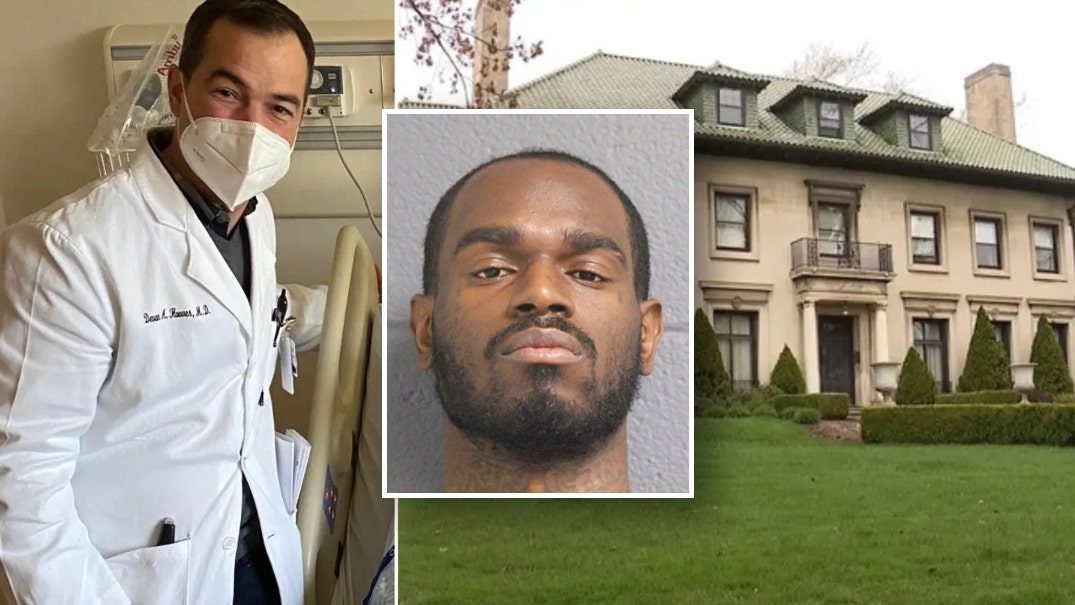
Detroit authorities on Wednesday announced an arrest in the fatal April 2023 shooting of 57-year-old neurosurgeon Devon Hoover.
Wayne County Prosecutor Kym Worthy said that Desmond Burks, 34, is charged with first-degree premeditated murder, felony murder, larceny of over $20,000, using a computer to commit a crime and felony firearm possession in connection with Hoover’s murder.
“This massive investigation was conducted for over a year in conjunction with local, state and federal law enforcement partners. This investigation spanned five states and three countries. Voluminous amounts of documents and evidence were recovered,” Worthy said.
Burks and Hoover apparently had an intimate relationship, and Burks would sometimes charge Hoover for their sexual encounters, Worthy said.
DETROIT POLICE INVESTIGATE BREAK-IN AT SLAIN DOCTOR’S MANSION
Wayne County Prosecutor Kym Worthy said Desmond Burks, 34, is charged with first-degree premeditated murder, felony murder, larceny of over $20,000, using a computer to commit a crime and felony firearm possession. (Michigan State Police)
Cellphone data allegedly shows Hoover’s phone moving back and forth between his million-dollar mansion in Detroit’s historic Boston-Edison neighborhood and Burks’ address in the Grandale area, about 15 minutes away, the day before the doctor’s murder.
The investigation crossed state lines through Michigan, Ohio, Indiana, Texas and California, as well as country lines through the U.S., England and France, Worthy said.
DETROIT POLICE HAVE PERSON OF INTEREST IN DOCTOR’S DEATH
On April 22, a Sunday, police received a civilian complaint about a white Range Rover blocking a driveway on Coyle Street in Detroit’s Grandale neighborhood. The vehicle had blood inside, and police collected it as evidence.
Detroit police on Wednesday announced an arrest in the fatal shooting of neurosurgeon Dr. Devon Hoover. (Sheryl Gibbs Leaver/ WJBK)
Police later discovered that Hoover owned the Range Rover and traveled to his address on West Boston Boulevard — about 15 minutes from Grandale. Police noticed that Hoover’s driveway gate leading to both the front and rear of the house was “wide open,” but no one appeared to be home.
On April 23, Hoover’s family contacted 911 to request a well-being check on the neurosurgeon after he failed to visit his dying mother in Indiana. Further evidence revealed what appeared to be blood on the back entrance of Hoover’s home, and police decided to force entry into his residence, where they found Hoover dead.
DETROIT NUREOSURGEON FOUND DEAD INSIDE HOME WAS AN ‘AMAZING DOCTOR,’ FORMER PATIENT SAYS
The Detroit Police Department Homicide Unit is investigating Hoover’s shooting death, which could be linked to a domestic situation. (WJBK)
“Dr. Devon Hoover was found deceased in the third-floor attic crawlspace. He was face-down. He was only wearing socks. He was wrapped in a blood-soaked carpet. He appeared to be shot in the head,” Worthy said, adding that a medical examiner later determined that he had been killed by two gunshot wounds to the head.
“He was only wearing socks. He was wrapped in a blood-soaked carpet.”
Almost immediately after his murder, authorities discovered that several of the doctor’s personal belongings were missing, including his cellphone, wallet, money, credit cards and designer watches. Fraudulent transactions were made from his financial accounts in the days following his death.
Devon Hoover, 53, was found dead inside his home. (WJBK)
Burks’ fingerprint was later found in Hoover’s Range Rover, and authorities found the neurosurgeon’s Cartier watches inside Burks’ residence.
Prior to Hoover’s murder, Burks was charged in connection with a road rage incident that left a 67-year old Dearborn man dead on April 17. The cases are unrelated, Worthy said.
DETROIT NEUROSURGEON FOUND SHOT DEAD INSIDE HOME: REPORT
In April 2023, police took the person of interest in Hoover’s death into custody on an unrelated charge, but Detroit Police Chief James White said he believed that the person may have information about the doctor’s apparent murder.
DETROIT NEUROSURGEON FOUND SHOT DEAD INSIDE HOME: REPORT
“I’m confident that this person of interest who is in custody on an unrelated charge will provide some information for us as to what occurred,” White said.
Hoover grew up working on his family’s dairy farm, “milking the cows, planting and harvesting crops, and doing many other chores alongside the rest of the family” until he decided “early in life” to become a doctor, according to his obituary.
“At the time of his death, he had been practicing for 27 years as a board-certified neurosurgeon specializing in the treatment of neck and back disorders,” the obituary states.
Read the full article from Here



Supreme Court rejects Trump’s birthright citizenship executive order
The Supreme Court struck down limits on birthright citizenship, a centerpiece of President Donald Trump’s immigration policy.
Immigration has been a defining force in creating the nation’s identity over the last two and a half centuries and continues to shape the country and Michigan as the United States looks beyond its 250th birthday on Saturday.
That was on display in Southwest Detroit during a recent weekend event, as hundreds gathered for the unveiling of a state historical marker honoring a Latina activist.
“Michigan is defined by the efforts and cultures from the waves of immigrants who began to arrive when we were still a territory,” said Laurie Kay Sommers, a folklorist and historic preservationist based in Okemos, who has been writing about Michigan history and culture since the 1970s.
While the state was once shaped by waves of German, Irish, Dutch and Polish immigrants who arrived in the 19th century seeking job opportunities, especially as the auto industry exploded, immigration continues to play a key role in the state’s population.
Immigration is the sole reason the state’s population is growing, according to U.S. Census Bureau figures, adding 55,000 residents in the 21st century. Population counts are a key factor in determining how much federal aid flows to states, counties and communities through hundreds of federal programs, according to the Project on Government Oversight, a nonprofit government watchdog based in Washington, D.C.
“All the growth in Michigan between 2020 and 2025 is attributable to immigration,” demographer Kurt Metzger said. “In other words, we’ve gotten more people from other parts of the country than the rest of the country got from us.”
According to the American Immigration Council, about 7% of Michigan’s population was born in another country, while another 7% are native-born U.S. citizens but have at least one immigrant parent. Metro Detroit’s immigrant population is even higher at 10.7%.
The Trump administration has sought to rein in immigration, specifically those who’ve entered the country illegally. Heightened immigration and customs enforcement since the start of Trump’s second term, as well as executive orders, have led to court cases and clashes with activists across the country.
Trump touched on the dangers of illegal immigration during his June 24 remarks at the opening ceremony of the Great American State Fair in Washington, D.C., marking the start of celebrations for the nation’s 250th anniversary.
“We inherited the worst, most dangerous, most wide open and insecure border in history, and we have quickly turned into the strongest, most secure border in the history of our country,” said Trump, according to video of his remarks posted online by Fox News.
“We are removing murderers, gang members, drug dealers and dangerous criminals by the thousands. They came in through a ridiculous open border.”
How immigration has evolved in Michigan
Still, how Michigan immigrants are reshaping Michigan continues to evolve.
In Detroit, a city once made up of a wide range of immigrants, the southwest side is one of the city’s last ethnic enclaves. Home to thousands of Latinos, it reflects how the contributions of immigrants and their descendants have shaped Michigan even before it became a state in 1837.
The Smithsonian was one of the sponsors of an event Saturday that recognized part of southwest Detroit’s commercial corridor, full of Latino businesses, which is now listed on the National Register of Historic Places.
In a separate event, about 100 people attended the Sunday unveiling of a State of Michigan historical marker in honor of Dr. Lucile “Luci” Cruz Arellano Gajec, a community organizer, author and historian, who died in 2008.
“It’s well-deserved and long overdue,” said Tobi Voigt, director of museums for the State of Michigan Historical Center, at the unveiling of the historical marker at 4000 W. Vernor.
Latino businesses in southwest Detroit are just one example of the way “Main Street” businesses in Metro Detroit rely on immigrants to own and operate restaurants, hardware stores, dry cleaners and pharmacies, to name a few professions, according to a recent study by nonprofit Global Detroit that explored the immigrant impact on the economy. Global Detroit said it advocates for “equitable local, regional and statewide economic growth through immigrant inclusion.”
The April report, called “Job Creators: How Immigrant and Diverse Entrepreneurs Drive Metro Detroit’s Prosperity,” found that while immigrants comprise 10.7% of Metro Detroit’s population, they make up 12.5% of the workforce, 18.4% of area business owners and 23.8% of “Main Street” business owners.
Like many immigrant business owners, Gias Uddin Talukder, a Bangladeshi immigrant, saw a niche that he could fill to help others in his community. In 2013, Talukder started Bengal Auto Sales, a used-car dealership in Hamtramck, to serve other Bangladeshi immigrants who have formed a community on the border of Hamtramck and Detroit.
“I want to be known as more than just a businessman; I want to be involved in lots of activities,” Talukder said in an interview with the nonprofit New Economy Initiative.
He has given cars away to those in need and has raised thousands of dollars for various charities.
The largest number of immigrant business owners in Metro Detroit were born in Iraq, according to the Global Detroit report. Organizations such as the Chaldean Chamber of Commerce and the Chaldean Free Loan Fund have invested millions of dollars to support start-up businesses within the Chaldean community, as well as services for immigrants and refugees.
The West Bloomfield-based Chaldean chamber said an estimated 59% of Chaldean households own at least one business.
“Immigrants are critical drivers of the small business economy and are well-represented among the region’s business owners despite their small share of the population,” the Global Detroit report said. “The facts rebut tropes that immigrants take jobs from U.S.-born workers. Immigrants expand the economy.”
Changing demographics
Still, data shows that the mix of those who come to Michigan from other countries is changing.
As the six-county Metro Detroit area continued to lose both Black and White residents in the last five years, the region experienced double-digit increases in the Asian and Latino populations.
In 2023, the region’s Asian population of 261,532 residents surpassed the Latino population’s total of 250,215. The latest Census data doesn’t fully capture the impact of Middle Eastern immigrants because, until recently, they were categorized as White. In 2024, President Joe Biden’s administration created the designation of Middle Eastern or North African (MENA) as a new federal race category.
The enduring influence of previous waves of immigration is felt in every part of the state, said Sommers, the Okemos-based historic preservationist. Whether it is the French names of cities like Detroit or Calumet, the former Finnish churches in the Upper Peninsula or the many local bakeries on the west side of the state that sell Dutch or Czech pastries, the impact can last through food and historical architecture.
“Much of Michigan’s surviving 19th and early 20th century buildings were built by immigrant carpenters, brick layers, iron workers,” Sommers said. “Much of the interior artistry of major architectural landmarks were decorated by immigrant artisans.”
Same immigration concerns, but a different century
Immigration at times has also created a backlash in the form of anti-immigration policies, nativist rhetoric and sometimes violence.
Much of the language and immigration policy of the Trump administration echoes the early 20th-century battles to halt the influx of Southern and Eastern Europeans, among others, said Ashley Bavery, an associate professor of history at Eastern Michigan University.
“There’s a lot of rhetoric about how immigrants are going to pollute the good Nordic and Protestant stock of America, and America is going to turn into something, kind of racially, that wasn’t right,” Bavery said. “They’re going to be too many Catholics and too many Russians and Poles, just to name a few.”
The Trump administration has justified its immigration enforcement efforts as an attempt to collar and expel criminals — whom Homeland Security Secretary Markwayne Mullin has termed “the worst of the worst” — who entered the country illegally while deporting undocumented immigrants it has encountered.
There were federal laws a century or more ago that limited the flow of immigration. In Detroit, during the 1920s and throughout the Great Depression, the city’s police chief teamed up with a local federal representative of immigration services to conduct what they called “a deportation war,” Bavery said.
Bavery is the author of a 2020 book, “Bootlegged Aliens: Immigration Politics on America’s Northern Border,” that looks at the labeling of immigrants as criminals, among other things. The book examines the policies applied to combat “bootleggers,” the smugglers of Canadian alcohol across the Detroit River during Prohibition, who sometimes would also transport a handful of immigrants on the boats along with the illegal booze.
23.8% of ‘Main Street’ businesses owned by immigrants
The April report by Global Detroit found that while immigrants account for 18.4% of all the business owners in the region, they are 23.8% of the business owners of so-called “Main Street” businesses. Those include supermarkets and grocery stores, convenience stores, pharmacies, gas stations, as well as hotels and motels.
Behind Iraq, India ranks as the second most common country of origin for business owners in Metro Detroit, followed by Romania.
Still, the report found that barriers remain for many immigrant entrepreneurs, especially in accessing loans and grants.
“The region’s economic success will depend, in part, on its ability to spark, attract, retain and nurture a wide range of businesses from a diverse group of business owners,” the report said.
laguilar@detroitnews.com

LUVERNE, Minn. (FOX 9) – There’s a new giant in town, and it’s turning heads and bringing the world to Luverne.
Luverne unveils a record-breaking nutcracker statue to attract visitors
What we know:
Towering 65 feet above a rock shop near the edge of town, Luverne’s new nutcracker statue is believed to be the tallest in the world—almost twice as tall as the current record holder.
“We know he’s the tallest because he is almost twice as tall as the current world record holder,” said Katie Walgrave, who designed the statue.
The nutcracker was finished a couple of weeks ago and has already drawn visitors from as far as Wales and China.
“This week we’ve had people from Wales. We had people from China last week,” said Walgrave.
The statue sits just a block from the interstate, with the goal of enticing travelers to stop and explore Luverne instead of driving past on I-90.
“We’ve just needed something to pull people off the interstate before they get to Sioux Falls or something like that. It’s basically we’re trying to mine the interstate,” said Vance Walgrave, owner of Those Blasted Things.
Since the nutcracker’s arrival, local businesses have seen a surge in visitors.
“The people coming in here were double and triple the amount of people. Just overnight, all of a sudden, we were going, did we create a monster?” said Vance Walgrave.
‘If you build it, they will come’
The backstory:
The idea for the giant nutcracker came after city leaders wanted a new attraction, something even more unique than the area’s previous claim to fame — a herd of bison at Blue Mounds State Park. A marketing consultant suggested something that would truly stand out.
Betty Mann, who has the second-largest collection of nutcrackers in the United States, played a big role in inspiring the project. Mann has collected over 7,000 nutcrackers since 2001, enough to fill two rooms at the Rock County Historical Society and outnumber the residents of Luverne.
“I bought my first nutcracker in 2001, and if you’d have told me then that this was all going to happen, I would have told you, ‘You’re crazy,’ because I had no clue. This just exploded, and there was really nothing I could do to stop it,” said Mann.
Mann donated her collection to the historical society, and she hopes the new statue will bring even more people to see what Luverne has to offer.
“It brings people to Laverne to see what we have. And then you’ll see all the good things that we have in our museum here. And that was my intent,” said Mann.
The city is planning an official ribbon cutting for the nutcracker in a couple of weeks. Anyone who donates $20 to the statue maintenance fund will get a chance to name the new resident.
“I’ve been hearing nutty a lot, but we’ll see,” said Vance Walgrave.
For many in Luverne, the nutcracker is more than just a statue — it’s a symbol of community pride and a way to put the town on the map.
“Anytime you see something weirdly big or weirdly small, we’re going to be interested in it. So if we can have something weirdly big that brings people off of the interstate and off of the highway and from all over the world, we are going to do it,” said Katie Walgrave.
The nutcracker joins other Minnesota record-holders, such as the largest ice maze and the tallest family, adding to the state’s reputation for quirky, oversized attractions.
Local perspective:
Residents are excited to see their town getting attention for something so unique.
“I just love that we’re doing something big for the community that everybody can benefit from,” said Katie Walgrave.
The nutcracker has already made an impact, with local shops and museums reporting more visitors and a renewed sense of excitement around town.
“Oh, they’re just kind of whimsical. There’s really nothing much to like about them. It just, some of them are kind of goofy looking and some of the are really a work of art,” said Mann.
‘It’s just the visual effect of it’
Why you should care:
Luverne’s giant nutcracker is not just a roadside oddity — it’s a new reason for travelers to stop, explore, and support a small Minnesota community. The project shows how creativity and a bit of whimsy can help put a town on the map and bring people together.
The upcoming ribbon cutting and naming contest offer a chance for everyone to get involved, whether they’re locals or visitors just passing through.
The Source: This story uses information gathered by FOX 9 reporter Maury Glover.
The Missouri Lottery offers several draw games for those aiming to win big.
Here’s a look at July 1, 2026, results for each game:
Winning Powerball numbers from July 1 drawing
02-06-26-39-68, Powerball: 06, Power Play: 2
Check Powerball payouts and previous drawings here.
Winning Pick 3 numbers from July 1 drawing
Midday: 1-3-3
Midday Wild: 9
Evening: 3-8-0
Evening Wild: 5
Check Pick 3 payouts and previous drawings here.
Winning Pick 4 numbers from July 1 drawing
Midday: 0-5-9-5
Midday Wild: 1
Evening: 5-4-4-8
Evening Wild: 5
Check Pick 4 payouts and previous drawings here.
Winning Cash Pop numbers from July 1 drawing
Early Bird: 12
Morning: 03
Matinee: 01
Prime Time: 07
Night Owl: 02
Check Cash Pop payouts and previous drawings here.
Winning Show Me Cash numbers from July 1 drawing
05-07-18-25-33
Check Show Me Cash payouts and previous drawings here.
Winning Powerball Double Play numbers from July 1 drawing
10-20-30-60-64, Powerball: 07
Check Powerball Double Play payouts and previous drawings here.
Feeling lucky? Explore the latest lottery news & results
Are you a winner? Here’s how to claim your lottery prize
All Missouri Lottery retailers can redeem prizes up to $600. For prizes over $600, winners have the option to submit their claim by mail or in person at one of Missouri Lottery’s regional offices, by appointment only.
To claim by mail, complete a Missouri Lottery winner claim form, sign your winning ticket, and include a copy of your government-issued photo ID along with a completed IRS Form W-9. Ensure your name, address, telephone number and signature are on the back of your ticket. Claims should be mailed to:
Ticket Redemption
Missouri Lottery
P.O. Box 7777
Jefferson City, MO 65102-7777
For in-person claims, visit the Missouri Lottery Headquarters in Jefferson City or one of the regional offices in Kansas City, Springfield or St. Louis. Be sure to call ahead to verify hours and check if an appointment is required.
For additional instructions or to download the claim form, visit the Missouri Lottery prize claim page.
When are the Missouri Lottery drawings held?
- Powerball: 9:59 p.m. Monday, Wednesday and Saturday.
- Mega Millions: 10 p.m. Tuesday and Friday.
- Pick 3: 12:45 p.m. (Midday) and 8:59 p.m. (Evening) daily.
- Pick 4: 12:45 p.m. (Midday) and 8:59 p.m. (Evening) daily.
- Cash4Life: 8 p.m. daily.
- Cash Pop: 8 a.m. (Early Bird), 11 a.m. (Late Morning), 3 p.m. (Matinee), 7 p.m. (Prime Time) and 11 p.m. (Night Owl) daily.
- Show Me Cash: 8:59 p.m. daily.
- Lotto: 8:59 p.m. Wednesday and Saturday.
- Powerball Double Play: 9:59 p.m. Monday, Wednesday and Saturday.
This results page was generated automatically using information from TinBu and a template written and reviewed by a Missouri editor. You can send feedback using this form.
-

 Michigan6 minutes ago
Michigan ‘defined’ by waves of immigration that keep shifting
-

 Massachusetts9 minutes ago
Massachusetts state police use robotic dog and drone in highway standoff
-

 Minnesota14 minutes ago
Luverne, Minnesota’s 65-foot nutcracker, may be the tallest in the world
-

 Mississippi21 minutes ago
Mississippi Lottery Mississippi Match 5, Cash 3 results for July 1, 2026
-
Missouri24 minutes ago
Missouri Lottery Powerball, Pick 3 winning numbers for July 1, 2026
-

 Montana29 minutes ago
Montana state auditor urges homeowners to review flood, wildfire insurance coverage
-

 Nebraska36 minutes ago
Online sports betting petition heads to Nebraska ballot review as opposition mounts
-

 Nevada39 minutes ago
Nevada Test Site shaped U.S. nuclear history, Southern Nevada’s growth

