Detroit, MI
Tarik Skubal, Tigers can’t agree on 2026 salary. Here’s what happens


Will Tigers trade Tarik Skubal before free agency? MLB insider speaks
USA TODAY Sports baseball insider Bob Nightengale joins “Days of Roar” podcast to answer several questions about Detroit Tigers left-hander Tarik Skubal, who can become a free agent after the 2026 season.
The Detroit Tigers and left-hander Tarik Skubal did not agree to terms on a one-year contract for the 2026 season before the 8 p.m. deadline Thursday, Jan. 8, to exchange salary figures in the arbitration process.
Skubal filed at $32 million; the Tigers filed at $19 million.
It’s a difference of $13 million.
An arbitration panel will review the case during a hearing scheduled for late January or early to mid-February. The arbitrators must determine whether Skubal is worth more or less than the $25.5 million midpoint. If he’s worth more, they will select his $32 million proposal; if less, they will select the Tigers’ $19 million proposal. The panel isn’t allowed to choose a salary in between $19 million and $32 million.
The Tigers operate as a file-and-trial club in salary arbitration under president of baseball operations Scott Harris, meaning there won’t be further negotiations with Skubal regarding a one-year contract. A multi-year contract could still be negotiated, but it’s highly unlikely.
Skubal – represented by agent Scott Boras – reaches free agency after the 2026 season. The 29-year-old is positioned to become the first pitcher in MLB history to receive a $400 million contract.
If the two sides were to reach an agreement before a hearing, it would likely be a one-year contract with a player option, thus maintaining Skubal’s path to free agency in the 2026-27 offseason.
The reigning back-to-back American League Cy Young winner was projected by MLB Trade Rumors to receive $17.8 million in his third and final year of salary arbitration. He previously earned $2.65 million in 2024, then $10.15 million in 2025.
Why couldn’t the Tigers and Skubal agree on a salary for 2026?
The arbitration case for Skubal is unusually complex, thanks to a rarely used provision highlighted by ESPN’s Jeff Passan. Because Skubal has more than five years of MLB service time, he isn’t limited to comparing himself only to past arbitration-eligible players. Instead, he can compare himself to any player in baseball.
Those unique rights allow Skubal – who has five years, 114 days of service time – to point to MLB’s highest-paid pitchers (such as Max Scherzer’s $43.3 million per year from 2022-24 or Zack Wheeler’s $42 million per year from 2025-27), arguing that his elite performance warrants a salary in that range – not in the $17.8 million range, as projected by MLB Trade Rumors.
That’s what pushed the Tigers and Skubal to an arbitration hearing.
[ MUST LISTEN: Make “Days of Roar” your go-to Tigers podcast, available anywhere you listen to podcasts (Apple, Spotify) ]
The current record for the largest one-year arbitration contract belongs to outfielder Juan Soto, who agreed to $31 million with the New York Yankees for the 2024 season.
If Skubal wins the arbitration hearing, he will surpass Soto and claim the new record with his proposed $32 million salary. If Skubal loses, then he will earn the $19 million salary proposed by the Tigers.
There are two other arbitration records on the line.
The highest-paid arbitration-eligible pitcher belongs to right-hander David Price, who earned $19.75 million with the Tigers in 2015 – his fourth year in the arbitration process as a Super Two qualifier. The largest raise for an arbitration-eligible pitcher belongs to right-hander Jacob deGrom, who surged from $7.4 million to $17 million – an increase of $9.6 million – with the New York Mets in 2019.
Those records for pitchers will belong to Skubal – but only if his proposed $32 million salary is selected by the arbitration panel. He will fall just short of the records if the panel selects the Tigers’ proposed $19 million.
Skubal is the best pitcher in baseball.
More notably, he is on a Hall of Fame trajectory.
In 2025, Skubal registered a 2.21 ERA with 33 walks (4.4% walk rate) and 241 strikeouts (32.2% strikeout rate) across 195⅓ innings in 31 starts. He made the All-Star Game for the second time in his six-year MLB career.
Skubal became the first back-to-back AL Cy Young winner since right-hander Pedro Martínez in 1999-2000, leading the AL with a 2.39 ERA in 2024 and a 2.21 ERA in 2025.
The Tigers haven’t been to an arbitration hearing since right-hander Michael Fulmer in 2019.
Fulmer lost the case, receiving the Tigers’ proposed $2.8 million salary rather than his requested $3.4 million. Before that hearing, the Tigers hadn’t participated in an arbitration hearing since 2001 – and the Tigers haven’t lost a case since 2000.
Contact Evan Petzold at epetzold@freepress.com or follow him @EvanPetzold.
Listen to our weekly Tigers show “Days of Roar” every Monday afternoon during the season and Tuesday afternoon during the offseason on Apple, Spotify or wherever you listen to podcasts.



If you need help with the Public File, call (313) 222-0566
At WDIV, we are committed to informing and delighting our audience. In our commitment to covering our communities with innovation and excellence, we incorporate Artificial Intelligence (AI) technologies to enhance our news gathering, reporting, and presentation processes. Read our article to see how we are using Artificial Intelligence.
Detroit, MI
Fangirl Culture is Front and Center as Detroit Mercy Theatre Company Presents a Zany Y2K Comedy

I’m Gonna Marry You Tobey Maguire closes Detroit Mercy’s 55th Season
DETROIT — Detroit Mercy Theatre Company (DMTC) closes the inaugural season of the new Detroit
Mercy Black Box Theatre with I’m Gonna Marry You Tobey Maguire by Samantha Hurley, playing April 10-19 on University of Detroit Mercy’s McNichols Campus.
I’m Gonna Marry You Tobey Maguire is set in 2004 and follows 14-year-old Shelby Hinkley, who is obsessed with Hollywood star Tobey Maguire and creates a play to kidnap and marry him in her basement.
“This play is as hilarious as it is heartfelt,” said DMTC managing director Sarah Rusk. “Shelby truly believes Tobey Maguire is her destiny, and through her obsession we get a look into the complicated emotions of growing up during the Y2K era.”
“I absolutely love working with young actors,” said director Cassandra Svacha.
“Watching them create and rise to the challenge is thrilling. I’m Gonna Marry You Tobey Maguire to college-aged kids is like a period piece; none of them were alive when this story takes place so it’s extra fun to have them dive into this world in an anthropologic way. They aren’t reminiscing or remembering 2004, they have to study that world and build it for themselves.”
I’m Gonna Marry You Tobey Maguire runs six performances April 10-19 at the new Detroit Mercy Black Box Theatre on University of Detroit Mercy’s McNichols Campus. The DMTC Ticket Office is open Tuesday-Thursday 10 a.m.- 2 p.m., with tickets being available for purchase anytime online at www.DetroitMercyArts.com.
Individual tickets are $25 for adults, $18 for seniors and Detroit Mercy faculty, staff and alumni, and $10 for veterans and students (ages 4-college). Discounts are available for groups of 10 or more. To schedule your group, contact Sarah Rusk at 313-993-3273.
Those looking to buy tickets should note that the play is rated R and contains adult language and
Detroit, MI
Detroit Pistons and A Kid Again team up to give children with illnesses a special night at the arena

DETROIT (WXYZ) — More than 600 family members facing life-threatening conditions stepped into Little Caesars Arena on Wednesday night to enjoy a Detroit Pistons game, thanks to a partnership with the organization A Kid Again.
Watch Christiana Ford’s video report:
Detroit Pistons host a special game night for kids with illnesses
Nine-year-old Kendall Yarbrough, who has lupus, picked out her outfit the night before the game. At center court, her focus was on being the best fan she could be.
“Feeling good, pretty good,” Yarbrough said, getting ready to go down to the court for the fan tunnel.
WXYZ-TV
Her mom surprised her with the news the night before.
“Yesterday she told me I was coming and I got really excited and I couldn’t really sleep,” Yarbrough said.
For the fourth year, A Kid Again partnered with the Pistons to create a behind-the-scenes adventure tailored for children with medical conditions. The event removes barriers like dietary restrictions and accessibility issues so families can focus on having a good time.
“We give them opportunities to come to events like tonight to meet with other families going through similar situations as well as just giving them a time that they can be a family and be together,” Amy Vining said.
WXYZ-TV
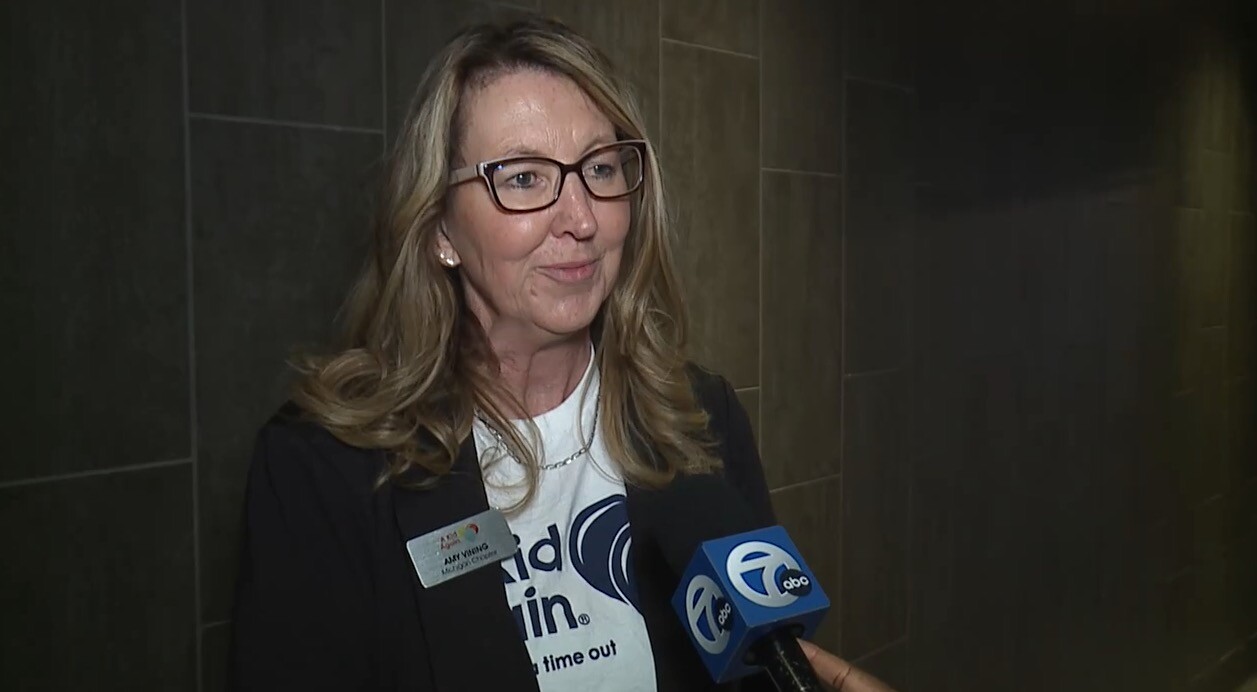
Vining, the executive director of A Kid Again, has a personal mission to help these families.
“My youngest was born with a condition called craniosynostosis. He had his skull remodeled at 4 months old at CS Mott Children’s Hospital, and I’ve always been a part of the non-profit community,” Vining said. “Going through that experience with my own child, his surgery corrected itself, but I saw so many children that were a part of the hospital at that time that were going to have lifelong complications from the conditions that they had, and I knew at some point in my non-profit journey that I wanted to give back to those families.”
Vincent Larkins, a 9th grader living with an undiagnosed rare neuromuscular disorder, also attended the game with his mom and three brothers who share the same disorder.
“It seems like it’s a very big deal, and I’m pretty excited to see the players up in person. I’ve never done something like this before, so I’m pretty happy,” Larkins said.
WXYZ-TV

Their mom, Alison Zanella, says the event provided a rare moment of rest for the kids who stood alongside players during the National Anthem.
“The only normal kid thing they do is go to school. Everything else is therapy and doctors appointments every day,” Zanella said.“It was really just about a chance to give the kids a break and let them be kids for the night.”
WXYZ-TV
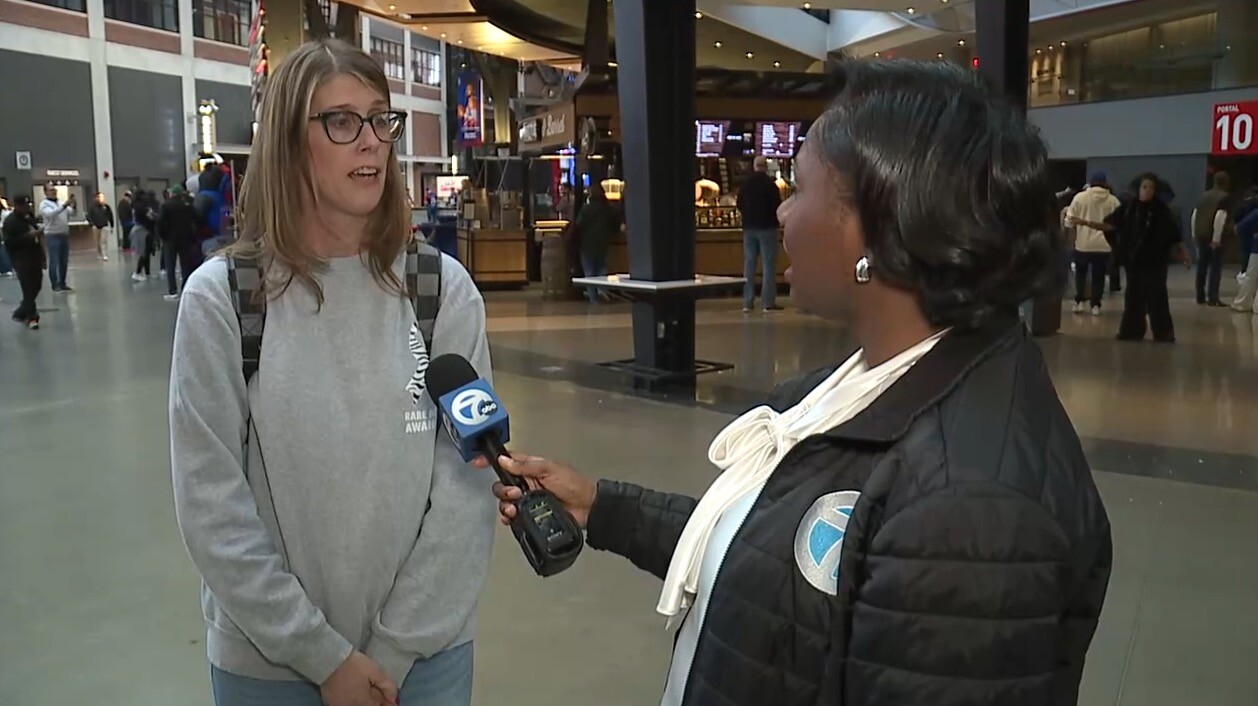
A Kid Again is a national organization with a mission to foster hope, happiness, and healing for children with life-threatening health conditions and their families. The organization provides cost-free, consistent, year-round activities that create meaningful shared experiences and joy-filled memories.
A Kid Again Michigan was established in December 2021 and currently serves more than 1850 families throughout the state.
——————————————————————
This story was reported on air by a journalist and has been converted for this platform with the assistance of AI. Our editorial team verifies all reporting on all platforms for fairness and accuracy.

Trump to sign emergency order to pay TSA agents as Augusta airport preps for golf week

50 years of DC Metro: A look back in photos

WKYC Channel 3

Austin’s Star Is Still Shining Bright: Venture Funding To City’s Startups Hits All-Time High

How To Watch: Michigan vs Alabama in NCAA Tournament Sweet 16

Florida High School Football Rankings: Top 25 teams – Oct. 21

How old is Bo Nix? What to know about Oregon quarterback ahead of 2024 NFL Draft

Cleary's 21 help Le Moyne down Central Connecticut State 69-64 in OT

99th annual Pony Swim held in Virginia

Indiana Members Credit Union announced as new anchor tenant at Bottleworks District

Video: Will ICE Change Under Its New Leader?

DHS shutdown breakthrough comes at cost for Republicans as funding fights nears end

Rubio joins crucial G7 talks as Iran war set to dominate second day

A surprise resignation could open the door for an independent to win a Montana Senate seat

Video: Savannah Guthrie Says She Believes Her Mother Was Taken for Ransom
-

 Detroit, MI1 week ago
Drummer Brian Pastoria, longtime Detroit music advocate, dies at 68
-

 Science1 week ago
How a Melting Glacier in Antarctica Could Affect Tens of Millions Around the Globe
-
 Science1 week ago
I had to man up and get a mammogram
-

 Movie Reviews1 week ago
‘Youth’ Twitter review: Ken Karunaas impresses audiences; Suraj Venjaramoodu adds charm; music wins praise | – The Times of India
-

 Sports6 days ago
IOC addresses execution of 19-year-old Iranian wrestler Saleh Mohammadi
-

 New Mexico5 days ago
Clovis shooting leaves one dead, four injured
-
 Business1 week ago
Disney’s new CEO says his focus is on storytelling and creativity
-

 Texas1 week ago
How to buy Houston vs. Texas A&M 2026 March Madness tickets