Detroit, MI
Looming Archdiocese of Detroit restructuring plan weighs on region’s Catholics


As the Archdiocese of Detroit prepares for a two-year restructuring, many local Catholics are bracing for the changes ahead, with some fearful their parishes could close and contemplating where they may go next, while others are taking a wait-and-see approach.
Archbishop Edward Weisenburger, who took the helm of the archdiocese last year, announced in November that the archdiocese cannot maintain its around 200 parish buildings and is working to “right-size and reallocate personal and financial resources. He said listening sessions are set to begin this spring at every parish.
For the region’s Catholics who have already experienced church closures or mergers, especially in Detroit and inner-ring suburbs such as Warren, Roseville and Dearborn Heights, some worry their church could be the next to shut its doors. Others are concerned about how the restructuring could affect the existing shortage of priests and nuns. And some worry about how the closures, especially in Detroit, could impact the city’s Black Catholic population.
Shirley Slaughter of Oak Park said her parish, Presentation Our Lady of Victory Catholic Church in Detroit, doesn’t have its own building and held Masses in the chapel of St. Scholastica Parish in Detroit until last October. At that point, the archdiocese began holding only one Sunday Mass time for both St. Scholastica and Presentation Our Lady of Victory, meaning the two parishes attend the same Mass.
St. Scholastica is a large church building, but it’s “not filled up every Sunday,” Slaughter said. Fewer than 100 people are parishioners of the two parishes, combined, she estimated.
“If anybody’s going to be restructured, they’ll probably restructure us again,” Slaughter said.
But the restructuring is “a necessary thing that has to happen,” said Hannah Kolpasky, a 30-year-old parishioner at Our Lady Star of the Sea Catholic Church in Grosse Pointe Woods. She said she is “cautiously optimistic,” now that Weisenburger is leading the archdiocese.
“I think that he has come out from the beginning of his tenure as archbishop with a more clear message of why these things need to happen and what kind of process it’s going to be,” Kolpasky said.
The debate comes as more than 170 of the Archdiocese of Detroit’s 224 priests last week attended a three-day meeting related to the restructuring, brainstorming what churches could potentially be grouped together as part of a “pastorate” model, in which a cluster of one or more parishes is led by one pastor. The new model will replace the archdiocese’s current “families of parishes” approach, in which a grouping of parishes has a team of priests.
While the details of the restructuring are still being worked out, the Rev. Mario Amore, executive director of parish renewal for the archdiocese, said no one “wants to go through a process like this.”
“Especially in our churches, because they’re such a part of the fabric of our lives,” Amore said.
So many of the archdiocese’s parish communities are “limited in what they’re able to do,” he said, because they’re trying to preserve buildings.
“But the Church … and even our buildings are not meant to be museums,” Amore said. “Yes, they are first and foremost places of worship. But if all of our resources are going to preserve a building, then it’s limiting our ministry as a Church and the very reason which we exist, which is to make disciples.”
Still, he acknowledged the anxiety some may be feeling about what could happen to their own parishes.
Amore said “we need to honor” people’s grief and “honor the angst that a process like this brings about.”
Decline in Catholic population
At one point, 1.5 million Catholics called the Archdiocese of Detroit home. The Catholic census is closer to 900,000 today, with around 150,000 regularly attending Mass.
Weisenburger said in November that many of the archdiocese’s churches were built “during a time of tremendous growth.”
The archbishop said the archdiocese doesn’t know how many parishes might merge or how many buildings may close.
What many Detroit-area Catholics may be bracing for is a reminder that their parishes are fighting for survival once again, said Brett Hoover, a theology professor who studies trends in U.S. Catholicism.
“It’s just a lot of grief,” said Hoover, who teaches at Loyola Marymount University in Los Angeles.
Closing or merging local parishes has been happening nationally since the late 1990s due to a confluence of events: parishioners moving to the suburbs, religious disaffiliation and aging membership. There is also a declining number of clergy, Hoover said.
Areas in the Midwest and Northeast have been particularly hard hit by declining and changing populations. Many parishes were built around communities that moved out decades ago, the Loyola Marymount scholar said.
The archdiocese’s two-year plan is likely based on lessons learned in other cities where Catholic populations protested closings and at times appealed to the pope to save their parishes, Hoover said.
“I’m sure there is genuine sincerity” behind the two-year plan, Hoover said, though he hasn’t been following the situation.
In the U.S., 19% of adults identified as Catholic in 2025, compared with 24% in 2007, according to the Pew Research Center.
Pew said the share of Americans who are Christian appears to be leveling off, at least temporarily, after years of decline, according to a 2023-2024 study. A report on the study said the Protestant share of the population has been fairly level since 2019 and the Catholic share has been stable since 2014, “with only small fluctuations in our annual surveys.”
The Archdiocese of Detroit conducted a downsizing in the late 1980s and early 1990s under Cardinal Edmund Szoka, and there were a few iterations of parishes clustering or merging in the 2000s and 2010s. The diocese then moved to the “Families of Parishes” model around five years ago under then Archbishop Allen Vigneron.
Past restructurings didn’t include as much feedback from parishioners as the current one, Amore said, adding that the archdiocese hasn’t restructured on this scale before with “this kind of process.”
“That’s part of telling the story of why the priests are so on board with what we’re doing right now, because they don’t want to do another one of those … processes in five years from now,” he said.
‘Very sentimental’
At a recent Communion Service at St. Margaret of Scotland in St. Clair Shores, more than a dozen people filled the pews. A deacon presided over the service in the church’s chapel, a smaller space with colorful stained glass windows. Mainly older adults attended the service, including Lawrence D’Agonstino of Fraser.
D’Agostino, a parishioner of St. Pio of Pietrelcina Parish in Roseville for 53 years, said the restructuring process is “concerning.”
“It’s very sentimental, because everyone … wants to have their own parish stay open, which is common sense,” he said.
One issue is that men are not becoming priests, D’Agostino said. Another issue is the financing of the parishes.
“It’s a shame that the younger generation doesn’t fulfill their obligation as we did when we were younger … and so therefore the amount of people going to the parishes is limited,” he said. ” And due to the fact that it’s limited, it makes it that much (more) difficult … for the parishes to stay open financially.”
D’Agostino, 79, said he doesn’t know where St. Pio of Pietrelcina Parish “is standing financially.” He thinks the archdiocese will be considering whether parishes are “in the red” or “in the green,” with those in the red likely to be a concern.
Paul Padyiasek, a parishioner at St. Louise de Marillac in Warren, said the restructuring has “got to be done.” He said priests are retiring and parishioners have been dying.
He added that some people who used to attend Mass at his church now go to churches farther north in Macomb County. Padyiasek, who is an usher at St. Louise, estimated that a total of 200 to 250 people attend one of two weekend Masses at the church, which is down from around 300 people three or four years ago.
Padyiasek, 81, said he is part of a group of around 20 people who get breakfast together every Sunday after Mass. They’ve already been talking about what church they might attend if St. Louise closes.
“I know a lot of people are going to be going probably to St Anne’s,” Padyiasek said.
St. Anne Parish on Mound Road in Warren will stay open because it has a school, he said.
“I think a lot of the churches that don’t have schools will close,” Padyiasek said.
Experience with closures
St. Christopher Church in Detroit, which was renamed St. Juan Diego Parish in 2019, held its final Mass on Jan. 11, drawing longtime and former parishioners and neighbors. The church had served Detroit’s community since 1941, but in recent years drew as few as 20 worshippers to Sunday Mass.
Slaughter, 80, said her parish in Detroit, Our Lady of Victory, closed in the 1980s and merged with Presentation church. The merged church, which is called Presentation Our Lady of Victory Catholic Church, lost its building in 2014, but it continued holding Masses in the chapel of St. Scholastica Parish in Detroit until recently.
Slaughter, who wrote a book about the history of Our Lady of Victory, said the Black Catholic Church in Detroit has lost “so many Catholics” over the decades because of archdiocese policies that “didn’t serve us.” She said her priest has changed frequently over the years, sometimes every two to three years, and the longest she has ever had a pastor is eight years. She argued that white Catholics have priests for longer periods of time.
Slaughter said Our Lady of Victory will “probably be hit again” because of the low numbers of parishioners.
“And then I’ll make a decision on what I’m going to do after that hit takes place,” she said.
The archdiocese’s Amore said the frequent changing of priests is “really the case across the archdiocese.” He said six to 12 years is a normal term for a priest to be at a parish community.
Amore said the Archdiocesan Restructuring Commission includes Detroiters and people from Black Catholic parishes. He noted that “we are the Archdiocese of Detroit.”
“And so the city of Detroit needs to be a definite focus for us,” Amore said. “And the archbishop has committed to that through this process.”
A Catholic church in Detroit known for its mural of a Black Jesus, St. Charles Lwanga, was at risk of closure late last year, but those plans were reversed thanks to a coalition of parishioners who fought to keep the church open. St. Charles Lwagna is still a place of worship, but now as the newly combined parish, Christ the King.
The biggest lesson that Steve Wasko, a leader in the Anti-Racism coalition, said should be applied to the restructuring process is asking the question, “What does it take to have a flourishing church?,’ as opposed to asking the question ‘What are we going to do with fewer parishioners, less money and less priests?”
Wasko, a longtime member of St. Suzanne Lady/Our Lady Gate of Heaven, said when the Archdiocese of Detroit closes parishes in the city, it disproportionately affects Black Catholics.
“There’s no evidence nationally that these restructuring processes lead to anything other than further retrenchment, usually impacting communities of color the most and usually resulting in the eventual continued loss of Black Catholics from their faith, organized religion and local parishes,” Wasko said.
Some parishioners moved to the suburbs
Southwest Detroiter Walter Glinka, 71, became a parishioner at St. Francis D’Assisi as a child, when his neighborhood was an enclave of residents of Polish heritage. He was baptized there, confirmed there, attended grade school and got married at the parish that is over 100 years old.
In 2004, his parish was merged with nearby St. Hedwig, less than one mile away. He described St. Francis as the oldest Polish-speaking parish in the city. But St. Francis and St. Hedwig have relied on Spanish-speaking immigrants and other Latinos for decades, he said.
Glinka became a lay minister at St. Francis years ago to help with services. But many of his peers have not been as loyal to the parish.
“They got married here, moved to the suburbs. We never had a plan to try to recruit people from the suburbs,” Glinka said.
He’s taking a wait-and-see approach on the latest plan.
“We only know the storyline that it is a two-year process. We don’t know the actual plan yet,” Glinka said.
Pastorate model
Amore said the archdiocese is still in the first phase of the restructuring process, which runs until March. He said the archdiocese has been collecting information from and sharing information with its priests during this phase.
Last week, the archdiocese gathered over 175 priests for a three-day meeting at Sacred Heart Major Seminary in Detroit.
“It was an opportunity for them to come together in the areas in which they work, in the different parts of the diocese, and really have … some conversations and ask questions about what the future of the diocese could look like, and then just come together to pray about and propose some different models for our parishes,” Amore said.
Though the exact restructuring plan is still being determined, parishes will become part of a “pastorate,” which is a grouping of one or more parishes led by a pastor, according to the Archdiocese of Detroit. The new model will replace the current “families of parishes” model, in which a grouping of parishes has a team of priests, Amore said. In a “pastorate” model, there will be one designated pastor, and other priests might serve as associate pastors.
In 2025, the archdiocese had 224 priests, a number that is projected to decline 40% to 134 by 2034.
“As all organizations ― secular, religious ― we need to be planning ahead for what our reality will look like, and so … forming these pastorates will help us to align the number of priests with the number of pastorates,” Amore said.
Listening sessions
Priests formed models, or groupings of parishes, during last week’s meeting, Amore said. Three models for each parish will be presented at the listening sessions, which will run from the week of April 13 to the beginning of June.
“There’ll be over 400 listening sessions, two in each of our parish communities, where parishioners can come, see the models for their particular area and then give some feedback,” Amore said.
In similar restructuring processes conducted in dioceses across the country, between 20% and 40% of the models changed based on the feedback from parishioners, Amore said. The plan will then go to the Archdiocesan Restructuring Commission and then an advisory body of priests, which will have to sign off on it. It will then go to Weisenburger for his final approval, Amore said.
A “pastorate” could take a few different forms, he said. One form is one parish, with one building. Another model is one parish, but several buildings. And another model is one pastor who oversees a few parishes.
Amore said there is “no set timeline” for deciding when church buildings in the archdiocese would close.
“Really, at this point, there’s no plan to have set dates for closures of specific church buildings,” he said. “We first are looking at the models and then how things play out from there.”
Some churches are already discussing closing because “they simply don’t have the resources to continue,” Amore said.
At this point, he said, closure is a possibility for all of the archdiocese’s parish communities.
“We don’t want to say that certain places are safe and certain places aren’t. … It’s the reality of where we’re at in the process right now that we just don’t know, and that it’s a possibility for everyone, for every parish,” he said.
Weisenburger will announce the new “pastorates” in early 2027. Amore said it’s possible that some announcements regarding closings could be made then.
asnabes@detroitnews.com



If you need help with the Public File, call (313) 222-0566
At WDIV, we are committed to informing and delighting our audience. In our commitment to covering our communities with innovation and excellence, we incorporate Artificial Intelligence (AI) technologies to enhance our news gathering, reporting, and presentation processes. Read our article to see how we are using Artificial Intelligence.
Detroit, MI
Fangirl Culture is Front and Center as Detroit Mercy Theatre Company Presents a Zany Y2K Comedy

I’m Gonna Marry You Tobey Maguire closes Detroit Mercy’s 55th Season
DETROIT — Detroit Mercy Theatre Company (DMTC) closes the inaugural season of the new Detroit
Mercy Black Box Theatre with I’m Gonna Marry You Tobey Maguire by Samantha Hurley, playing April 10-19 on University of Detroit Mercy’s McNichols Campus.
I’m Gonna Marry You Tobey Maguire is set in 2004 and follows 14-year-old Shelby Hinkley, who is obsessed with Hollywood star Tobey Maguire and creates a play to kidnap and marry him in her basement.
“This play is as hilarious as it is heartfelt,” said DMTC managing director Sarah Rusk. “Shelby truly believes Tobey Maguire is her destiny, and through her obsession we get a look into the complicated emotions of growing up during the Y2K era.”
“I absolutely love working with young actors,” said director Cassandra Svacha.

“Watching them create and rise to the challenge is thrilling. I’m Gonna Marry You Tobey Maguire to college-aged kids is like a period piece; none of them were alive when this story takes place so it’s extra fun to have them dive into this world in an anthropologic way. They aren’t reminiscing or remembering 2004, they have to study that world and build it for themselves.”
I’m Gonna Marry You Tobey Maguire runs six performances April 10-19 at the new Detroit Mercy Black Box Theatre on University of Detroit Mercy’s McNichols Campus. The DMTC Ticket Office is open Tuesday-Thursday 10 a.m.- 2 p.m., with tickets being available for purchase anytime online at www.DetroitMercyArts.com.
Individual tickets are $25 for adults, $18 for seniors and Detroit Mercy faculty, staff and alumni, and $10 for veterans and students (ages 4-college). Discounts are available for groups of 10 or more. To schedule your group, contact Sarah Rusk at 313-993-3273.
Those looking to buy tickets should note that the play is rated R and contains adult language and
Detroit, MI
Detroit Pistons and A Kid Again team up to give children with illnesses a special night at the arena

DETROIT (WXYZ) — More than 600 family members facing life-threatening conditions stepped into Little Caesars Arena on Wednesday night to enjoy a Detroit Pistons game, thanks to a partnership with the organization A Kid Again.
Watch Christiana Ford’s video report:
Detroit Pistons host a special game night for kids with illnesses
Nine-year-old Kendall Yarbrough, who has lupus, picked out her outfit the night before the game. At center court, her focus was on being the best fan she could be.
“Feeling good, pretty good,” Yarbrough said, getting ready to go down to the court for the fan tunnel.
WXYZ-TV
Her mom surprised her with the news the night before.
“Yesterday she told me I was coming and I got really excited and I couldn’t really sleep,” Yarbrough said.
For the fourth year, A Kid Again partnered with the Pistons to create a behind-the-scenes adventure tailored for children with medical conditions. The event removes barriers like dietary restrictions and accessibility issues so families can focus on having a good time.
“We give them opportunities to come to events like tonight to meet with other families going through similar situations as well as just giving them a time that they can be a family and be together,” Amy Vining said.
WXYZ-TV
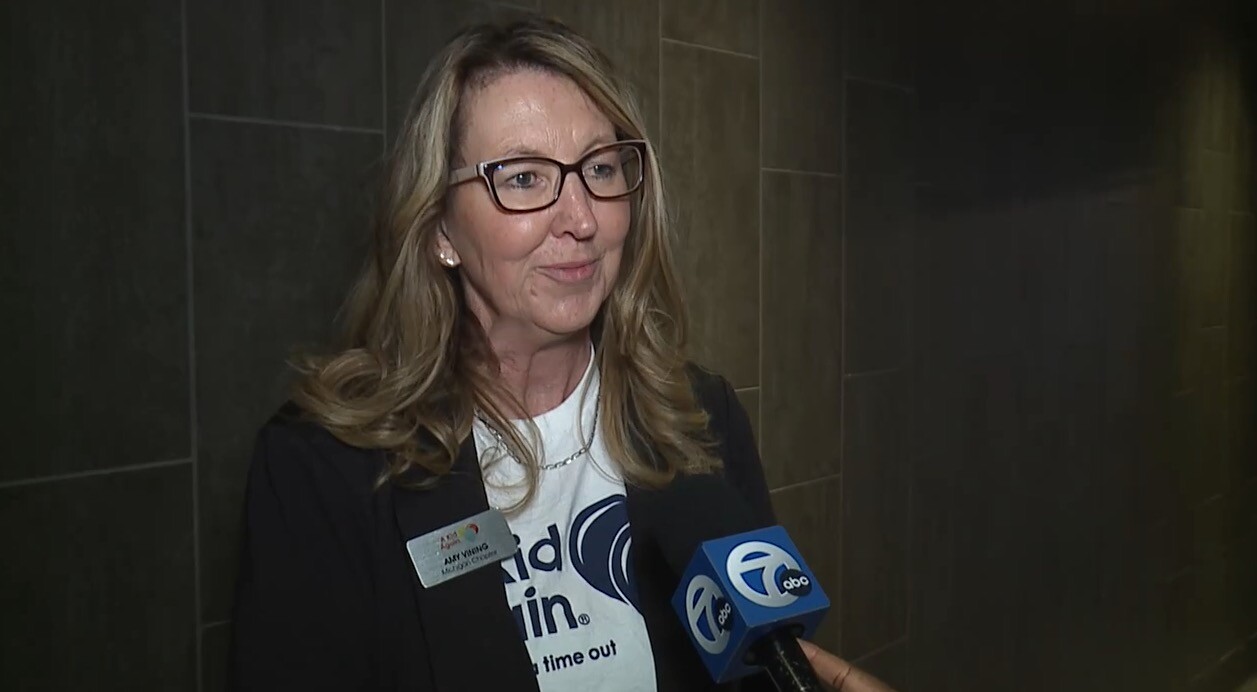
Vining, the executive director of A Kid Again, has a personal mission to help these families.
“My youngest was born with a condition called craniosynostosis. He had his skull remodeled at 4 months old at CS Mott Children’s Hospital, and I’ve always been a part of the non-profit community,” Vining said. “Going through that experience with my own child, his surgery corrected itself, but I saw so many children that were a part of the hospital at that time that were going to have lifelong complications from the conditions that they had, and I knew at some point in my non-profit journey that I wanted to give back to those families.”
Vincent Larkins, a 9th grader living with an undiagnosed rare neuromuscular disorder, also attended the game with his mom and three brothers who share the same disorder.
“It seems like it’s a very big deal, and I’m pretty excited to see the players up in person. I’ve never done something like this before, so I’m pretty happy,” Larkins said.
WXYZ-TV

Their mom, Alison Zanella, says the event provided a rare moment of rest for the kids who stood alongside players during the National Anthem.
“The only normal kid thing they do is go to school. Everything else is therapy and doctors appointments every day,” Zanella said.“It was really just about a chance to give the kids a break and let them be kids for the night.”
WXYZ-TV
A Kid Again is a national organization with a mission to foster hope, happiness, and healing for children with life-threatening health conditions and their families. The organization provides cost-free, consistent, year-round activities that create meaningful shared experiences and joy-filled memories.
A Kid Again Michigan was established in December 2021 and currently serves more than 1850 families throughout the state.
——————————————————————
This story was reported on air by a journalist and has been converted for this platform with the assistance of AI. Our editorial team verifies all reporting on all platforms for fairness and accuracy.

Jogging 101: Benefits for Your Body and Mind
Movie reviews reveal A Poet and All That’s Left of You dominate March with perfect 100% scores – Art Threat

Phillies third baseman Alec Bohm sues his parents, accuses them of misusing his money

Video: Will ICE Change Under Its New Leader?

Video: Trump’s Signature to Appear on Dollar Bills

Florida High School Football Rankings: Top 25 teams – Oct. 21

How old is Bo Nix? What to know about Oregon quarterback ahead of 2024 NFL Draft

Cleary's 21 help Le Moyne down Central Connecticut State 69-64 in OT

99th annual Pony Swim held in Virginia

Indiana Members Credit Union announced as new anchor tenant at Bottleworks District
Video: Will ICE Change Under Its New Leader?

DHS shutdown breakthrough comes at cost for Republicans as funding fights nears end

Rubio joins crucial G7 talks as Iran war set to dominate second day

A surprise resignation could open the door for an independent to win a Montana Senate seat

Video: Savannah Guthrie Says She Believes Her Mother Was Taken for Ransom
-

 Detroit, MI1 week ago
Drummer Brian Pastoria, longtime Detroit music advocate, dies at 68
-

 Science1 week ago
How a Melting Glacier in Antarctica Could Affect Tens of Millions Around the Globe
-

 Movie Reviews1 week ago
‘Youth’ Twitter review: Ken Karunaas impresses audiences; Suraj Venjaramoodu adds charm; music wins praise | – The Times of India
-
 Science1 week ago
I had to man up and get a mammogram
-

 Sports6 days ago
IOC addresses execution of 19-year-old Iranian wrestler Saleh Mohammadi
-

 New Mexico4 days ago
Clovis shooting leaves one dead, four injured
-

 Texas1 week ago
How to buy Houston vs. Texas A&M 2026 March Madness tickets
-

 Tennessee3 days ago
Tennessee Police Investigating Alleged Assault Involving ‘Reacher’ Star Alan Ritchson