Midwest
DeSantis campaign accuses Haley of 'insulting' Iowans by saying NH will 'correct' caucus results

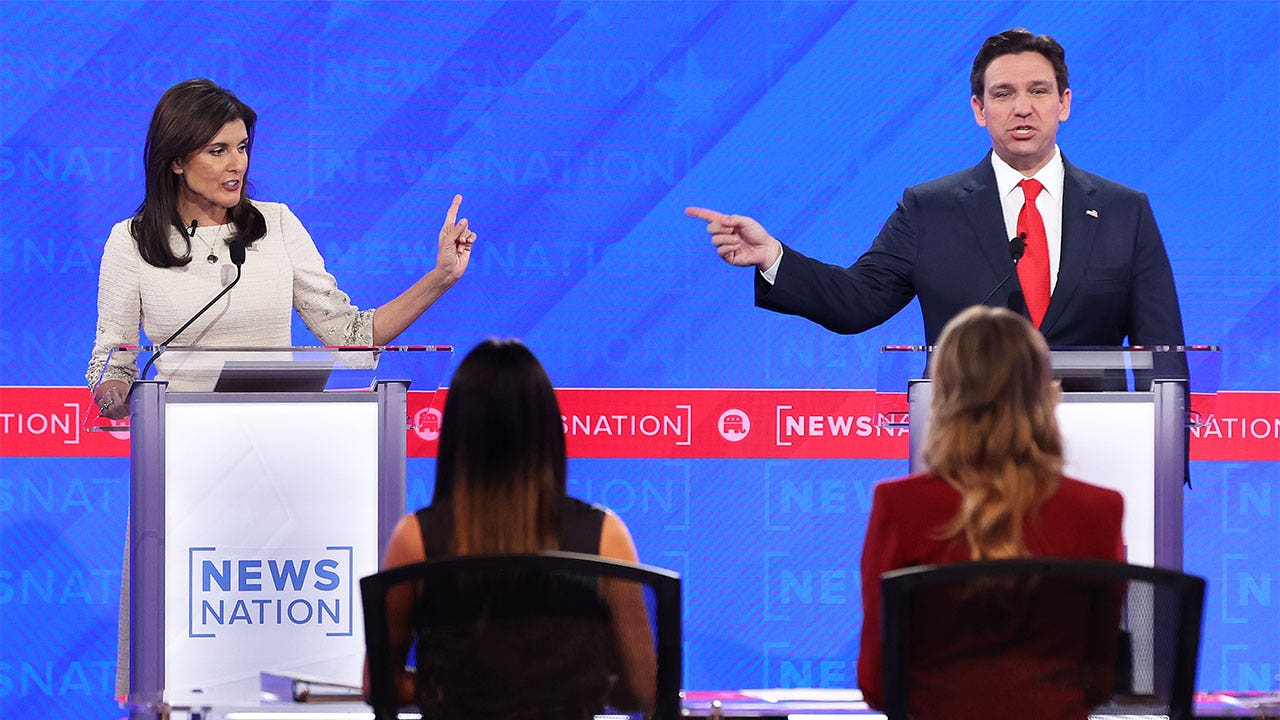
With just a week and a half to go until the Iowa caucuses kick off the Republican presidential nominating calendar, the war of words between Florida Gov. Ron DeSantis and former ambassador to the United Nations and former South Carolina Gov. Nikki Haley is reaching fever pitch.
DeSantis and Haley are neck and neck for second in the latest polls in the Hawkeye State, far behind former President Donald Trump, who remains the commanding frontrunner for the GOP nomination as he makes his third straight White House run.
But Haley has soared in recent months, catching up with DeSantis for second place not only in Iowa but also in national surveys, and surpassing the Florida governor and narrowing the gap with Trump in the latest polls in the New Hampshire primary, which will be held just eight days after the caucuses.
Campaigning in Milford, New Hampshire, on Wednesday, Haley told the large crowd listening to her that “we have an opportunity to get this right. And I know we’ll get it right, and I trust you. I trust every single one of you. You know how to do this. You know Iowa starts it. You know that you correct it.”
ONLY ON FOX: HALEY PUSHES BACK BUT DOESN’T CATEGORICALLY RULE OUT BEING TRUMP’S RUNNING MATE
Nikki Haley speaks at a town hall in Rye, New Hampshire, on Jan. 2, 2023. (Fox News – Paul Steinhauser)
Pointing to her home state, which on Feb. 24 will hold the first southern contest in the Republican presidential primary schedule, Haley added “and then my sweet state of South Carolina brings it home.”
The comment appeared to be tailored to Granite Staters, and the crowd cheered Haley’s remarks.
Recent political history backs up Haley’s comment. The past three winners of the Iowa Republican presidential caucuses – former Arkansas Gov. Mike Huckabee in 2008, former Sen. Rick Santorum of Pennsylvania in 2012, and Sen. Ted Cruz of Texas in 2016 – all came up short the next week in New Hampshire. And none of them went on to win the GOP nomination.
FIRST ON FOX: HALEY FUNDRAISING SOARS THE PAST THREE MONTHS
Then-Texas Gov. George W. Bush, the winner of the 2000 Iowa GOP caucuses, also lost the following week in New Hampshire, but went on to capture the nomination and then the White House.
Haley has placed plenty of emphasis on a strong finish in New Hampshire, and her upward momentum in the state has accelerated since she landed the endorsement last month of popular Republican Gov. Chris Sununu, who joins her at each of her campaign stops.
But she’s also spent plenty of time and resources in Iowa, and returns to the state on Thursday. Since launching her campaign last February, Haley’s held roughly 150 town halls, just about equally divided between Iowa and New Hampshire.
Republican Iowa Gov. Kim Reynolds, left, Florida Gov. Ron DeSantis and his wife, Florida first lady Casey DeSantis, at a campaign event in Bettendorf, Iowa, on Dec. 18, 2023. (Fox News – Paul Steinhauser)
But another popular GOP governor, Kim Reynolds of Iowa, didn’t seem to care for Haley’s remark.
Reynolds, who endorsed DeSantis in November, took to social media soon after Haley’s comment grabbed attention to write, “I trust Iowans to make their own decisions. No ‘corrections’ needed!”
And DeSantis campaign communications director Andrew Romeo charged that Haley’s “closing argument is insulting Iowans by saying their votes will need to be corrected.”
“Meanwhile, Ron DeSantis is closing strong in Iowa by outworking and outorganizing the competition day in and day out,” Romeo added.
On Thursday morning, DeSantis argued in a local radio interview in Iowa that Haley was “incredibly disrespectful to Iowans to say somehow their votes need to be corrected. I think she’s trying to provide an excuse for her not doing well.”
Haley and DeSantis clash during the fourth Republican presidential primary debate, which was held on the campus of the University of Alabama in Tuscaloosa, Alabama on Dec. 6, 2023 (Justin Sullivan/Getty Images)
While he’s spent plenty of time in New Hampshire, DeSantis appears to be staking his campaign on a strong finish in Iowa.
GOP NOMINATION RACE: WHAT A DIFFERENCE A YEAR MAKES FOR DONALD TRUMP
“We’re going to win here in Iowa. We have the organization in place,” DeSantis told Fox News Digital in an interview last month.
DeSantis predicted that the caucus results “will be very clarifying in terms of who is the real deal and who is not.”
Haley has been careful not to state what kind of finish she expects in either Iowa or New Hampshire.
“I need to be strong in Iowa, strong in New Hampshire, strong in South Carolina. That’s what I intend to do,” Haley said Tuesday in a Fox News Digital interview.
But the next day, Sununu made some predictions.
“We know Trump is going to win the caucus in Iowa,” Sununu said at a Haley campaign event in Londonderry, New Hampshire. “But again, Nikki coming in second place when nobody thought it could happen, that’s going to happen and give her even more momentum.”
Get the latest updates from the 2024 campaign trail, exclusive interviews and more at our Fox News Digital election hub.
Read the full article from Here


BISMARCK (KFGO) – North Dakota is offering new grant money to help improve the health and well being of workers at rural hospitals.
North Dakota Health and Human Services has opened applications for the hospital wellness equipment program. The goal is to help hospitals create healthier workplaces and support employees’ physical and mental health.
“The healthcare professionals caring for our communities need support, too,” said HHS Commissioner Pat Traynor. “These frontline workers often put the needs of others ahead of their own. By creating opportunities for staff to stay healthy, manage stress and recharge, hospitals can build stronger teams, improve retention and ultimately provide better care for the patients who depend on them.”
About $500,000 in federal funding is available. The state expects to award around 10 grants of about $50,000 each to eligible rural hospitals.
The grants can be used to by wellness equipment like treadmills, exercise bikes and weight equipment.
State officials say healthcare workers continue to deal with staffing shortages and burnout, and hope the grants will improve employee wellness to keep hospital workers in rural communities.

A West Price Hill man is accused of punching an Ohio assistant attorney general after asking her for money, according to arrest documents and officials.
Jermaine Johnson, 50, is charged with misdemeanor assault after Cincinnati police say he punched Kathleen Fischer in the face July 1, according to court records.
Fischer was injured in the attack but was not hospitalized, arrest documents show.
Fischer is a senior assistant attorney general in the consumer protection section of the Ohio Attorney General’s Office. She spent more than a decade as an assistant prosecuting attorney in the Hamilton County Prosecutor’s Office before taking on her new role in 2025.
Fischer is also the daughter of Ohio Supreme Court Justice Pat Fischer, who hails from Fort Thomas.
Arrest documents list Fischer as the victim of the attack. An attorney general’s office spokesman and Hamilton County Prosecutor’s Office spokesman also confirmed Fischer was the victim of the attack.
Fischer told police she was walking on Sycamore Street outside the prosecutor’s office around 4:30 p.m. when she ran into Johnson, arrest documents show. Johnson asked Fischer for money and as she continued to walk away, he punched her in the face, documents state.
A Cincinnati police officer then found Johnson two blocks away shortly after.
Johnson gave police a “conflicting statement” but told officers he may have accidentally hit her.
Johnson is also charged with misdemeanor possession of drug paraphernalia, court records show. Police say they found a glass pipe on Johnson while he was being arrested.
Johnson is expected to be arraigned in Hamilton County Municipal Court at 12:30 p.m., according to court records. He remains in custody at the Hamilton County Justice Center.
This report will be updated.
Enquirer reporter Matthew Cupelli contributed.

PIERRE, S.D. (Dakota News Now) – The South Dakota State Museum in Pierre reopened three rooms to the public on July 1st after three years of renovations.
The State Historical Society received funds to enhance the Cultural Heritage Center in 2022, aimed at improving the building and expanding collection storage.
The museum’s exhibits were redeveloped based on extensive public input and updated state social studies standards, ensuring they reflect South Dakota’s story for modern visitors.
The reopening of the three rooms is part of the America 250 celebration.
“Come to Pierre and experience South Dakota’s history! People of many backgrounds have aided the process, so come see the collective work,” said South Dakota State Museum Director David Grabitske.
The South Dakota State Museum is closed on Mondays, but is open from 10:00 am to 4:30 pm, Tuesday through Saturday, and 1:00 pm to 4:30 pm on Sundays.
Admission is free for all South Dakotans and children from anywhere.
The remainder of the museum gallery space will be reopened later this year.
Copyright 2026 Dakota News Now. All rights reserved.
-

 New Jersey4 minutes ago
Independence Day surprise: New Jersey’s costly new data broker law | IAPP
-

 New Mexico6 minutes ago
Here were New Mexico State’s best moments in the WAC
-

 North Carolina12 minutes ago
North Carolina Football Top 30 Players Countdown: No. 22
-

 North Dakota19 minutes ago
North Dakota offers wellness grants to rural hosptials
-

 Ohio22 minutes ago
Assistant Ohio AG punched on Cincinnati street by man seeking money, police say
-
 Oklahoma27 minutes ago
10,000 texts per hour: How campaigns are reaching Oklahoma voters whether they like it or not
-
Oregon34 minutes ago
Oregon Says Racism Is a Health Crisis, Now It Has a To-Do List
-

 Pennsylvania37 minutes ago
Why are flags at half-staff today? Why they’ll stay lowered in PA


