Midwest
Biden admin scraps eco-friendly fuel rules as gas prices remain high

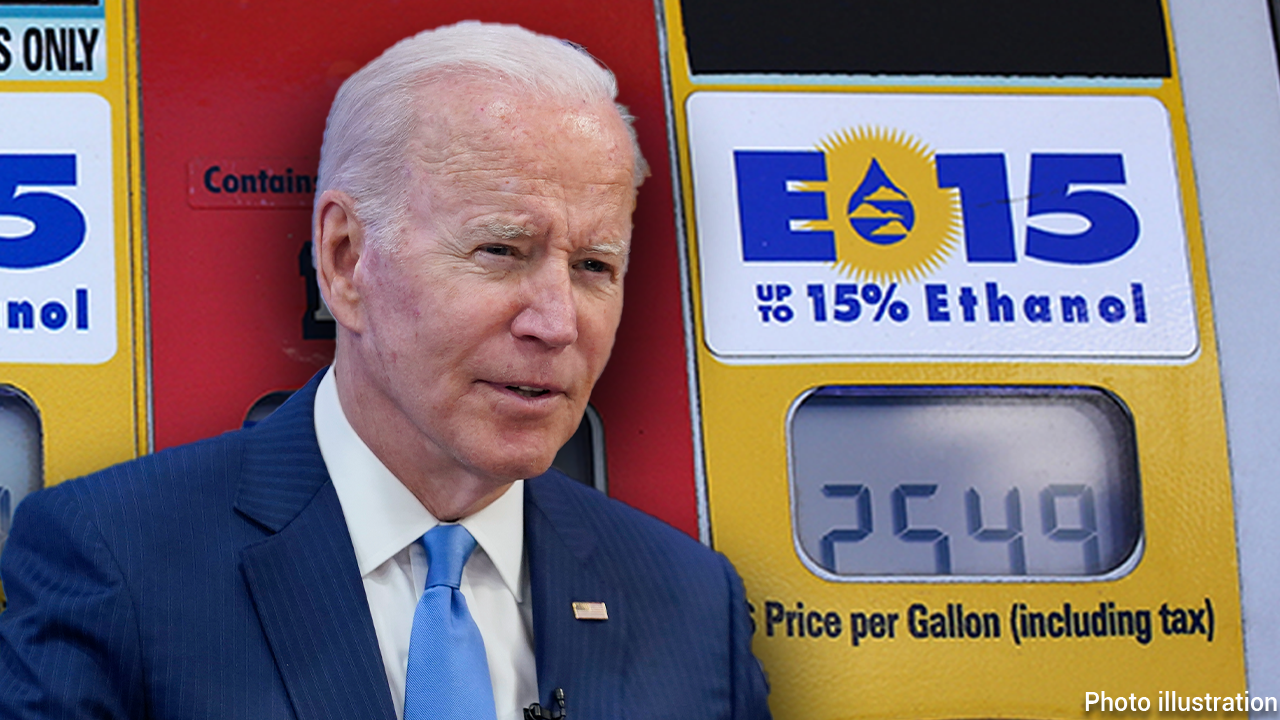
The Biden administration is scrapping environmental rules regulating the quantity of ethanol that refiners are able to mix into gasoline, which are designed to reduce smog during the summer.
In a final rule published by the Environmental Protection Agency (EPA), the agency granted a 2022 request from eight Midwestern governors, led by Iowa Gov. Kim Reynolds, to allow gas stations in their states to sell 15% ethanol blend fuel year-round. So-called E15 fuel is generally less expensive than regular blend fuel with less ethanol content, but it is prohibited from being sold during the summer months because it produces higher amounts of smog.
An EPA official confirmed in a statement to Fox News Digital that it is removing a federal waiver that has for years required gasoline-ethanol blends containing 10% ethanol to be used in the summer in Illinois, Iowa, Minnesota, Missouri, Nebraska, Ohio, South Dakota and Wisconsin. The action will take effect in 2025, a timeline that was criticized by refiners as too soon and by renewable fuel proponents as too late.
“After continuous delays by the EPA to allow year-round sales of E15 fuel, consumers across the country can finally look forward to lower-cost, cleaner-burning year-round E15 in 2025,” Reynolds said in a statement. “Nearly two years ago, I organized a bipartisan coalition of eight Midwest governors to join me in challenging the EPA’s refusal to allow E15 sales during summer months.”
BIDEN-APPOINTED JUDGE DELIVERS BLOW TO CLIMATE LAWSUIT TARGETING GAS STOVES
Environmental Protection Agency Administrator Michael Regan, left, speaks as President Biden looks on Feb. 16, 2024, in East Palestine, Ohio. (AP Photo/Andrew Harnik)
“Finally, our request is approved, however, the EPA’s unjustified delays come at a cost for drivers and the environment,” the Iowa governor continued. “As governor of the nation’s top ethanol producing state, I’m pursuing a waiver to continue offering drivers the option to purchase lower-cost, cleaner-burning E15 in Iowa this summer, and I won’t stop fighting for year-round E15 until it’s available nationwide.”
130+ HOUSE, SENATE REPUBLICANS JOIN FORCES IN OPPOSITION OF BIDEN’S UPCOMING EV MANDATE
In April 2022, Reynolds led a bipartisan coalition of governors — including Govs. JB Pritzker of Illinois; Laura Kelly of Kansas; Tim Walz of Minnesota; Doug Burgum of North Dakota; Kristi Noem of South Dakota; and Tony Evers of Wisconsin, and former Nebraska Gov. Pete Ricketts — in formally requesting that EPA Administrator Michael Regan allow year-round sales of E15 fuel in their states.
The coalition, whose state economies account for more than 10% of U.S. gasoline sales, invoked the federal Clean Air Act that gives governors the authority to make such a request. They argue that renewable fuels are the “immediate solution to high gas prices, lower emissions, and restoring our energy independence.”
Republican Iowa Gov. Kim Reynolds speaks at the Family Leadership Summit on July 14, 2023, in Des Moines, Iowa. (Scott Olson/Getty Images)
“While we are pleased to see EPA has finally approved year-round E15 in these eight states, we are extremely disappointed by the Agency’s needless decision to delay implementation until 2025,” Renewable Fuels Association CEO and President Geoff Cooper said Thursday. “It’s helpful to finally have some certainty about 2025 and beyond, but what happens this summer?”
“The Biden administration missed its statutory deadline to finalize the governors’ petition by more than 500 days, and now it claims there just isn’t enough time to implement the rule in time for summer 2024,” he added. “Why should ethanol producers, farmers, fuel retailers, and consumers in these states be penalized for EPA’s foot-dragging and failure to meet a clear deadline?”
BIDEN ADMIN REPORTEDLY DOUBLING DOWN ON GAS CAR CRACKDOWN
The Renewable Fuels Association and bipartisan lawmakers have called on the federal government to permanently allow year-round sales of E15 fuel, arguing such an action would help ease gas prices nationwide.
President Biden announces a temporary waiver allowing the nationwide sale of E15 in the summer at POET Bioprocessing in Menlo, Iowa, on April 12, 2022. (AP Photo/Carolyn Kaster, File)
President Biden acknowledged as much in April 2022 when he issued a nationwide waiver allowing summer E15 sales in response to the Ukraine war, which roiled global energy markets, saying at an event in Iowa that, as a result, Americans are “not going to show up at your local gas station and see a bag over the pump that has the cheapest gas.” However, the action was only temporarily effective in 2022.
The EPA’s actions Thursday, though, received criticism from the American Fuel & Petrochemical Manufacturers (AFPM), the nation’s largest industry association representing petroleum refiners. The group said the rule change could impact overall fuel supplies and lead to higher costs.
“E15 is about 10 cents a gallon cheaper than E10, and some gas stations offer an even bigger discount than that,” President Biden remarked during an event in Iowa in April 2022. “You’re going to be able to keep filling up with E15. And it’s going to solve a whole problem.” (AP Photo/Susan Walsh)
“We’ve made clear to the administration that it’s too late for 2024 implementation and even 2025 would be problematic,” said AFPM Senior Director of Fuels and Vehicle Policy Patrick Kelly. “Refiners start making the switch to summer production very early in the year and to minimize costs, there must be a reasonable transition to producing summer gas according to a different specification.”
“Studies show that even with at least a two-year lead time, the RVP change will reduce overall supply, increase costs and make the region more vulnerable to supply disruptions. With less time, costs to produce and supply fuel and risks of supply disruptions could be greater.”
Meanwhile, gasoline prices across the country have remained stubbornly high, hitting $3.27 per gallon as of Friday, according to AAA data. Those prices represent a 6% month-over-month increase and are nearly 37% higher than pump prices when Biden first took office.
Read the full article from Here


ILLINOIS – A severed arm with a distinctive Green Bay Packers tattoo led investigators to identify a Plainfield man whose remains were recovered from Lake Mattoon, and two people have now been charged in the case, including the man’s mother, Illinois State Police said.
James Adams, 26, and Robin Turner, 62, are each charged with concealment of a homicidal death, a Class 3 felony, and dismembering a human body, a Class X felony.
Two charged after severed arm with Packers tattoo found in Illinois lake, police say
The backstory:
Boaters found part of a human arm floating in Lake Mattoon on the evening of June 28, according to Illinois State Police. The arm had several distinctive tattoos, including a skeleton holding a Green Bay Packers helmet and an unidentified letter or number.

Severed arm found in Illinois lake belonged to Plainfield man, police say (Illinois State Police)
Authorities searched the lake and recovered additional human remains. The victim was later identified as 38-year-old Dalewayne Turner of Plainfield.
Investigators executed a search warrant Wednesday at a home in the 2400 block of Ruth Fitzgerald Drive in Plainfield, where Adams and Robin Turner were taken into custody, state police said. Robin is reportedly Dalewayne’s mother.
Police said investigators also recovered additional evidence from the home but have not disclosed what was found.
What’s next:
Illinois State Police presented the case Thursday to the Will County State’s Attorney’s Office, which approved the charges.
Adams and Turner remain in custody as the investigation continues. State police said additional charges are expected.
The Source: The information in this article was provided by Illinois State Police and previous FOX Chicago reporting.

What to know about the ‘Speedway Slammer’ ICE detainee facility in Indiana
Miami Correctional Facility can house up to 1,000 ICE detainees.
The warden of an Indiana prison that serves as one of the Midwest’s largest Immigration and Customs Enforcement detention centers has departed his role as head of the maximum security facility.
Brian English, who ran Miami Correctional Facility in Bunker Hill, announced his exit on LinkedIn.
“After much reflection, I’ve decided to take the next step in my career and will be transitioning out of my role at the Miami Correctional Facility,” he wrote. “Closing this chapter has reminded me just how much can change when a team decides to move forward together.”
English’s announcement described the prison as a “difficult place” recovering from lockdowns, strained community relations and severe staffing shortages when he first took over in October 2022.
“Over the past three years and nine months, we’ve strengthened operations of a maximum-security prison, with a minimum-security unit, infirmary unit and a newly opened 1,000‑bed ICE detention facility,” he wrote. “We rebuilt community relations, expanded partnerships with law enforcement and Grissom Air Force Base, doubled volunteer engagement, grew programming, and improved staffing and retention in meaningful ways.”
English confirmed in a telephone call to IndyStar that Friday, June 26, was his last day on the job.
“I no longer work there,” he said via phone. “I don’t really have any comment about it. I’m just taking some time off, and I’ll be pursuing other opportunities.”
When asked if he was leaving on his own or had forced out, English told IndyStar the decision was “totally his decision.”
“That’s all I’m going to really comment about,” he said. “It was my decision to go.”
The prison, which Trump administration officials nicknamed the “Speedway Slammer” despite local protestations, has continued to suffer from serious problems during English’s tenure. An IndyStar investigation found that violence and drug use were rampant at the facility before it began accepting ICE detainees in October.
Last summer, Indiana Gov. Mike Braun and the U.S. Department of Homeland Security announced that the prison would become an ICE detention site, housing up to 1,000 detainees, as part of President Donald Trump’s crackdown on immigration. Two detainees have since died at the facility, which as of last month housed more than 600 immigration detainees in addition to about 1,800 state prisoners.
Concerns about conditions at the prison have prompted calls to shut down ICE detention at the facility from U.S. Rep. André Carson, faith leaders and civil liberty advocates. They say detainees have complained of inadequate medical care, inconsistent food service and difficulties maintaining their hygiene.
Although state officials have said the arrangement with ICE will be profitable, delayed payments from the federal government have resulted in expenditures exceeding revenue. Prison officials have said they expect that to change as the arrangement continues.
It’s unclear who will run the prison in the interim or if a new warden has been identified. The Indiana Department of Correction did not immediately respond to an IndyStar inquiry about English’s departure. Neither did ICE.
Contact IndyStar investigative reporter Alexandria Burris at aburris@indystar.com. Follow her on X, formerly Twitter, at @allyburris and on Bluesky at@allymburris.bsky.social.

IOWA – Congresswoman Mariannette Miller-Meeks (IA-01) today marked the one-year anniversary of the Working Families Tax Cuts becoming law, highlighting the real savings and tax relief the legislation has delivered for Iowa families, workers, farmers, seniors, and small businesses.
Signed into law one year ago, the Working Families Tax Cuts have lowered taxes, increased take-home pay, and helped hardworking Americans keep more of what they earn.
“One year later, the Working Families Tax Cuts are delivering exactly what they promised: lower taxes, bigger paychecks, stronger family budgets, and real savings for hardworking Americans,” said Congresswoman Miller-Meeks. “Whether it is tax relief for seniors, workers earning overtime, families raising children, or farmers passing their operations on to the next generation, these policies are making a real difference. I will continue fighting for policies that put Iowans first.”
Background
One year after becoming law, the Working Families Tax Cuts continue to provide meaningful relief for millions of Americans through provisions including No Tax on Tips, No Tax on Overtime, tax relief for seniors, permanent protections for family farms, incentives to strengthen American manufacturing, and new $1,000 Baby Investment Accounts for eligible newborns.
Since enactment, the Working Families Tax Cuts have delivered:
- Tax refunds increased by 11%, putting more money back into the pockets of hardworking Americans.
- No Tax on Tips: More than 7.5 million Americans have claimed the deduction, with an average tax benefit of over $7,000. By allowing workers to deduct up to $25,000 in qualified tip income, servers, bartenders, hospitality workers, and others who rely on tips are keeping more of what they earn.
- No Tax on Overtime: More than 29 million Americans have claimed the deduction, saving an average of over $3,100. This provision helps police officers, firefighters, nurses, EMTs, corrections officers, and countless other workers keep more of their overtime pay.
- Social Security Tax Deduction: More than 35 million seniors have claimed the new deduction, receiving an average tax benefit of over $7,500. Eligible seniors can claim a $6,000 deduction, while married couples can receive up to $12,000, helping them afford everyday necessities and enjoy greater peace of mind after a lifetime of hard work.
- Enhanced Child Tax Credit: Nearly 40 million families have claimed the expanded $2,200 Child Tax Credit, helping parents cover the costs of raising children and providing additional financial stability.
-
Doubled Standard Deduction: The law preserves the doubled standard deduction, benefiting over 90% of taxpayers and allowing families to keep more of their hard-earned income.
-
Protection for Family Farms: Delivered permanent relief from the ‘Death Tax’ and helps protect family farms ensuring there farms are passed down to kids and grandkids not sold to pay the IRS.
-
No Tax on Car Loan Interest: Allows eligible Americans to deduct interest on qualifying loans for new American-made vehicles.
-
Small Business Tax Deduction: Makes the 20% small business deduction permanent, giving Main Street businesses the certainty they need to invest, hire, and grow.
-
$1,000 Baby Investment Accounts: Provides eligible newborns with a $1,000 investment account, helping families begin building long-term financial security from the start of their child’s life.
###
-

 Arkansas5 minutes ago
August special primary set for vacant southeast Arkansas state Senate seat | Arkansas Democrat Gazette
-
 California8 minutes ago
California returns stretch of coast to Indigenous tribes. ‘This is beyond huge’
-

 Colorado13 minutes ago
Douglas County, Colorado, celebrates Independence Day without fireworks
-

 Connecticut20 minutes ago
Connecticut 250, 251, 252, 253 . . . – New Haven Independent
-

 Delaware22 minutes ago
Wilmington fire displaces 20, damages 6 homes on Clayton Road; cause under investigation
-

 Florida28 minutes ago
USF Health brings emergency pregnancy training to rural Florida without maternal care
-

 Georgia35 minutes ago
Middle Georgia looks to see a scorcher for the Fourth of July
-

 Hawaii38 minutes ago
Car drives into Sunshine Market in Honolulu

