Lifestyle
Zorthian Ranch, 'a magical, deep labyrinth' of art, suffers major damage in Eaton fire

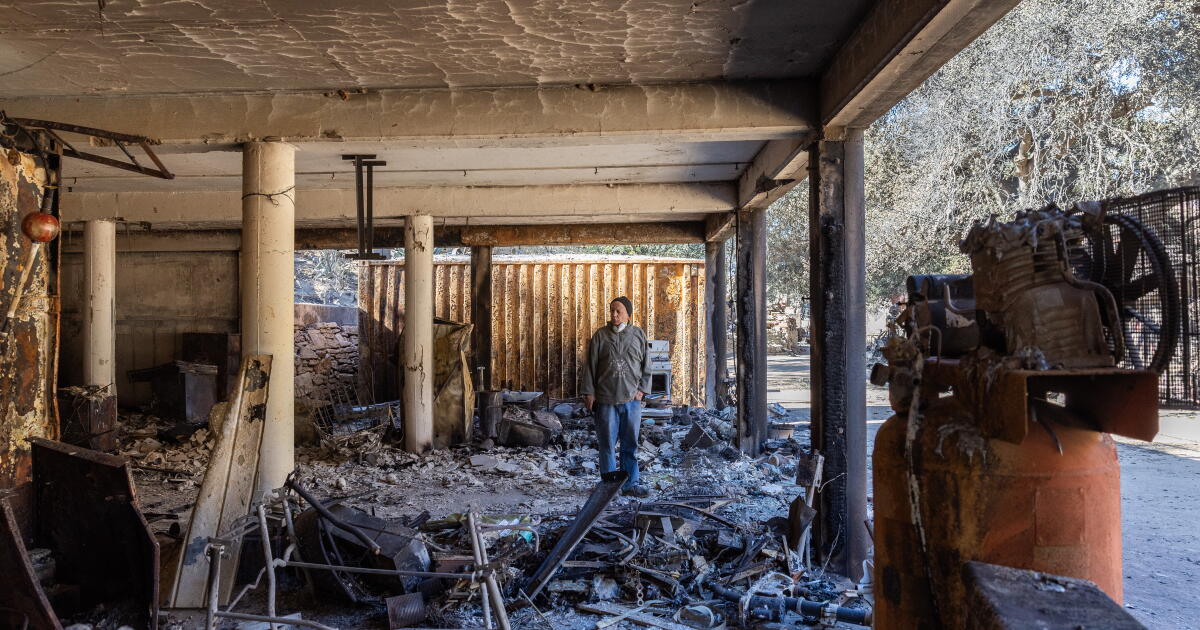
For years rumors swirled about a cult living on the secluded property at the end of Fair Oaks Avenue in the San Gabriel Mountain foothills bordering Altadena. There were stories of wild bacchanals involving nudists, and grand parties attended by the likes of artist Andy Warhol, jazz musician Charlie Parker and Nobel laureate physicist Richard Feynman.
Since 1946, the Zorthian Ranch had served as a haven for artists and creatives who wanted to escape the confines of urban living and find their bliss in a rustic paradise. The sculptor who founded the ranch, Jirayr Zorthian, transformed discarded objects into art. His family carried on that legacy after his death in 2004, and the property lived on as a sort of outdoor museum featuring artwork by established and new artists alike.
But last week, the Eaton fire ripped through the property, leaving mostly ashes in its wake. Jirayr’s son, Alan Zorthian, who oversees the ranch, fought alongside others to save the 40-acre estate and its eclectic collection of sculptures and artwork.
The Zorthian Ranch, pictured in March 2019, came to encapsulate an eccentric, untamed slice of Altadena.
(Hannah Taylor)
The ranch had survived wildfires in the past. Its caretakers had firefighting equipment, hoses and standpipes at the ready to draw water across different points of the property. But this firestorm, driven by hurricane-force winds, proved too fast and overwhelming. The blaze consumed every structure on the property save for two — the main house where Alan was raised and a mid-century home known as the “green house.”
But Alan’s one bedroom cottage, his father’s studio, the various barns and outbuildings that supported the farming operation and countless pieces of art are gone.
“I don’t know if I can duplicate 57 years of work,” Alan, 66, said this week, referencing the years his father devoted to establishing the ranch. A steel container that stores some of his father’s artwork survived, he said, but he’s afraid to open it; the outer shell shows signs of heat damage.
“I start to feel bad about the cultural infrastructure that we’ve lost,” Alan said. “But then I look around and I see what other people have lost. I mean, our whole area has lost everything.”

A stand pipe at Zorthian Ranch ran dry as Alan Zorthian attempted to fight the flames of the Eaton fire.
(Myung J. Chun / Los Angeles Times)
After erupting Jan. 7, the Eaton fire devastated large swaths of Altadena, a community of 42,000 residents, destroying more than 4,600 structures and killing at least 16 people. In some areas, entire blocks of homes were razed. The Bunny Museum, Pasadena Waldorf School and Zane Grey Estate are among the historic landmarks destroyed.
The Zorthian Ranch had come to encapsulate an untamed slice of Altadena: It was a brazenly bohemian scene, cloaked by forest, that attracted a range of artists, scientists and musicians. Bears, coyotes and mountain lions were regular visitors. Beehives, pig pens and horses coexisted. On clear days, the ranch offered a nearly panoramic view of downtown L.A. and Catalina Island.
Alan evacuated the property during the early hours of Jan. 8, leaving behind key documents and nearly all his belongings. He was forced to abandon his Jeep after the wooden bridge connecting the upper and lower portions of the ranch was incinerated. He crossed a deep gully full of ember and ash to escape.
“That was a barn,” he noted, pointing to a pile of rubble. His office, where he worked on architectural projects, was gone. Near the ruins of what was once his father’s art studio, he bent to pick up a piece of shattered white Masonite board. It was all that remained of a painting his father had crafted after an acrimonious divorce with his first wife.
The painting, titled “The Divorcement,” depicted Jirayr’s former mother-in-law in an unflattering light, and as part of the divorce settlement, could not be shown while Jirayr and his ex-wife were alive. But after their deaths, the painting was hung in a multipurpose room that doubled as a gift shop.
“There’s nothing left,” Alan said, defeated. He dropped the piece, which landed with a sharp crack. “It’s all gone.”

The “Wall of Passion,” which Jirayr Zorthian created as a tribute to physicist Richard Feynman, survived the Eaton fire.
(Myung J. Chun / Los Angeles Times)
Jirayr Zorthian and his family fled the Armenian genocide when Jirayr was 11. They ended up on the East Coast, and Jirayr eventually studied fine arts at Yale University on a scholarship. He served in the military during World War II, and after his Turkish language abilities were no longer needed, was tasked with creating propaganda. He painted a 157-foot mural titled “Phantasmagoria of Military Intelligence Training.” Photocopy plates of the mural survived the fire.
In 1945, Jirayr and his first wife, Betty Williams, bought 27 acres in the foothills of Altadena. After they divorced, Zorthian kept the land and continued to expand along the rugged foothills. He married Dabney, Alan’s mother, and together the couple ran the “Zorthian’s Ranch for Children” summer camp for more than 25 years.
With friends and fellow artisans, they would throw alchohol-fueled parties where Jirayr would dress in a toga, as “Zor-Bacchus,” and nude women would feed him grapes. They famously hosted tryouts for the Doo Dah Parade queen, an irreverent counter to Pasadena’s Rose Parade.

A view of downtown Los Angeles from a fire-damaged terrace at Zorthian Ranch.
(Myung J. Chun / Los Angeles Times)
For Alan, growing up on the ranch meant learning how to live off the land. He fed the pigs and horses and helped at the summer camp. Feynman even helped him with his algebra homework, he recalled. But when he turned 21, a trip to Europe exposed him to a life beyond the ranch, and he left to study architecture in San Diego.
He found himself back at the ranch in 2006, after both his parents died, to help manage it with his sister Alice. Over the years, their father, who opined on the wastefulness of Americans, had accumulated discarded objects and found ways to introduce them into his art. The property was cluttered with telephone poles, car doors, old trailers, broken concrete.
Alan said he was determined to create a “museum with no walls” that would showcase art created at the ranch. His daughters, Julia and Caroline, grew up spending weekends and summers there, running around property decorated in intricate sculptures and meeting people from around the world.
“The place itself was a sort of magical, deep labyrinth that was full of nooks and crannies of strange objects, out in the elements to be enjoyed by whoever wanted to walk by,” said Julia, now 29.

A bull and a cow that proved too difficult to evacuate during the Eaton fire remained in their pen at Zorthian Ranch and survived.
(Myung J. Chun / Los Angeles Times)
She moved to the ranch as a young adult, dropping out of college to help her father manage the ranch when it hit a precarious period of financial instability. They needed to find a way to stay true to their roots, she said, while also creating a viable business.
In recent years, the family transitioned the property into a working farm. They maintained four gardens, growing squash, potatoes, watermelons and oranges, and sold their honey. A community of about 20 people lived and worked at the ranch as docents, hosting drawing and yoga classes. Airbnb became a primary source of income, as artists rented out structures on the property, including Jirayr’s former art studio.
The family has launched a GoFundMe to keep the ranch afloat. So far, they’ve raised a little more than $100,000, with notes from people who remembered their time there.
But already, Alan said, he’s getting calls from real estate agents vying to buy out area residents and develop their land. The family is intent on keeping the property and returning the ranch to its former glory. As Alan sifted through the debris, he eyed a melted strip of aluminum.
“I guess we’ll have to make art out of this damn fire,” he said.



Wyle, who spent 11 seasons on ER, returns to the hospital in The Pitt. Now in Season 2, the HBO series has earned praise for its depiction of the medical field. Originally broadcast April 21, 2025.
Hear The Original Interview
Television
After years of avoiding the ER, Noah Wyle feels ‘right at home’ in ‘The Pitt’

TMZ Live Stream
Come Into Our Office and Watch News Happen!!!
Published
We want you to be a part of TMZ, so every weekday, between 9:30 AM and 11:30 AM PT, we take you inside our newsroom via live stream.
You never know what you’re gonna get … a big story that breaks, an argument erupts in the room, or someone’s just joking around.
Your comments are a big part of the stream, and the staff spends a lot of time speaking directly to you. Every day is different!
We also use our live stream to produce our “TMZ Live” TV show.

From left: Noah Wyle plays Dr. Michael “Robby” Robinavitch, the senior attending physician, and Fiona Dourif plays Dr. Cassie McKay, a third-year resident, in a fictional Pittsburgh emergency department in the HBO Max series The Pitt.
Warrick Page/HBO Max
hide caption
toggle caption
Warrick Page/HBO Max
The first five minutes of the new season of The Pitt instantly capture the state of medicine in the mid-2020s: a hectic emergency department waiting room; a sign warning that aggressive behavior will not be tolerated; a memorial plaque for victims of a mass shooting; and a patient with large Ziploc bags filled to the brink with various supplements and homeopathic remedies.
Scenes from the new installment feel almost too recognizable to many doctors.
The return of the critically acclaimed medical drama streaming on HBO Max offers viewers a surprisingly realistic view of how doctors practice medicine in an age of political division, institutional mistrust and the corporatization of health care.
Each season covers one day in the kinetic, understaffed emergency department of a fictional Pittsburgh hospital, with each episode spanning a single hour of a 15-hour shift. That means there’s no time for romantic plots or far-fetched storylines that typically dominate medical dramas.
Instead, the fast-paced show takes viewers into the real world of the ER, complete with a firehose of medical jargon and the day-to-day struggles of those on the frontlines of the American health care system. It’s a microcosm of medicine — and of a fragmented United States.

Many doctors and health professionals praised season one of the series, and ER docs even invited the show’s star Noah Wyle to their annual conference in September.
So what do doctors think of the new season? As a medical student myself, I appreciated the dig at the “July effect” — the long-held belief that the quality of care decreases in July when newbie doctors start residency — rebranded “first week in July syndrome” by one of the characters.
That insider wink sets the tone for a season that Dr. Alok Patel, a pediatrician at Stanford Medicine Children’s Health, says is on point. Patel, who co-hosts the show’s companion podcast, watched the first nine episodes of the new installment and spoke to NPR about his first impressions.
To me, as a medical student, the first few scenes of the new season are pretty striking, and they resemble what modern-day emergency medicine looks and sounds like. From your point of view, how accurate is it?
I’ll say off the bat, when it comes to capturing the full essence of practicing health care — the highs, the lows and the frustrations — The Pitt is by far the most medically accurate show that I think has ever been created. And I’m not the only one to share that opinion. I hear that a lot from my colleagues.
OK, but is every shift really that chaotic?
I mean, obviously, it’s television. And I know a lot of ER doctors who watch the show and are like, “Hey, it’s really good, but not every shift is that crazy.” I’m like, “Come on, relax. It’s TV. You’ve got to take a little bit of liberties.”
As in its last season, The Pitt sheds light on the real — sometimes boring — bureaucratic burdens doctors deal with that often get in the way of good medicine. How does that resonate with real doctors?
There are so many topics that affect patient care that are not glorified. And so The Pitt did this really artful job of inserting these topics with the right characters and the right relatable scenarios. I don’t want to give anything away, but there’s a pretty relatable issue in season two with medical bills.
Right. Insurance seems to take center stage at times this season — almost as a character itself — which seems apt for this moment when many Americans are facing a sharp rise in costs. But these mundane — yet heartbreaking — moments don’t usually make their way into medical dramas, right?
I guarantee when people see this, they’re going to nod their head because they know someone who has been affected by a huge hospital bill.
If you’re going to tell a story about an emergency department that is being led by these compassionate health care workers doing everything they can for patients, you’ve got to make sure you insert all of health care into it.
As the characters juggle multiple patients each hour, a familiar motif returns: medical providers grappling with some heavy burdens outside of work.
Yeah, the reality is that if you’re working a busy shift and you have things happening in your personal life, the line between personal life and professional life gets blurred and people have moments.
The Pitt highlights that and it shows that doctors are real people. Nurses are actual human beings. And sometimes things happen, and it spills out into the workplace. It’s time we take a step back and not only recognize it, but also appreciate what people are dealing with.
2025 was another tough year for doctors. Many had to continue to battle misinformation while simultaneously practicing medicine. How does medical misinformation fit into season two?
I wouldn’t say it’s just mistrust of medicine. I mean that theme definitely shows up in The Pitt, but people are also just confused. They don’t know where to get their information from. They don’t know who to trust. They don’t know what the right decision is.
There’s one specific scene in season two that, again, no spoilers here, but involves somebody getting their information from social media. And that again is a very real theme.
In recent years, physical and verbal abuse of healthcare workers has risen, fueling mental health struggles among providers. The Pitt was praised for diving into this reality. Does it return this season?
The new season of The Pitt still has some of that tension between patients and health care professionals — and sometimes it’s completely projected or misdirected. People are frustrated, they get pissed off when they can’t see a doctor in time and they may act out.
The characters who get physically attacked in The Pitt just brush it off. That whole concept of having to suppress this aggression and then the frustration that there’s not enough protection for health care workers, that’s a very real issue.
A new attending physician, Dr. Baran Al-Hashimi, joins the cast this season. Sepideh Moafi plays her, and she works closely with the veteran attending physician, Dr. Michael “Robby” Robinavitch, played by Noah Wyle. What are your — and Robby’s — first impressions of her?
Right off the bat in the first episode, people get to meet this brilliant firecracker. Dr. Al-Hashimi, versus Dr. Robby, almost represents two generations of attending physicians. They’re almost on two sides of this coin, and there’s a little bit of clashing.
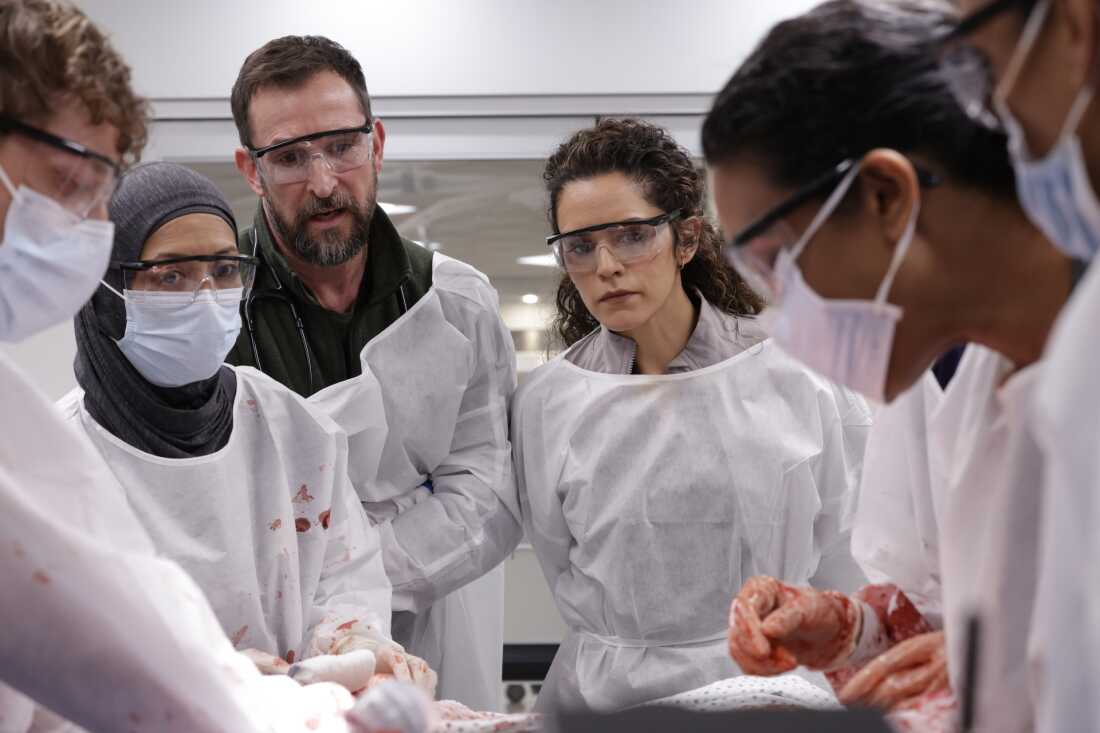
Sepideh Moafi, fourth from left, as Dr. Baran Al-Hashimi, the new attending physician, huddles with her team around a patient in a fictional Pittsburgh teaching hospital in the HBO Max series The Pitt.
Warrick Page/HBO Max
hide caption
toggle caption
Warrick Page/HBO Max
Part of that clash is her clear-eyed take on artificial intelligence and its role in medicine. And she thinks AI can help doctors document what’s happening with patients — also called charting — right?
Yep, Dr. Al-Hashimi is an advocate for AI tools in the ER because, I swear to God, they make health care workers’ lives more efficient. They make things such as charting faster, which is a theme that shows up in season two.
But then Dr. Robby gives a very interesting rebuttal to the widespread use of AI. The worry is that if we put AI tools everywhere, then all of a sudden, the financial arm of health care would say, “Cool, now you can double how many patients you see. We will not give you any more resources, but with these AI tools, you can generate more money for the system.”
The new installment also continues to touch on the growing corporatization of medicine. In season one we saw how Dr. Robby and his staff were being pushed to see more patients.
Yes, it really helps the audience understand the kind of stressors that people are dealing with while they’re just trying to take care of patients.
In the first season, when Dr. Robby kind of had that back and forth with the hospital administrator, doctors were immediately won over because that is such a big point of frustration — such a massive barrier.
There are so many more themes explored this season. What else should viewers look forward to?
I’m really excited for viewers to dive into the character development. It’s so reflective of how it really goes in residency. So much happens between your first year and second year of residency — not only in terms of your medical skill, but also in terms of your development as a person.
I think what’s also really fascinating is that The Pitt has life lessons buried in every episode. Sometimes you catch it immediately, sometimes it’s at the end, sometimes you catch it when you watch it again.
But it represents so much of humanity because humanity doesn’t get put on hold when you get sick — you just go to the hospital with your full self. And so every episode — every patient scenario — there is a lesson to learn.
Michal Ruprecht is a Stanford Global Health Media Fellow and a fourth-year medical student.

Colorado man heads to Washington, D.C., to gain support for Marshall Fire survivors

New Connecticut economic data: “It takes job seekers longer”

Wilmington’s first homicide of 2026 claims life of 19-year-old

Protest photos in Florida after ICE shooting in Minneapolis

Georgia ‘super flu’ activity hits ‘extremely high’ levels: When to call 911

Florida High School Football Rankings: Top 25 teams – Oct. 21

Cleary's 21 help Le Moyne down Central Connecticut State 69-64 in OT

How old is Bo Nix? What to know about Oregon quarterback ahead of 2024 NFL Draft

99th annual Pony Swim held in Virginia

Video: ‘It Didn’t Have to Happen This Way:’ U.Va. Faculty Call for Review of Police Response to Protests

AOC accuses Vance of believing ‘American people should be assassinated in the street’
Mercosur: How Macron’s domestic weakness undercut his Brussels clout

National Park Service will void passes with stickers over Trump’s face

Trump plans to meet with Venezuela opposition leader Maria Corina Machado next week

Trump says meeting Iran’s ‘Crown Prince’ Pahlavi would not be appropriate
-

 Detroit, MI6 days ago
2 hospitalized after shooting on Lodge Freeway in Detroit
-

 Technology3 days ago
Power bank feature creep is out of control
-

 Dallas, TX4 days ago
Defensive coordinator candidates who could improve Cowboys’ brutal secondary in 2026
-

 Health5 days ago
Viral New Year reset routine is helping people adopt healthier habits
-

 Iowa3 days ago
Pat McAfee praises Audi Crooks, plays hype song for Iowa State star
-

 Nebraska3 days ago
Oregon State LB transfer Dexter Foster commits to Nebraska
-
 Nebraska3 days ago
Nebraska-based pizza chain Godfather’s Pizza is set to open a new location in Queen Creek
-

 Missouri3 days ago
Damon Wilson II, Missouri DE in legal dispute with Georgia, to re-enter transfer portal: Source