Lifestyle
What's Making Us Happy: A guide to your weekend raking, listening and gaming

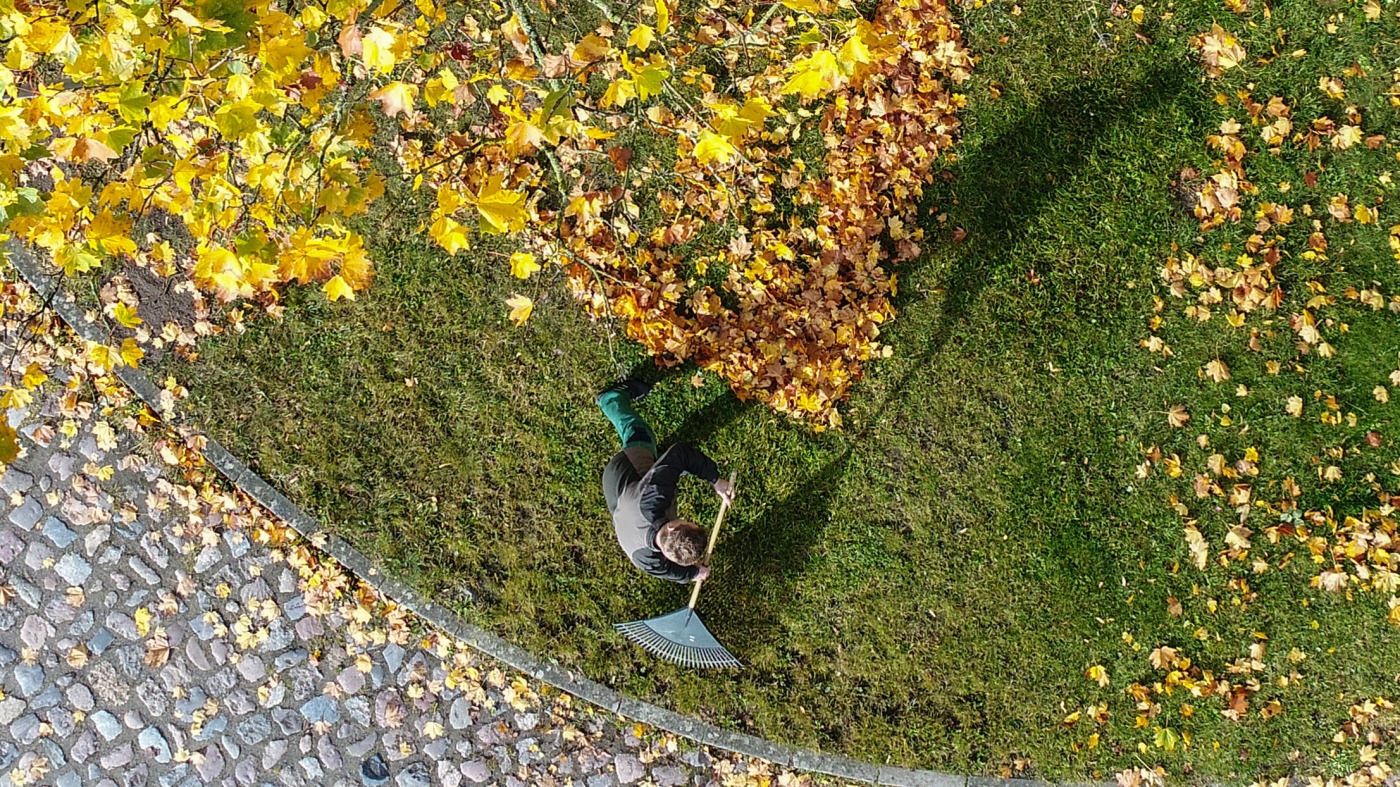
It’s raking season! Above, a man tends to fallen leaves in Sieversdorf, Germany in 2017.
Patrick Pleul/AFP via Getty Images
hide caption
toggle caption
Patrick Pleul/AFP via Getty Images
This week, statues proliferated, we lost a great actor, and being animated was no protection from being incarcerated.
Here’s what NPR’s Pop Culture Happy Hour crew was paying attention to — and what you should check out this weekend.
Raking leaves
I am enjoying raking leaves more than I can say. We have a dogwood tree in the front yard that has recently released all of its leaves. They are coming down in reds and yellows and greens. I remember going around in elementary school and picking up a pretty leaf that I would take to school to put in a book or on a page, and I loved it. I love the smell of the falling leaves. In two weeks, I know I’m going to hate it but right now, I am enjoying this. It’s heaven. — Bob Mondello
‘Songs of a Lost World’ by The Cure
YouTube
Any time a band takes kind of a long break from recording, say, 16 years, I don’t expect the subsequent album to be among an artist’s career highlights. But I absolutely love the new album by The Cure, Songs of a Lost World. It is this lavishly produced, very cohesive and coherent collection of songs. Lyrically, it is very dark. It is, after all, The Cure, which is a band known to inject their songs with a little bit of bleakness. But it’s also very beautiful. The song “Alone” for example is not peppy but is leavened by the beauty of the arrangements in ways that make it feel not oppressive.

When I interviewed Robert Smith of The Cure for Morning Edition, I asked him if he’d thought about what he wants his final music statement to be and he replied, “Good grief! This is a bit bleak, isn’t it?” It felt like a true endorsement to have Robert Smith think that something I asked him was bleak.
Lawn Mowing Simulator
YouTube
We have a big election next week. There’s a lot going on in the world. The main thing that is giving me comfort right now is playing video games on my PlayStation 5, including one called Lawn Mowing Simulator.

I am enjoying an imaginary lawn where I sit on a lawn mower and drive it around, mowing the lawn. It’s very satisfying. Sometimes I’m very efficient and I try to get the job done and earn my money and a bonus for getting it done in a normal period of time. Other times I just ride and do little circles in the lawn mower and make pretty patterns in the lawn. It’s giving me a lot of warm fuzzies as I try to maintain my equilibrium in these tense times. — Linda Holmes
More recommendations from the Pop Culture Happy Hour newsletter
by Linda Holmes

The second season of The Diplomat has arrived. I really loved the first season, and this one is very good, too — although at six episodes, it’s shorter than I wish it were. Like the third season of The Bear, it feels less like a season and more like half of a two-part season. But Keri Russell remains excellent, and the addition of Allison Janney is a masterstroke. And check out Eric Deggans’ review of the new season.
Have you been playing Astro Bot? I have. (Just ask all my other responsibilities how neglected they feel.) A platformer for PlayStation 5, it allows you to become an adorable little robot who runs through various levels, punching and jumping and pulling on things, and it’s wildly entertaining. If you’ve played Mario games on a Nintendo device, Astro Bot’s aesthetic (which has appeared in a couple of previous games starring the same robot) will remind you of those, but it has a vigor and a kick all its own.

Rachel Martin is such a good interviewer, and Seth Meyers is somebody I’ve admired for a long time. So I was delighted to see him on Wild Card talking about all manner of things. In one section of the conversation, he essentially says he had more ambition than talent when it came to acting in movies – which is the kind of thing you don’t hear from very successful people all that often.
Dhanika Pineda adapted the Pop Culture Happy Hour segment “What’s Making Us Happy” for the Web. If you like these suggestions, consider signing up for our newsletter to get recommendations every week. And listen to Pop Culture Happy Hour on Apple Podcasts and Spotify.

For Iris van Herpen, couture is a laboratory as much as a runway. Our chief fashion critic, Vanessa Friedman, takes us inside this Dutch designer’s latest Paris show — from sci-fi-inspired gowns to an audacious attempt at a dress made of charged plasma.
Lifestyle
The BoF Podcast | Decoding Paris Haute Couture: Wonder, Restraint and the Call of the Void


-

 Detroit, MI1 minute ago
Metro Detroit weather forecast, July 10, 2026 — 11 p.m. Update
-

 San Francisco, CA11 minutes ago
Classical music series helps reconnect downtown San Francisco community
-

 Dallas, TX16 minutes ago
Dallas police officers, paramedics recall saving woman stuck in a ravine for days;
-

 Boston, MA26 minutes ago
Red Sox win 7th straight game just hours after landing in New York
-
 Denver, CO31 minutes ago
One tree at a time: Denver nonprofit works to close shade gap as heat dome threatens neighborhoods
-

 Seattle, WA38 minutes ago
VIDEO: West Seattle Summer Fest 2026 day 1, evening report
-

 San Diego, CA41 minutes ago
The World’s Number One Wellness Retreat is Right in Our Backyard
-
 Milwaukee, WI46 minutes ago
Festivalgoers say Milwaukee’s summer events fill a gap in downtown entertainment

