Connect with us

Lifestyle

Walk on, L.A.! Why you should absolutely explore the city by foot — and how to do it

Published

on

Walk on, L.A.! Why you should absolutely explore the city by foot — and how to do it
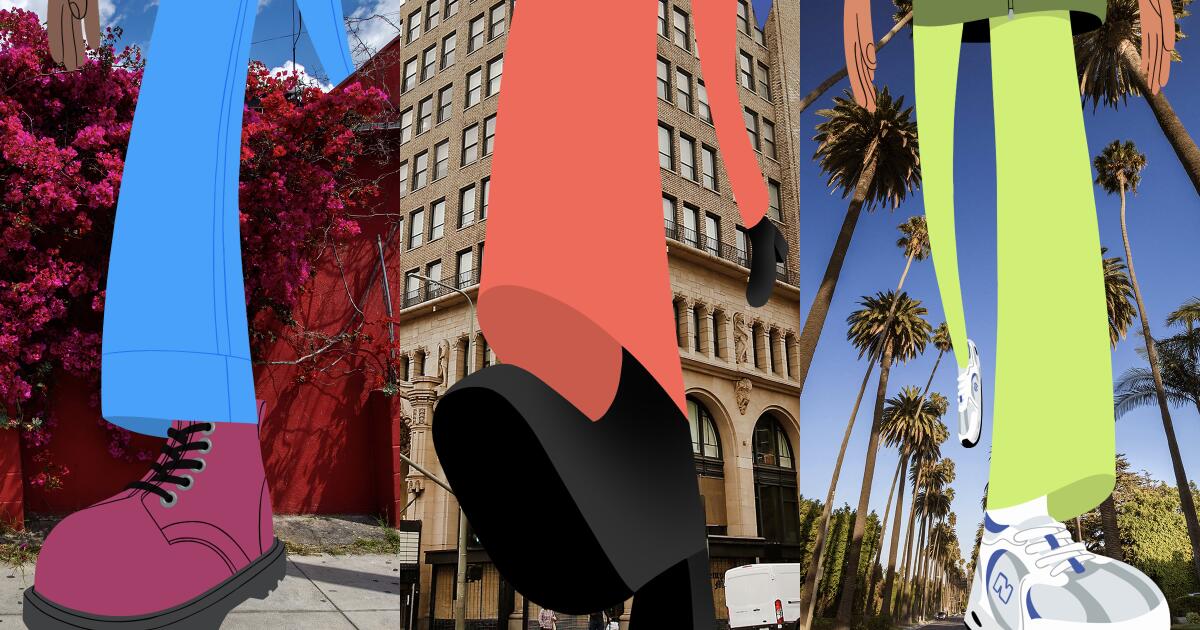
When it comes to “walkability,” L.A. gets a bad rap. To the weekend visitor, our city can seem like a maze of twisting freeways and roads built for cars, walled off to pedestrians. But those who really know L.A. can tell you it’s a pleasure to stroll through, replete with blooming bougainvillea, rich history and street vendors and shops. You just have to know where to look.

Lucky for you, we’ve put together a guide for exactly that. Discover the essential walking paths that will show you the best of L.A. Get to know local groups and leaders who are fusing community and exercise. Learn about the vast stretch of culture contained on one 27.4-mile boulevard. And connect with personal stories about the power of a good walk.

We’ll be publishing new stories on walking L.A. all week. C’mon, it’s time to get moving.

— Alyssa Bereznak, Wellness Editor

Advertisement
Photo of Rodeo Drive with an illustration of giant-sized person walking along the street.

From the Venice Boardwalk to Rodeo Drive and Boyle Heights’ Cesar E. Chavez Boulevard, these walks allow you to experience L.A.’s streets and sidewalks by foot.

Advertisement
Illustrated red converse shoes flexing
GLENDALE, CA - OCTOBER 11, 2024: Michael Schneider founded the Great Los Angeles Walk in 2006. The walk leads hundreds of Angelenos along the full length of an iconic boulevard each year. The 19th edition of the Great Los Angeles Walk returns on Saturday, November 23, 2024. (Robert Hanashiro / For The Times)

Michael Schneider founded the Great Los Angeles Walk in 2006. Now in its 19th year, it’s still going strong.

LOS ANGELES, CA - AUGUST 21, 2024 - A young visitor looks out over MacArthur Park Lake towards downtown Los Angeles on August 21, 2024. His father was just outside of frame. (Genaro Molina/Los Angeles Times)

Do you have a favorite neighborhood, trail or secret pathway to walk in Los Angeles? The Times wants to hear from you.

Advertisement
Illustrated tan Birkenstock sandals flexing
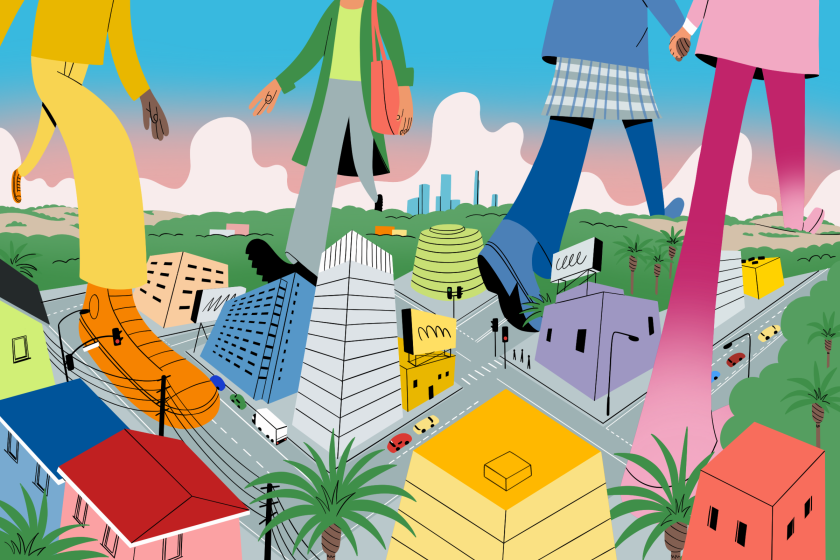
Colorful illustration of four giant people walking in an L.A.-based city and landscape

How walkable is your L.A. neighborhood? Consult our admittedly biased, wholly unscientific ranking that goes way beyond the numbers.

Advertisement
Illustrated pink and white new balance tennis shoes flexing
Photo collage of an industrial bridge over river, a pier, an astronaut mural, a street vendor cart and brunette person waving

Washington Boulevard runs from Whittier to Venice and is filled with every type of Angeleno. Walking it provided me with a genuine slice of life in L.A., a city I love.

Santa Monica, CA - November 03: Achilles Los Angeles guide Heather Cox, left, walks with Hsiu-ling Chang, center and Chae Won, right, during nonprofit walking/running group's monthly meetup on Sunday, Nov. 3, 2024 in Santa Monica, CA. The organization pairs people with disabilities with able-bodied people to walk in groups. (Brian van der Brug / Los Angeles Times)

These exercise-based social clubs cater to every interest and skill level — from stairclimbing to slow walking — and almost all them are free.

Advertisement
Illustrated blue Adidas tennis shoes flexing
Photo collage of 5 tall vertical images side by side of views from a hiking trail in L.A., and a woman posing on a mountain top

This solo hike has helped me process life’s hardest moments and become a staple of my life in L.A. After walking it over and over again, I feel more connected to nature — and myself.

Advertisement
Illustrated green Teva sandals flexing
two photos of a little free library, flipping back and forth

Plan your next walk around L.A.’s many Little Free Libraries, outposts found everywhere from Studio City to Pasadena that allow you to take a book and/or leave a book.

Advertisement
Pasadena, CA - October 08: Comedian Allan McLeod, left, walks and talks with actress Betsy Sodaro, right, as they cross a bridge at Hahamongna Watershed Park for his podcast, "Walkin' About" on Tuesday, Oct. 8, 2024 in Pasadena, CA. (Brian van der Brug / Los Angeles Times)

Comedian Allan McLeod hosts “Walkin’ About,” a podcast that celebrates the “complex and profound” act of traveling by foot in and around Los Angeles.

Advertisement
Illustrated black Prada platform loafer shoes
Venice Beach on Sunday, October 27, 2024.

Want to explore L.A. foot but don’t know where to go? Here’s our complete collection of city walking guides

Advertisement

Lifestyle

‘How to Rule the World’ explores education and power at Stanford University

Published

on

‘How to Rule the World’ explores education and power at Stanford University

Students walk on the Stanford University campus on March 14, 2019, in Stanford, Calif.

Ben Margot/AP


hide caption

toggle caption

Advertisement

Ben Margot/AP

When Theo Baker arrived at Stanford University a few years ago, he joined the student newspaper, following the path of his journalist parents, Peter Baker, a White House correspondent for The New York Times, and Susan Glasser, a writer for The New Yorker.

Through his reporting as a student journalist, he eventually broke a story about manipulated data in Stanford President Marc Tessier-Lavigne’s neuroscience research that helped lead to the university president’s resignation.

Theo Baker’s book, How to Rule the World: An Education in Power at Stanford University was released May 19. In it, Baker describes Stanford as a place where proximity to Silicon Valley gives rise to a parallel system of influence, recruitment and money, with investors looking to identify promising students almost as soon as they arrive on campus.

Advertisement

He told Morning Edition host Steve Inskeep there was “a sort of Stanford inside Stanford,” where elite students are drawn into an “alternate reality” of excess and access to cut corners.

In the interview, he discusses how Stanford is not just a university but also a pipeline where status and power can matter as much as ideas.

We reached out to Stanford University for comment and have not heard back.

Listen to the interview by clicking play on the blue box above.

Advertisement
Continue Reading

Lifestyle

OTB Takes Full Control of Viktor & Rolf

Published

on

OTB Takes Full Control of Viktor & Rolf
The Italian fashion group behind Diesel and Maison Margiela is taking full ownership of the avant-garde haute couture house, acquiring the remaining 30 percent it didn’t already own. Founders Viktor Horsting and Rolf Snoeren remain creative directors.
Continue Reading

Lifestyle

How having zero points in tennis — or ‘love’ — came to sound so sweet

Published

on

How having zero points in tennis — or ‘love’ — came to sound so sweet

The scoreboard shows the results of the women’s singles final match between Iga Swiatek of Poland and Amanda Anisimova of the U.S. at the Wimbledon Tennis Championships in London, Saturday, July 12, 2025.

Kirsty Wigglesworth/AP


hide caption

toggle caption

Advertisement

Kirsty Wigglesworth/AP

Fifteen points in tennis? Nice. Thirty, 40 — even better. Advantage — that sounds good. “Love” — that also must be great, right? Well, not quite.

As the French Open rolls on and Serena Williams has announced her return to the sport, maybe you’ve been paying a little more attention to tennis. The sport’s scoring system is notably distinct, and can sometimes be hard to grasp for newcomers. But even tennis aficionados might not know why, or how, “love” became the unmistakable callout for zero points. For this installment of NPR’s Word of the Week, we’re exploring how a word that signifies trailing behind got such a sweet name.

“Love” comes from the heart — or an egg?

It’s hard to pinpoint when the first tennis ball went over the net. Tennis is a derivative of lots of other sports, such as “jeu de paume,” a handball game played in France, said JT Buzanga, the collections manager at the International Tennis Hall of Fame museum.

Advertisement

But tennis became a patented, official sport in 1874, said Steve Flink, a journalist whose tennis coverage got him inducted into the International Tennis Hall of Fame. It has retained its unique, mysterious scoring system ever since.

“By and large, the original system has held up almost entirely,” Flink said.

The use of “love” goes back to the late 18th century, said Jesse Sheidlower, a lexicographer. But it was used earlier than that in card games such as whist and bridge. Before the term made its way to tennis, the sport favored plain old “nothing,” or “nil,” he said.

Why love in the first place, though? Historians don’t really know for sure, but there are a few theories.

The French could have something to do with it. Some historians believe “love” derives from “l’oeuf,” which means “the egg” in French. Because eggs are shaped like zeros, terms such as “goose egg” and “duck’s egg” have been used in other contexts to mean zero, Sheidlower said.

Advertisement

It’s also possible English speakers mispronounced l’oeuf as “love.” But Sheidlower isn’t convinced that’s the answer.

“It’s the French equivalent of an English expression. But since that expression doesn’t appear in French, the French word wouldn’t have been used,” he said.

To be sure, France has had a lot of influence on tennis culture, Buzanga said. For example, “deuce” or a game tied at 40 points, comes from the French word for “two”: “deux.” But he prefers another prominent theory: that “love” comes from the idiom “for the love of the game.” Even if a player hasn’t scored, it doesn’t matter, because their heart is in it. It’s the theory Sheidlower said is the most plausible, because the idiom was used by the English before tennis was popularized.

Another variation of the “love of the game” theory is that the word could have come from the Dutch “lof,” or “honor” — or the Latin “amare,” meaning “to love,” Flink said.

But if tennis’ “love” doesn’t come from a French word, the theory at least has a French sensibility.

Advertisement

“I think the ‘for the love of the game’ is kind of romantic,” Buzanga said.

“Love” probably isn’t going anywhere

Tennis used to be a sport of leisure. The style of play has changed a lot over the years; players are more athletic and competitive, for instance, Flink said. But the rules of the sport are more steadfast, he said.

“There’s this incredible, enduring respect for tradition in tennis,” he said. “Changes are not made easily.”

There has been one major change in modern history: the tie-break. Matches can go on and on because players have to score two consecutive points to break a deuce, or by two games to break a tied set. But the onset of television meant matches would have to get shorter if the sport wanted to capture a larger audience, Flink said.

Change even came for “love.” An alternative sprouted up in the 1970s, and is still used today: “bagel,” named for its zero shape, Sheidlower said. Novices may say “zero,” and insiders will understand what they mean, but they “will needle them about it,” Flink said.

Advertisement

But “love” still prevails.

“People kind of like it,” Flink said. “It’s different. Why say zero when you can say love?”

Continue Reading
Advertisement

Trending
