Lifestyle
Uzo Aduba thanks her mom: 'I didn't know how many prayers she sent up to heaven for me'
Aduba dedicates her new memoir to her mother, Nonyem Aduba. “My self-talk, the way that I motivate myself into pursuing this business … is built out of language that my mother had given me,” Aduba says.
Evan Agostini/Invision/AP
hide caption
toggle caption
Evan Agostini/Invision/AP
Roughly translated, actor Uzo Aduba’s first name — Uzoamaka — means “the road is good” in Igbo. But the Emmy Award-winning Orange Is the New Black actor says the essence of her name runs deeper: “It really means the journey was worth it.”
Aduba explains: Imagine planning to meet up at a friend’s house at 3:00 p.m., but it’s raining and you have a flat tire, and then there’s traffic and you run out of gas. So you wind up getting there almost two hours late. But as you arrive, the sun comes out. When the host asks how the trip was, you respond: “It was hard, but it’s worth it because I’m here now with you,” Aduba says. “Uzoamaka, the journey was worth it.’”
In her new memoir, The Road Is Good, Aduba recounts the winding path of her own life story. The daughter of Nigerian immigrants, Aduba grew up in the predominantly white suburb of Medfield, Mass.
“My mom used to do green, white, green beads for my sister and I in representation of the Nigerian flag,” Aduba says. “I thought those beads were great, and there would always be someone at school who had something to say about the beads in the hair.”
Whether it was comments about her hair or, in one case, being called the n-word, Aduba didn’t tell her parents what she faced at school because she didn’t want to trouble them. “I remember all of the stuff [my parents] had fought through and fought for,” she says. “And I didn’t want them to have to start fighting again.”
Aduba dedicates the memoir to her mother, Nonyem Aduba, who died from pancreatic cancer in 2020. “I knew that I was going to include her story [in the memoir] because so many of the tenets with which I live and motivators that display themselves in me come directly from her,” Aduba says. “She poured so heavily into my cup. My cup is ultimately filled with her.”
Aduba currently stars in the coming-of-age film, The Supremes at Earl’s All-You-Can-Eat.
Interview highlights
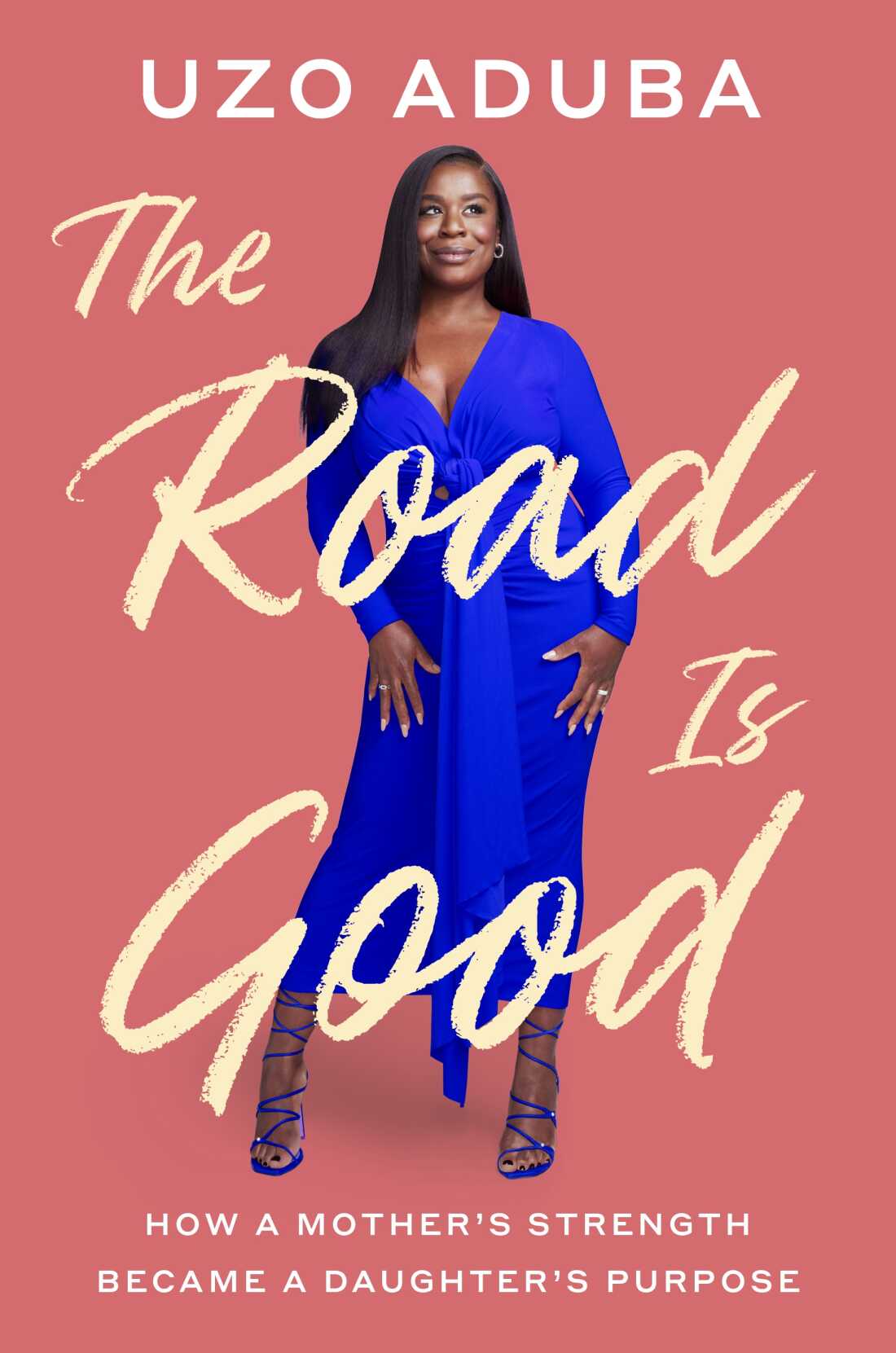
The Road is Good
Penguin Random House
hide caption
toggle caption
Penguin Random House
On the lessons she picked up from her mother
My self-talk, the way that I motivate myself into pursuing this business and going to audition after audition, the way I prepare for it, is built out of language that my mother had given me and my siblings since we were children. It’s her saying constantly to us, “I’ve never heard of nothing coming from hard work.” … And when we were kids, you hear that you’re like, “OK, She keeps saying that.” But then you grow up and you start to see life and you realize, No. 1, she’s living that. You see her through her own conduct, working hard and breeding results. Whether that’s keeping a roof over the head of five kids and bellies full, whether that’s having moved to this country and achieving not one but two masters in social work. Whether that is showing up and shuttling us to whichever activity that we needed to be at and then coming home after a long day’s work and cooking and getting everything ready to check homework, she worked hard and saw the impacts of that hard work. And I know that’s how I talk to myself. I say that expression even still.
On the journals her mother left behind
I was just looking at one yesterday I’ve not read, because I haven’t read them all. And I just opened a page and one of them was like, page 252. I’ve seen another one that’s, like, 400 [pages]. And she writes small. And then sometimes if she’s running out of pages, she takes a ruler and adds, splits the lines and then writes in there, so they’re really, really, really, really, really dense. And if she didn’t have her journal with her because she was traveling, there’s a paper clip held to the page of the entry because she wrote on a piece of paper that day’s event and then paper clipped it, so it’s sequential.
I’m still on the first one, which is like 500, 400 and something pages long. … It took me a minute to start. When I read the first page, I could feel her breath come back into her lungs and she was alive again, which felt very woo-woo intense.
On learning how much her mother prayed for her
Before I started working in film and television, I didn’t know how many prayers she sent up to heaven for me to have my dreams come true. She was just praying for, like, peace of mind. She was praying for my stability. … I didn’t know how much she worried for me, you know, always just that I would be OK.
And that’s true for my other siblings. She loved us so much. … I did not have a good mother. I did not have a great mother. I had an excellent mother. She took that pact, that initiation into that sacred circle so seriously, and it was everything to her to be our mother. And I am just so proud to be the daughter of Nonyem Aduba.
On when she realized she was different from the other kids in her town
I think it first started with my hair. My first real core memory is being in the third grade. And we had a neighbor who had really long brown hair, this girl down the street. And I can remember one day we were all playing in front of our house and I don’t know if we braided her hair, and then she decided to braid mine. I don’t know. But I just know she somehow was now getting ready to braid my hair. And she went to put her hands in my hair and she said, “Ewww, your hair is so greasy.” And there was grease in it because we’re laying down the front [for a ponytail] … And it had never occurred to me. To even attach the word “ewww” to it. … And from that I was also aware that it was different and I had never even thought of it as being different.
On her mom working at McDonalds when money was tight
We were in this community that they were scraping to keep us in and give us everything that they could and the American dream. … She was there because she’s trying to pay the bills. She wasn’t there for laughs, she was there to support her family. But me as a kid, I would love when we would go to the McDonald’s … right up the road, and we would go through the drive-thru and she would come and meet us there. And I thought it was the coolest thing.
And by the way, there’s nothing wrong with working at McDonald’s. It’s a job you can be proud of and take pride in. My mom was working there and she would come and we’d get Happy Meals. And because she was getting a discount, we would get so many more things than we would ever get [before]. …
I have a fond spot in my heart for McDonald’s because that helped carry our family through some tough times. … [My mom] was so fiercely protective of her family and would do anything — and I do mean anything — for us. … [She] was not ever too proud to do any job, and didn’t think she was above anything — despite knowing she had graduated with distinction with two masters degrees. She was not too proud to do what she needed to do.
Sam Briger and Joel Wolfram produced and edited this interview for broadcast. Bridget Bentz, Molly Seavy-Nesper and Beth Novey adapted it for the web.

Lifestyle
Make Way for the Investment Bank Influencers
It’s 5:30 a.m. Allison Sheehan switches on the light in the bathroom of her New York City apartment and stretches in front of the mirror. “Welcome back to another morning in the life of an ‘investment baker,’ which means someone who works at an investment bank but also makes cakes,” she says at the beginning of the video, which she uploaded to TikTok in early 2025.
Tying an apron over her pajamas, Ms. Sheehan, now 26, proceeds to pipe lilac buttercream ruffles on a heart-shaped funfetti cake she had baked the night before.
At 6:50, she heads to the gym, filming herself doing crunches before heading home to shower, put on makeup and pick out an outfit. By 8:20, Ms. Sheehan heads to her wealth management job, at Goldman Sachs (she didn’t reveal the name of the bank in her videos while employed there).
In 2023, Ms. Sheehan, who has since made cakes for brands including Goop and LoveShackFancy as well as the model Gigi Hadid, was posting on social media as “The Investment Baker,” a persona she created for her custom-cake business, Alleycat.
On her Investment Baker Instagram and TikTok pages, Ms. Sheehan posted familiar influencer content like “What I eat in a week” and day-in-the-life videos, along with breakdowns of her corporate wardrobe. At the time, her DMs were inundated both with cake orders and with young women seeking advice on how to break into finance.
The finance industry remains one of the most sought-after sectors for college graduates. In 2025, Goldman Sachs saw 360,000 students competing for just 2,600 internships — up 15 percent from the previous year. It has also historically insisted that employees maintain a low profile on the internet. Ms. Sheehan was careful never to disclose the bank at which she worked in her videos, and she never filmed herself in the office, per her employer’s rules. In fact, she never discussed finance much at all. Still, the tension between the “two worlds of baking and being a financier was the whole allure,” Ms. Sheehan said.
Yet Ms. Sheehan was informed that her baking content was seen as a “reputational risk” for the firm. She was instructed to delete every post on her TikTok and Instagram and to change her handle so that it made no reference to the word “investment.” When Ms. Sheehan drew comparisons to the firm’s chief executive, David Solomon, who moonlights as a D.J., she was told she could not compare herself to him. She pushed back, saying that the firm’s policy should apply to everyone. “It doesn’t work like that,” she said she was told.
Like Ms. Sheehan, Sahilee Waitman, 28, used the fact of her employment at an investment bank as a hook for her TikTok videos. Ms. Waitman moved to New York City from Amsterdam to work in compliance at an investment bank in 2023. She soon started posting day-in-the-life content, detailing everything from her workouts to what she ate for lunch, with the goal of building financial autonomy outside her corporate role. Both women were clear that while they worked at investment banks, they were not investment bankers, often a point of contention or confusion in the comments section.
The New York Times reached out to many of the investment bank employees on TikTok, but they declined to comment for this article, fearing the risk to their reputation. The New York Times also reached out to 14 different banks, among them Goldman Sachs, but none responded to requests for comment regarding the matter of social media use among employees.
Despite these fears, investment banking content is going viral across social media. Nearly 60,400 videos tagged #investmentbanking have appeared on TikTok in recent years. Time-stamped 100-hour work weeks and late-night keyboard A.S.M.R. regularly draw hundreds of thousands of views on TikTok. Part of the appeal is that influencers offer a more realistic depiction of the world of work than can be gleaned from shows like “Industry” on HBO or from actual recruitment events.
Ms. Sheehan was determined to show that even bankers could have a life outside work. In October 2024, a year after posting her first video, a meeting with her manager appeared unexpectedly on Ms. Sheehan’s calendar. At first, she thought it might be good news. But the excitement was short-lived when she was greeted by three compliance officers. “We see you have an online persona called ‘The Investment Baker,’” she recalled them saying.
At present, there is no widely agreed-upon policy regarding employees’ personal social media use. The Financial Industry Regulatory Authority, the largest independent regulator for brokerage firms in the United States, and the Securities and Exchange Commission, a government agency that regulates the entire U.S. securities industry, have rules and guidance dictating that employees cannot share any information that is deemed confidential or in any way sensitive. But how firms apply their own internal policy is at their discretion.
Hannah Awonuga, the former head of colleague engagement at Barclays U.K. and a cultural transformation and inclusion consultant, sees both parties as at risk. Employees might find themselves on the wrong side of human resources. For employers, “once you allow staff to post freely,” she said, “you run the risk that they might express an opinion on a Saturday that goes against your values.”
For decades, “workism” — the belief that work is central to one’s identity — has infiltrated the American ethos, particularly for many city dwellers, whose hobbies and leisure activities can fall by the wayside. Increasingly, younger workers are pushing back, demanding a healthier work-life balance and actively working to decouple their identity from their careers.
The world of high finance is one of the last sectors to catch up. “Once you work in these industries,” Ms. Waitman said, “you’re essentially taught to choose one lane.” You are either a “serious professional,” she said, or a “creative.” “I just don’t believe those things are mutually exclusive,” she added.
Ms. Waitman, who is Black, hoped that by posting on TikTok, she would be promoting diversity in the industry. She received the occasional negative comment, insisting she must be a “secretary,” but a majority of her messages were positive, she said, and came from other women seeking her advice about pursuing careers in finance.
At the time, Ms. Waitman did not receive pushback from her employer on her videos, though she made sure to declare any outside business activity to compliance and her director. “I think firms are just now catching on to this,” Ms. Waitman said. “Once they find out, you have compliance on your neck.”
A recent glossy fashion spread in Interview Magazine entitled “Meet the Finest Boys in Finance” highlighted what can happen when young finance professionals attract the wrong kind of publicity. The designer-heavy photo shoot was mocked and meme-ified online for violating Wall Street’s sacrosanct rule against flashiness.
Across social media, some women were quick to point out the double standard at play. “But women get fired from Goldman for being influencers …” read one comment left on a TikTok video about the spread.
In fact, many of the people posting influencer-like content are young women, which is at odds with the traditionally male-dominated world of high finance.
A spokesperson for Goldman Sachs told Bloomberg that the interviews in Interview Magazine were not approved by the firm.
After the compliance meeting, Ms. Sheehan did as she was instructed and archived all her social media posts. Three months later, though, she put them back up. “I didn’t see my posts as a violation of the bylaws,” she said. Immediately, another meeting with compliance landed on her calendar. This time, her cake business was taking off, and Ms. Sheehan decided to hand in her resignation. (Goldman Sachs did not respond to requests for comment.)
As banks are forced to iron out their policies in an ever more online world, workers sharing the minutiae of their days is likely to become an increasing headache for compliance. “If you have five followers, there’s no need to make anyone aware,” Ms. Awonuga said. But, she added, “as more Gen Z’s come into the workplace and grow in their roles, I just don’t know how feasible it becomes to say you’re not allowed a social media presence.”
Ms. Sheehan, meanwhile, has no regrets. “I cannot believe,” she said, “that they were concerned about me making pink cakes when people are insider trading.”
Lifestyle
She’s the so-called Womb Witch of L.A. Here’s why her clients keep returning
Leigh McDaniel always knew she was destined to become a witch. Growing up in Hawaii, she came from a long line of “kitchen witches,” she explains — women who intuited measurements, spices and when a cake was done from the next room. “There was always a part of me that was like: Yeah, I’m a witch,” says McDaniel from her California sun-soaked studio.
Today, McDaniel — who calls herself a “womb witch”— practices a different kind of magic: pelvic care bodywork. Based in a bright studio in Glendale, McDaniel serves clients of all genders. Before each session, McDaniel invites clients to share their personal histories, and then McDaniel performs bodywork through touch as sage smoke curls in the air.
“A person who left today had their first session and was like, ‘I’m so much lighter in my body,’” McDaniel says.
McDaniel’s work is rooted in holistic pelvic health and touch therapy, which she discovered after giving birth to her second child at age 46. Before her daughter was born, McDaniel says she met her in a dream. The child introduced herself as “Luna.” The name stuck. After her birth, McDaniel theorized that her daughter had “reorganized her pelvic bowl.” When she sought out answers from her midwife and OB-GYN, they were dismissive; the experience prompted her to explore alternative care.
“It sent me down a few rabbit holes,” McDaniel says. “Previously, I had studied naturopathy with the intention of going to a naturopathic school — herbalism, Reiki and light touch therapy.”
Leigh McDaniel says that after one session her clients often feel an immediate shift in their bodies.
(Dania Maxwell / For The Times)
While body wisdom and alternative healing are framed as part of the Goop-conscious modern wellness movement, McDaniel explains that these practices are not new. She cites Ubuntu, a South African philosophy that informs her healing approach. “Indigenous practices knew how to hold people in trauma,” she says. “We’re only just beginning to figure it out.”
After an explanation of the nervous system, consent and the pelvic floor, her sessions begin with McDaniel burning sage or mugwort while the client is on the table. She asks for consent before touching the client and offers a prayer or blessing. McDaniel explains she’s feeling for energy before moving on to the abdomen, where she applies various levels of pressure. She compares it to a guided meditation as she incorporates breathwork while asking clients to breathe into her fingers. She emphasizes that the client controls the pace and asks for consent at each step.
“I think consent and boundaries are so critical to taking care of your body,” she says.
The intimate nature of McDaniel’s practice has garnered attention — and occasional skepticism. Comedian Ali Macofsky, for example, says with a smile, “I go in person to this womb witch,” on “The Endless Honeymoon” podcast. The hosts are baffled and intrigued. Macofsky adds, “It feels very old school the way women have to go through things.”
Macofsky discovered Leigh through actor and comedian Syd Steinberg who highly recommended her work. “I went to help with some CPTSD [complex post-traumatic stress disorder] and TMJ [temporomandibular joint] pain and she helped,” says Steinberg. “She really is a miracle worker.”
Macofsky was intrigued by the whimsical title of “Womb Witch.” “I was like, I’ll make an appointment and see what happens.” After a phone call, McDaniel explained that she helped clients with physical intimacy and sexual trauma through bodywork. The comedian was hooked.
Macofsky notes that in a culture where female pleasure is not prioritized, it’s hard to know where to seek advice. After a session with Leigh where she discussed advocating for oneself sexually, Macofsky began to see the results take hold in surprising ways. “It’s helping me in other areas where normally I’d be uncomfortable to advocate for myself or speak up about what I want.”
Clients seek out the womb witch for a variety of reasons. Some report physical discomfort during sexual encounters, while others come after experiencing sexual assault, abuse or consent violation. At other times, clients may experience stiffness or pain that McDaniel believes may be a reaction to trauma.
Her session also focuses on sexual health. McDaniel gives her clients a tutorial on pleasure anatomy and consent, most recently teaching sexual health lessons to a gathering in Silver Lake. “I like to show a lot about the pleasure anatomy, the mobility of the uterus, and where the cervix is at different times of the month,” she explains.
McDaniel argues that pleasure is an important part of daily life. “Female pleasure is finally being noticed,” she says. “Pleasure is a birthright. There’s pleasure and there’s grief. To be full-spectrum humans, we need to be feeling pleasure.” McDaniel cites that recent studies claim the clitoris has 10,000 nerve endings.
Leigh McDaniel holds a bowl of coconut and castor oil that she often uses with clients.
(Dania Maxwell / For The Times)
McDaniel says that everyday stress — including sexual harassment and misogyny — manifests in the body, often leading to chronic pain. “In patriarchy, the comments land in your body, and you find yourself bracing every time you pass them,” she says. “They can seem so small and harmless, but even those little things add up. They’re felt. It’s part of feeling unsafe in the world.”
Though many people struggle to navigate the American healthcare system, more Americans are turning to a spiritual wellness approach. The National Institutes of Health reports that holistic care methods such as meditation, acupuncture and yoga have grown significantly in recent years. Ancient Chinese medicine techniques have gone viral on TikTok, capturing the attention of Gen Z. “People are more willing to look outside the Western medicine model,” McDaniel explains. “I have people that come here to see me because of medical trauma too.”
Dr. Tanaz R. Ferzandi, director of urogynecology and reconstructive pelvic surgery at Keck Medicine of USC, believes that holistic medicine can be a potent adjunct to more traditional remedies. She has recommended acupuncture to her patients who have experienced sexual trauma. “The whole idea of acupuncture is you’re lying there, and coming to peace with yourself and your body,” she explains. “It’s a forced therapy where you can be alone with yourself and shut out the rest of the world.”
Simultaneously, Ferzandi believes a healthy amount of skepticism is good. “We have to stay scientific — what’s the evidence behind it? As long as women understand that we don’t know if there’s data to support some of the things they’re doing,” she says. “I’m very cautious about touting certain things that are somehow going to be a panacea.”
McDaniel’s explains its rare she encounters skeptics at her practice. “I never try to convince anyone to come in for a session,” she says. “There are scientific studies on the efficacy of different types of work that are adjacent to, or similar to what I do, but nothing exact.”
She acknowledges elements of her work are difficult to quantify. “There is also a mysterious space between bodies, the client and myself, where something happens that I cannot really explain, but it feels magical,” she says. “I don’t think any of this would convince anyone who is inherently skeptical though.”
McDaniel views her daughter Luna’s birth as the inciting incident into her true calling — becoming the “Womb Witch.” “Everything that happened to my own body after her birth, it was a calling to do this,” she says. “I’ve done so many things, and this is the first time I really feel settled in what I do.”
Lifestyle
N.F.L. Style Will Never Beat N.B.A. Style
You want to see some real fashion ingenuity? Watch the N.F.L. draft.
I’m not saying it’s all good, but where else are you going to see someone in a double-breasted suit made by a company better known for making yoga pants? Or an Abercrombie & Fitch suit jacket so short that it exposes the belt loops on the pants beneath?
On the whole, the style on display at the N.F.L. draft last night was very overeager senior formal: a lot of suits in colors beyond basic blue. The quarterback Ty Simpson wore a custom suit by the athleisure label Alo, which, I have to say, looked better than I would have envisioned had you said the words “Alo Yoga suit” to me.
I thought it might have been from Suitsupply, but the conspicuous “Alo” pin on his right lapel put that idea to rest. Simpson, smartly, unfastened that beacon before appearing onstage as the 13th pick to the Los Angeles Rams. He had, perhaps, satisfied his contractual obligations by that point.
Earlier in the evening, as the wide receiver Carnell Tate threw up his arms in exaltation after being picked fourth by the Tennessee Titans, his cropped Abercrombie & Fitch jacket revealed a swatch of rib cage. He looked like a mâitre d’ who had just hit the Mega Millions.
During the N.B.A.’s extended fashion awakening, its draft has become a sandbox for luxury brands to cozy up to would-be endorsers. The Frenchman Victor Wembanyama broke a kind of cashmere ceiling when he wore Louis Vuitton to go first overall in the 2023 N.B.A. draft.
The N.F.L. draft has none of that. The brands you see are often not brands at all, but custom tailors that reach the league’s neophytes through a whisper network among players. The draft is also a platform to raise the curtain on longer-term brand deals that better suit these rookies. We may, for instance, never see Simpson in a suit again. Nearly every photo from his time at Alabama shows him in a T-shirt or hoodie. It makes sense for him to sign with Alo.
Football is the most mainstream of American cultural entities. And it’s one that still hasn’t, in spite of the league’s best efforts, taken off overseas. Few players, save some quarterbacks and a tight end who happens to be engaged to a pop star, feel bigger than the game itself. If you’re a new-to-the-league linebacker, you’ll most likely never harness the star power to grab the attention of Armani, but you might have just the right pull for Abercrombie.
The N.F.L. draft is therefore one of the few red carpets where the brands worn by the athletes may also be worn by those watching at home. How many people watching the Oscars will ever own clothes from Louis Vuitton or Chanel? People may comment online about Lady Gaga wearing Matières Fécales to the Grammys, but how many of those fans and viewers could afford to buy clothes from it?
The Japanese designers changing fashion
Yesterday, I published a deep dive into how a newish crop of Japanese designers are soaking up all the attention in men’s fashion right now. This was a piece I was writing in my head long before I sat down and finally started typing. I remember sitting at a fashion show in Paris over a year ago — I believe it was Dior — and being asked by my seatmate if I’d made it over to a showroom in the Marais to check out A.Presse. That Tokyo-based brand is now part of a vanguard of Japanese labels that, on many days, seems to be all anyone in fashion wants to talk about. I spent months talking with designers, store owners and big-time shoppers to make sense of why these brands have kicked up so much buzz and, more than that, what makes their clothes so great. You can read the story here.
Other things worth knowing about:
-
Alaska5 minutes ago‘The birds are a global citizen’: Indigenous groups in Australia and Alaska team up to track a feathered adventurer’s epic journey
-
Arizona11 minutes agoBears NFL Draft 2026: Chicago selects Keyshaun Elliott, Arizona State, LB
-
Arkansas17 minutes ago
2026 NFL Draft: Browns select Arkansas QB Taylen Green at No. 182 overall
-
California23 minutes agoBudget Rent a Car heiress assaulted and strangled during a California home invasion
-
Colorado29 minutes agoColorado’s Serene Mountain Lake Is A Deep-Blue Vacation Haven For Camping, Paddling, And Fishing – Islands
-
Connecticut35 minutes agoRain showers slowly spread east today and tonight
-
Delaware41 minutes agoFort Delaware Debuts Fort Fest for 75th Anniversary – State of Delaware News
-
Florida47 minutes ago
Colts select Florida defensive end George Gumbs Jr. in fifth round of 2026 NFL Draft
