Lifestyle
This is genius: A new graphic novel imagines conversations between Einstein and Kafka

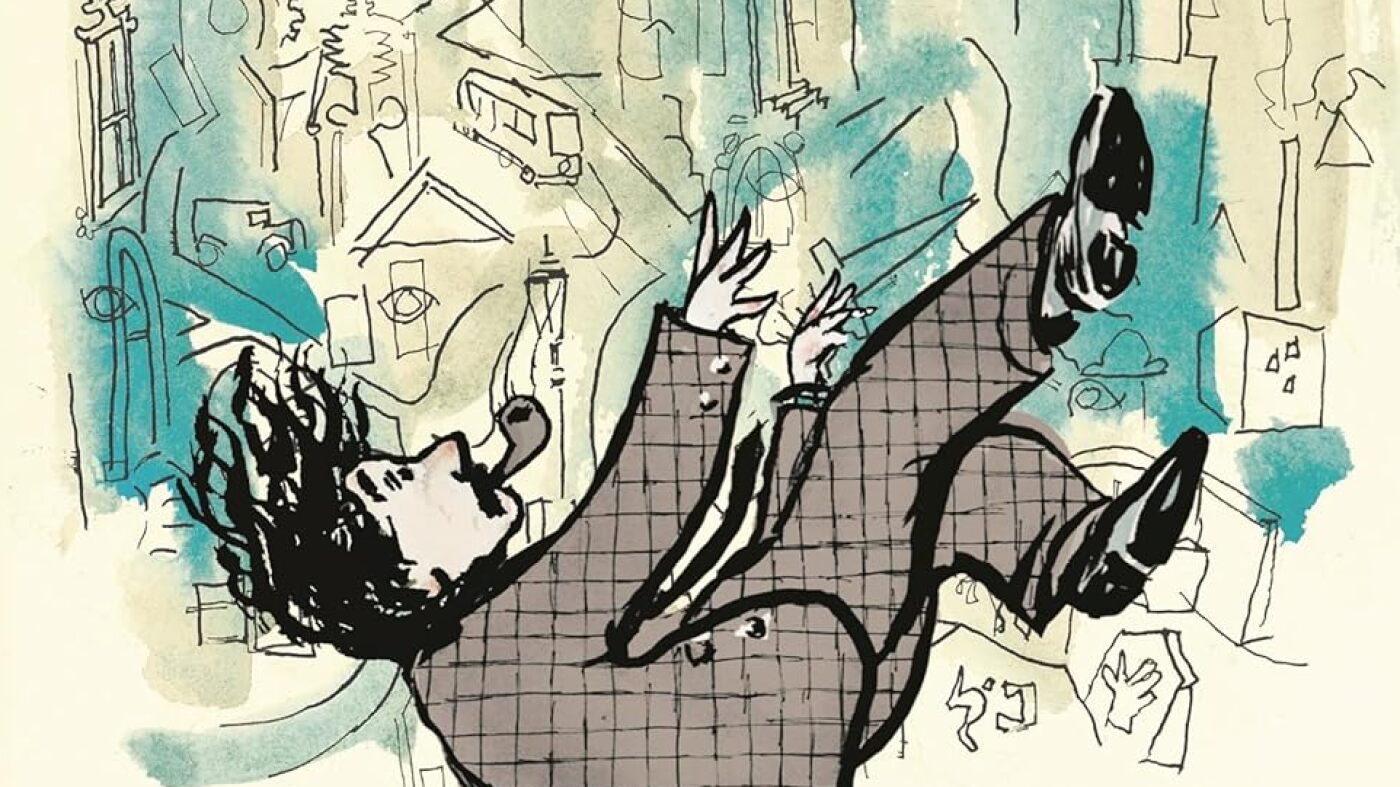
Turns out Albert Einstein and Franz Kafka lived in Prague at the same time and had the same circle of friends. In the new graphic novel, Einstein in Kafkaland, Ken Krimstein puts us in the room with two 20th century geniuses.
Ken Krimstein/Bloomsbury Publishing
hide caption
toggle caption
Ken Krimstein/Bloomsbury Publishing
It’s April 1, 1911, and 32-year-old Albert Einstein — former bureaucrat at the Swiss Patent Office, with a half-decade old doctorate in physics from the University of Zurich — sits in a train car with his two sons and his wife, fellow physicist and mathematician Mileva Marić. They are travelling from Zurich to Prague, where Einstein has landed a job as a full professor in theoretical physics, teaching in the German section of what is now Charles University. He has a few things on his mind, including money troubles, but most critical is his unfinished theory of relativity. When they leave the city 15 months later, Einstein will have cracked the code.
What happens over the course of this long, mysterious year in Prague is the question driving Ken Krimstein’s new graphic novel Einstein in Kafkaland. Part biography, part historical fiction, Krimstein playfully explores the possibilities, building, with footnotes, on a thorough archive of letters, diaries, and other research. The result, a thought-provoking work made up of comics suffused in a gentle mix of aquamarine watercolors, is equal parts joyful and ruminative. (Think: Alice in Wonderland meets The Lives of the Poets meets Krazy Kat.) The full subtitle to the book — How Albert Fell Down the Rabbit Hole and Came Up with the Universe — signals the lavish whimsy that goes a long way towards making this such a delightful, inspiring read.

Throughout, cartoon-Einstein sports his characteristic pipe alongside a signature frizzy head of hair. But it’s his obsessive ruminations that perhaps most effectively signal what has become Einstein-the-character, a culmination of all the gossip, public appearances, private words, and first-hand accounts of one of the best-known scientists to have ever lived. Krimstein pairs Einstein’s story with that of Franz Kafka, who was 28, virtually unpublished, and living with his parents in a house in Prague when Einstein arrived for his short but impactful stay. What binds the two together, in addition to an alleged one-time meeting at a weekly salon, is a complementary preoccupation with getting at the truth — “the true truth” — against all odds, and against many other people’s better judgements. For both, a journey to find this truth, whether in science or literature, is one that will sometimes alienate as painfully as it may ultimately bind them to others.
During Einstein’s time in Prague, a time in which he works out his theory of relativity, Kafka will have his own breakthrough. In one long feverish night he will pen the short story, most often known in English as “The Judgment,” which will launch an unparalleled writing career forever transforming art and literature. Like Einstein’s completed theory of relativity, Kafka, too, will offer the world a new way of thinking. It’s a way of thinking that, our narrator assures us, “we’re all still struggling to catch up to.”

Einstein in Kafkaland: How Albert Fell Down the Rabbit Hole and Came Up With the Universe by Ken Krimstein
Ken Krimstein/Bloomsbury Publishing
hide caption
toggle caption
Ken Krimstein/Bloomsbury Publishing
Despite his title, Krimstein centers his book unevenly, focusing mainly on Einstein, and taking us step by step through the meditations that lead to his discovery. Nonetheless, along the way he also provides readers with glimpses into the life of the perpetually melancholic insomniac insurance clerk, Kafka. We witness, for example, an early morning swimming routine with his best bud — and future literary executor — Max Brod. But what Kafka’s presence in the narrative most crucially enables are imagined conversations between him and Einstein. In these, the two puzzle, and sometimes commiserate, over what it means to see the world differently from everyone else. What happens when you believe so confidently in your own hard-won perceptions that you risk killing the heroes that brought you there?
Krimstein, a well-published cartoonist whose previous work includes another delightful graphic biography, The Three Escapes of Hannah Arendt, luxuriates in intellectual history shoulder to shoulder with juicy biographical details. He depicts Einstein debating with his foe, Max Abraham; taking fantastical trips into a four-dimensional world with Euclid; and walking and talking with Austrian physicist, and dear friend, Paul Ehrenfest. And he exposes, too, scenes of the future Nobel Prize winner in the bath, trying to kill off bedbugs; or engaging with his young children, and wife, in Gedankenexperiments (thought experiments), to help him think through the problems that continually occupy him.
At its heart, Einstein in Kafkaland is the story of ordinary genius. It unwraps the ways in which genius so often arises out of ordinary circumstances. Perhaps even more compellingly, the book tracks how unimaginable discoveries develop following exchanges with others — friends and family, colleagues and nemeses, neighbors and role models. Aberrations aside, works of genius most wholly emerge in dialogue.
Tahneer Oksman is a writer, teacher, and scholar specializing in memoir as well as graphic novels and comics. She lives in Brooklyn, N.Y.




“You kinda have this Wednesday Addams vibe going on.”
I shrieked.
I was wearing my best armor: a black dress that accentuated my curves, a striped bolero to cover the arms I’ve resented for years and black platform sandals displaying ruby toes. My dark hair was in wild, voluminous curls and my sultry makeup was finished with an inviting Chanel rouge lip.
I would’ve preferred the gentleman at the speed dating event had likened my efforts to, at least, Morticia, a grown woman. But in this crowd of men and women ages ranging from roughly 21 to 40, I suppose my baby face gave me away.
My mind flitted back to a conversation I had with my physical therapist about modern love: Dating in L.A. has become monotonous.
The apps were oversaturated and underwhelming. And it seemed more difficult than ever to naturally meet someone in person.
She told me about her recent endeavor in speed dating: events sponsoring timed one-on-one “dates” with multiple candidates. I applauded her bravery, but the conversation had mostly slipped my mind.
Two years later, I had reached my boiling point with Jesse, a guy I met online (naturally) a few months prior who was good on paper but bad in practice.
Knowing my best friend was in a similar situationship, I found myself suggesting a curious social alternative.
Much of my knowledge of speed dating came from cinema. It usually involved a down-on-her-luck hopeless romantic or a mature workaholic attempting to be more spontaneous in her dating life, sitting across from a montage of caricatures: the socially-challenged geek stumbling through his special interests; the arrogant businessman diverting most of his attention to his Blackberry; the pseudo-suave ladies’ man whose every word comes across rehearsed and saccharine.
Nevertheless, I was desperate for a good distraction. So we purchased tickets to an event for straight singles happening a few hours later.
Walking into Oldfield’s Liquor Room, I noticed that it looked like a normal bar, all dark wood and dim lighting. Except its patrons flanked the perimeter of the space, speaking in hushed tones, sizing up the opposite sex.
Suddenly in need of some liquid courage, we rushed back to the car to indulge in the shooters we bought on our way to the venue — three for $6. I had already surrendered $30 for my ticket and I was not paying for Los Angeles-priced cocktails. Ten minutes later, we were ready to mingle.
The bar’s back patio was decked out with tea lights and potted palm plants. House-pop music put me in a groove as I perused the picnic tables covered with conversation starters like “What’s your favorite sexual position?” Half-amused and half-horrified, I decided to use my own material.
We found our seats as the host began introductions. Each date would last two minutes — a chime would alert the men when it was time to move clockwise to the next seat. I exchanged hopeful glances with the women around me.
The bell rang, and I felt my buzz subside in spades as my first date sat down. This was really happening.
Soft brown eyes greeted me. He was polite and responsive, giving adequate answers to my questions but rarely returning the inquiry. I sensed he was looking through me and not at me, as if he had decided I wasn’t his type and was biding his time until the bell rang. I didn’t take it personally.
Bachelor No. 2 stood well over six feet with caramel-brown hair and emerald eyes. He oozed confidence and warmth when he spoke about how healing from an accident a few years prior inspired him to become a physical therapist.
I tried not to focus on how his story was nearly word-perfect to the one I heard him give the woman before me. He offered to show me a large surgery scar, rolling up his right sleeve to reveal the pale pink flesh — and a well-trained bicep. Despite his obvious good looks and small-town charm, something suspicious gnawed at me. I would later learn he had left the same effect on most of the women.
My nose received Bachelor No. 3 before my eyes. His spiced cologne quickly engulfing my senses. He had a larger-than-life presence, seeming to be a character himself, so I asked for his favorite current watch.
“I love ‘The Summer I Turned Pretty,’” he actually said.
“Really?”
“Oh yeah, it’s my favorite. Oh, and ‘Wednesday.’ You kinda have this Wednesday Addams vibe going on.”
I was completely thrown to hear this 40-something man’s favorite programs centered around teenage girls, and by his standards, I resembled one of them. Where was the host with the damn bell?
Although a few conversations clearly left impressions, most of the dates morphed into remnants of information like fintech, middle sibling, allergic to cats, etc. Perhaps two minutes was too short to spark genuine chemistry.
After a quick lap around the post-date mingling, we practically raced to the car. A millisecond after the doors closed, my friend said, “I think I’m going to call him.” I knew she wasn’t referring to any of the men we met tonight. The last few hours were all in vain. “And you should call Jesse.”
I scoffed at her audacity.
When I arrived home and called him, it only rang once.
The following three hours of witty banter and cheeky innuendos were bliss until the call ended on a low note, and I remembered why I tried speed dating in the first place.
Jesse and I had great chemistry but were ultimately incompatible. He preferred living life within his comfort zone while I craved adventure and variety. He couldn’t see past right now, and I was too busy planning the future to live in the moment.
Still, in a three-hour call, long before the topic of commitment soured things, we laughed at the mundanity of our day, traded wildest dreams for embarrassing anecdotes, and voiced amorous intentions that would make Aphrodite’s cheeks heat.
Why couldn’t I have had a conversation like that with someone at the event?
It’s possible I was hoping to find the perfect replica of my relationship with Jesse. But when I had the opportunity to meet someone new, I reserved my humor and my empathy.
Also, despite knowing Jesse and I weren’t a good match, I thought we had a “chance connection” that I needed to protect. In reality, if I had shown up to speed dating as my complete self, that would have been more than enough to stir sparks with a new flame.
It would be several more weeks before I was ready to release my attachment to Jesse. But when I did, I had a better appreciation for myself and my capacity for love.
The author is a multidisciplinary writer and mother based in Encino.
L.A. Affairs chronicles the search for romantic love in all its glorious expressions in the L.A. area, and we want to hear your true story. We pay $400 for a published essay. Email LAAffairs@latimes.com. You can find submission guidelines here. You can find past columns here.
Editor’s note: On April 3, L.A. Affairs Live, our new storytelling competition show, will feature real dating stories from people living in the Greater Los Angeles area. Tickets for our first event will be on sale starting Tuesday.

Warner Bros. Discovery said Thursday that it prefers the latest offer from rival Hollywood studio Paramount over a bid it accepted from Netflix.
Bloomberg/Bloomberg via Getty Images/Bloomberg
hide caption
toggle caption
Bloomberg/Bloomberg via Getty Images/Bloomberg
The Warner Bros. Discovery board announced late Thursday afternoon that Paramount’s sweetened bid to buy the entire company is “superior” to an $83 billion deal it had struck with Netflix for the purchase of its streaming services, studios, and intellectual property.
Netflix says it is pulling out of the contest rather than try to top Paramount’s offer.
“We’ve always been disciplined, and at the price required to match Paramount Skydance’s latest offer, the deal is no longer financially attractive, so we are declining to match the Paramount Skydance bid,” the streaming giant said in a statement.
Warner had rejected so many offers from Paramount that it seemed as though it would be a fruitless endeavor. Speaking on the red carpet for the BAFTA film awards last weekend, Netflix CEO Ted Sarandos dared Paramount to stop making its case publicly and start ponying up cash.
‘If you wanna try and outbid our deal … just make a better deal. Just put a better deal on the table,” Sarandos told the trade publication Deadline Hollywood.
Netflix promised that Warner Bros. would operate as an independent studio and keep showing its movies in theaters.
But the political realities, combined with Paramount’s owners’ relentless drive to expand their entertainment holdings, seem to have prevailed.
Paramount previously bid for all of Warner — including its cable channels such as CNN, TBS, and Discovery — in a deal valued at $108 billion. Earlier this week, Paramount unveiled a fresh proposal increasing its bid by a dollar a share.
On Thursday, hours before the Warner announcement, Sarandos headed to the White House to meet Trump administration officials to make his case for the deal.

The meetings, leaked Wednesday to political and entertainment media outlets, were confirmed by a White House official who spoke on condition he not be named, as he was not authorized to speak about them publicly.
President Trump was not among those who met with Sarandos, the official said.
While Netflix’s courtship of Warner stirred antitrust concerns, the Paramount deal is likely to face a significant antitrust review from the U.S. Justice Department, given the combination of major entertainment assets. Paramount owns CBS and the streamer Paramount Plus, in addition to Comedy Central, Nickelodeon and other cable channels.
The offer from Paramount CEO David Ellison relies on the fortune of his father, Oracle co-founder Larry Ellison. And David Ellison has argued to shareholders that his company would have a smoother path to regulatory approval.
Not unnoticed: the Ellisons’ warm ties to Trump world.

Larry Ellison is a financial backer of the president.
David Ellison was photographed offering a MAGA-friendly thumbs-up before the State of the Union address with one of the president’s key Congressional allies: U.S. Senator Lindsey Graham of South Carolina, a Republican.
Trump has praised changes to CBS News made under David Ellison’s pick for editor in chief, Bari Weiss.
The chair of the Federal Communications Commission, Brendan Carr, told Semafor Wednesday that he was pleased by the news division’s direction under Weiss. She has criticized much of the mainstream media as being too reflexively liberal and anti-Trump.

“I think they’re doing a great job,” Carr said at a Semafor conference on trust and the media Wednesday. As Semafor noted, Carr previously lauded CBS by saying it “agreed to return to more fact-based, unbiased reporting.”

‘The Wire’ Star Bobby J. Brown
He’s Trapped Inside Barn Fire!!!
Listen To Dispatch Audio
Published
Broadcastify.com
Here’s the dispatch audio from the fatal barn fire that killed “The Wire” actor Bobby J. Brown … and you hear dispatchers saying he’s trapped in the building after trying to start an old Cadillac.
TMZ obtained the dispatch audio, which also reveals Bobby’s wife called for help. It sounds like a huge inferno, the barn is 50-feet-by-100 and — by the end of the call — it’s all up in flames.

We broke the story … Bobby died Tuesday from smoke inhalation. The deadly fire started after Bobby entered the barn to jump-start a car. His wife suffered severe burns trying to save him.
Bobby played Officer Bobby Brown on the hit HBO series “The Wire” … and his other credits include “Law & Order: SVU” and “We Own This City.”
He was 62.

Anthony Richardson free to seek trade after injury setbacks amid Colts’ shift to Daniel Jones

300,000 Chrome users hit by fake AI extensions
Commentary: How Trump helped foreign markets outperform U.S. stocks during his first year in office
Philip Glass canceled a Kennedy Center show, but this conductor brings his work center stage at L.A. Opera
L.A. Affairs: Sick of swiping, I tried speed dating. The results surprised me

Florida High School Football Rankings: Top 25 teams – Oct. 21

Cleary's 21 help Le Moyne down Central Connecticut State 69-64 in OT

How old is Bo Nix? What to know about Oregon quarterback ahead of 2024 NFL Draft

99th annual Pony Swim held in Virginia

Indiana Members Credit Union announced as new anchor tenant at Bottleworks District

Has India’s influence in Afghanistan grown under the Taliban?

Bill Clinton to testify before House committee investigating Epstein links

Read Judge Schiltz’s Order

Vulnerable House Dem lashes out at Trump’s ‘racist’ SOTU challenge: ‘That was uncomfortable’

Italy calls for suspension of EU carbon market
-

 World1 day ago
Exclusive: DeepSeek withholds latest AI model from US chipmakers including Nvidia, sources say
-

 Massachusetts2 days ago
Mother and daughter injured in Taunton house explosion
-

 Montana1 week ago
2026 MHSA Montana Wrestling State Championship Brackets And Results – FloWrestling
-

 Oklahoma1 week ago
Wildfires rage in Oklahoma as thousands urged to evacuate a small city
-

 Louisiana4 days ago
Wildfire near Gum Swamp Road in Livingston Parish now under control; more than 200 acres burned
-

 Technology6 days ago
YouTube TV billing scam emails are hitting inboxes
-

 Denver, CO2 days ago
10 acres charred, 5 injured in Thornton grass fire, evacuation orders lifted
-

 Technology6 days ago
Stellantis is in a crisis of its own making