Lifestyle
This blue, curvy Baldwin Hills house is Black postmodernism in motion

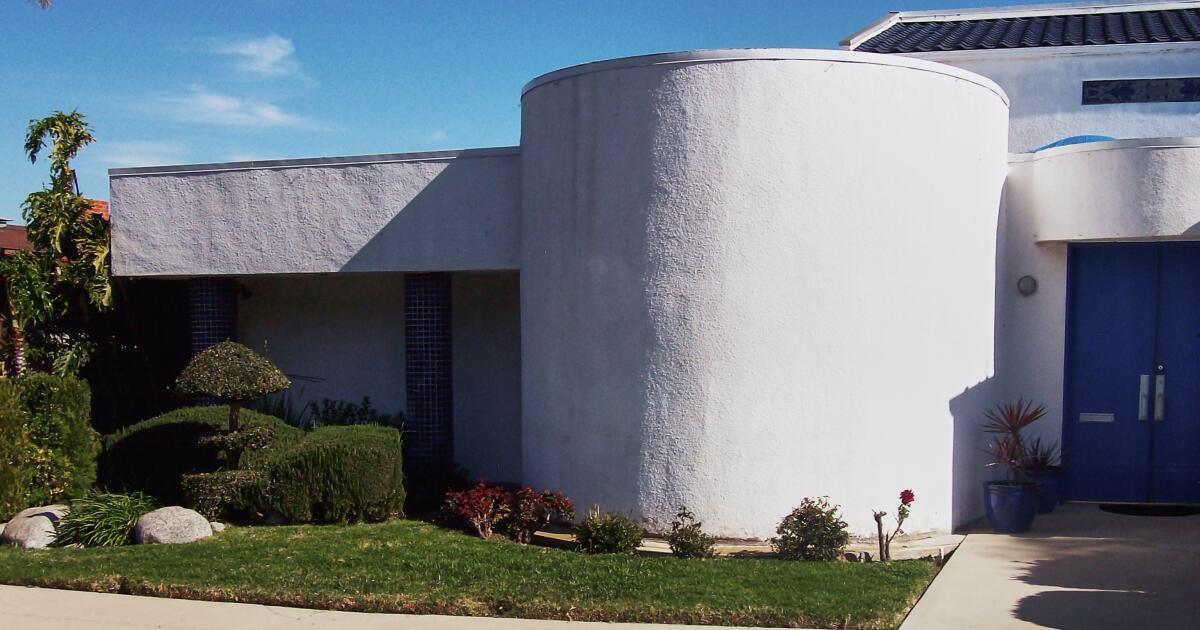
The first time Felema Yemaneberhan invited me over was maybe in 2025. I know it was sunny and warm, but I can’t figure out the season in L.A. from that. Pulling up to Felema’s home in Baldwin Hills Estates, the first thing I saw was a Japanese garden tucked on the right side of the home’s facade. The Black neighborhoods like Baldwin Hills Estates, Ladera Heights and View Park all sit hillside with some of the illest views in the city. Nah, like for real. The white curved walls offset with those two Miami Beach electric-blue mosaic columns, a single rose and an ADT home security sign took my eye. I didn’t even notice the facade was windowless until Felema said something.
The home was developed in 1983 by Edward and Lynn Edward Ivie, and designed and completed by Black builder and Cal Poly grad E. Michael White in 1985, who lived in the home with his family. Felema and her family moved in just five years later. As soon as she told me the crib was built by a brother I said, “Yo, is this some Black postmodernist architecture?”

Felema Yemaneberhan in front of her family home in Baldwin Hills.
I won’t assume y’all know what that postmodern design is. Emerging in the late ’60s and hitting its stride by the ’80s, postmodernism is defined as a reaction against that less-is-more, strict-type of modernism that came from Europe. Postmodernism reintroduced that playful, ornamental, whimsical design to everything from homes to shoes to pop culture.
So what is Black postmodernism then?
Walking into that long, blue-hued foyer with the marble floors, built-in planters and the spiral staircase that winds you through the home, left and right, mimics the feeling of descending these same hills. The speckled print on the walls behind the family bookshelf gives that Memphis design energy (or “Afro-Memphis” if y’all hip!). The home feels like a very intentional example of Black postmodernism. Playful, lived in, like a hug made from curved walls and different levels that guide you through the rooms.
I met Felema in 2020, online. She was one of the first Black architects I had ever met. She has designed homes and spaces in the U.S., Africa and Europe, and she has her own design studio, Felemaye, which she describes as “rooted in memory, material culture, and spatial intelligence.” In talking with Felema, it became immediately clear that she is super-knowledgeable about everything concerning the hood. She would tell me about where her family came from, the Eritrean capital, Asmara, and its complex history, rooted in years of Italian occupation and Art Deco infrastructure. In many ways, both subconsciously and intentionally, that Italian Art Deco city must have become the inspiration for not only Felema’s childhood home, but a profession that has driven her to really look at her neighborhood much differently.
A few days after the shoot, I chatted again with Felema. This time along with Rossen Ventzislavov, an educator who brought me out to Woodbury University last spring as a fellow to teach a one-of-a-kind semester on Black modernism in architecture, design and popular culture. All three of us share a focus on researching, archiving and documenting Black modernism and space. Yeah, it’s architecture and design, but it’s also everything from civic awareness to infrastructure, or what I’ve recently been calling, “us and the city.”
At the house with Felema, we looked through family photos, chatting with her sister Delina and playing with her son, Hyabna. She told us about this Amharic word tizita, that speaks to nostalgia, memory and longing. I saw it in her family’s decisions all through the house. Hers too. The crib looks exactly the same as it did in the ’90s. Her father’s mono bloc chair hasn’t moved from the spot it was last in since he passed. I wondered a lot about why her family chose this home in the first place.
— Jerald “Coop” Cooper

Walking into the long, blue-hued foyer with marble floors, and the spiral staircase that winds you through the home, left and right, mimics the feeling of descending the surrounding hills.
Jerald Cooper: To start off, tell us where we are right now.
Felema Yemaneberhan: We are in the heart of the city, 90008 to be exact. We are in a subdivision called Baldwin Hills, or Baldwin Hills Estates. South L.A.
JC: Tell us about the origin story of this space. How did your family end up here?
FY: The home was originally developed and designed between 1983-1985 by father and son Edward and Lynn Edward Ivie alongside structural engineer Ronald Greene. The project was then purchased and completed between 1987-1988 by E. Michael White. When White got the property, only a few rooms were finished. He worked with contractor Travis Randolph to design the interior architecture and finish the home before my family bought it in the late ‘80s. This property’s history represents a rare lineage of design across two distinct chapters. Every hand that shaped this home was Black, an intentional choice that documents a standard of excellence often omitted from the traditional architectural narrative.
My family looked at countless homes throughout Los Angeles, and they didn’t really feel moved by anything, until one day they stumbled upon this. My parents made the transaction immediately, because the house, the views and the intentionality of the way the space was designed just spoke to them both. They are design nerds. They value the preciousness of beauty, be it in a space or an object. They just wanted to make sure that their future family would live in a beautiful and serene place.
Rossen Ventzislavov: Could you tell us about the official designation of your house?
FY: If you’re familiar with the building tradition in Eritrea, it’s not a special or glamorous thing to title a house. So most houses are named after the family. For the purpose of creating a sense of anonymity for our family we call our home “Geza Ḥlmi.” “Geza” is equivalent to villa or casa. “Hil’mi” means dreams. So it’s more of an ode to the feeling, a space to dream.


“I was a dancer my whole life,” says Yemaneberhan. “So even in the way that the body moves, and the movement through the space, there’s compression and there’s release.”
RV: How does the house connect your African existence and your L.A. existence?
FY: We’re not as exotic as we might romanticize it. I’m very much an Angelena. I was born and raised in L.A., but actually, a lot of Eritreans, when they first meet my sister and myself, assume we were born back home. We were raised with English, but we didn’t speak English in this house. We didn’t mix with the diasporic children of Los Angeles. We went back to Eritrea every summer. My parents’ choice to settle down in Los Angeles had to do with climate. It was very important when you looked outside to feel as close to home as possible. This explains the cute parallels around, like the veranda. My parents used to dress us up in our traditional clothes and take photos of us in front of the bougainvillea or the jacaranda tree. If you look at the natural landscape in Eritrea, it’s the same exact atmosphere.
JC: Tell us about some of your earlier memories of the home.
FY: We have countless memories. We used to have pool parties up here with our cousins. We did every major event here, prom, homecoming, all the homies would come here and take photos across the different points of the house. My mom’s incredible cooking. Both sides of our family used to come here, and it was just a beautiful time. And you know, the people who had to come over here due to various reasons, often reminisce on what they had back home. I often wrestled with it as a young adult, if the past had actually been better than the present day. And I could fully, wholeheartedly say, yes, it was a beautiful, charmed childhood, and in a way this home sheltered us from a lot of the chaos that was going on in the ’90s here in L.A. The inner city, gang terror, it’s all not too far from here.
RV: What is the thrill for you living in this house as an architect?
FY: There are many undulations in the space. I was a dancer my whole life. So even in the way that the body moves, and the movement through the space, there’s compression and there’s release. The main atrium, or as I call it the “Hall of Mirrors,” is kind of compressed. Then there are the heights of the house, fluctuating greatly. I also like the specific corners and the way we have created unofficial wings. If you look at the facade, there’s absolutely no windows. So it is basically a house of secrets. There are specific times of day that I particularly love, and then there are other points when I don’t want to be here. I love this house at 10 o’clock because of the cantilever and the shadows. I have my coffee on the balcony, I relax, I write my emails. I don’t really particularly enjoy the house at night. There is a playfulness in the day and there’s a seriousness at night. I also like the idea of creating a permanence in the playfulness. I have a child, and I’m very much a child, and I think it’s a testament to the spirit of this home and my father’s spirit.


JC: One gets the sense that living here triggered your choice of profession? Is that true?
FY: Absolutely! My father had a tremendous influence in terms of my career choice. There’s a beautiful image that my uncle took of us at the kitchen table where I’m coloring. My uncle would say, “Color in the lines.” And my dad’s, like, “No, let her do what she wants to do.” If I wanted to be something, I’d find the proper avenues to make it happen. We didn’t watch TV growing up, there was always an activity. So from seventh grade on, I wanted to be an architect. Which is atypical. If you’re the child of an immigrant family, you go with specific professions. You’re a doctor, a lawyer, an engineer. It’s very rare to be in this field, in the creative arts. But I think it is a testament to my parents saying to me, “OK, you can do whatever you want, just be really good at it. Take all the honest steps, do the hard work, but just be free.” That freedom has allowed me to kind of come in and out of different subsets within architecture, and really handle my curiosity. Because every part of this house, now that I think about it, has had a point of activation of curiosity.
RV: Since Hood Century [a.k.a. Jerald Cooper] has brought us together, I have a question that is consistent with Coop’s own practice. He speaks of Black inhabitation as transformative living, a nexus between design and humanity. What does it mean to you?
FY: I think that architects and designers have to be anthropologists. What is precedence without the people? If anything, Coop studies people, studies groups of folks and systems, and how informal and formal systems of specific societies interact. What are the systems that have been put in place for these people, and what are the organic solutions that the people have made for themselves because they know that the system is not serving them?


“If it’s a well-designed building, you don’t have to do anything. You just have to steward and preserve.”
To your point, I think people feel compelled to make fundamental design moves like the blueness of this house. We put in the skylights this year because we were trying to protect the plants from light exposure and the rising heatwaves. And, if you can have simple and gentle conversations about the modifications, it’s important to consider the original design intent, but also what inhabitants do right in terms of respecting heritage, and what standards we’re using to evaluate their contribution. We have designers in the family and they would come here and give different suggestions. But my argument is, if it’s a well-designed building, you don’t have to do anything. You just have to steward and preserve.
JC: Talking about stewardship and preservation, tell us about your current indexing project of Black homes here in the neighborhood.
FY: The “90008 Index.” It’s an anthropological, architectural and sociological study of the people who’ve lived within the 90008 ZIP Code from 1950 to 2000. It’s important to study and establish provenance. My argument is that there are just as many, if not more, architecturally significant buildings on this side of town, and we need to study them. In the 2000s, the media cast this neighborhood as the Black Beverly Hills. And I’m trying to step back from the exclusive focus on financial affluence. I want to study the people, because there are everyday people who built and lived here. The subtitle I’m using for this project is “L.A.’s Last Enclave of Black Glory.” I want to establish legitimacy for the architects and contractors that created here. I want to honor the families, because the intentional inhabitation of these spaces was an act of resistance. These were some of the movers and shakers of Black foundation, of Black American society. The first of many things — the first person to join the L.A. Philharmonic as a brass player is here, the first judge. These were just really decent people who wanted to make a change in their respective industries. They could have chosen to live anywhere, but they chose to live amongst their own. There was a powerful sense of Black belonging within a larger landscape. I just want to be able to capture a moment that will not be replicated.
Jerald “Coop” Cooper is an artist and founder of Hood Century, a media agency researching, archiving and educating the masses on Black folks lived experience with the city, via architecture, design and popular culture.
Rossen Ventzislavov is a philosopher and cultural critic from Bulgaria who lives in Los Angeles and teaches at Woodbury University.

Words Jerald “Coop” Cooper and Rossen Ventzislavov
Photography Jerald “Coop” Cooper
Art director and editor Savannah Sinhal
Producer and photo editor/retoucher Randy Scott Hounkpe
Videographer Devin Williams


Author Julia Elliott won for her short story collection Hellions.
Forrest Clonts/Tin House
hide caption
toggle caption
Forrest Clonts/Tin House
Writer Julia Elliott has won this year’s Carol Shields Prize for Fiction for her short story collection Hellions. The award honors work by women and nonbinary authors in the U.S. and Canada.
Elliott, who also authored the novel The New and Improved Romie Futch and the short story collection The Wilds, is known for blending elements of Southern gothic horror, surrealism and fairy tale. Hellions, published in 2025, includes stories set against backdrops like a plague-stricken medieval convent, a feminist art colony, and small Southern towns.
“This eerie, eclectic, genre-leaping collection takes no half-measures; every sentence of Hellions crackles or crawls,” wrote the prize jury in a statement. “Here, human folly moves against a backdrop of horror and magic … But for all its wildness, there is tremendous control.”
The prize, named after a Pulitzer Prize-winning novelist, awards $150,000 to one winner each year. Novels, short story collections, and graphic novels by women and nonbinary authors are eligible.
This year’s finalists included Quiara Alegría Hudes (The White Hot), Lee Lai (Cannon), Megha Majumdar (A Guardian and a Thief), and Sonya Walger (Lion). They will each receive $12,500.
The Carol Shields Prize went to writer Canisia Lubrin in 2025.
You can listen to actor Donna Lynne Champlin read Elliott’s story “Hellion” on the Death, Sex & Money podcast here.

new video loaded: The Fashion References in ‘Cats: The Jellicle Ball’

By Helen Shaw, Vanessa Friedman, Léo Hamelin, Laura Salaberry and Sutton Raphael
June 2, 2026

At around 1 in the morning at the Sassafras Saloon in Hollywood, four masc lesbians in cowboy hats and chaps were dancing on top of the bar while bartenders attempted to continue making espresso martinis beneath them.
One performer crawled into the crowd and between the spread legs of an audience member, licking the air between their thighs. Another wrapped a belt around their girlfriend’s neck while thrusting against her to Bon Jovi’s “You Give Love a Bad Name.” The ravenous audience, almost entirely women, fluttered dollar bills all around, while easily filling the saloon’s 300-person capacity.
Across Los Angeles, countless strip clubs and revue shows were unfolding at that same hour, though none quite like this and likely few provoking this level of frenzy. The night had all the riotous energy of a scene from “Coyote Ugly,” with the choreographed masculinity of “Magic Mike.” Playing on the latter’s name, this was the doing of Magic Mascs, an all-masc lesbian and translesbian revue, by sapphics for sapphics.
Skye Valentinez, from left, Alexa Legend, Daddii Syd and King Captain are members of Magic Mascs, an all-masc lesbian and translesbian collective, that started in February.
“Our idea was to give lesbians what men get all the time at a strip club, but instead of just sitting around and singing ‘Pink Pony Club,’ actually going wild,” said group founder Daddii Syd, a.k.a. Syd Latimore.
The performers, self-described “daddies” — Daddii Syd, Alexa Legend, Skye Valentinez and King Captain — formed Magic Mascs in February. The performance at the Saloon was their third overall, but the group has already become an institution within lesbian nightlife in Los Angeles. They will make their debut during a Pride Month performance on Friday at Womxn Pride’s rooftop party in downtown L.A.
The members come from professional dance backgrounds. King Captain entered dance school at age 12 and taught dance for nearly a decade. Daddii Syd has danced since childhood. Alexa Legend spent years go-go dancing across clubs in the city before joining the troupe. Skye Valentinez, the baby of the group — cherub-faced, smiling through braces — is the newest to performing, though she steps into it naturally, exhibiting the same living, breathing caricature of masculinity as the rest of them.
“No one’s trying to be cisgender,” King Captain makes clear. “We’re not trying to be the kind of men who are born into and fed by patriarchy,” Daddii Syd added. “We’re redefining masculinity.”

King Captain gets their underwear stuffed with dollar bills from the crowd.
Magic Mascs’ success follows a broader trend of lesbians confidently stepping into masculinity before hungry eyes. In the past year, performative masc competitions have appeared across the country, with lesbians — hair slicked back and carabiners dangling from their Carhartt jeans — showing off in front of leering crowds. Magic Mascs feels like a more professionalized version of that phenomenon, less tongue-in-cheek — just tongue.
“We always knew there was a huge hunger for this,” Daddii Syd said.
Their first performance, in San Diego, sold out fast.
“I knew right away we were onto something special,” Daddii Syd said.
Videos of the troupe traveled far across sapphics’ algorithms, especially clips of King Captain, whose devoted fan base — known collectively as “The Castle” — make arduous trips just to see them in the flesh. One fan drove more than 20 hours from Dallas to San Diego to see Magic Mascs. Another sent an edible fruit bouquet from Australia.
Backstage, every gesture from the troupe was ultra-confident. Captain, wearing briefs stuffed with a sock full of rice, talked to me with a leg cocked on the footrest of my stool. Daddii Syd, Alexa Legend and Skye Valentinez stood pelvis-forward, hands behind their heads, flexing ropey muscles. They loved the camera, eyeing it like prey while tipping the brims of their cowboy hats. (“You guys are like the modern-day Beatles,” our photographer said.)

King Captain gets the Hollywood crowd into a frenzy during a recent show.
Everything in the show revolved around their hips. The performers rolled and glided before delivering sudden, mechanical thrusts powerful enough to rattle nearby glasses. Their bodies were taut with effort and exaggerated lust. Daddii Syd performed with her girlfriend Jamie in matching plaid, not leaving much to the imagination as they licked whipped cream off each other.
Alexa Legend, who described herself as shy offstage, eventually stripped down to nipple pasties and a cowboy hat, firing confetti from her crotch into the crowd. King Captain swerved their hips like a powerful mechanical bull. “Oh, Captain, my captain,” someone in the crowd said, hand pressed dramatically to her forehead.
They paid particular attention to a woman in a wheelchair in the crowd — typical of their performances — asking if they could sit on the wheelchair. They received keen consent. “That was, um, very nice,” she told me after, still a little lost for words.
“We’re huge on consent,” Daddii Syd said. At the start of the show, they told the crowd to cross their arms in a Wakanda Forever pose if they didn’t wish to be touched. They checked in constantly while moving through the crowd, leaning close to ask questions like, “Is this OK?” and “Anywhere you don’t like to be touched?”
Captain learned these habits through work in intimacy coordination and under the mentorship of Tonia Sina, among the first professional intimacy coordinators in Hollywood. That ethos of care extended beyond their interactions with the audience and into the way they interacted with one another offstage.

“We want everyone in the crowd to feel gorgeous,” King Captain said before the recent show at Sassafras Saloon in Hollywood.

King Captain, left, and Lauren Henson, a stage kitten for the Magic Mascs, perform together on the bar.
Forming a sanctuary for themselves was just as important to the troupe as emboldening others’ desire. “It’s hard to find other masc friends,” Daddii Syd said. “Everybody’s weirdly competitive and trying to sabotage each other.” King Captain agreed, asking: “Why can’t we all be daddies at the same time?”
Daddii Syd and King Captain, who are both in their 30s, had little butch representation or friendship growing up and they have now become something like father figures to Alexa Legend and Skye Valentinez, who are in their 20s.
“We have to protect each other,” King Captain said. “We have to look out for each other.”
Daddii Syd put her arm around Skye Valentinez and said: “Look at this beautiful baby we have.”
That tenderness carried straight into the night. There was a striking seriousness to the whole performance, which spanned from just past 10 p.m. to 2 a.m. Unlike a bachelorette party or the typical male revue, there was no giggling in the room, and no wink of camp from the performers. Here was a rare claim to unabashed public sapphic desire; it was given the scale and seriousness routinely afforded to heterosexual display, like the gleeful bravado of a man striding into Hooters.
By the end of the night at Sassafras Saloon, the performers had stripped down nearly to nothing, pouring water over themselves while the audience roared. The atmosphere felt like one of collective release, a recognition that masculinity and desire don’t belong only to men — that a group of four masc lesbians can be horny, inspire horniness and ultimately stir a hysteria that once greeted Channing Tatum or even the Beatles.
It was the magnitude of the response that night at the Saloon, as on every other night they’ve performed, that’s inspiring their next moves: total domination in sum. The troupe is already planning a national tour through Florida, Dallas and Sacramento, though Daddii Syd’s ambitions extend much further.
“The idea,” she told me, “is to go global. Like a boy band.”
-

 Los Angeles, Ca8 minutes ago
California primary election results: governor and L.A. mayor races
-

 Detroit, MI27 minutes ago
Another bribery scandal hits Detroit. It involves the People Mover
-

 San Francisco, CA38 minutes ago
What’s Worth More Than Cash in San Francisco Real Estate? Anthropic Stock
-

 Dallas, TX42 minutes ago
Dallas weighs $500 million‑plus repair plans as City Hall’s future comes up for debate
-

 Miami, FL50 minutes ago
Miami biotech executive was followed into his condo by man who allegedly threw him from 25th floor
-

 Boston, MA52 minutes ago
What a World Cup ‘fan zone’ is and what Boston fans can expect in 2026
-

 Denver, CO57 minutes ago
Defensive lineman Jordan Miller has a tough battle to make the Broncos’ final 53-man roster
-

 Seattle, WA1 hour ago
VIDEO: Mayor Wilson proposes renewing, expanding Seattle Transit Measure by doubling the sales-tax percentage that funds it.

