Lifestyle
These pop-ups, drops and art events got you covered for spring

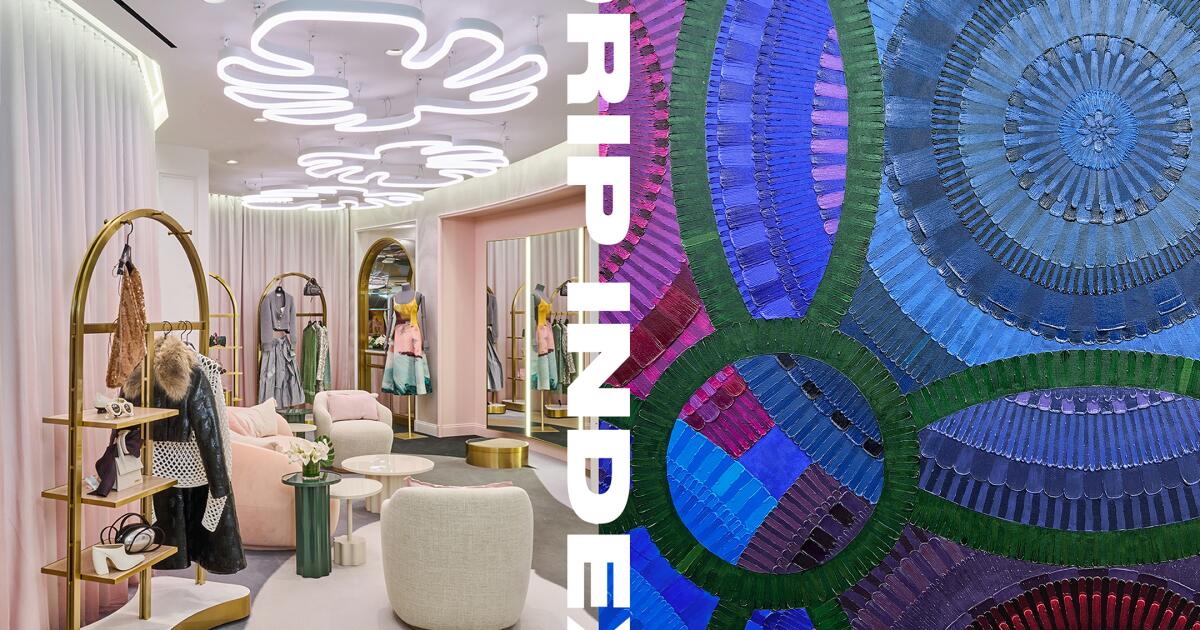
Miss Dior Avenue pop-up comes to West Hollywood
(Christian Dior Parfums / Marc Patrick/BFA.com)
Sometimes you need a 1960s-inspired style adventure. You’re in luck thanks to the new immersive Miss Dior Avenue experience that has popped up this week on Melrose Avenue in West Hollywood. ( The pop-up event isn’t too far from the Pacific Design Center and the WeHo park where Elton John AIDS Foundation’s annual Academy Awards viewing party will be held Sunday.)
In the colorful Miss Dior space, visitors will find a La Parfumerie celebration of the new Miss Dior Parfum, which was created by brand perfume creative director Francis Kurkdjian and has floral, fruity and woody notes. (The original Miss Dior perfume from designer Christian Dior dates back to 1947.) Also, guests will get a chance to check out the Miss Dior campaign starring Natalie Portman at the Diorama Cinema or have a snack at the Miss Dior cafe before venturing back into the world. There also will be exclusives and goodies as well as a special Miss Dior flower shop — a tribute to the love of flowers that Dior and his sister Catherine shared. Make a reservation soon, because this pop-up is only from Friday morning through Sunday evening. 8626 Melrose Ave., West Hollywood, dior.com
Saks Fifth Avenue opens women’s store in Beverly Hills
(Peter Christiansen Valli / Saks Fifth Avenue)
Still miss the old Barneys New York space in Beverly Hills and its Regency-style marble staircase? Well, you’re in luck. Luxury retailer Saks Fifth Avenue, a longtime staple of Wilshire Boulevard, moved its women’s store to the space at 9570 Wilshire Blvd. Called a reimagined West Coast flagship, this revived building is stocked with well-known luxury labels (think McQueen, Loewe, Celine, Brunello Cucinelli, Dolce & Gabbana, Valentino and Dries van Noten), beauty items, footwear and goods from emerging designers spread over 130,000 square feet of space. Louis Vuitton, Dior, Gucci and Chanel have dedicated main boutiques in the store. As a bonus, there’s an expanded Fifth Avenue Club with an outdoor terrace. 9570 Wilshire Blvd., Beverly Hills, saks.com
Burberry pop-up lands at South Coast Plaza
The revered British brand is settling into a stateside visit at luxury shopping center South Coast Plaza in Costa Mesa. This interactive pop-up, billed as a celebration of the brand’s heritage, offers a showcase of new clothes and bags as well as the beloved trench coat, including new styles in checks and prints from Chief Creative Officer Daniel Lee’s Spring 2024 collection. Shoppers at this Orange County event will find Burberry’s tent-like, outdoor-inspired setting along with furniture that takes its cues from camping. The pop-up is open through March 14. 3333 Bristol St., Costa Mesa, burberry.com, southcoastplaza.com
Jaime Muñoz solo exhibition and capsule collection with Huf
L.A.-born artist Jaime Muñoz’s solo exhibition, “The Meaning Is the End,” at John Doe Gallery explores commodity and consumerism as well as the effects of modernity through a series of diagram drawings that look like auto repair manuals. To commemorate the exhibition’s opening, Muñoz and the L.A. skate and streetwear brand Huf, the exhibition presenter, dropped a new capsule collection, including a hat, T-shirt, short-sleeve shirt and sweater. The pieces are available through Huf’s website. The exhibition is open through April 7. 107 E. 11th St., Los Angeles, johndoegallery.com
Prada Mode presents the Double Club Los Angeles
This weekend, artist Carsten Höller will indulge the minds of visitors at a private club escape, the Double Club Los Angeles, in the Arts District inside the warehouse complex occupied by the Drake-backed amusement park exhibition, “Luna Luna: Forgotten Fantasy.” (On a side note, Höller, who’s known for his experimental installations and sculptures, visited the original Luna Luna art amusement park featuring the works of Jean-Michel Basquiat, Keith Haring, Sonia Delaunay, David Hockney and others in Hamburg, Germany, in 1987.)
This exclusive downtown L.A. event is presented by contemporary cultural series Prada Mode in partnership with Luna Luna, and will focus on Höller’s “signature tropes” such as “the principle of division and the machinery of fun within carnival aesthetics,” according to a media release. During their visit, guests will be able to interact with nine individual spaces as part of the Double Club, which originally opened in 2008 in London, commissioned by Fondazione Prada. March 9 and 10. Ace Six, 516 S. Mission Road, Los Angeles. Admission to the Double Club Los Angeles is free with the purchase of a Luna Luna ticket.
‘Scratching at the Moon’ comes to the Institute of Contemporary Art, Los Angeles
During the summer of 2020, L.A.-based sculptor Anna Sew Hoy started dreaming about an exhibition of Asian American artists with ties to L.A., and that eventually led to a new exhibition at the Institute of Contemporary Art, Los Angeles. Dubbed the first focused survey of Asian American artists in a major contemporary Los Angeles museum, “Scratching at the Moon” is a celebration of the work of an intergenerational group of 13 artists who were born in the United States or who emigrated from Asia, New Zealand and Canada. They are Patty Chang, Young Chung, Vishal Jugdeo, Simon Leung, Michelle Lopez, Yong Soon Min, Na Mira, Amanda Ross-Ho, Miljohn Ruperto, Dean Sameshima, Amy Yao, Bruce Yonemoto and Sew Hoy. Through May 12. 1717 E. 7th St., Los Angeles, theicala.org
‘Karla Diaz: Wait ’til Your Mother Gets Home’ opens
‘No Te Metas Con Mi Cucu (Don’t mess with my ass),’ 2022 watercolor and ink on paper.
(Karla Diaz / 18th Street Arts Center)
“Wait ’til Your Mother Gets Home,” which is on display at 18th Street Arts Gallery’s Propeller Gallery, is an exploration of American Mexican identity from the 1970s through today via the paper and canvas work of artist Karla Diaz. Called her first institutional solo exhibition in Greater L.A., the exhibition features 37 of the writer, teacher and multidisciplinary artist’s new and recent works. At the heart of the exhibition is “The Silver Dollar” (2021), a work on paper that commemorates Ruben Salazar, the L.A. Times reporter and columnist — the city’s leading Latino media voice — who was killed in August 1970 when a sheriff’s deputy shot a projectile into East L.A. bar the Silver Dollar. Through June 22. 3026 Airport Ave., Santa Monica, 18thstreet.org
Fashion brand 424 opens a new flagship store
One thing is clear: Menswear designer Guillermo Andrade, founder and creative director of L.A. label 424, wanted a new retail space that would get people talking and posting on social media. The first thing you’ll notice about 424’s newly minted flagship is that it looks as if the cave-like space, with clothes neatly hanging on racks made from industrial beams and footwear placed on floating shelves throughout, came from a postapocalyptic subterrane in a “Blade Runner”-style Los Angeles. The store is a return to an actual physical space for the streetwear brand, which had a Fairfax Avenue space from 2010 to late 2022. 8441 Melrose Place, Los Angeles, fourtwofour.com
The Frankie Shop opens West Hollywood pop-up experience
High-fashion label the Frankie Shop has collaborated with product and architectural design studio Crosby Studios in a pop-up experience called the Meeting Room, at 8580 Sunset Blvd. in West Hollywood. The space pays tribute to a bygone era, taking inspiration from “powerful women of the post-office age,” according to a press release. Here you’ll find the Frankie Shop’s latest collection of leather goods and exclusive items set up in a space that looks like the remnants of a once-bustling office. (Think stacks of binders, monitors, office chairs and a broken printer and water coolers.) To commemorate the collab, a new campaign called “The Frankie Shop Goes to Hollywood,” features actor Demi Moore in photos by artist and photographer Collier Schorr. 8580 Sunset Blvd., West Hollywood, thefrankieshop.com
June Edmonds at Luis De Jesus Los Angeles
(June Edmonds / Luis De Jesus Los Angeles)
Black strength, endurance, joy and harmony are all qualities found in L.A.-born artist June Edmonds’ work. In her new exhibition, “Meditations on African Resilience,” Edmonds takes a deeper look at the river leaf emblem, a sacred quatrefoil used as a spiritual symbol (unity, balance and protection) as well as a symbol for “the power and regality of kings, healers and deities” in the Kingdom of Benin in what’s now southern Nigeria. Pay attention to the “deep color,” as Edmonds calls it, used to tap “into a part of our psyche linked to an ancient memory that exists within all of us.” Through April 13. 1110 Mateo St., Los Angeles, luisdejesus.com
S.R. Studio. LA. CA. for OTW by Vans collaborate on new sneakers
Having collaborated with designer Raf Simons and fashion brand Calvin Klein, artist Sterling Ruby isn’t a stranger to fashion. His own label, S.R. Studio. LA. CA., debuted in 2019, and now Ruby is the first collaborator for Costa Mesa-based brand Vans’ new premium line called OTW by Vans. With this new collab titled Clash the Wall, there’s a bold mash-up of four Vans iconic styles — the Style 36, the Authentic, the Mid Skool ’77 and the Sk8-Hi — in full-on neon green and an orange reminiscent of Crush soda, both signature S.R. colors. The sneakers, part of an extended partnership between S.R. and Vans, are $160, and the green version can be purchased at kith.com.
‘At the Edge of the Sun’ at Jeffrey Deitch
(Joshua and Charles White)
Twelve artists who have known each other through artistic discourse as well as just living, working, surviving and thriving in Los Angeles were brought together for “At the Edge of the Sun” exhibition at Deitch. Focusing on landmarks, memories and communities, the artists take us on a year-in-the-making exploration of the complex realities of life today in L.A.: underground economies, surveillance, youth culture, California landscapes, public transportation, night life and more. The artists are Diana Yesenia Alvarado, Michael Alvarez, Mario Ayala, Karla Ekaterine Canseco, rafa esparza, Alfonso Gonzalez Jr., Ozzie Juarez, Maria Maea, Jaime Muñoz, Guadalupe Rosales, Gabriela Ruiz and Shizu Saldamando. Through May 4. 925 N. Orange Drive, Los Angeles, deitch.com
‘RETROaction (part two)’ pays homage to 1993 exhibition in downtown L.A.
“Twenty Five Candles,” 1993, 25 color Polaroid prints. © Lorna Simpson and Hauser & Wirth
(Timothy Doyon)
The new exhibition “RETROaction (part two)” revisits and pays homage to the seminal Charles Gaines-led 1993 exhibition “Theater of Refusal: Black Art and Mainstream Criticism” at UC Irvine, which featured the work of Jean-Michel Basquiat, Renée Green, David Hammons and other artists. Not only is this Hauser & Wirth exhibition a showcase for early-1990s works by Gaines, Lorna Simpson and Gary Simmons, who participated in “Theater of Refusal,” but it also has on display the works of 10 artists who were selected by Gaines and art historian Ellen Tani: Edgar Arceneaux, Kevin Beasley, Mark Bradford, Torkwase Dyson, Lauren Halsey, Leslie Hewitt, Rashid Johnson, Caroline Kent, Tony Lewis and Rodney McMillian. Through May 5. 901 E. 3rd St., Los Angeles, hauserwirth.com
Tory Burch and Humberto Leon open new Melrose Avenue concept store
Designer Tory Burch and restaurateur and Opening Ceremony co-founder Humberto Leon recently celebrated their collaboration on a Tory Burch concept store on Melrose Avenue in West Hollywood. The façade and interior of the new shop feature the work of German photographer Walter Schels, whose animal portraits are featured in Burch’s Resort 2024 collection. In addition to having the initial drop of the Spring 2024 collection, the Melrose store carries a dedicated capsule collection of T-shirts, sweatshirts and totes that were screen-printed with Schels’ portraits of a bunny and a cat. The concept store will be open through the end of 2024 while the Tory Burch flagship on Rodeo Drive in Beverly Hills is renovated. 8483 Melrose Ave., West Hollywood, toryburch.com
Merrick Morton’s exhibition celebrates photographer’s work
“Two Cholas ‘Lisa and Crystal,’” circa 1981.
(Merrick Morton)
The camera of L.A.-born Merrick Morton, the documentary street photographer and film still photographer of more than 90 films, has captured the realities of life from the streets to the sets of films. In “Merrick Morton: Un-Rehearsed” at Eastern Projects art gallery, you’ll find a solo exhibition that shows the barrio and inner city as well as incarcerated people in prisons and the locked wards of a California psychiatric hospital. In the mix on display, there’s a variety of portraits taken in Mexico and Cuba as well as of actors on film sets. As a bonus, there’s a special poetry and photo collaboration with actor-poet Richard Cabral called “Life of a Cholo.” Also, this spring, Morton will release the photography book “Clique: West Coast Portraits From the Hood, 1980-1996” (Hat & Beard Press). March 30 through May 18. 900 N. Broadway, Suite 1090, Los Angeles, easternprojectsgallery.com


How to enter your Sporty Spice era.
Getty Images/quantic69/Olga Kurbatova/Anastasiia Zvonary/Photo Illustration by NPR
hide caption
toggle caption
Getty Images/quantic69/Olga Kurbatova/Anastasiia Zvonary/Photo Illustration by NPR
Reality dating and professional sports are not as different as you’d think.
Brittany is in her Sporty Spice era – she watched the NBA playoffs, she’s following World Cup games, and she’s watching the New York Liberty play their WNBA season. These games are daily – and so is the reality dating show Love Island. And she noticed that the two formats are not very different at all. Defector.com staff writer and co-owner Kelsey McKinney came to the same conclusion – so the two of them discuss why these games of athleticism and love can bring us together… and why they get valued differently in our culture.
For more episodes on sports and reality TV, check out:
Get rich or die trying: how sports betting is changing our love of the game
Is this the end of reality TV?
The ugly truth of America’s expensive homes
Support Public Media. Join NPR Plus.
Follow Brittany on Instagram: @bmluse
This episode was produced by Liam McBain. It was edited by Neena Pathak. Our Supervising Producer is Cher Vincent. Our Executive Producer is Barton Girdwood. Our VP of Programming is Yolanda Sangweni.


As the nation marks the 250th anniversary of its founding, NPR asked students all around the country to reflect on the moment and to make podcasts about the American experience and what “life liberty and the pursuit of happiness” means to them.

We received more than 700 entries, including many conversations with immigrant parents, grandparents, aunts and uncles about why their family decided to move to the United States. Others scored high-profile interviews with veterans, government officials and even Gloria Steinem.
We listened to reenactments and retellings of histories like the Battle of Monmouth, the Stonewall riots, the Underground Railroad and a special presentation on President Theodore Roosevelt’s pets. Other podcasts take place in the present, including one in which students report on civics education in their school.
Our team chose a handful of winning entries and honorable mentions from fourth graders, middle and high schoolers. Here they are, in alphabetical order:
Winners
Abridged
Students: Grace Kepka and Angelika Garrett, Montgomery Blair High School in Silver Spring, Md.
Teacher/Sponsor: Kyle Wannen
High schooler Grace lives in Takoma Park, Md., one of the handful of cities in the United States that allow 16 year olds to vote in all local elections. In her podcast with her friend Angelika, they discuss the power of the youth vote, and how voting rights encourage residents to learn about their government and be more politically active in their communities.
Civics in Our Schools
Students: Izabella Anthony, Benjamin Baigel, Bridget Castellon, Rile DeLeon, Maxwell Gibbs, Daniel Hernandez, Malcolm Johnson, Sylpa Kafle, Mason King, Kyle Li, Maximus Lin, Emmerson Quinn, Ariella Schoenfeld, Owenize Udevbulu and Dara Widzowski, Hewlett Elementary School in Hewlett, N.Y.
Teacher/Sponsor: Jaime Harrington
“Here’s the surprising truth. Many Americans, even grownups, don’t know the basics of how our country was founded or how our government works.” In Civics in Our Schools, a group of fifth graders voice their concerns about the lack of good civics education and discuss what they can do to be better citizens.
Leaving Greece
Student: Livie Courser, Wickliffe Progressive Elementary School in Upper Arlington, Ohio
Teacher/Sponsor: Shelly Hughes
Livie interviews her grandfather about his move from Greece to the United States. “How did it feel to immigrate to the U.S.?” she asks. “Very hard. Very very hard,” he responds. He shares with his granddaughter why he took the risk, and how his move to the U.S. allowed him to work hard at a factory, dream big and eventually open up his own restaurants.
Researching the Underground Railroad
Students: Travis Bozeman and Oliver Heering, South Douglas Elementary School in Douglasville, Ga.
Teacher/Sponsor: Thomas Bruno
“Did you know around 100,000 slaves escaped using the Underground Railroad?” In a deep dive into a slice of history they learned from school, fourth graders Travis and Oliver report on the Underground Railroad. They present their research in the podcast, and weave in the expert interview they scored.
The American Dream
Student: Makayla Cheung, Mercer Island High School in Mercer Island, Wash.
Teacher/Sponsor: Lauren Schechter
In her podcast about her father, Makayla explores how different everyone’s American Dream is. Case in point, her dad moved from Hong Kong to the United States because of his talent in running. He tells Makayla he had a hard time adjusting at first and understanding his coach. But cross country, he says, didn’t require too much communication, and the sport gave him confidence and a way for him to find community and connect with other people.
The Journal
Student: Violet Maxinoski, Carmel High School in Carmel, Calif.
Teacher/Sponsor: Shelley Grahl
In an interview with her daughter Violet, Sandi Maxinoski revisits stories from her journal from the years she served in Iraq. She describes being in “cities fractured by bombings, checkpoints, smoke and uncertainty,” then returning to the United States where she felt an “intense amount of security” being able to walk down the street without the fear of something blowing up. Through these conversations, Violet discusses how the “life, liberty and happiness” she’s gotten used to shouldn’t be taken for granted.
Welcome Home, Grandpa
Student: Ursula Koestner, Roslyn High School in Roslyn Heights, N.Y.
Teacher/Sponsor: Matthew Vogt
“The Vietnam War destroyed more than it saved, even decades after its end,” high schooler Ursula says in her podcast. “My grandfather remains one of its victims despite returning home alive.” In her moving podcast, Ursula shares her family’s story and explores the generational trauma and lasting impact the Vietnam War has on veterans.
Honorable Mentions
America the Beautiful
Students: Pareena Gupta and Vidushee Bala, Amador Valley High School in Pleasanton, Calif.
Teacher/Sponsor: Stacey Sklar
America: The Ups and the Downs
Student: Alana Burwell, The Waldorf School of Philadelphia, Philadelphia, Pa.
Teacher/Sponsor: Anyta Thomas
America’s New Favorite Sport-Girls’ Flag Football
Students: Josephine Barry-Kao and Malcolm Barry-Kao, Lowell High School in San Francisco, Calif.
Teacher/Sponsor: Jacqueline Moses
An Intro to Differing Perspectives
Student: Waylon Heikinen, Ingomar Middle School in Franklin Park, Pa.
Teacher/Sponsor: Heath Gamache
Becoming American
Students: Karolina Zientek, James Gearhart, Andrea Vezmar, Troy Murray and August Hutchison, Greenwich High School in Greenwich, Conn.
Teacher/Sponsor: Lukasz Zientek
Before You Drop A Track: America’s 250th Anniversary
Student: Lukas Boulom, Public Academy For Performing Arts in Albuquerque, N.M.
Teacher/Sponsor: Su Hudson
Dawg Talk | Are we equal now?
Students: Makenna Aniszewski, Trinlee Leitner, Nagamoshitha Manivannan, Nethra Prabhu, Vaishnavi Tiwari and Sophia Van Dorn, Otwell Middle School in Cumming, Ga.
Teacher/Sponsor: David Miller
Democracy for Everyone or No One
Student: Jeju Daisy Ahn-Miles, Punahou School in Honolulu, Hawaii
Teacher/Sponsor: Christine Ahn
Everything Given Forward
Student: Lara Leon, Mountain View High School in Mountain View, Calif.
Teacher/Sponsor: Tom Chang
Fifty Stars, One Banner
Student: Naina Dhillon, Khan Lab School in Palo Alto, Calif.
Teacher/Sponsor: Emily Lindsey
Freedom’s Shore
Student: Dipa Chéry, The Kinkaid School in Houston, Texas
Teacher/Sponsor: Olen Rambow
From One Immigrant To Another
Student: Afomia Lemma, St. Mary’s Lynn in Lynn, Mass.
Teacher/Sponsor: Tiringo Endalamaw
Hope and Resistance
Student: Zinnia Bender, North Fork High School in Hotchkiss, Colo.
Teacher/Sponsor: Clara Pena
How Is My Life Like In US
Student: Yicheng Sun, Rectory School in Pomfret, Conn.
Teacher/Sponsor: Andrew Barker
Life of a Soldier
Students: Della Axelband, Peyton Johnson, Lily Epstein and Lilly Murillo, Jupiter Middle School in Jupiter, Fla.
Teacher/Sponsor: Sireesha Rutter
More Than A Photograph
Student: Josie Sloan-Westmoreland, The Learning Community School in Swannanoa, N.C.
Teacher/Sponsor: David Bird
Moving From Country to Country
Students: Ida Buerckert, Daniella Cubas, Ayano Enishi and Anastaiia Koshyk, Irving A. Robbins Middle School in Farmington, Conn.
Teacher/Sponsor: Alysson Olsen
Picketts Charge
Student: Zoe Snyder, Susquenita High School in Duncannon, Pa.
Teacher/Sponsor: Terrance Shepler
“So What??”
Student: Caroline Harris, Marin Academy in San Rafael, Calif.
Teacher/Sponsor: Kelly Kurtzig
Somewhere Over the Rainbow
Student: Lark (Miles) Jackman, Public Academy For Performing Arts in Albuquerque, N.M.
Teacher/Sponsor: Su Hudson
Teddy Roosevelt and His Pets
Student: Abbott Mearns and Keaton Rainwater, College Place Middle School in Lynnwood, Wash.
Teacher/Sponsor: Colindra Connolly
The Battle of Monmouth: A Twist on History
Students: Leonardo, Zinna and Kaiden, Marlboro Middle School in Marlboro, N.J.
Teacher/Sponsor: Tara Meara
The Freedom to Fail
Students: Abraham Coher and William Pan, Polytechnic School in Pasadena, Calif.
Teacher/Sponsor: Aliya Coher
The Government Exodus: Why Federal Workers Resign
Student: Anna Su, Montgomery Blair High School in Silver Spring, Md.
Teacher/Sponsor: Kyle Wannen
The Name I Chose Polly Bemis (September 11, 1853 – November 6, 1933)
Student: Jubilee Sung, Imaginate Ink in Irvine, Calif.
Teacher/Sponsor: Clarissa Ngo
The Pig and Potato Podcast
Student: Petra Rouhana, Maryvale Preparatory School in Lutherville, Md.
Teacher/Sponsor: Deirdre McAllister
The Small Pond of Peace
Students: Noam Dekel, Ronnie Dekel, Ian Rodriguez, Leonardo Leon-Espinoza, Singary Fofana, Ashly Arboleda-Osorio, Olumide Martin and Salma Elshaarawi, P.S. 333 Manhattan School for Children in New York, N.Y.
Teacher/Sponsor: Karin Patterson
to be united as citizens
Student: Josh Langlois, Cloverleaf Home Education in Highlands Ranch, Colo.
Teacher/Sponsor: Tony Winger
Two Worlds, One Dream
Student: Allayar Maratov, Rectory School in Pomfret, Conn.
Teacher/Sponsor: Andrew Barker
What is Home?
Student: Siobhan Allen, The Hewitt School in New York, N.Y.
Teacher/Sponsor: Jonathan Sabol
-

 New York1 hour ago
How a Museum Security Guard and Artist Lives on $51,000 in Parkchester
-

 Los Angeles, Ca2 hours ago
Heat advisory issued as Southern California temps near triple digits this week
-

 Detroit, MI2 hours ago
Detroit Battery Safety Provider Reaches to the Skies with Med Hawk
-

 San Francisco, CA2 hours ago
A Locals-Approved Modern Guide to Fisherman’s Wharf: Seafood, Beer Gardens + Iconic Bay Views
-

 Dallas, TX2 hours ago
New glitzy Houston steakhouse Juliet opens next to Delilah this summer
-

 Miami, FL2 hours ago
Allapattah man faces charges over armed robbery after crash in Miami’s Liberty City
-

 Boston, MA2 hours ago
Somehow, This is a Fitting, Confusing End to Jaylen Brown’s Boston Celtics Career
-

 Denver, CO2 hours ago
Denver Broncos 2026 schedule

