Lifestyle
These images, that light. In Hollywood with Paz de la Huerta


“I am technically a princess,” says Paz de la Huerta over lunch at the Chateau Marmont — her castle, if you recall her appearance in Lana Del Rey’s “Video Games.” Born in New York City to Judith Bruce and Spanish aristocrat Ricardo Ignacio de la Huerta, Duke of Mandas y Villanueva, De la Huerta doesn’t hold an official title. Born to nobility; ultimately powerless.
Yet in New York’s SoHo, where her family settled in the 1980s, she was royalty of another kind. Larry Gagosian lived above the family, and when they moved to Tribeca, Miramax — the distribution and production company founded by brothers Bob and Harvey Weinstein — rented the apartment next door. De la Huerta attended Saint Ann’s in Brooklyn with Lena Dunham and Jemima Kirke. At school, she met designer Zac Posen and became an early muse. She babysat Lexi Jones, daughter of David Bowie and Iman, and appeared in a film nominated for best picture at the 2000 Academy Awards — all before turning 21. Paz de la Huerta is a real downtown princess.

Paz wears her own Dolce & Gabbana dress, stylist’s own vintage Louboutin shoes.
She now sits comfortably inside the courtyard of the Chateau, 13 years after “Video Games” made iconic the TMZ footage of her stumbling away from a Golden Globes after-party hosted at the hotel. At the time, she was working on HBO’s “Boardwalk Empire,” and the incident almost got her fired. Clear-eyed and steady today, she finishes her earlier thought while piling salt on her arancini: “It’s forbidden for the aristocracy to speak to the press. But in my case, I had no choice.”
Let’s begin with that night at the Chateau. Writer Jay Bulger’s infamous 2010 profile for New York magazine described her as someone who “excels at creating, and causing, drama.” An understandable reputation, given that was the year De la Huerta alleges Harvey Weinstein stalked and assaulted her. In 2011, she approached a journalist about the alleged assault. “Somehow,” she says, “Weinstein learned I had spoken out right before that night.”
At the time, De la Huerta was taking Suboxone for opioid withdrawal. Mixing it with alcohol can be fatal, yet drinks kept appearing in her hands. “There’s the back door for drunk celebrities,” she says, pointing behind me as a waiter approaches, then turns away. That night, she was kicked out the front, where paparazzi awaited. For a while, the scene tarnished her credibility.


Friends told me to brace myself for the petulant movie star, the diva. What I find is a woman early to our date, eager to talk. Her long, Modigliani face has softened over time, more beautiful than in pictures. A scoop neckline and string of pearls frame her often-photographed bust. Her dress, with banded sheer sleeves and an embroidered bodice, recalls Adjani in “Queen Margot,” but the thigh-high slit makes it distinctly Paz. The look flirts with the 15th-century-inspired French Gothic arches behind her. She orders another arancini, covering it with so much salt it spills onto the phone next to her plate.
When she recounts her life, De la Huerta speaks openly, often repeating details. Sometimes she lunges forward to emphasize, shaking the four-top wicker table, giving the impression that hardly anyone has believed her. Sexual assault is discredited when details fumble, as if memory isn’t elastic and unreliable. But De la Huerta’s timeline is always the same. She punctuates stories with smoke breaks, ignoring the poor air quality, and taking them frequently.

Los Angeles is burning, a tragedy so vast it renders Didion’s prose on the Santa Ana winds unhelpful. The images I saw from New York were apocalyptic, the GoFundMe links constant. In Hollywood, it feels as though nothing has happened. I assumed De la Huerta’s latest duo show with Jaxon Demme at the gallery Spy Projects would be canceled. Yet, here we are.
De la Huerta has flown into town from an undisclosed location. In 2021, she ran away from her father in Madrid, ditched her lawyer, and flew to Los Angeles to retrieve her Weinstein settlement. She then rented a farmhouse “near Paris,” as her artist bio states. She operates from a private Instagram and Proton email. “If I stayed in America,” she says, “I would’ve gone bankrupt.” Her paintings, like Francisco Goya’s “Black Paintings,” were created in exile, the two artists centuries apart and finally free from the Spanish aristocracy. De la Huerta’s bright palette recalls Marc Chagall, the painter who fled to New York when the Nazis invaded France.
On Instagram, she posts in a constant finsta-like stream — long captions of horrors she has faced mixed with past shoots and aspirational images. On Oct. 10, 2024, De la Huerta posted a black-and-white still of Helena Christensen in a 1992 Revlon commercial. The caption reads: “I want to take photos like this. I have some photo shoots coming up, but I am feeling the need for some glamour in my life, and I am looking for a modeling manager.” I’m lucky to know many talented photographers, so I messaged her to say I could be of service. Sebastian Acero was set to photograph, Fern Cerezo to style, and Sonny Molina to bless the hair.

It was through photography that I discovered De la Huerta — her brazen sexiness, often captured in Purple magazine, collided with my adolescence. I gazed at her the way she looks at Helena Christensen. Frequently photographed by Terry Richardson for Purple, she asserts that he was never inappropriate with her. That’s her truth, though it may not reflect another’s experience. (Richardson has faced accusations of sexual assault as recently as 2023; he denies all claims of non-consensual sex.)
The list of photographers who have shot De la Huerta reads like the greatest hits of the turn of last century: Terry Richardson, Tina Barney, Nan Goldin, Juergen Teller, Mario Sorrenti, Bruce Weber. De la Huerta has lived a life of pictures, and when everything was lost, it was the pictures that remained.
Around age 6, her parents split. Her father, described by De la Huerta as drunk and abusive — claims that he has denied — moved back to Spain. De la Huerta moved with her mother from SoHo to 311 Greenwich St. in Tribeca. In Barney’s portrait “The Lipstick” (1999), we see a teenage De la Huerta as the punky Lolita applying rouge in her bedroom as her mother looks on. Behind Judith Bruce, a French door is slightly ajar. That door, De la Huerta alleges, connected their apartment, 3C, to 3B, rented out by her mother to Miramax.

Paz wears her own jewelry, stylist’s top and bottom, stylist’s own vintage Louboutin shoes. Rocky wears Primrose Vintage LA top and overalls.

In 1998, Billy Hopkins, a casting director from Miramax, approached De la Huerta and her mother on the street in front of their apartment about a role in “The Cider House Rules.” A complaint filed in Los Angeles by De la Huerta and her then-lawyer Aaron Filler in 2019 states: “Miramax selected their next-door neighbor — 13-year-old Paz De La Huerta — to star in Cider House Rules, so it is indisputable that senior executives at Miramax — almost certainly Harvey Weinstein — were well aware of Paz.” In the same complaint, De la Huerta alleges a series of intimidations and assaults that she said took place in 2010 and 2011 between her and Weinstein. These alleged events would take place years after they met on the set of “The Cider House Rules.” Last year, Weinstein’s 2020 rape conviction was overturned by New York’s highest court — a case built on multiple testimonies and allegations. De la Huerta has since been organizing a GoFundMe to restart her case against him. “It is crucial that someone big takes this story on, someone my family can’t pay off,” says De la Huerta, “someone like Amal Clooney.”
When Luis Bobadilla, one of the muses of our team, picks me up from Union Station, Madonna’s “Live to Tell” — De la Huerta’s exhibition title at Spy Projects — plays. The synchronicities in L.A. keep accumulating, and I’ll learn this is even more true around De la Huerta. A devout Catholic, the artist makes paintings that are heavy with sporadic, jagged symbolism. Larry Gagosian sold Basquiat upstairs while De la Huerta was a baby below, and her work sometimes has the effect of childlike depictions of what she learned by osmosis.
The narrative of her 10-painting offering is as follows: A princess is cursed with never receiving the love she’s given. A butterfly breaks the curse, providing her with a baby girl, born with the love the princess badly needed. Think of Sarah, the conspiracy daughter of Jesus and Mary Magdalene. Jaxon Demme’s sculptures in the gallery’s center are princesses encased in chrome and wire, still waiting for the butterfly to arrive and the suffering to end.
“Which is your favorite?” De la Huerta asks me at the opening. I point to the large painting in the middle that bears the phrase: I thought I had to grieve you. Words spoken by a therapist who encouraged her to paint as a way to heal. “I thought I had to grieve you,” he’d say after long stretches of silence from De la Huerta — instances when she’d be committed and recommitted to mental hospitals.

Paz wears Swarovski jewelry, stylist’s own dress tailored by Bontha, underwear tailored by Bontha, stylist’s own vintage Louboutin shoes. Rocky wears stylist’s own top, shorts and belt.
Inside the painting is a rendering of Kenny the Tiger, the famous inbred white Bengal. “That’s what they do in the royal family,” she says, pointing. “Incest.”
This story is hard to tell: It’s her story — uniquely, terribly hers.
In 2020, De la Huerta traveled to Spain for what would be the last time, to screen “Puppy Love,” a film that won her awards but still hasn’t had a wide release. She hadn’t seen her father in a decade, so she booked a hotel near him in Madrid. Her friend Miguel Morillo later recounted the night in an email: he, a mutual friend and De la Huerta spent the evening in Madrid, talking about movies and life before ending the night with a sleepover at her hotel. In the middle of the night, someone began banging on the door — “Paz, open the door,” a man’s voice demanded. De la Huerta said it was her father. Frightened, de la Huerta pleaded with him to come back later, then asked her friends to leave.

At the opening, all is well. A cooler full of beer below a cheese table signals where I am: the show of an early-career painter. De la Huerta is drinking only the cameras and eyes that are on her. On this night, she is Rita Hayworth. The day before, I’d encountered a hardened grace reserved by life for a select few. What I see on this night is the spell of hair and makeup; I mean this as glamour, a way to make others see what you want them to see. On her private Instagram, she posts long captions about reversing the aging process, and tonight, I watch her do it.
In attendance is De la Huerta’s friend Marilyn Manson; sexual and domestic violence charges against him had just been dropped earlier that day. She insists on his innocence more than once, and my stomach turns. I want to believe her as I do everything I’ve written above, but I can’t. I’ve seen women speak against Manson with the same urgency and detail that De la Huerta has shown me.
Why do we believe some people and not others? During #MeToo, I dated someone who lost their Condé Nast job over similar accusations. I chose to believe their innocence. I cannot ask De la Huerta to turn her back on her friend, just as she cannot ask me to turn my ear from Evan Rachel Wood’s testimony against Manson. Whenever he comes up, I change the subject.
These images, that light. The reason we’re in Hollywood is to make pictures. A month prior, on Zoom, De la Huerta told me and photographer Sebastian Acero that this would work best if it felt like a movie. She set three characters: Whore, Mother and the Ghost of Marilyn Monroe. Through fashion, hair and makeup, she would direct herself into three viable paths her life could’ve taken. We begin with Monroe and end on Whore. When I told her the order, she smiled: “So, we’re starting at the end.”
In the final completed role of her life, Marilyn Monroe plays divorcée Roslyn Taber in “The Misfits” (1961). In it, Clark Gable asks her, “Why are you so sad? You’re the saddest girl I’ve ever met.” As a child, Monroe went to the movies to project dreams of a father onto Gable. Knowing everything we do about Monroe — and how much is still unknown — the film’s penultimate scene is grating. Gable and his crew of men tie up a distressed horse while an equally distressed Monroe watches. She runs, screaming at them, at the camera, at the world: “Horse killers! Killers! Murderers! You’re liars! All of you, liars! You’re only happy when you can see something die!” The scene unsettles Monroe fans, knowing it was her husband, writer Arthur Miller, who perhaps plagiarized her intimate words for the screen.

As Linda in Gaspar Noé’s “Enter the Void” (2009), De la Huerta delivers a scene that evokes a similar feeling for me, that feeling that the actor’s reality is braiding with the film. Linda, a dancer at a club called Sex Money Power, is working when she learns her drug-dealing brother has died. His spirit hovers over the entire film, witnessing the wreckage of his absence. Linda, left without her only friend, crumbles when the person who gave her brother up tries to apologize. She can only scream: “I don’t wanna be here, I don’t wanna be here with these evil f–ing people! They’re f–ing evil!” A video on De la Huerta’s private profile, posted on Jan. 12, shows her being driven around in a van. Laughing, she says, “Gaspar was right — my memoir should be a comedy. But I’m angry with Gaspar because he hasn’t written a statement against my father.”
For the ghost of Monroe, De la Huerta insisted on wearing a red rose-printed Dolce & Gabbana dress she bought herself as a birthday gift years ago. She says it was the dress she wore during a near-death experience. In the great purge of her old life, this dress is something she decided to keep, because it protected her. She wants to wear it at Monroe’s grave, because she says it could’ve been her. What does she mean? “The dead actress,” she puts it simply.

Paz wears her own jewelry, stylist’s own top, bottom and tights.
The night before our fitting, I dream my father is staring at me menacingly in a loud club. I am begging my friends to leave, but they can’t hear me over the music.
When it’s finally time to see the Dolce & Gabbana dress at our fitting, I tell her about the dream. I ask for more details about the night her dress saved her. De la Huerta says she was taken out to dinner by the people who manage her father’s money, on the occasion of her birthday, and felt something terrible was imminent. Later that night, in a club, she begged strangers to help her hide. No one listened. My dream connection goes ignored as her focus zeroes in on the dress zipping up. Our patient stylist, Fern Cerezo, does their best, but the zipper won’t close — the gap is too wide.
“I’ll be thinner in the morning, but don’t worry, I won’t make myself throw up.”
Should I be worried about that?
The next morning, after the “Misfits” wig goes on and makeup artist Kennedy’s Warhol paint is stamped, I watch over Cerezo’s shoulder as De la Huerta steps into the dress. The zipper goes up with ease.
It’s raining on the drive to Westwood Memorial Park, where Monroe is buried. At first, I take it as a good sign — then I’m told of mudslides. We Google Monroe’s favorite music and settle on Ella Fitzgerald. De la Huerta requests “Love for Sale,” a song learned back when she hoped to become a lounge singer. She turns around from the front seat and counts Fitzgerald’s different loves from the chorus: old love, new love, every love but true love.
She plays it on repeat at the grave. We hand her the white roses she requested — “It’s customary” — and watch in whispers. “Quiet!” De la Huerta shimmies toward Monroe in homage. More lipstick goes on, and she kisses the name plaque. On her knees, she bows, splaying her arm in praise. Marilyn Monroe, the guardian angel of all working girls. A saint whose image still works and sells in smoke shops, tourist traps and museums.
A family tries to visit the grave but instead watches De la Huerta perform from across the street. The rain stops and the sun comes out on schedule for the next look.

Paz wears Manolo Blahnik shoes, talent’s own jewelry, stylist’s own bottom, tights and gloves.
Monroe experienced three miscarriages in her lifetime; De la Huerta has lost two children. Her desire for motherhood is evident — not just in conversation but in the narrative arc of her show at Spy Projects. For our photo shoot, she requested a child to act out a maternal scene with her.
Fortunately, our head producer, Palma Villalobos, had a connection: Rocky Mosse, age 8. For this look, De la Huerta is referencing “Domestic Bliss,” Angelina Jolie’s 2005 editorial with Steven Klein for W Magazine. We are lucky to have Justin Bontha — tailor to Rihanna and Madonna — on set to tweak a caftan that Cerezo crafted from polka dot fabric.
By the pool, De la Huerta is playful with Rocky, and this time, the audience is allowed to make noise. Our laughter emboldens her. “You’ve got to sleep for 15 days, Rocky!” Because it’s almost “Mommy and Daddy day.” Rocky stamps his foot in giggly indignation. If he does his homework, she says, he doesn’t get to eat. If he doesn’t do it, he gets candy.
She plays bad mommy like a John Waters muse; I think we need to see De la Huerta in a comedy. She nicknames her scene-mate “Rocko” in a Long Island accent from 1985. Rocky protests this new name. De la Huerta accuses him of hating her. All is said with an air toward entertaining us, but something else hovers over the interaction.
Back in the makeup chair, robe on, she thinks out loud while her lipstick is being wiped off: “I don’t know what I’d do with a son, you know? I’m so feminine.” Some of us AMABs on set joke that our mothers said the same.
We’re back at the Hollywood Roosevelt Hotel, where De la Huerta is staying and Monroe once lived as a model. The doorman is very friendly and asks if there’s a party going on. “It used to be a party place,” says De la Huerta, lighting her first indoor cigarette of the shoot. At the fitting, I had asked if she was in a smoking room. She laughed, then mocked me as she blew out the window. “Is this a smoking room?”


Her best friend James Orlando has been her right hand the entire shoot, a quiet and supportive presence. It was Orlando who paid for the Iboga, the West African psychedelic De la Huerta credits with rewiring her brain, allowing her to live without a pill in her body.
Orlando met De la Huerta on set for a Bullett Magazine shoot in August 2010. In a video interview for the issue, an off-screen voice asks her, “What was your first acting experience that did not involve a camera or a stage?” She lists a few things — playing dress-up with her sister, negotiating with her father, and learning how to manipulate him to get what she wanted. If it was a dress she wanted, she’d do “anything and everything to get it.”
Behind the camera, something about her answer unsettled Orlando. Maybe it was that moment, or maybe it was the way De la Huerta walked around naked at the Bullett offices, but his judgment was already forming.
In 2007, De la Huerta directed a short film called “Pupa, Papa, Puta.” The tongue-twister translates to “Doll, Dad, Whore.” The creator of the film’s lead, a doll, is a violent man. It’s only when the doll shatters that she can come alive in the form of De la Huerta, her own self-directed star, naked in broad daylight, sweeping up the pieces.
At the Hollywood Roosevelt, she’s channeling Anouk Aimée in “Lola” (1961), her current style icon, and whom she believes she most resembles. She’s energized, still speaking in the Long Island accent from earlier, lighting cigarettes constantly.
As we set up for the next shot, room service delivers a bottle of wine. To be clear, De la Huerta has never claimed sobriety. Orlando advises her not to drink on camera, as any good friend should. Through the lens of harm reduction, a glass of wine seems benign, certainly less harmful than opiates. But the details of excessive drinking that she attributes to anxiety and depression in her 2019 complaint against Weinstein ring in my ears. If you believe her — and I do, completely — it’s hard not to think about.
De la Huerta calls herself a method actor, and watching her now, I don’t see someone with a drinking problem. I see an artist doing what artists do: opening the wound, peering into it, and extracting what she can.

Cerezo dresses De la Huerta in a white petticoat and matching corset until she tosses off the top and demands total silence. To keep talking among ourselves, we hide in the bathroom, where I spray her perfume — Queen Nzinga by Marissa Zappas — on my wrist. From outside, I hear De la Huerta giving Sebastian Acero a striptease to “Nutshell” by Alice in Chains. Jerry Cantrell’s guitar weeps on the track for Layne Staley, who died of an overdose at 34. No matter how much of De la Huerta’s story you believe, it’s a miracle she has lived to tell it. Her 40th birthday was this past fall, a benchmark that might make an actor nervous, but De la Huerta still dreams, wishing to sell paintings, make films and star in fashion campaigns. At one point, she tells us she’ll fly us out to dress her for a future wedding, wherever it is that she lives.
We try one more look, but she vetoes it. The shoot is over. Sonny Molina quickly throws De la Huerta’s hair up for a dinner date she’s late for. Once dressed, she pulls me over to share a secret. It leaves me unsure of what to do or how to forget it. She says it’s something to keep in mind, you know, “as you write my story.”
Devan Díaz is a writer from Queens, N.Y.

Creative direction by Devan Díaz
Photography by Sebastian Acero
Styling by Fern Cerezo
Production Palma Villalobos
Hair Sonny Molina
Makeup Kennedy
Child model Rocky Mosse
Production assistant Luis Bobadilla
Hair assistant Kalia White Smith



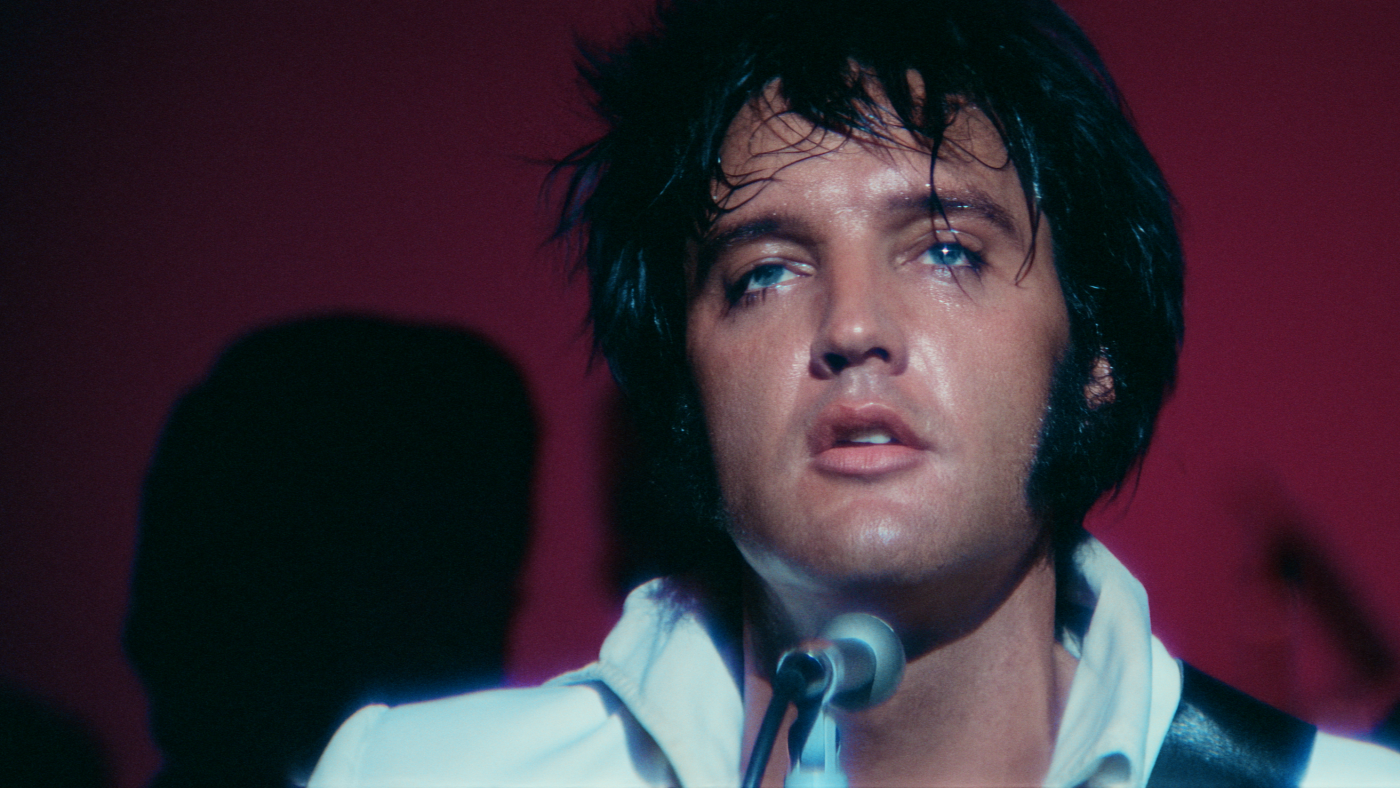
Elvis Presley in Las Vegas in Aug. 1970.
NEON
hide caption
toggle caption
NEON
“You are my favorite customer,” Baz Luhrmann tells me on a recent Zoom call from the sunny Chateau Marmont in Hollywood. The director is on a worldwide blitz to promote his new film, EPiC: Elvis Presley in Concert — which opens wide this week — and he says this, not to flatter me, but because I’ve just called his film a miracle.
See, I’ve never cared a lick about Elvis Presley, who would have turned 91 in January, had he not died in 1977 at the age of 42. Never had an inkling to listen to his music, never seen any of his films, never been interested in researching his life or work. For this millennial, Presley was a fossilized, mummified relic from prehistory — like a woolly mammoth stuck in the La Brea Tar Pits — and I was mostly indifferent about seeing 1970s concert footage when I sat down for an early IMAX screening of EPiC.
By the end of its rollicking, exhilarating 90 minutes, I turned to my wife and said, “I think I’m in love with Elvis Presley.”
“I’m not trying to sell Elvis,” Luhrmann clarifies. “But I do think that the most gratifying thing is when someone like you has the experience you’ve had.”
Elvis made much more of an imprint on a young Luhrmann; he watched the King’s movies while growing up in New South Wales, Australia in the 1960s, and he stepped to 1972’s “Burning Love” as a young ballroom dancer. But then, like so many others, he left Elvis behind. As a teenager, “I was more Bowie and, you know, new wave and Elton and all those kinds of musical icons,” he says. “I became a big opera buff.”
Luhrmann only returned to the King when he decided to make a movie that would take a sweeping look at America in the 1950s, ’60s, and ’70s — which became his 2022 dramatized feature, Elvis, starring Austin Butler. That film, told in the bedazzled, kaleidoscopic style that Luhrmann is famous for, cast Presley as a tragic figure; it was framed and narrated by Presley’s notorious manager, Colonel Tom Parker, portrayed by a conniving and heavily made-up Tom Hanks. The dark clouds of business exploitation, the perils of fame, and an early demise hang over the singer’s heady rise and fall.

It was a divisive movie. Some praised Butler’s transformative performance and the director’s ravishing style; others experienced it as a nauseating 2.5-hour trailer. Reviewing it for Fresh Air, Justin Chang said that “Luhrmann’s flair for spectacle tends to overwhelm his basic story sense,” and found the framing device around Col. Parker (and Hanks’ “uncharacteristically grating” acting) to be a fatal flaw.
Personally, I thought it was the greatest thing Luhrmann had ever made, a perfect match between subject and filmmaker. It reminded me of Oliver Stone’s breathless, Shakespearean tragedy about Richard Nixon (1995’s Nixon), itself an underrated masterpiece. Yet somehow, even for me, it failed to light a fire of interest in Presley himself — and by design, I now realize after seeing EPiC, it omitted at least one major aspect of Elvis’ appeal: the man was charmingly, endearingly funny.
As seen in Luhrmann’s new documentary, on stage, in the midst of a serious song, Elvis will pull a face, or ad lib a line about his suit being too tight to get on his knees, or sing for a while with a bra (which has been flung from the audience) draped over his head. He’s constantly laughing and ribbing and keeping his musicians, and himself, entertained. If Elvis was a tragedy, EPiC is a romantic comedy — and Presley’s seduction of us, the audience, is utterly irresistible.
Unearthing old concert footage
It was in the process of making Elvis that Luhrmann discovered dozens of long-rumored concert footage tapes in a Kansas salt mine, where Warner Bros. stores some of their film archives. Working with Peter Jackson’s team at the post-production facility Park Road Post, who did the miraculous restoration of Beatles rehearsal footage for Jackson’s 2021 Disney+ series, Get Back, they burnished 50-plus hours of 55-year-old celluloid into an eye-popping sheen with enough visual fidelity to fill an IMAX screen. In doing so, they resurrected a woolly mammoth. The film — which is a creative amalgamation of takes from rehearsals and concerts that span from 1970 to 1972 — places the viewer so close to the action that we can viscerally feel the thumping of the bass and almost sense that we’ll get flecked with the sweat dripping off Presley’s face.
This footage was originally shot for the 1970 concert film Elvis: That’s The Way It Is, and its 1972 sequel, Elvis on Tour, which explains why these concerts were shot like a Hollywood feature: wide shots on anamorphic 35mm and with giant, ultra-bright Klieg lights — which, Luhrmann explains, “are really disturbing. So [Elvis] was very apologetic to the audience, because the audience felt a bit more self conscious than they would have been at a normal show. They were actually making a movie, they weren’t just shooting a concert.”
Luhrmann chose to leave in many shots where camera operators can be seen running around with their 16mm cameras for close-ups, “like they’re in the Vietnam War trying to get the best angles,” because we live in an era where we’re used to seeing cameras everywhere and Luhrmann felt none of the original directors’ concern about breaking the illusion. Those extreme close-ups, which were achieved by operators doing math and manually pulling focus, allow us to see even the pores on Presley’s skin — now projected onto a screen the size of two buildings.
The sweat that comes out of those pores is practically a character in the film. Luhrmann marvels at how much Presley gave in every single rehearsal and every single concert performance. Beyond the fact that “he must have superhuman strength,” Luhrmann says, “He becomes the music. He doesn’t mark stuff. He just becomes the music, and then no one knows what he’s going to do. The band do not know what he’s going to do, so they have to keep their eyes on him all the time. They don’t know how many rounds he’s going to do in ‘Suspicious Minds.’ You know, he conducts them with his entire being — and that’s what makes him unique.”

Elvis Presley in Las Vegas in Aug. 1970.
NEON
hide caption
toggle caption
NEON
It’s not the only thing. The revivified concerts in EPiC are a potent argument that Elvis wasn’t just a superior live performer to the Beatles (who supplanted him as the kings of pop culture in the 1960s), but possibly the greatest live performer of all time. His sensual, magmatic charisma on stage, the way he conducts the large band and choir, the control he has over that godlike gospel voice, and the sorcerer’s power he has to hold an entire audience in the palm of his hands (and often to kiss many of its women on the lips) all come across with stunning, electrifying urgency.
Shaking off the rust and building a “dreamscape”
The fact that, on top of it all, he is effortlessly funny and goofy is, in Luhrmann’s mind, essential to the magic of Elvis. While researching for Elvis, he came to appreciate how insecure Presley was as a kid — growing up as the only white boy in a poor Black neighborhood, and seeing his father thrown into jail for passing a bad check. “Inside, he felt very less-than,” says Luhrmann, “but he grows up into a physical Greek god. I mean, we’ve forgotten how beautiful he was. You see it in the movie; he is a beautiful looking human being. And then he moves. And he doesn’t learn dance steps — he just manifests that movement. And then he’s got the voice of Orpheus, and he can take a song like ‘Bridge Over Troubled Water’ and make it into a gospel power ballad.
“So he’s like a spiritual being. And I think he’s imposing. So the goofiness, the humor is about disarming people, making them get past the image — like he says — and see the man. That’s my own theory.”
Elvis has often been second-classed in the annals of American music because he didn’t write his own songs, but Luhrmann insists that interpretation is its own invaluable art form. “Orpheus interpreted the music as well,” the director says.
In this way — as in their shared maximalist, cape-and-rhinestones style — Luhrmann and Elvis are a match made in Graceland. Whether he’s remixing Shakespeare as a ’90s punk music video in Romeo + Juliet or adding hip-hop beats to The Great Gatsby, Luhrmann is an artist who loves to take what was vibrantly, shockingly new in another century and make it so again.

Elvis Presley in Las Vegas in Aug. 1970.
NEON
hide caption
toggle caption
NEON
Luhrmann says he likes to take classic work and “shake off the rust and go, Well, when it was written, it wasn’t classical. When it was created, it was pop, it was modern, it was in the moment. That’s what I try and do.”
To that end, he conceived EPiC as “an imagined concert,” liberally building sequences from various nights, sometimes inserting rehearsal takes into a stage performance (ecstatically so in the song “Polk Salad Annie”), and adding new musical layers to some of the songs. Working with his music producer, Jamieson Shaw, he backed the King’s vocals on “Oh Happy Day” with a new recording of a Black gospel choir in Nashville. “So that’s an imaginative leap,” says Luhrmann. “It’s kind of a dreamscape.”
On some tracks, like “Burning Love,” new string arrangements give the live performances extra verve and cinematic depth. Luhrmann and his music team also radically remixed multiple Elvis songs into a new number, “A Change of Reality,” which has the King repeatedly asking “Do you miss me?” over a buzzing bass line and a syncopated beat.
I didn’t miss Elvis before I saw EPiC — but after seeing the film twice now, I truly do.

“You kinda have this Wednesday Addams vibe going on.”
I shrieked.
I was wearing my best armor: a black dress that accentuated my curves, a striped bolero to cover the arms I’ve resented for years and black platform sandals displaying ruby toes. My dark hair was in wild, voluminous curls and my sultry makeup was finished with an inviting Chanel rouge lip.
I would’ve preferred the gentleman at the speed dating event had likened my efforts to, at least, Morticia, a grown woman. But in this crowd of men and women ages ranging from roughly 21 to 40, I suppose my baby face gave me away.
My mind flitted back to a conversation I had with my physical therapist about modern love: Dating in L.A. has become monotonous.
The apps were oversaturated and underwhelming. And it seemed more difficult than ever to naturally meet someone in person.
She told me about her recent endeavor in speed dating: events sponsoring timed one-on-one “dates” with multiple candidates. I applauded her bravery, but the conversation had mostly slipped my mind.
Two years later, I had reached my boiling point with Jesse, a guy I met online (naturally) a few months prior who was good on paper but bad in practice.
Knowing my best friend was in a similar situationship, I found myself suggesting a curious social alternative.
Much of my knowledge of speed dating came from cinema. It usually involved a down-on-her-luck hopeless romantic or a mature workaholic attempting to be more spontaneous in her dating life, sitting across from a montage of caricatures: the socially-challenged geek stumbling through his special interests; the arrogant businessman diverting most of his attention to his Blackberry; the pseudo-suave ladies’ man whose every word comes across rehearsed and saccharine.
Nevertheless, I was desperate for a good distraction. So we purchased tickets to an event for straight singles happening a few hours later.
Walking into Oldfield’s Liquor Room, I noticed that it looked like a normal bar, all dark wood and dim lighting. Except its patrons flanked the perimeter of the space, speaking in hushed tones, sizing up the opposite sex.
Suddenly in need of some liquid courage, we rushed back to the car to indulge in the shooters we bought on our way to the venue — three for $6. I had already surrendered $30 for my ticket and I was not paying for Los Angeles-priced cocktails. Ten minutes later, we were ready to mingle.
The bar’s back patio was decked out with tea lights and potted palm plants. House-pop music put me in a groove as I perused the picnic tables covered with conversation starters like “What’s your favorite sexual position?” Half-amused and half-horrified, I decided to use my own material.
We found our seats as the host began introductions. Each date would last two minutes — a chime would alert the men when it was time to move clockwise to the next seat. I exchanged hopeful glances with the women around me.
The bell rang, and I felt my buzz subside in spades as my first date sat down. This was really happening.
Soft brown eyes greeted me. He was polite and responsive, giving adequate answers to my questions but rarely returning the inquiry. I sensed he was looking through me and not at me, as if he had decided I wasn’t his type and was biding his time until the bell rang. I didn’t take it personally.
Bachelor No. 2 stood well over six feet with caramel-brown hair and emerald eyes. He oozed confidence and warmth when he spoke about how healing from an accident a few years prior inspired him to become a physical therapist.
I tried not to focus on how his story was nearly word-perfect to the one I heard him give the woman before me. He offered to show me a large surgery scar, rolling up his right sleeve to reveal the pale pink flesh — and a well-trained bicep. Despite his obvious good looks and small-town charm, something suspicious gnawed at me. I would later learn he had left the same effect on most of the women.
My nose received Bachelor No. 3 before my eyes. His spiced cologne quickly engulfing my senses. He had a larger-than-life presence, seeming to be a character himself, so I asked for his favorite current watch.
“I love ‘The Summer I Turned Pretty,’” he actually said.
“Really?”
“Oh yeah, it’s my favorite. Oh, and ‘Wednesday.’ You kinda have this Wednesday Addams vibe going on.”
I was completely thrown to hear this 40-something man’s favorite programs centered around teenage girls, and by his standards, I resembled one of them. Where was the host with the damn bell?
Although a few conversations clearly left impressions, most of the dates morphed into remnants of information like fintech, middle sibling, allergic to cats, etc. Perhaps two minutes was too short to spark genuine chemistry.
After a quick lap around the post-date mingling, we practically raced to the car. A millisecond after the doors closed, my friend said, “I think I’m going to call him.” I knew she wasn’t referring to any of the men we met tonight. The last few hours were all in vain. “And you should call Jesse.”
I scoffed at her audacity.
When I arrived home and called him, it only rang once.
The following three hours of witty banter and cheeky innuendos were bliss until the call ended on a low note, and I remembered why I tried speed dating in the first place.
Jesse and I had great chemistry but were ultimately incompatible. He preferred living life within his comfort zone while I craved adventure and variety. He couldn’t see past right now, and I was too busy planning the future to live in the moment.
Still, in a three-hour call, long before the topic of commitment soured things, we laughed at the mundanity of our day, traded wildest dreams for embarrassing anecdotes, and voiced amorous intentions that would make Aphrodite’s cheeks heat.
Why couldn’t I have had a conversation like that with someone at the event?
It’s possible I was hoping to find the perfect replica of my relationship with Jesse. But when I had the opportunity to meet someone new, I reserved my humor and my empathy.
Also, despite knowing Jesse and I weren’t a good match, I thought we had a “chance connection” that I needed to protect. In reality, if I had shown up to speed dating as my complete self, that would have been more than enough to stir sparks with a new flame.
It would be several more weeks before I was ready to release my attachment to Jesse. But when I did, I had a better appreciation for myself and my capacity for love.
The author is a multidisciplinary writer and mother based in Encino.
L.A. Affairs chronicles the search for romantic love in all its glorious expressions in the L.A. area, and we want to hear your true story. We pay $400 for a published essay. Email LAAffairs@latimes.com. You can find submission guidelines here. You can find past columns here.
Editor’s note: On April 3, L.A. Affairs Live, our new storytelling competition show, will feature real dating stories from people living in the Greater Los Angeles area. Tickets for our first event will be on sale starting Tuesday.

Warner Bros. Discovery said Thursday that it prefers the latest offer from rival Hollywood studio Paramount over a bid it accepted from Netflix.
Bloomberg/Bloomberg via Getty Images/Bloomberg
hide caption
toggle caption
Bloomberg/Bloomberg via Getty Images/Bloomberg
The Warner Bros. Discovery board announced late Thursday afternoon that Paramount’s sweetened bid to buy the entire company is “superior” to an $83 billion deal it had struck with Netflix for the purchase of its streaming services, studios, and intellectual property.
Netflix says it is pulling out of the contest rather than try to top Paramount’s offer.
“We’ve always been disciplined, and at the price required to match Paramount Skydance’s latest offer, the deal is no longer financially attractive, so we are declining to match the Paramount Skydance bid,” the streaming giant said in a statement.
Warner had rejected so many offers from Paramount that it seemed as though it would be a fruitless endeavor. Speaking on the red carpet for the BAFTA film awards last weekend, Netflix CEO Ted Sarandos dared Paramount to stop making its case publicly and start ponying up cash.
‘If you wanna try and outbid our deal … just make a better deal. Just put a better deal on the table,” Sarandos told the trade publication Deadline Hollywood.
Netflix promised that Warner Bros. would operate as an independent studio and keep showing its movies in theaters.
But the political realities, combined with Paramount’s owners’ relentless drive to expand their entertainment holdings, seem to have prevailed.
Paramount previously bid for all of Warner — including its cable channels such as CNN, TBS, and Discovery — in a deal valued at $108 billion. Earlier this week, Paramount unveiled a fresh proposal increasing its bid by a dollar a share.
On Thursday, hours before the Warner announcement, Sarandos headed to the White House to meet Trump administration officials to make his case for the deal.

The meetings, leaked Wednesday to political and entertainment media outlets, were confirmed by a White House official who spoke on condition he not be named, as he was not authorized to speak about them publicly.
President Trump was not among those who met with Sarandos, the official said.
While Netflix’s courtship of Warner stirred antitrust concerns, the Paramount deal is likely to face a significant antitrust review from the U.S. Justice Department, given the combination of major entertainment assets. Paramount owns CBS and the streamer Paramount Plus, in addition to Comedy Central, Nickelodeon and other cable channels.
The offer from Paramount CEO David Ellison relies on the fortune of his father, Oracle co-founder Larry Ellison. And David Ellison has argued to shareholders that his company would have a smoother path to regulatory approval.
Not unnoticed: the Ellisons’ warm ties to Trump world.

Larry Ellison is a financial backer of the president.
David Ellison was photographed offering a MAGA-friendly thumbs-up before the State of the Union address with one of the president’s key Congressional allies: U.S. Senator Lindsey Graham of South Carolina, a Republican.
Trump has praised changes to CBS News made under David Ellison’s pick for editor in chief, Bari Weiss.
The chair of the Federal Communications Commission, Brendan Carr, told Semafor Wednesday that he was pleased by the news division’s direction under Weiss. She has criticized much of the mainstream media as being too reflexively liberal and anti-Trump.

“I think they’re doing a great job,” Carr said at a Semafor conference on trust and the media Wednesday. As Semafor noted, Carr previously lauded CBS by saying it “agreed to return to more fact-based, unbiased reporting.”

Maryland family wants answers after boy with special needs breaks leg in class

Michigan Lottery: Woman wins $822K prize after buying ticket during lunch break

State health officials announce two confirmed cases of measles in Massachusetts – Boston News, Weather, Sports | WHDH 7News

Former federal attorney faces arson charge after two fires in Fondren

See how much new unemployment claims in Missouri fell last week

Florida High School Football Rankings: Top 25 teams – Oct. 21

Cleary's 21 help Le Moyne down Central Connecticut State 69-64 in OT

How old is Bo Nix? What to know about Oregon quarterback ahead of 2024 NFL Draft

99th annual Pony Swim held in Virginia

Indiana Members Credit Union announced as new anchor tenant at Bottleworks District

Where Iran’s ballistic missiles can reach — and how close they are to the US

Has India’s influence in Afghanistan grown under the Taliban?

Bill Clinton to testify before House committee investigating Epstein links

Read Judge Schiltz’s Order

Vulnerable House Dem lashes out at Trump’s ‘racist’ SOTU challenge: ‘That was uncomfortable’
-

 World2 days ago
Exclusive: DeepSeek withholds latest AI model from US chipmakers including Nvidia, sources say
-

 Massachusetts2 days ago
Mother and daughter injured in Taunton house explosion
-

 Montana1 week ago
2026 MHSA Montana Wrestling State Championship Brackets And Results – FloWrestling
-

 Oklahoma1 week ago
Wildfires rage in Oklahoma as thousands urged to evacuate a small city
-

 Louisiana5 days ago
Wildfire near Gum Swamp Road in Livingston Parish now under control; more than 200 acres burned
-

 Technology6 days ago
YouTube TV billing scam emails are hitting inboxes
-

 Denver, CO2 days ago
10 acres charred, 5 injured in Thornton grass fire, evacuation orders lifted
-

 Technology6 days ago
Stellantis is in a crisis of its own making