Lifestyle
The internet loves this L.A. Chinese herb shop. Can its ancient prescriptions really improve your health?

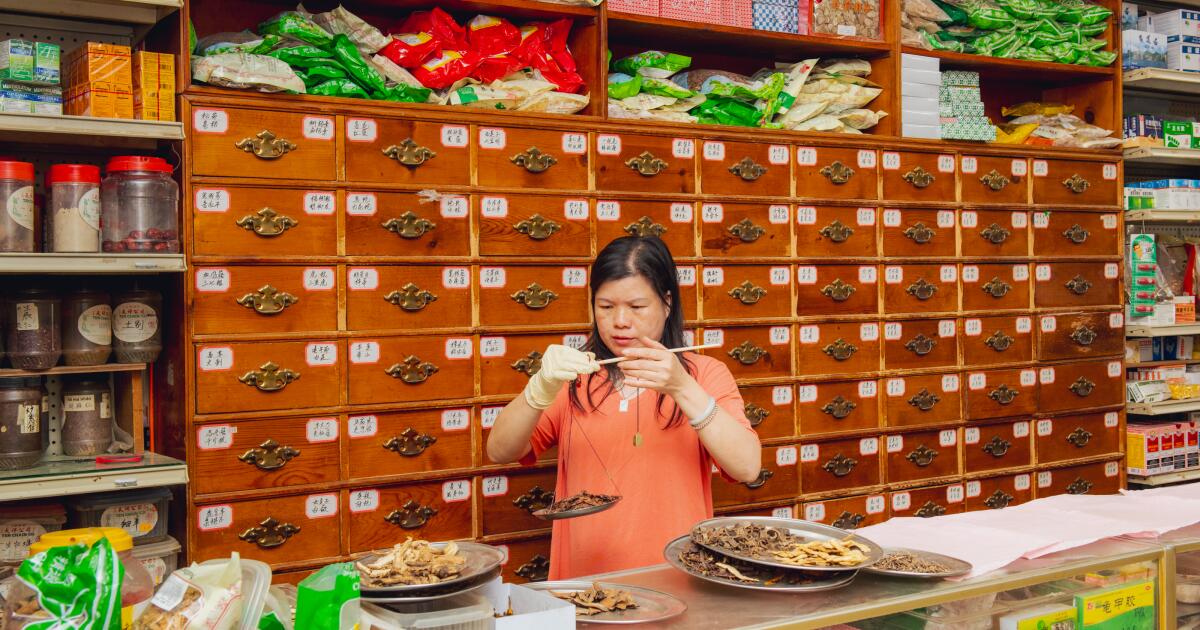
Based on the number of local L.A. content creators that have visited Tian Xiang — a small, nondescript herbal medicine shop in Los Angeles’ Chinatown — you might think it’s the single best Chinese pharmacy in Los Angeles. Its TikTok star, in particular, is rising. You can find more than two dozen videos on the platform of customers touring the business and documenting their alternative healthcare journeys.
One TikTok user, who goes by mooneyegoddess, traveled 2½ hours by train to L.A.’s Union Station in May, then walked several blocks to Chinatown to see the herbal doctor at Tian Xiang. Why?
“After being frustrated with modern doctors not listening to me when I go in, I decided to go to what my spirit connected best with, an herbal doctor,” the caption for her video read.
“And I’m telling you guys, I feel amazing!” she raved in the video.
Another customer gushed over the customization of the herbal prescriptions.
“Oh, you can’t find this in the store, uh-uh, not this, baby!” the user actressamira voiced over a TikTok video of raw herbs being sorted.
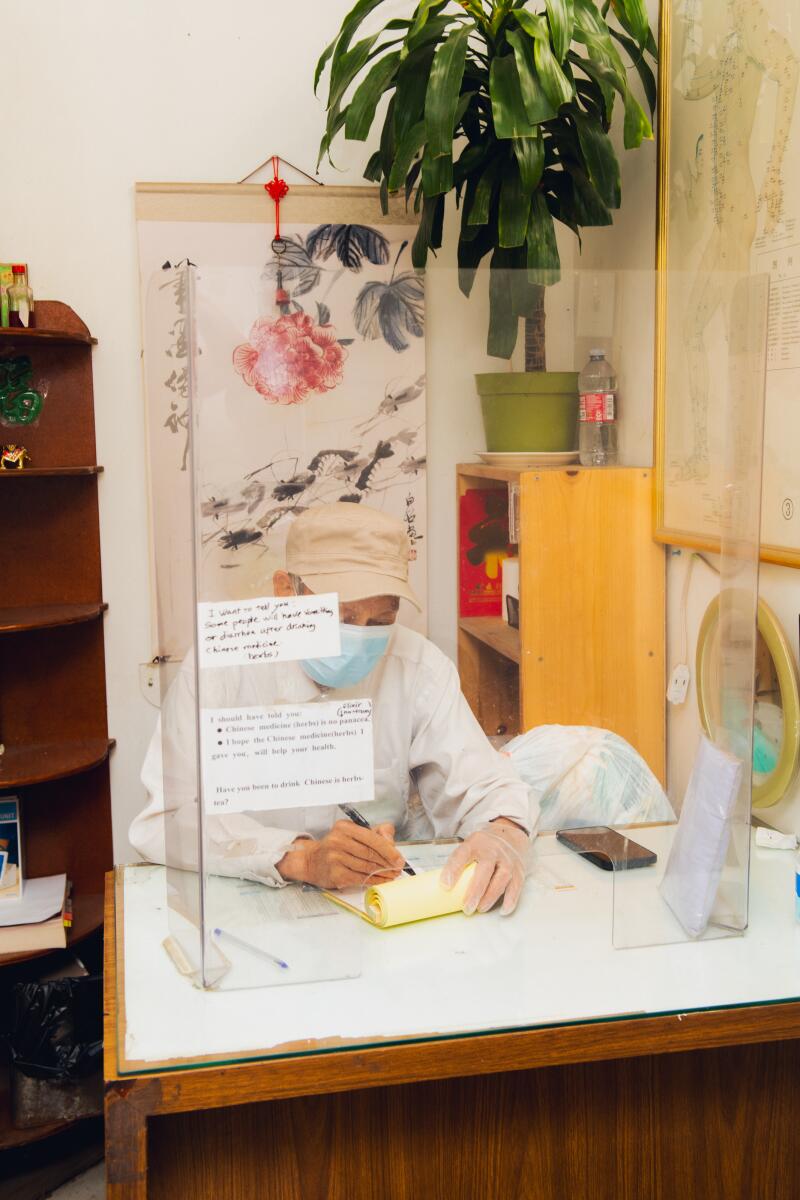
Huang at his desk inside the clinic.
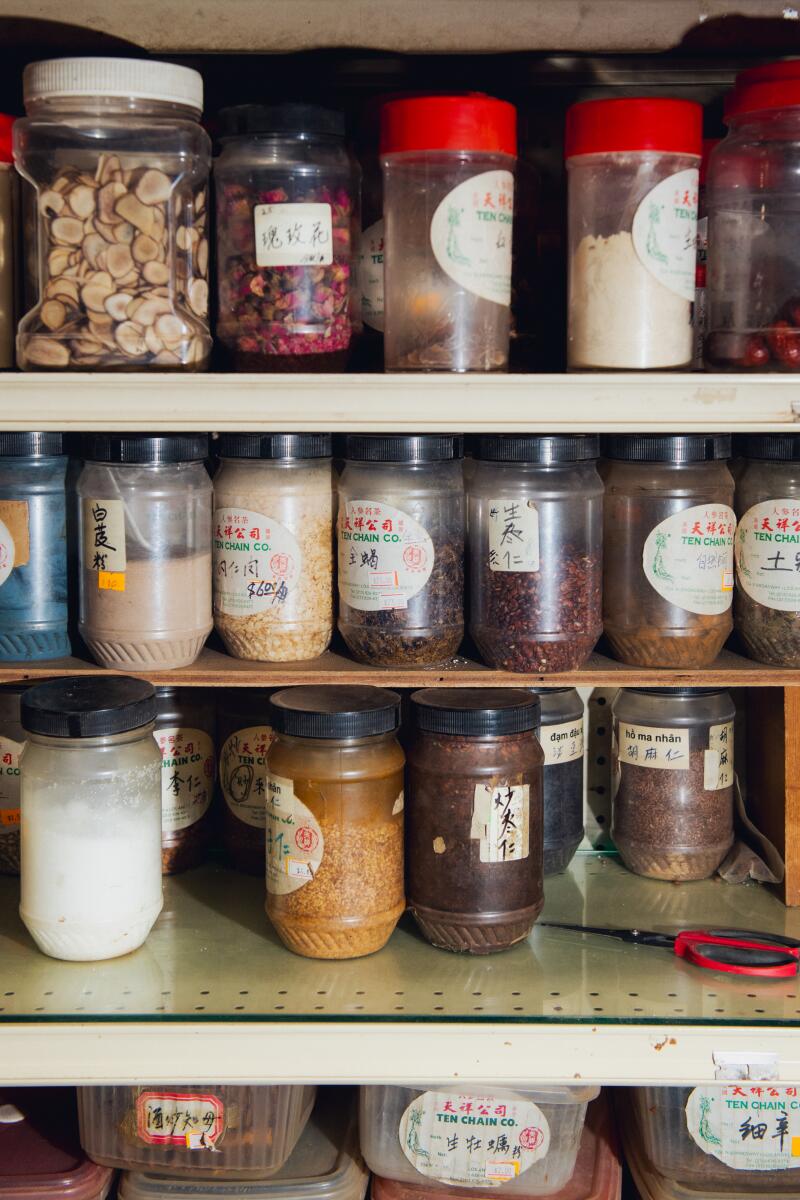
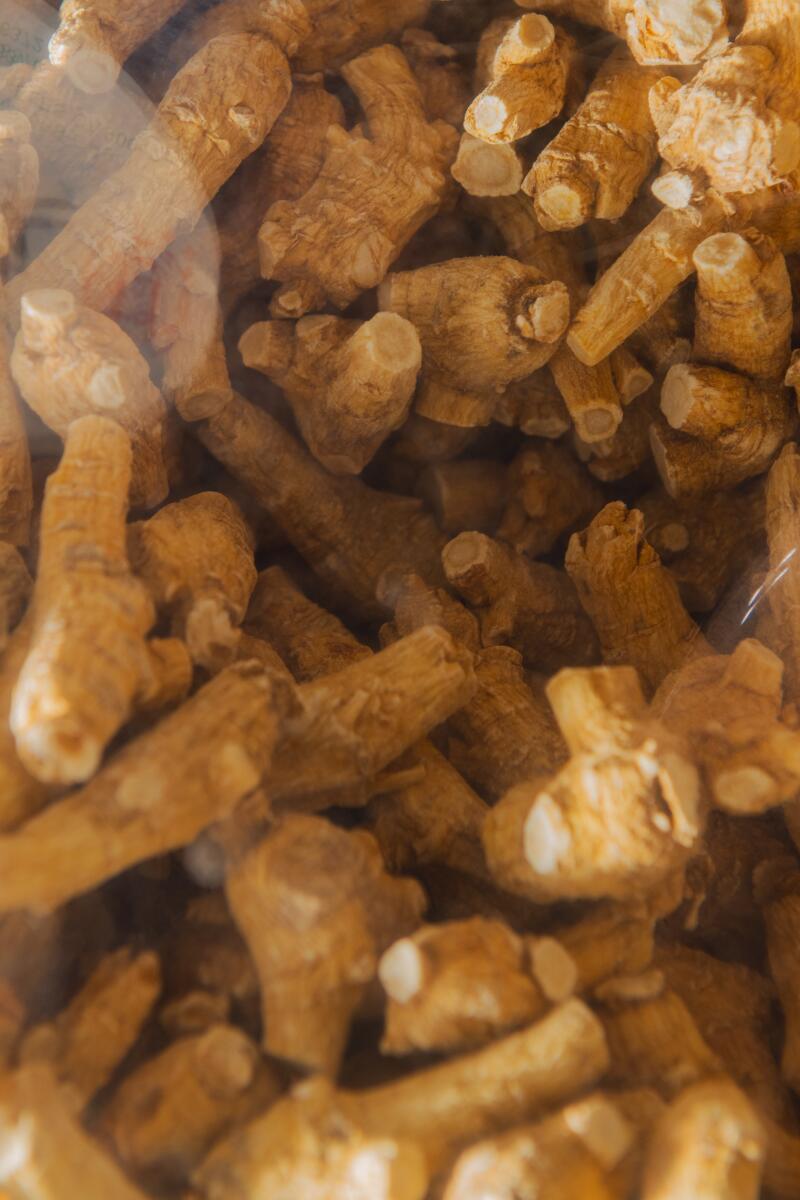
From top, left: Dry herbs, roots, and spices inside Tian Xiang.
The appeal is clear. Tian Xiang’s shelves are packed with dried herbs, roots and flowers that make a prism of colors and textures. A wall of wooden drawers stores loose herbs; bulk bins contain varieties of ginseng, goji berries and medicinal spices such as cinnamon and dried turmeric; a display behind the checkout counter showcases bottles of pre-made herbal supplements for nearly every imaginable condition: digestive issues, allergies, immune support, menopause, liver, heart and lung function among them.
What sets the store apart from other retail outlets, though, is the tiny clinic, jammed in a back corner beside a stack of unpacked boxes, barely larger than a walk-in closet. There, a man who goes by Dr. Huang — wearing a plastic surgical glove and medical mask — sits at a small desk behind a protective divider. (He did not go to medical school but has practiced traditional Chinese medicine, he says, for more than 50 years.)
There’s no weeks-long wait to see him, as is so often the case with, say, the U.S. healthcare system. Customers simply drop by, sans appointment, and pay $15 for a few minutes for Huang to assess their condition and prescribe them a customized, herbal remedy. It runs, on average, about $80-$95 for 10 days of daily use. The pharmacy will mix the herbs right there and send customers home with directions for how to prepare the loose tea.
There are more than 50 Chinese herbal apothecaries in the Los Angeles area, according to Willie So, sales director of Chinatown-based Solstice Medicine, a leading distributor of traditional Chinese medicine products since 1979. (He said Solstice Medicine has been providing inventory to Tian Xiang since the store opened.) And while Tian Xiang is a well-stocked and conveniently located one, its social media success is a mystery — even to the people who work there.
David He, the store’s manager, says Tian Xiang began seeing an uptick in business in 2020, at the start of the COVID pandemic, that has become amplified on social media over the last two years.
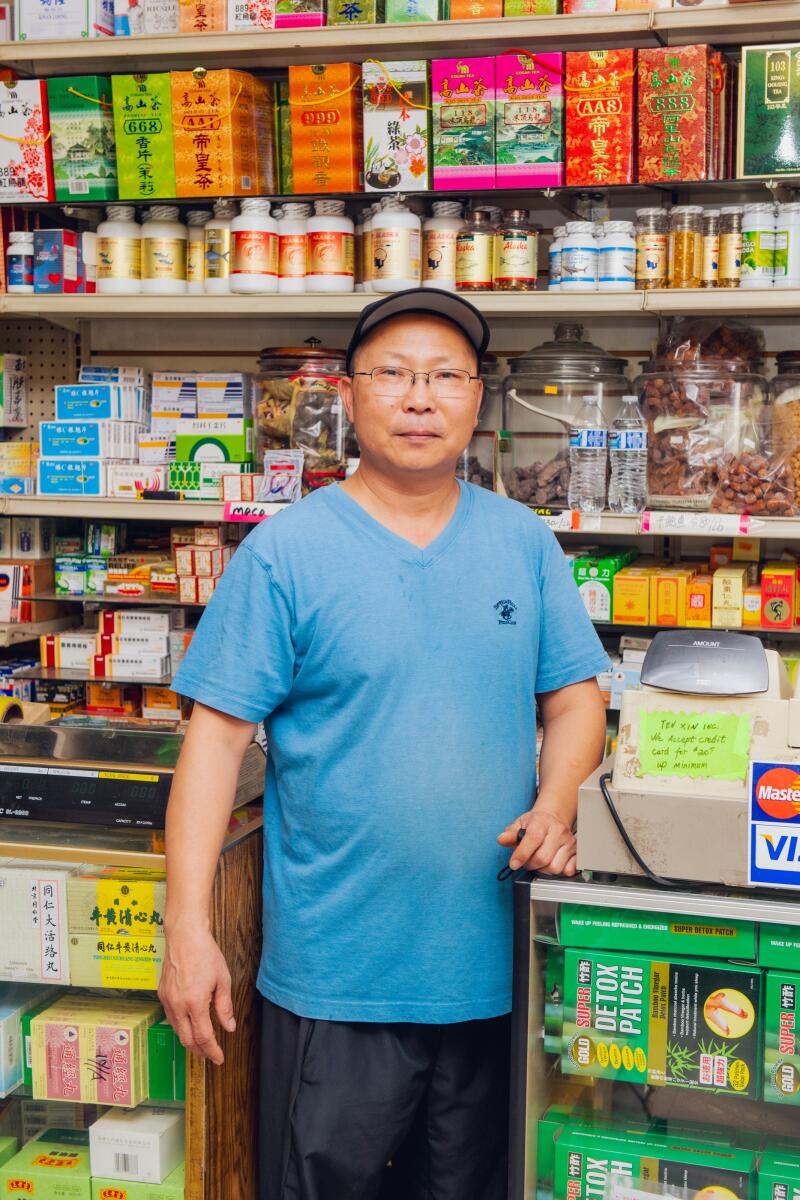
Store Manager, David He.
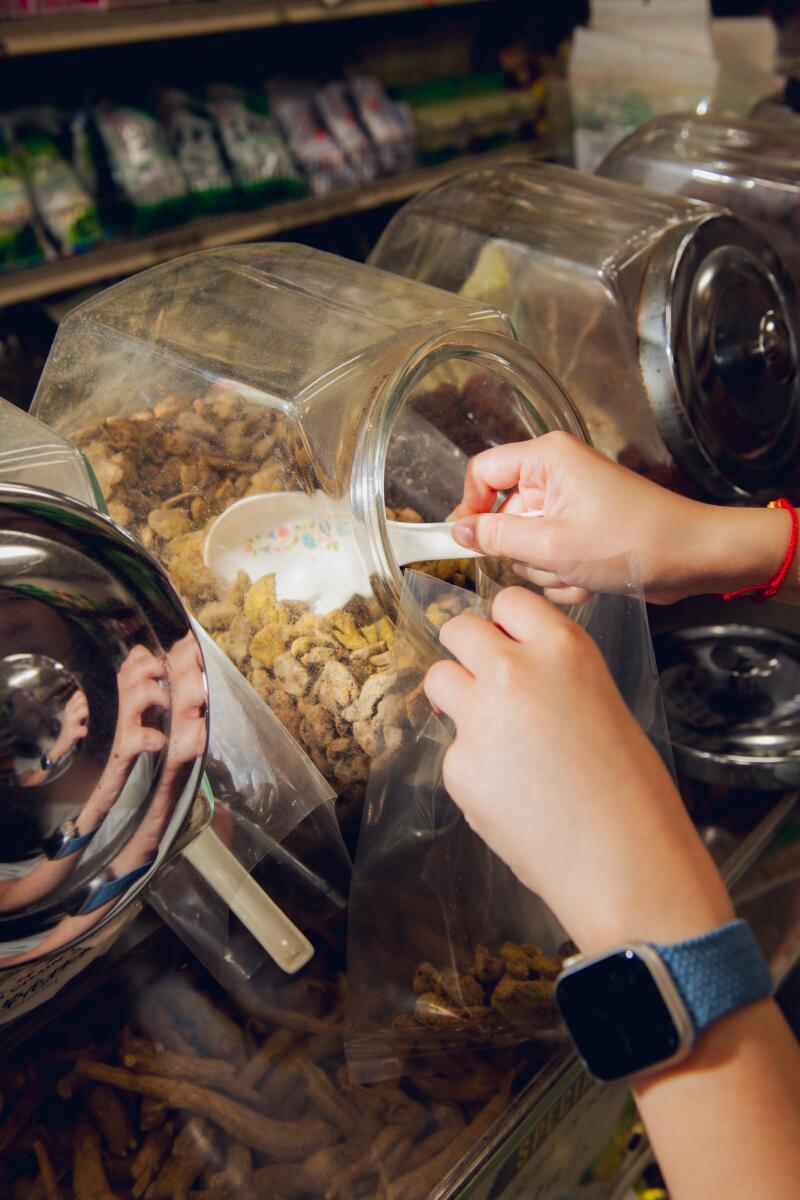
A container of dried fruit at Tian Xiang.
“Many Asian people from China and Cambodia and Vietnam came to get medicine for COVID because they believe more in traditional herbs to boost the immune system,” he said through a translator. “And at that time there was no vaccine. The customers felt good, and they posted about it, and then more people started coming. So it’s word of mouth.”
The type of wellness that Tian Xiang was peddling at the time was ripe for TikTok, says Freddy Tran Nager, a digital media professor at USC.
“A lot of alternative wellness trends do exceptionally well on social media, especially since the pandemic, as people look for new ways to be healthy,” he says. “And Asian culture, in particular, has been gaining more popularity online, whether that’s boba drinks or K-pop music — and Asian wellness goes along with it.”
That Tian Xiang is situated on Broadway, a main thoroughfare in Chinatown, didn’t hurt, he adds.
I was intrigued and decided to check out Tian Xiang for myself. I’m currently nursing a gym injury and open to anything that might help ease the pain in my neck and shoulder.
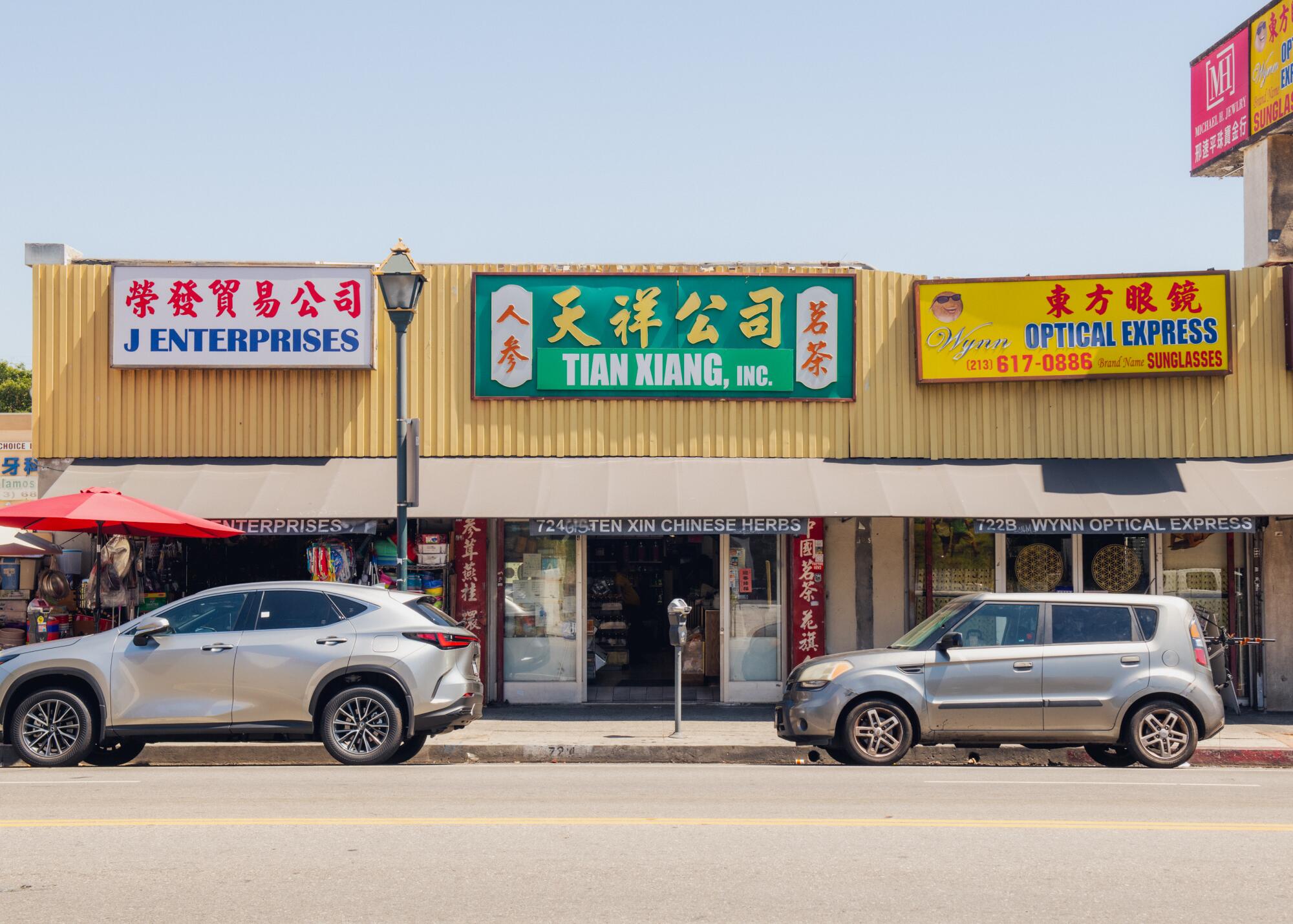
Tian Xiang’s location on Broadway, a main thoroughfare in Chinatown, provides it visibility to the curious wellness seeker.
Tian Xiang has been in the neighborhood for more than 40 years, though it has changed ownership multiple times. It’s a lively place, with a steady stream of customers — “mostly older, mostly repeat visitors and mostly Asian and Hispanic,” He says. They come regularly to treat everything from colds and the flu to infertility and back pain. The late-August afternoon I visited, I saw customers perusing the aisles and consulting with He, who frequently steps out from behind the counter, rubbing his belly or tapping his chest to demonstrate how the herbs might aid their ailments.
Nearby, two employees prepared a prescription for a customer, moving with assembly line-like efficiency in a precise but fluid dance: one ground herbs with a mortar and pestle while the other measured slabs of marbled ginseng on a traditional handheld gram scale. They alternately layered scoops of one ingredient or a sprinkle of another onto pieces of pink paper laid out on the counter top. Side by side, the piles of mixed herbs were like still-life paintings, each sparking with texture. Finally, a third employee packaged the herbs, sealing them in plastic bags.
“The doctor’s ready for you,” He told me, interrupting the mesmerizing show.
Our consultation was quick and to-the-point. Huang had me fill out my name and age on a small sheet of paper. Then he took my pulse. As he cradled my wrist, his forehead wrinkled in concentration. Then he tapped the keyboard on his phone for several minutes, writing into the Google Translate app, before pushing the phone toward me: “Poor blood circulation, weak spleen and stomach, disordered hormones, and a bit,” read the screen.
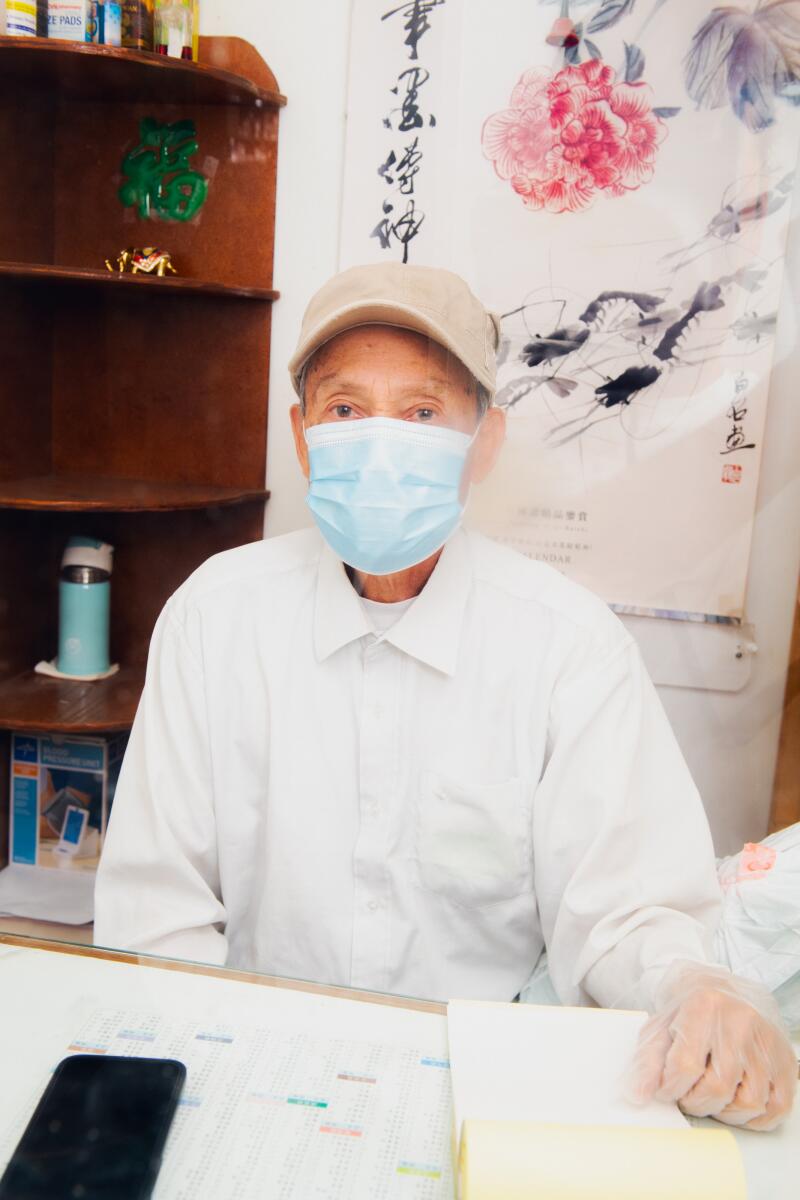
Huang inside the clinic.
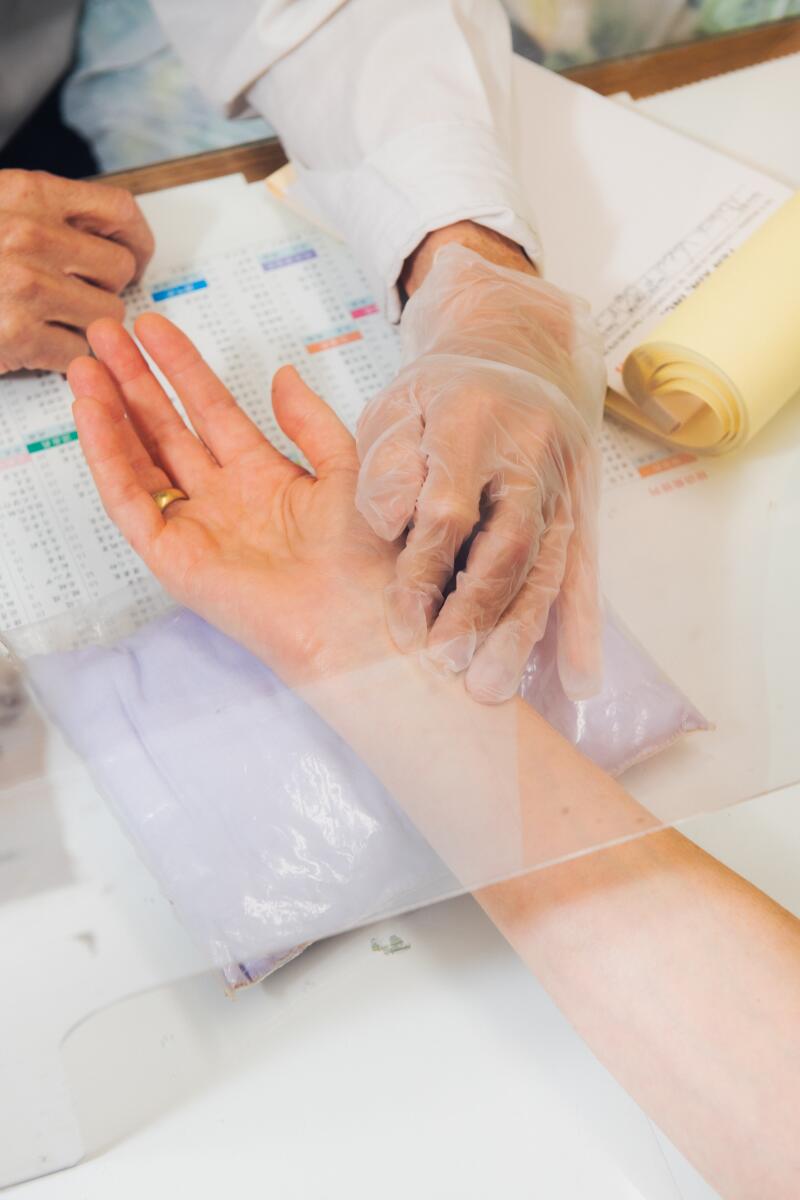
Huang takes reporter Deborah Vankin’s pulse.
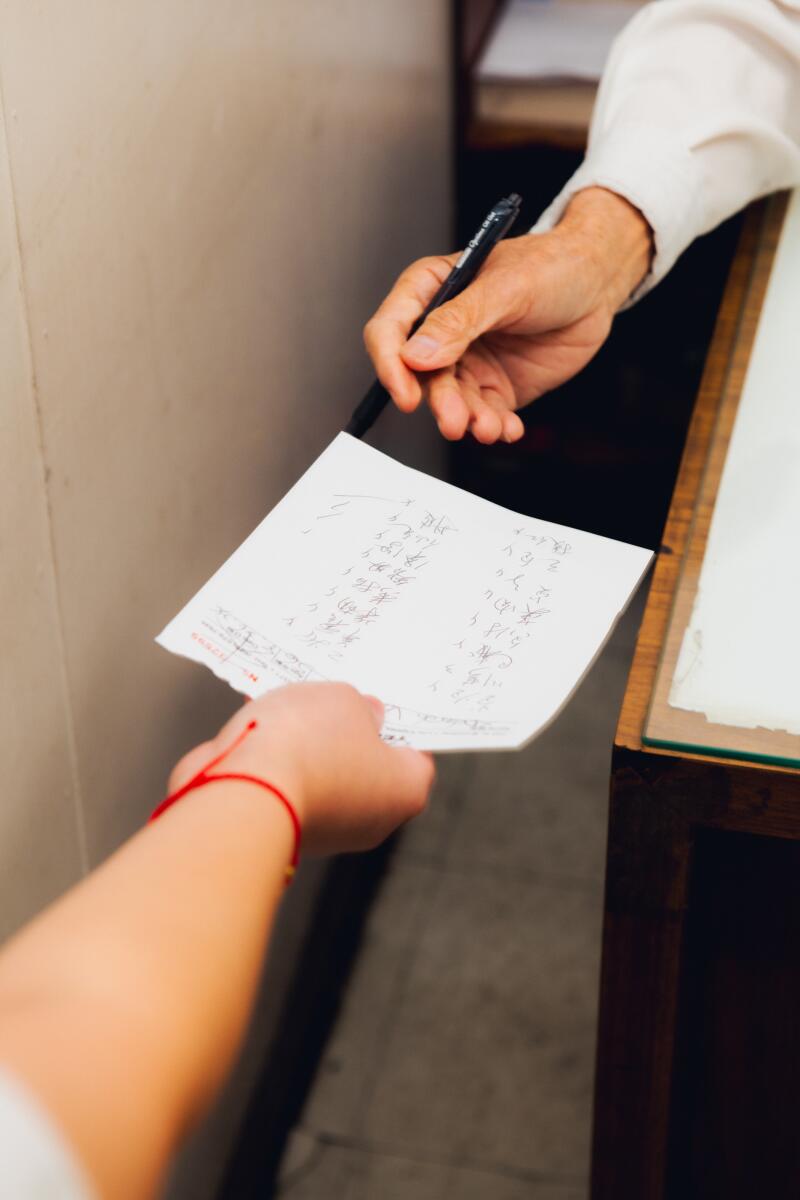
Huang hands over his prescription.
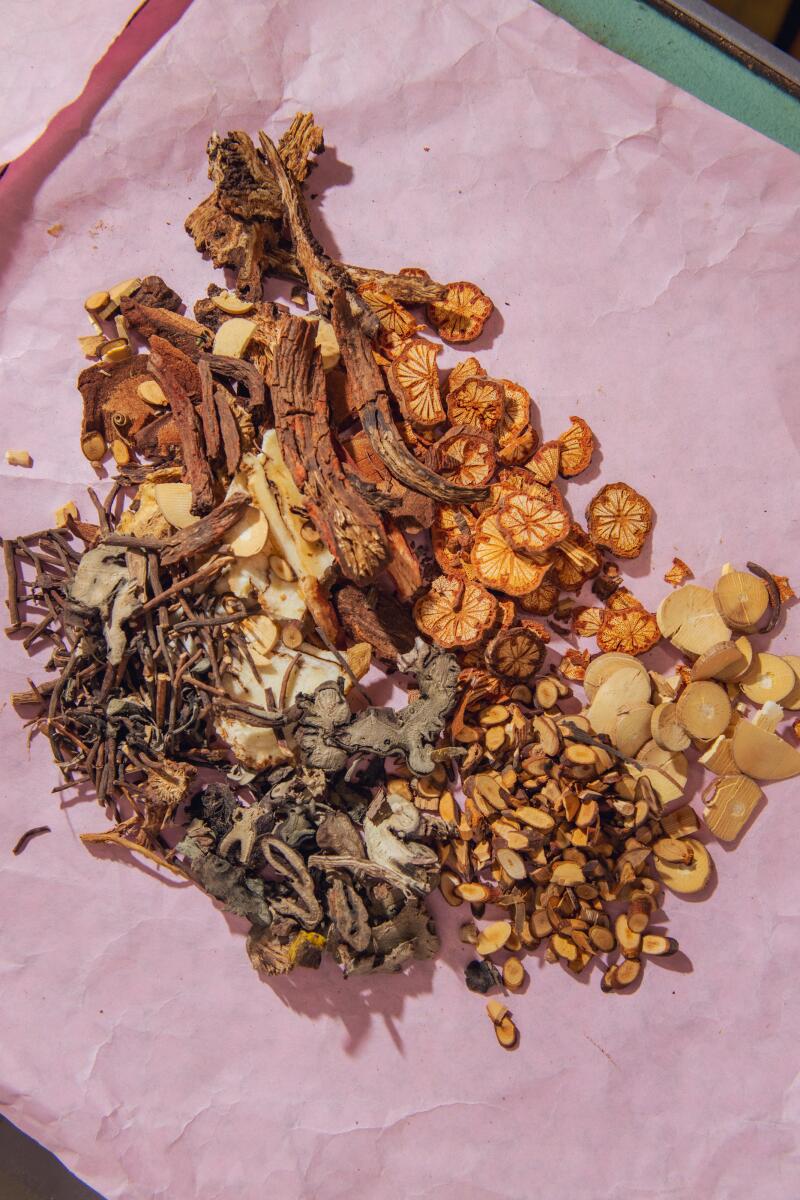
Dry herbs, roots, and spices for Deborah Vankin’s customized medicinal tea.
How did he know all this without examining me? He didn’t even look at my tongue, which is typical of a traditional Chinese medicine, or TCM, “tongue and pulse consultation,” I learned from a doctor at UCLA’s Center for East-West Medicine, while researching this piece.
“Experience,” he says through a translator. Huang has been working at Tian Xiang for more than 20 years. Before that, he practiced traditional Chinese medicine for 30 years in the city of Taishan in the Guangdong province of China. He’s a third-generation TCM doctor.
My neck stiffness, he says, is from poor blood circulation — he can tell that by listening to the rhythm and patterns of my pulse on each wrist, not just the number of beats per minute.
Herbal remedies in traditional Chinese medicine have been around for thousands of years, though their efficacy is debatable. Some, such as Dr. KaKit Hui, director of UCLA’s Center for East-West Medicine, say the right combination of herbs for the appropriate ailment can “save lives,” though he stresses the importance of practitioners being properly educated.
“Many conditions — coughing and upper respiratory infections or GI problems — can be helped,” Hui says. “They use herbs for lupus and cancer in China. But you don’t want to use herbs to replace necessary medications or [receive treatment] from someone who doesn’t know what can be mixed with what — herbs can interact with medications — you need someone who knows how to monitor it.”
Others, such as Dr. Craig Hopp of the National Institutes of Health’s National Center for Complementary and Integrative Health, which researches medical approaches outside the Western mainstream, note that Chinese herbs, like supplements, are not FDA regulated and there can be concerns about the purity of the plants and their provenance.
“It can sometimes get a little murky as to where [the herbs] come from,” Hopp says. “Lots of plants look alike and are called similar things, so the taxonomy and the nomenclature can be confusing. Unless you have a very well-trained botanist who knows what they’re looking for, you could be getting something else by the time it gets to an apothecary.”
My prescription — which came in three large plastic bags for six days worth of tea — was $63. It included 16 ingredients, Indian mulberry, golden eye-grass, the deciduous perennial Asian lizard’s tail and the carrot-like plant Szechuan Lovage among them.
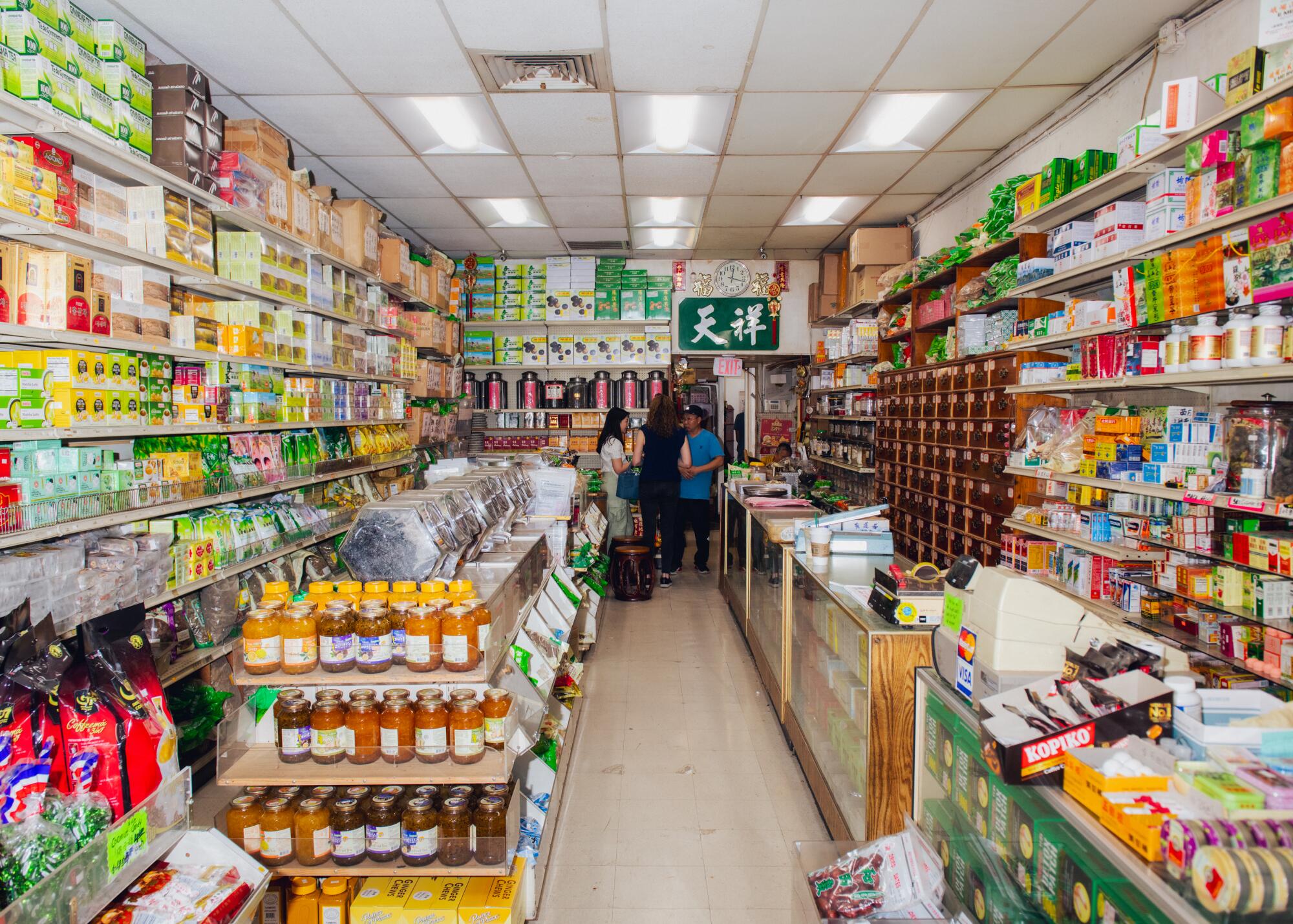
The interior of Tian Xiang, a Chinese herbal remedy shop.
He wouldn’t say where, exactly, the herbs come from, just that the store gets them from distributors in Monterey Park and Alhambra, who source them mostly from China, with some coming from Korea, Vietnam and Japan. He did say the herbs are “high quality.”
“My father, he’s 80 and he just had gallbladder surgery and the herbs seem to help,” one customer, Dericia Witalina, said while awaiting herbs her dad was prescribed. Her family lives in the San Fernando Valley and despite the drive, “if we need something, we come here,” she said.
Most, however, visit because it makes them feel healthier, He says.
“Many customers come here not to kill this germ or kill this virus, but it’s more about boosting the general body function.”
No matter how much better TikTok users claim to sleep or feel after drinking their prescribed herbal tea, the consensus on its taste seems to be less enthusiastic. One patron, who goes by 123aram5 on TikTok, summed up their review in two words: “Uh-uh — nope!” Others complained about the woodsy, pungent flavor.
I proceeded with caution, simmering the herbs for about an hour, per the store’s instructions, until they were mushy and the tea was a deep, murky brown. My home smelled like a forest after the rain, which was actually kind of pleasant and soothing.
The taste, however, was rank, nearly impossible to get down. I made a note to next time use a dollop of the honey and yuzu mixture, sold at the store. If there would be a next time.
That night I slept especially deeply. Was it the herbs? A placebo effect? The hot yoga I’d done earlier? Who’s to say. But I’ll take whatever I can get.
Grace Xue contributed reporting for this article, including translating interviews.



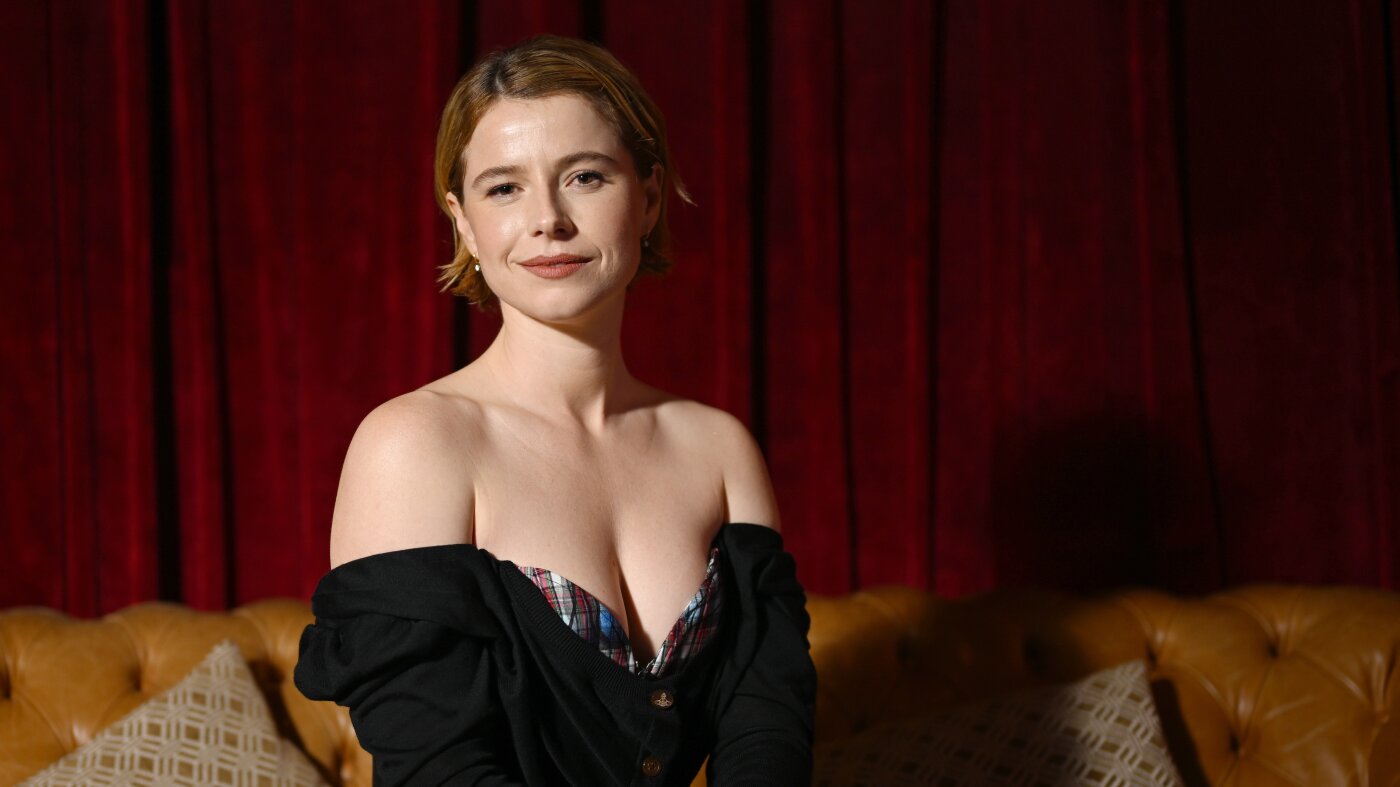
Jessie Buckley has been nominated for an Academy Award for best actress for her portrayal of William Shakespeare’s wife in Hamnet.
Kate Green/Getty Images
hide caption
toggle caption
Kate Green/Getty Images
Actor Jessie Buckley says she’s always been drawn to the “shadowy bits” of her characters — aspects that are disobedient, or “too much.” Perhaps that’s what led her to play Agnes, the wife of William Shakespeare, in Hamnet.
Buckley says the film, which is based on Maggie O’Farrell’s 2020 novel, offered a chance to counter a common narrative about the playwright’s wife: that she “had kept him back from his genius,” Buckley says.

But, she adds, “What Maggie O’Farrell so brilliantly did, not just with Agnes and Shakespeare’s wife, but also with Hamnet, their son, was to bring these people … and give them status beside this great man. … [And] give the full landscape of what it is to be a woman.”
The film is nominated for eight Academy Awards, including best actress for Buckley. In it, she plays a woman deeply connected to nature, who faces conflicts in her marriage, as well as the death of their son Hamnet.
Buckley found out she was pregnant a week after the film wrapped. She’s since given birth to her first child, a daughter.

“The thing that this story offered me, that brought me into this next chapter of my life as a mother was tenderness,” she says. “A mother’s tenderness is ferocious. To love, to birth is no joke. To be born is no joke. And the minute something’s born into the world, you’re always in the precipice of life and death. That’s our path. … I wanted to be a mother so much that that overrode the thought of being afraid of it.”

Jessie Buckley stars as Agnes and Joe Alwyn plays her brother Bartholomew in Hamnet.
Courtesy of Focus Features/Courtesy of Focus Features
hide caption
toggle caption
Courtesy of Focus Features/Courtesy of Focus Features
Interview highlights
On filming the scene where she howls in grief when her son dies
I didn’t know that that was going to happen or come out, it wasn’t in the script. I think really [director] Chloé [Zhao] asked all of us to dare to be as present as possible. Of course, leading up to it, you’re aware this scene is coming, but that scene doesn’t stand on its own. By the time I’d met that scene, I had developed such a deep bond with Jacobi Jupe, who plays Hamnet, and [co-stars] Paul [Mescal] and Emily Watson, and all the children and we really were a family. And Jacobi Jupe who plays Hamnet is such an incredible little actor and an incredible soul, and we really were a team. …

The death of a child is unfathomable. I don’t know where it begins and ends. Out of utter respect, I tried to touch an imaginary truth of it in our story as best I could, but there’s no way to define that kind of grief. I’m sure it’s different for so many people. And in that moment, all I had was my imagination but also this relationship that was right in front of me with this little boy and that’s what came out of that.
On what inspired her to pursue singing growing up
I grew up around a lot of music. My mom is a harpist and a singer and my dad has always been passionate about music, so it was always something in our house and always something that was encouraged. … Early on, I have very strong memories of seeing and hearing my mom sing in church and this quite intense mercurial conversation that would happen between her, the story and the people that would listen to her. And at the end of it, something had been cracked between them and these strangers would come up with tears in their eyes. And I guess I saw the power of storytelling through my mom’s singing at a very young age, and that was definitely something that made me think I want to do that.
On her first big break performing as a teen on the BBC singing competition I’d Do Anything — and being criticized by judges about her physical appearance
I was raw. I hadn’t trained. I had a lot to learn and to grow in. I was only 17. I think there was part of their criticism which I think was destructive and unfair when it became about my awkwardness, or they would say I was masculine and send me to kind of a femininity school. … They sent me to [the musical production of] Chicago to put heels on and a leotard and learn how to walk in high heels, which was pretty humiliating, to be honest, and I’m sad about that because I think I was discovering myself as a young woman in the world and wasn’t fully formed. … I was different. I was wild, I had a lot of feeling inside me. I could hardly keep my hands beside myself and I think to kind of criticize a body of a young woman at that time and to make her feel conscious of that was lazy and, I think, boring.
On filming parts of the 2026 film The Bride! while pregnant
I really loved working when I was pregnant. I thought it was a pretty wild experience, especially because I was playing Mary Shelley and I was talking about [this] monstrosity, and here I was with two heartbeats inside me. Becoming a mom and being pregnant did something, I think, for me. My experience of it, it’s so real that it really focuses [me to be] allergic to fake or to disconnection.
Since my daughter has come and I know what that connection is and the real feeling of being in a relationship with somebody … as an actress, it’s very exciting to recognize that in yourself and really take ownership of yourself.
I’m excited to go back and work on this other side of becoming a mother in so many ways, because I’ve shed 10 layers of skin by loving more and experiencing life in such a new way with my daughter. I’m also scared to work again because it’s hard to be a mother and to work. That’s like a constant tug because I love what I do and I’m passionate and I want to continue to grow and learn and fill those spaces that are yet to be filled — and also be a mother. And I think every mother can recognize that tug.
On the possibility of bringing her daughter to travel with her as she works
I haven’t filmed for nearly a year and I cannot wait. I’m hungry to create again. And my daughter will come with me. She’s seven months, so at the moment she can travel with us and it’s a beautiful life. And she meets all these amazing people and I have a feeling that she loves life and that’s a great thing to see in a child. And I hope that’s something that I’ve imparted to her in the short time that she’s been on this earth is that life is beautiful and great and complex and alive and there’s no part of you that needs to be less in your life. You might have to work it out, but it’s worth it.
Lauren Krenzel and Susan Nyakundi produced and edited this interview for broadcast. Bridget Bentz, Molly Seavy-Nesper and Beth Novey adapted it for the web.

Bruce Campbell
I’m Battling Cancer
Published
Bruce Campbell has revealed he has cancer, but says it’s a type that’s treatable, though not curable.
“The Evil Dead” actor shared the news Monday in a message to fans, writing, “Hi folks, these days, when someone is having a health issue, it’s referred to as an ‘opportunity,’ so let’s go with that — I’m having one of those.” He continued, “It’s also called a type of cancer that’s ‘treatable’ not ‘curable.’ I apologize if that’s a shock — it was to me too.”

Campbell said he wouldn’t go into further detail about his diagnosis, but explained his work schedule will be changing. “Appearances and cons and work in general need to take back seat to treatment,” he wrote, adding he plans to focus on getting “as well as I possibly can over the summer.”
As a result, Campbell says he has to cancel several convention appearances this summer, noting, “Treatment needs and professional obligations don’t always go hand-in-hand.”
He says his plan is to tour this fall in support of his new film, “Ernie & Emma,” which he stars in and directs.
Ending on a determined note, Campbell told fans, “I am a tough old son-of-a-bitch … and I expect to be around a while.”

Neve Campbell in Scream 7.
Paramount Pictures
hide caption
toggle caption
Paramount Pictures
The OG Scream Queen Neve Campbell returns. Scream 7 re-centers the franchise back on Sidney Prescott. She has a new life, a family, and lots of baggage. You know the drill: Someone dressing up as the masked slasher Ghostface comes for her, her family and friends. There’s lots of stabbing and murder and so many red herrings it’s practically a smorgasbord.
Follow Pop Culture Happy Hour on Letterboxd at letterboxd.com/nprpopculture

Weiss keeps focus on job as Colorado AHL assistant, not historic promotion | NHL.com

The Great Westport Sandwich Contest kicks off with event at Old Mill Grocery

Delaware eyes $25.3 million infusion to affordable child care. But to what end?

Man convicted of 1991 fatal shooting of police officer is set to be executed in Florida

Middle Georgia DSA condemns U.S.-Israel strikes on Iran, calls escalation ‘illegal’

Florida High School Football Rankings: Top 25 teams – Oct. 21

Cleary's 21 help Le Moyne down Central Connecticut State 69-64 in OT

How old is Bo Nix? What to know about Oregon quarterback ahead of 2024 NFL Draft

99th annual Pony Swim held in Virginia

Indiana Members Credit Union announced as new anchor tenant at Bottleworks District

Trump sends official notification to Congress on strikes against Iran

Unexpected birth brings hope to near-extinct Amazon tribe

Supreme Court blocks redrawing of New York congressional map, dealing a win for GOP

Map: Earthquake Shakes Central California

Gas prices could jump as Middle East tensions threaten global oil supply
-

 World5 days ago
Exclusive: DeepSeek withholds latest AI model from US chipmakers including Nvidia, sources say
-

 Massachusetts6 days ago
Mother and daughter injured in Taunton house explosion
-

 Denver, CO5 days ago
10 acres charred, 5 injured in Thornton grass fire, evacuation orders lifted
-

 Louisiana1 week ago
Wildfire near Gum Swamp Road in Livingston Parish now under control; more than 200 acres burned
-

 Technology1 week ago
YouTube TV billing scam emails are hitting inboxes
-

 Politics1 week ago
OpenAI didn’t contact police despite employees flagging mass shooter’s concerning chatbot interactions: REPORT
-

 Technology1 week ago
Stellantis is in a crisis of its own making
-

 Oregon4 days ago
2026 OSAA Oregon Wrestling State Championship Results And Brackets – FloWrestling